Within American Hoaxes
How Sensational Hoaxes Turned Curiosity Into Cash
The Great Moon Hoax and Barnum's mermaid reveal how borrowed authority, vivid images and public argument transformed doubt into sales.
On this page
- The Great Moon Hoax and the rise of the penny press
- Barnum's Feejee Mermaid publicity machine
- Why corrections rarely matched the original spectacle
Page outline Jump by section
Introduction
Some of the most influential American hoaxes were not designed merely to fool people. They were designed to attract attention, sell newspapers, fill exhibition halls and keep the public talking. In the nineteenth century, the expanding media economy rewarded spectacle. Editors and showmen discovered that a startling claim could generate profits long before anyone had time to verify it. The result was a new kind of deception: the commercial wonder story.
Two famous examples illustrate the mechanism perfectly. The Great Moon Hoax of 1835 helped demonstrate how sensational reporting could drive newspaper sales, while P. T. Barnum’s Feejee Mermaid showed how carefully staged publicity could transform a doubtful curiosity into a national attraction. In both cases, the key was not simply inventing a false claim. It was creating an information environment in which debate, uncertainty and excitement became valuable commodities.[The Library of Congress]loc.govthe great moon hoaxThe Library of CongressBelief, Legend, and the Great Moon Hoax | Folklife Today26 Aug 2014 — During the week of August 25, 1835, the worl…
The Great Moon Hoax and the Rise of the Penny Press
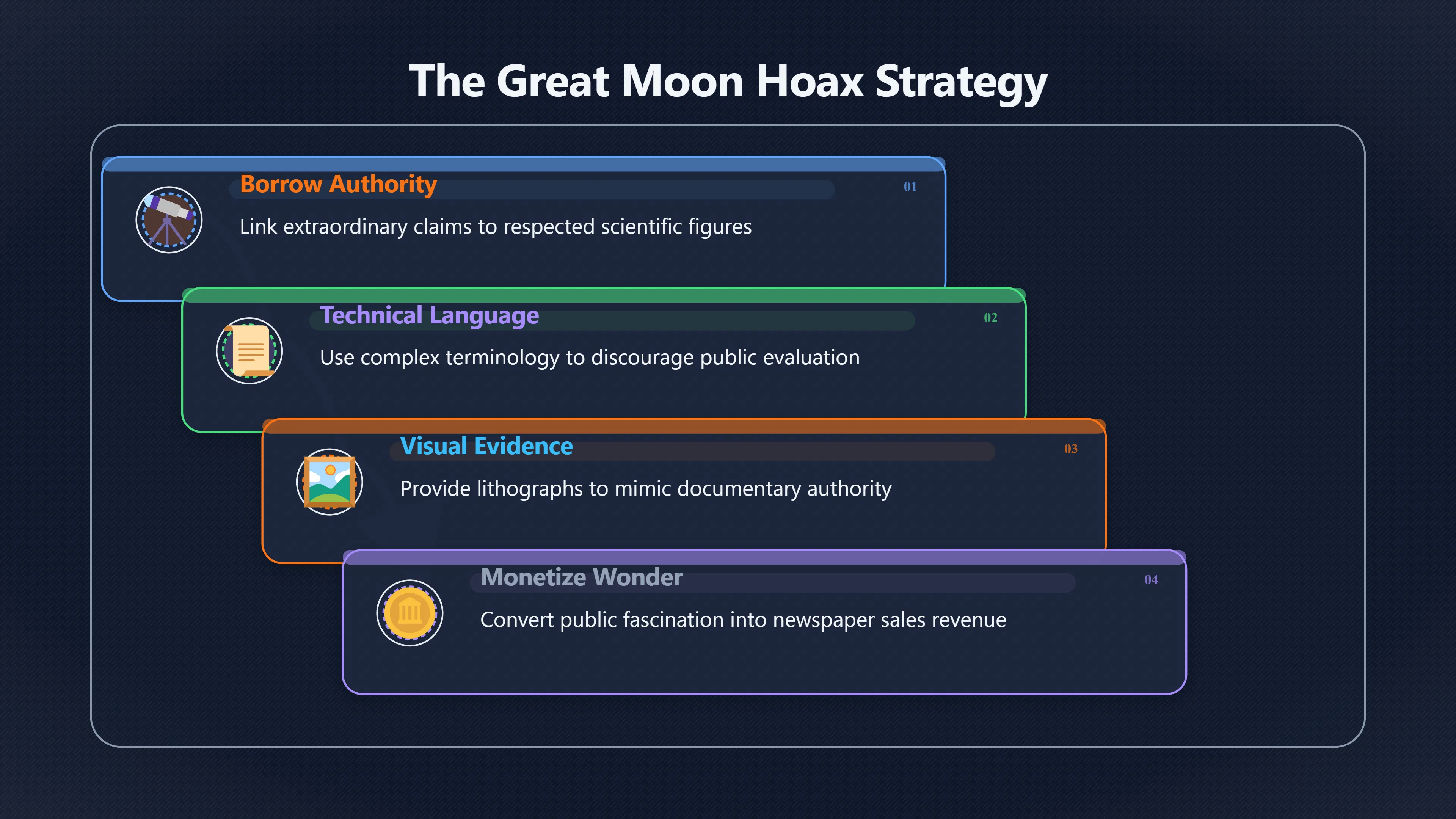
The Great Moon Hoax appeared in August 1835 in the New York Sun, one of the leading examples of the new “penny press” newspapers. Unlike older papers aimed at political and commercial elites, penny papers depended on mass circulation. They needed large audiences, and large audiences responded to extraordinary stories.[JSTOR Daily]daily.jstor.orghow the sun conned the world with the moon hoaxJSTOR DailyHow the Sun Conned the World With "The Great Moon Hoax"7 Nov 2017 — The birth of the penny press, the first mass media, was ve…
The Sun published a series of articles claiming that the celebrated British astronomer Sir John Herschel had observed life on the Moon through a revolutionary telescope in South Africa. Readers encountered detailed descriptions of forests, strange animals, unicorn-like creatures, beaver-like builders and winged humanoids often remembered as “man-bats”. The reports were presented in a style that imitated scientific journalism and were falsely linked to respected scientific authorities.[wikipedia.org]WikipediaGreat Moon HoaxMay 4, 2026 — The "Great Moon Hoax", also known as the "Great Moon Hoax of 1835", was a series of six articles published in The Sun (a Ne…
Several factors made the story persuasive:
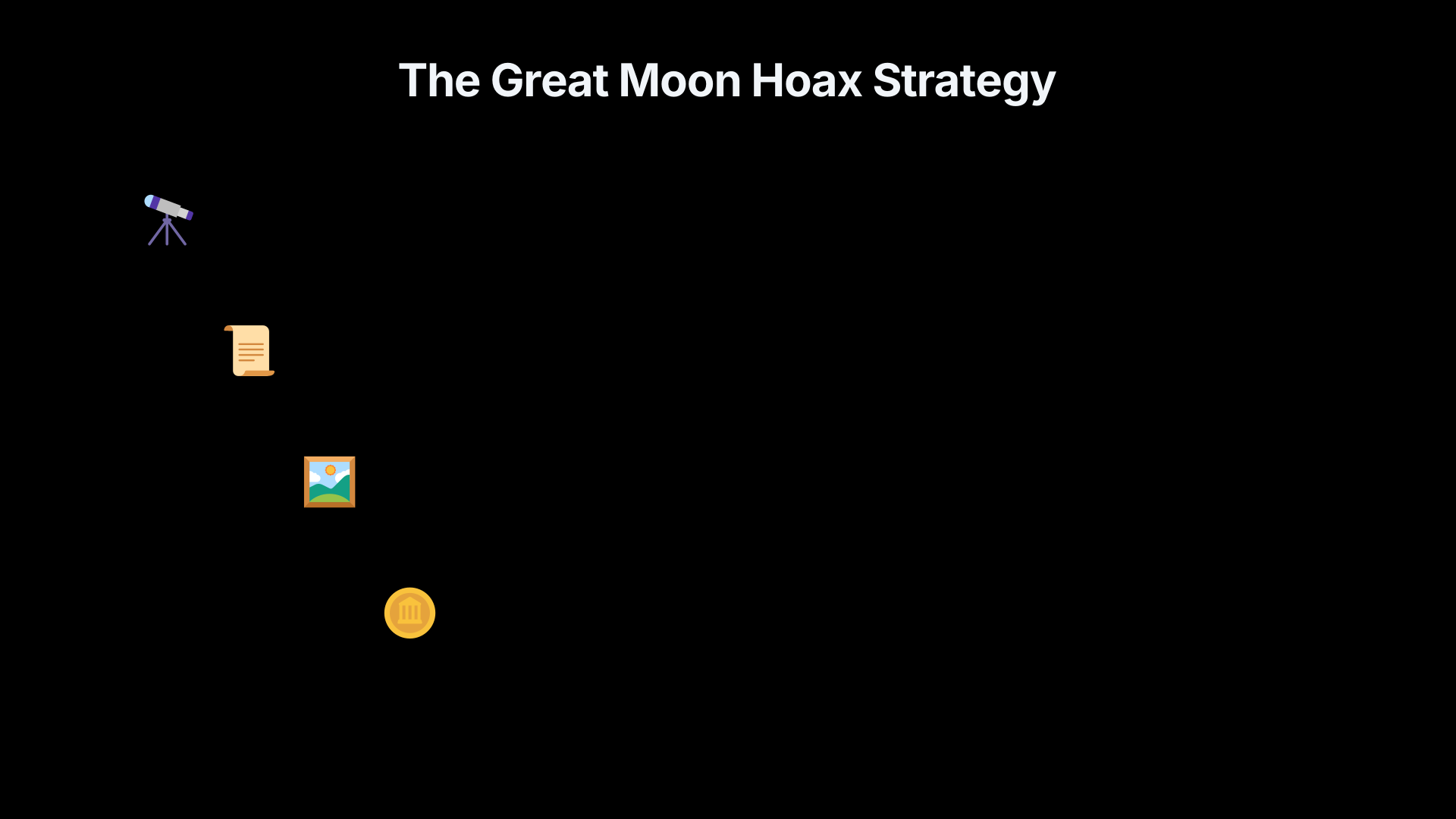
- It borrowed the reputation of a real and highly respected astronomer.
- It appeared during a period of genuine astronomical discovery, when new observations regularly surprised the public.
- It used technical language that many readers could not easily evaluate.
- The alleged observations occurred far away, making immediate verification difficult.[loc.gov]loc.govthe great moon hoaxThe Library of CongressBelief, Legend, and the Great Moon Hoax | Folklife Today26 Aug 2014 — During the week of August 25, 1835, the worl…
The hoax was also helped by visual culture. Illustrations depicting lunar creatures gave the reports an appearance of documentary authority. Readers were not simply told about the discoveries; they were shown images that resembled scientific evidence.[The Library of Congress]loc.govThe Library of CongressLunar animals and other objects Discovered by Sir John…1 print: lithograph; 36.8 x 53.6 cm (sheet) | Print sh…
Whether every reader fully believed the story is less important than the commercial outcome. The articles became a sensation, drove sales and demonstrated that wonder itself could be monetised. The Sun gained enormous attention, and rival newspapers discussed the claims rather than immediately dismantling them. Public fascination became a business asset.[si.edu]airandspace.si.eduservice pnp pga 02600 02667rjpegservice pnp pga 02600 02667rjpeg
Borrowed Authority as a Commercial Tool
One of the lasting lessons of the Moon Hoax was that credibility could be borrowed rather than earned. The articles relied on genuine scientific names, plausible-sounding instruments and references to scholarly publications. Readers were asked to trust institutions and experts they could not personally inspect.[blog.library.si.edu]blog.library.si.edugreat moon hoax 1835The Moon Hoax of 1835: Great Astronomical Discoveries28 Aug 2013 — An incredible story broke in the Sun Newspaper, New York City, which r…
This approach became a recurring feature of later American hoaxes. Rather than inventing an entirely separate reality, promoters attached extraordinary claims to existing authorities. The authority supplied the credibility; the sensational claim supplied the audience. The combination proved highly profitable.[Smithsonian Magazine]smithsonianmag.comgreat moon hoax was simply sign its time 180955761Herschel), Napoli, 1836 Smithsonian Institution Libraries. Anyone who opened the pages of the New York Sun on Tuesday, August 25, 1835, h…
Barnum’s Feejee Mermaid Publicity Machine
If the Moon Hoax revealed how newspapers could profit from wonder, P. T. Barnum demonstrated how newspapers could be turned into marketing tools.
In 1842 Barnum promoted the Feejee Mermaid, a grotesque specimen that appeared to combine a monkey-like upper body with a fish tail. Modern examination and contemporary descriptions make clear that it was an artificial construction rather than a genuine mermaid.[livescience.com]livescience.com56037 feejee mermaid56037 feejee mermaid
What made the exhibit remarkable was not the object itself but the publicity campaign surrounding it. Barnum understood that people were more likely to pay to see something if they had already encountered a mystery in the press. According to contemporary accounts and later analyses, he orchestrated a campaign involving fabricated correspondence, a false scientific expert and carefully distributed illustrations. Newspapers were encouraged to report on the mermaid before the public could inspect it.[The New Yorker]newyorker.comThe New Yorker What P. T. Barnum Understood About AmericaThe New Yorker What P. T. Barnum Understood About America
A central feature of the campaign was misdirection. The promotional images often depicted an attractive mermaid, while the exhibited object was a shrivelled and unsettling specimen. The gap between expectation and reality generated discussion rather than destroying interest. Visitors wanted to see for themselves what everyone was arguing about.[Hyperallergic]hyperallergic.comhow a fake monster creeped into our museumshow a fake monster creeped into our museums

Selling the Argument, Not Just the Attraction
Barnum’s real innovation was recognising that uncertainty could be more profitable than certainty.
Instead of demanding unquestioning belief, he encouraged controversy. Journalists, sceptics and supporters argued over the mermaid’s authenticity. Each new argument generated additional publicity. Even criticism helped advertise the exhibit. As Barnum later acknowledged in various accounts of his career, newspaper attention itself was often the valuable product.[The New Yorker]newyorker.comThe New Yorker What P. T. Barnum Understood About AmericaThe New Yorker What P. T. Barnum Understood About America
When the mermaid went on display, curiosity created by the press translated into paying visitors. The exhibit became one of the most famous attractions associated with Barnum’s American Museum and helped establish a publicity model that would influence later entertainment industries.[smithsonianmag.com]smithsonianmag.comtrue story pt barnum greatest humbug them all 180967634true story pt barnum greatest humbug them all 180967634
Why Corrections Rarely Matched the Original Spectacle
The Great Moon Hoax and the Feejee Mermaid reveal a recurring pattern in American media history: exposure rarely generates as much attention as the original claim.
Part of the reason is structural. A dramatic discovery is exciting. A detailed correction requires patience. Newspapers gained readers through novelty, while debunking often arrived later and lacked the same emotional appeal. By the time doubts emerged, many people had already bought the newspaper, visited the exhibition or participated in the conversation.[JSTOR Daily]daily.jstor.orghow the sun conned the world with the moon hoaxJSTOR DailyHow the Sun Conned the World With "The Great Moon Hoax"7 Nov 2017 — The birth of the penny press, the first mass media, was ve…
There was also a social dimension. Spectacles created shared experiences. People discussed lunar creatures, argued about mermaids and exchanged opinions with friends and neighbours. Participation became part of the entertainment. Even when evidence weakened the claim, the public memory of the event remained.[The New Yorker]newyorker.commoon shot race a hoax and the birth of fake newsmoon shot race a hoax and the birth of fake news
In Barnum’s case, exposure could actually strengthen publicity. If newspapers denounced an attraction as fraudulent, readers still encountered the attraction’s name repeatedly. The dispute kept it visible. The same basic dynamic would later appear in other media eras, from sensational tabloid stories to internet-age viral misinformation.[The New Yorker]newyorker.comThe New Yorker What P. T. Barnum Understood About AmericaThe New Yorker What P. T. Barnum Understood About America
What These Spectacles Revealed About American Hoaxes
The significance of these episodes lies less in whether people were fooled than in how attention was converted into revenue.
The Moon Hoax showed that mass-market newspapers could profit from extraordinary claims presented with the appearance of scientific authority. The Feejee Mermaid showed that publicity could be manufactured through staged debate, selective information and media cooperation. Together they revealed a powerful formula:
- Attach a remarkable claim to a trusted authority.
- Provide vivid images or descriptions.
- Encourage public discussion and disagreement.
- Profit before verification catches up. Horniman Museum and Gardens+3The Library of Congress+3blog.library.si.edu
These nineteenth-century spectacles helped establish a commercial logic that would echo through later American media culture. The most successful hoaxes were often not the most convincing. They were the ones that transformed curiosity into a product and public attention into cash. JSTOR Daily+2The New Yorker
Amazon book picks
Further Reading
Books and field guides related to How Sensational Hoaxes Turned Curiosity Into Cash. Use these as the next step if you want deeper reading beyond the article.

eBay marketplace picks
Marketplace Samples
Live-tested eBay searches with available results related to this page.


Endnotes
1.
Source: daily.jstor.org
Title: how the sun conned the world with the moon hoax
Link:https://daily.jstor.org/how-the-sun-conned-the-world-with-the-moon-hoax/
Source snippet
JSTOR DailyHow the Sun Conned the World With "The Great Moon Hoax"7 Nov 2017 — The birth of the penny press, the first mass media, was ve...
2.
Source: Wikipedia
Title: Great Moon Hoax
Link:https://en.wikipedia.org/wiki/Great_Moon_Hoax
Source snippet
May 4, 2026 — The "Great Moon Hoax", also known as the "Great Moon Hoax of 1835", was a series of six articles published in The Sun (a Ne...
Published: May 4, 2026
3.
Source: blog.library.si.edu
Title: great moon hoax 1835
Link:https://blog.library.si.edu/blog/2013/08/28/great_moon_hoax_1835/
Source snippet
The Moon Hoax of 1835: Great Astronomical Discoveries28 Aug 2013 — An incredible story broke in the Sun Newspaper, New York City, which r...
4.
Source: history.com
Link:https://www.history.com/this-day-in-history/august-25/the-great-moon-hoax
Source snippet
HISTORY"The Great Moon Hoax" is published in the "New York Sun"The first in a series of six articles announcing the supposed discovery of...
5.
Source: blog.library.si.edu
Title: the great moon hoax or was it the jokes on who
Link:https://blog.library.si.edu/blog/2013/09/04/the-great-moon-hoax-or-was-it-the-jokes-on-who/
6.
Source: hyperallergic.com
Title: how a fake monster creeped into our museums
Link:https://hyperallergic.com/how-a-fake-monster-creeped-into-our-museums/
7.
Source: library.si.edu
Title: other lunar discoveries mr herschel
Link:https://library.si.edu/donate/adopt-a-book/other-lunar-discoveries-mr-herschel
8.
Source: Wikipedia
Title: Fiji mermaid
Link:https://en.wikipedia.org/wiki/Fiji_mermaid
9.
Source: hoaxes.org
Title: the feejee mermaid
Link:https://hoaxes.org/archive/permalink/the_feejee_mermaid
11.
Source: smithsonianmag.com
Title: great moon hoax was simply sign its time 180955761
Link:https://www.smithsonianmag.com/smithsonian-institution/great-moon-hoax-was-simply-sign-its-time-180955761/
Source snippet
Herschel), Napoli, 1836 Smithsonian Institution Libraries. Anyone who opened the pages of the New York Sun on Tuesday, August 25, 1835, h...
Published: August 25, 1835
12.
Source: loc.gov
Link:https://www.loc.gov/pictures/item/2003665049/
Source snippet
The Library of CongressLunar animals and other objects Discovered by Sir John...1 print: lithograph; 36.8 x 53.6 cm (sheet) | Print sh...
13.
Source: airandspace.si.edu
Title: service pnp pga 02600 02667rjpeg
Link:https://airandspace.si.edu/multimedia-gallery/image/service-pnp-pga-02600-02667rjpeg
14.
Source: newyorker.com
Title: moon shot race a hoax and the birth of fake news
Link:https://www.newyorker.com/books/page-turner/moon-shot-race-a-hoax-and-the-birth-of-fake-news
15.
Source: livescience.com
Title: 56037 feejee mermaid
Link:https://www.livescience.com/56037-feejee-mermaid.html
16.
Source: smithsonianmag.com
Title: true story pt barnum greatest humbug them all 180967634
Link:https://www.smithsonianmag.com/history/true-story-pt-barnum-greatest-humbug-them-all-180967634/
17.
Source: horniman.ac.uk
Title: unmasking the mysterious merman
Link:https://www.horniman.ac.uk/story/unmasking-the-mysterious-merman/
18.
Source: newyorker.com
Title: The New Yorker What P. T. Barnum Understood About America
Link:https://www.newyorker.com/magazine/2019/08/05/what-p-t-barnum-understood-about-america
19.
Source: loc.gov
Title: peoples and creatures of the moon
Link:https://www.loc.gov/static/collections/finding-our-place-in-the-cosmos-with-carl-sagan/articles-and-essays/life-on-other-worlds/peoples-and-creatures-of-the-moon.html
20.
Source: clements.umich.edu
Title: life on the moon
Link:https://clements.umich.edu/publication/the-heavens/life-on-the-moon/
21.
Source: smithsonianmag.com
Title: descend depths ocean maryland museum delves history mermaids 180978335
Link:https://www.smithsonianmag.com/smart-news/descend-depths-ocean-maryland-museum-delves-history-mermaids-180978335/
Additional References
22.
Source: youtube.com
Title: Feejee Mermaid & Centaur of Tymfi | Bizarre Secrets of Barnum Museum!
Link:https://www.youtube.com/watch?v=qQL5pJgM-XM
Source snippet
Joseph Pulitzer and the Rise of Yellow Journalism (Part 1) | STUFF YOU MISSED IN HISTORY CLASS...
23.
Source: youtube.com
Title: Exeter History Minute
Link:https://www.youtube.com/watch?v=lXta_lGj9ZI
Source snippet
Feejee Mermaid & Centaur of Tymfi | Bizarre Secrets of Barnum Museum...
24.
Source: coneyisland.com
Link:https://www.coneyisland.com/shof-attractions/feejee-mermaid
25.
Source: youtube.com
Title: The ‘Great Moon Hoax’ that fooled the world – BBC REEL
Link:https://www.youtube.com/watch?v=93BHCewPiPU
Source snippet
The Feejee Mermaid: An American Tradition...
26.
Source: ripleys.com
Link:https://www.ripleys.com/stories/fiji-mermaid-hoax
27.
Source: researchgate.net
Link:https://www.researchgate.net/publication/300338742_The_Great_Moon_Hoax
28.
Source: linkedin.com
Link:https://www.linkedin.com/posts/alex-wright-90a79_in-1835-the-new-york-sun-published-one-of-activity-7473358753560547330-wsmf
29.
Source: youtube.com
Link:https://www.youtube.com/watch?v=Ui_ama9eCm4
Source snippet
You stopped this response...
30.
Source: aeon.co
Title: bat people on the moon what a famed 1835 hoax reveals about misinformation today
Link:https://aeon.co/videos/bat-people-on-the-moon-what-a-famed-1835-hoax-reveals-about-misinformation-today
31.
Source: facebook.com
Title: on this day in 1835 the first in a series of articles appeared in the new york s
Link:https://www.facebook.com/AmericanExperiencePBS/posts/on-this-day-in-1835-the-first-in-a-series-of-articles-appeared-in-the-new-york-s/1166062628902683/
Topic Tree