Within Suriname
Was Oroonoko History, Fiction or Something Between?
Aphra Behn's famous Suriname story borrowed the voice of eyewitness reporting while reshaping colonial experience into fiction.
On this page
- How the narrator claimed eyewitness authority
- Which details resist historical verification
- Why the story still shapes views of slavery
Page outline Jump by section
Introduction
Was Oroonoko history, fiction or something in between? More than three centuries after its publication in 1688, that question remains central to understanding one of the most influential works ever associated with Suriname. Aphra Behn presented Oroonoko: or, The Royal Slave. A True History as an eyewitness account of an African prince enslaved in colonial Suriname. She explicitly claimed that she had personally witnessed much of what she described and insisted that she was reporting real events rather than inventing a romance. Yet historians and literary scholars have long struggled to verify many of the story’s most dramatic details.[Wikipedia]WikipediaOpen source on wikipedia.org.
For a project about contested truth, Oroonoko is especially revealing because it is not a straightforward hoax. Instead, it occupies a grey area where travel writing, memoir, political commentary and fiction overlap. The book helped shape later views of slavery and colonial society, even though its status as a “true history” remains deeply disputed.[newberry.org]dcc.newberry.orgNewberry Digital CollectionsAphra Behn's Oroonoko: Slavery and Race in the Atlantic World14 May 2012 — Aphra Behn published Oroonoko in 1…
How the Narrator Claimed Eyewitness Authority
From its opening pages, Oroonoko asks readers to trust the narrator. Behn presents herself not as a novelist but as a witness. The narrative states that it is neither an invented tale nor a formal history compiled from second-hand reports. Instead, the narrator claims to have been present in Suriname and to have observed many of the events directly. The first edition even carried the subtitle “A True History”, signalling that readers were expected to treat the work as a factual account.[wikipedia.org]WikipediaOpen source on wikipedia.org.
This claim mattered because seventeenth-century readers placed considerable value on eyewitness testimony. Travel narratives from the Americas were popular, and colonial promoters often relied on personal observation to establish credibility. By adopting the voice of a witness, Behn gave her story an authority that a plainly fictional romance would not have possessed.[Newberry Digital Collections]dcc.newberry.orgNewberry Digital CollectionsAphra Behn's Oroonoko: Slavery and Race in the Atlantic World14 May 2012 — Aphra Behn published Oroonoko in 1…
The strategy was effective. The book contains detailed descriptions of Suriname’s landscape, Indigenous peoples, colonial settlements and plantation society. Such passages create the impression that the narrator knew the colony intimately. Even today, some of the most vivid images many readers associate with seventeenth-century Suriname come from Behn’s account.[Wikipedia]WikipediaOpen source on wikipedia.org.
Yet the narrator’s authority is not as straightforward as it first appears. Modern scholarship continues to debate the extent of Behn’s personal experience in Suriname and how much of the narrative derives from observation, memory, hearsay or literary invention.[Taylor & Francis Online]tandfonline.comTaylor & Francis OnlineFull article: Aphra Behn, Oroonoko, and Surinameby H Wilcox · 2025 · Cited by 1 — The significance of Aphra Behn's…
Which Details Resist Historical Verification?
The greatest challenge to the book’s claim of being a “true history” is the limited evidence for its central events.
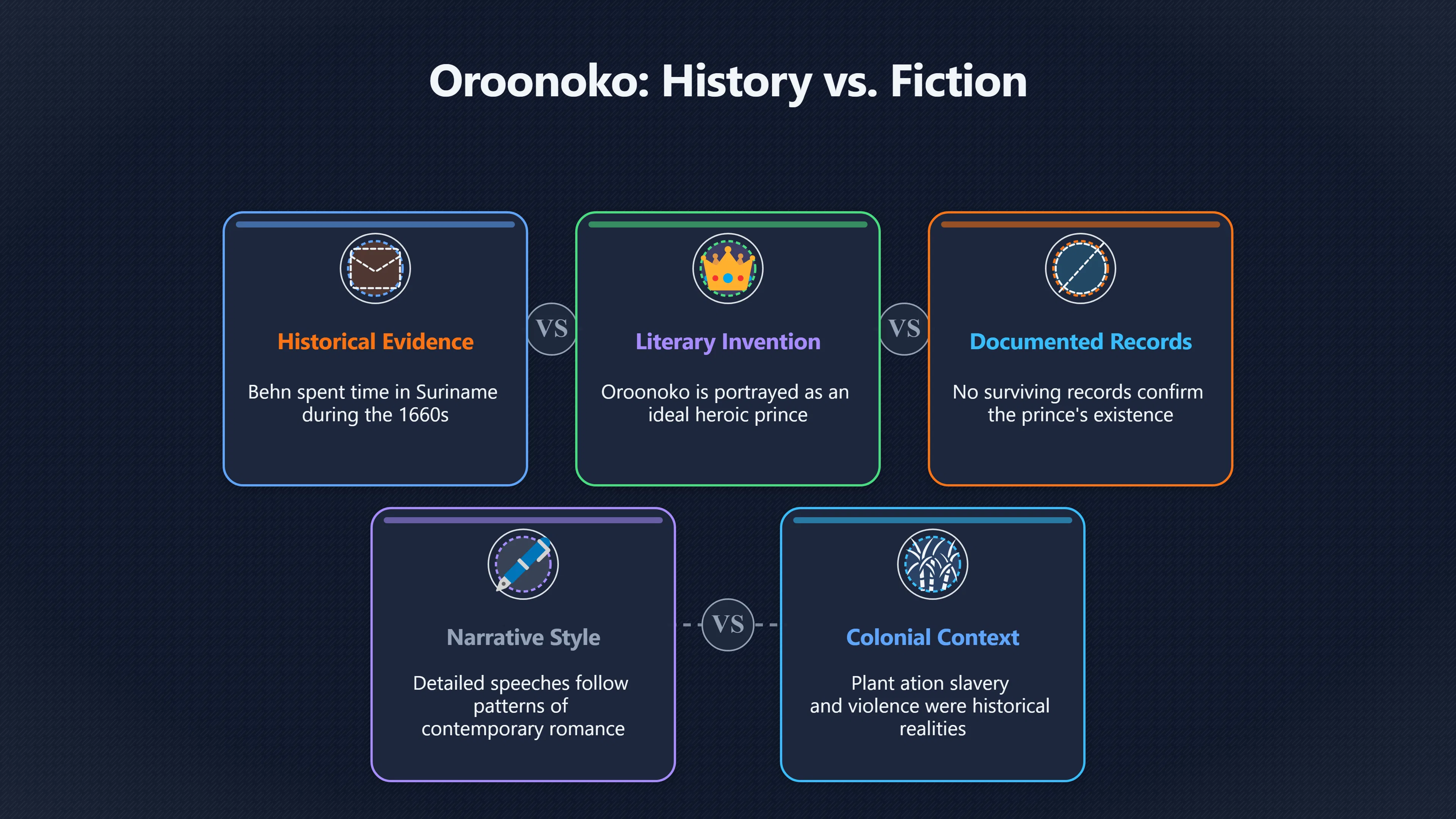
There is some evidence suggesting that Aphra Behn spent time in Suriname during the early 1660s, and her correspondence has often been cited in support of that possibility. However, many details of her life remain uncertain, and historians have been unable to verify several aspects of the autobiographical framework presented in the narrative.[Wikipedia]WikipediaAphra BehnAphra Behn
More importantly, researchers have struggled to identify a historical Oroonoko. No surviving records clearly confirm the existence of the African prince described in the book, nor has a slave uprising matching the narrative’s dramatic climax been conclusively documented in the colony’s records. The absence of evidence does not prove the events never occurred, but it does make the book difficult to treat as straightforward history.[Wikipedia]WikipediaAphra BehnAphra Behn
Several features of the narrative also resemble literary conventions rather than eyewitness reporting:
- Oroonoko is portrayed as an almost ideal heroic prince, possessing qualities associated with aristocratic romance.
- The love story between Oroonoko and Imoinda follows patterns familiar from contemporary fiction.
- Speeches and conversations are presented in remarkable detail despite the practical impossibility of recording them.
- African and colonial settings are often shaped to support moral and emotional themes rather than documentary precision.[newberry.org]dcc.newberry.orgNewberry Digital CollectionsAphra Behn's Oroonoko: Slavery and Race in the Atlantic World14 May 2012 — Aphra Behn published Oroonoko in 1…
Because of these features, most modern scholars regard Oroonoko as a hybrid work rather than a reliable historical chronicle. It draws on real colonial circumstances while reshaping them through literary storytelling.[jstor.org]jstor.orgBehn's first-person narrator claims that she went to Surinam2 as the daughter of the Lieutenant-General-elect of…Read more…
Why Readers Believed It
The book’s credibility rested on more than the narrator’s claims. It appeared during a period when the boundaries between history, travel writing and fiction were less rigid than they are today.
Seventeenth-century readers were accustomed to narratives that mixed observation with interpretation. Explorers, missionaries and colonial officials routinely blended firsthand experience, rumour and speculation in published accounts. A text could therefore be substantially factual in spirit while containing embellishments that modern readers would classify as fictional.[Newberry Digital Collections]dcc.newberry.orgNewberry Digital CollectionsAphra Behn's Oroonoko: Slavery and Race in the Atlantic World14 May 2012 — Aphra Behn published Oroonoko in 1…
Behn also supplied enough authentic colonial detail to make the broader story plausible. The existence of plantation slavery, the violence of colonial rule and the economic importance of enslaved labour were all realities of the Atlantic world. Readers encountering Oroonoko’s tragedy were not being asked to believe something impossible. They were being invited to accept a dramatic individual story set within recognisable historical conditions.[Newberry Digital Collections]dcc.newberry.orgNewberry Digital CollectionsAphra Behn's Oroonoko: Slavery and Race in the Atlantic World14 May 2012 — Aphra Behn published Oroonoko in 1…
This mixture of genuine context and uncertain narrative detail is precisely what makes the book important in discussions of contested truth. It demonstrates how a persuasive account can derive credibility from an accurate setting even when key elements remain unverified.
Why the “True History” Label Still Matters
The question of truth in Oroonoko is not merely literary. It affects how later generations have understood slavery, colonialism and Suriname itself.
For many readers, the book represented one of the earliest English-language works to portray an enslaved African as a tragic hero deserving sympathy. Although modern scholars debate the limits of its racial politics and note its continuing attachment to aristocratic and colonial assumptions, the narrative nevertheless encouraged readers to see the human suffering produced by slavery.[newberry.org]dcc.newberry.orgNewberry Digital CollectionsAphra Behn's Oroonoko: Slavery and Race in the Atlantic World14 May 2012 — Aphra Behn published Oroonoko in 1…
At the same time, the claim of eyewitness authenticity helped give the work lasting influence. Readers often remember Oroonoko not simply as a novel but as a window into the colonial world of seventeenth-century Suriname. The authority created by the phrase “A True History” allowed the book to shape historical imagination long after questions arose about its factual accuracy.[Wikipedia]WikipediaOpen source on wikipedia.org.
This creates a lasting tension. The narrative may contain invention, exaggeration or literary reconstruction, yet it also preserves valuable evidence about how Europeans imagined slavery, race and colonial society in the late seventeenth century. Scholars therefore continue to read it both as literature and as a historical document—though not always for the same reasons.[tandfonline.com]tandfonline.comTaylor & Francis OnlineFull article: Aphra Behn, Oroonoko, and Surinameby H Wilcox · 2025 · Cited by 1 — The significance of Aphra Behn's…
A Case of Contested Truth Rather Than Simple Fraud
Unlike a forged artefact or a fabricated newspaper story, Oroonoko cannot be neatly classified as a hoax. There is no clear moment when a false claim was conclusively exposed. Instead, the work sits in a disputed space between memory, observation and invention.
What makes it relevant to Suriname’s history of contested truth is the way it borrowed the authority of eyewitness reporting while transforming colonial experience into a powerful literary narrative. The result was a story that generations of readers treated as substantially true, even as historians found it increasingly difficult to verify its most important details.[tandfonline.com]tandfonline.comTaylor & Francis OnlineFull article: Aphra Behn, Oroonoko, and Surinameby H Wilcox · 2025 · Cited by 1 — The significance of Aphra Behn's…
As a consequence, Oroonoko remains one of the most fascinating examples of how claims of authenticity can shape public belief. It is not remembered because scholars proved every detail correct. It endures because it demonstrates how persuasive a “true history” can be when fact, memory and storytelling become inseparable.[wikipedia.org]WikipediaOpen source on wikipedia.org.
Amazon book picks
Further Reading
Books and field guides related to Was Oroonoko History, Fiction or Something Between?. Use these as the next step if you want deeper reading beyond the article.
Aphra Behn: A Secret Life
Provides background on the author's claimed eyewitness authority.
The Interesting Narrative of the Life of Olaudah Equiano
Offers comparison with other early narratives about slavery.
The Cambridge Companion to Aphra Behn
Examines authorship, context and historical debates.
Endnotes
1.
Source: Wikipedia
Link:https://en.wikipedia.org/wiki/Oroonoko
2.
Source: ota.bodleian.ox.ac.uk
Title: OTAOroonoko, or, The royal slave: a true history / by Mrs
Link:https://ota.bodleian.ox.ac.uk/repository/xmlui/handle/20.500.12024/A27305
Source snippet
A. Behn.Oroonoko, or, The royal slave: a true history / by Mrs. A. Behn. Oxford Text Archive. Authors: Behn, Aphra, 1640-1689. Date of p...
3.
Source: dcc.newberry.org
Link:https://dcc.newberry.org/?p=14443
Source snippet
Newberry Digital CollectionsAphra Behn's Oroonoko: Slavery and Race in the Atlantic World14 May 2012 — Aphra Behn published Oroonoko in 1...
Published: May 2012
4.
Source: asu.pressbooks.pub
Title: teaching aphra behns oroonoko as execution narrative
Link:https://asu.pressbooks.pub/race-in-the-european-renaissance-classroom-guide/chapter/teaching-aphra-behns-oroonoko-as-execution-narrative/
Source snippet
Teaching Aphra Behn's Oroonoko as Execution Narrativeby J Lodine-Chaffey · 2023 · Cited by 1 — Written as both a romantic c...
5.
Source: Wikipedia
Title: Aphra Behn
Link:https://en.wikipedia.org/wiki/Aphra_Behn
6.
Source: jstor.org
Link:https://www.jstor.org/stable/29532539
Source snippet
Behn's first-person narrator claims that she went to Surinam2 as the daughter of the Lieutenant-General-elect of...Read more...
7.
Source: study.com
Title: Oroonoko by Aphra Behn
Link:https://study.com/learn/lesson/oroonoko-aphra-behn-summary-analysis-themes.html
8.
Source: jstor.org
Link:https://www.jstor.org/stable/41849082
9.
Source: blogs.brighton.ac.uk
Title: University of Brighton Blogs1
Link:https://blogs.brighton.ac.uk/brightonline/issue-1/1-oroonoko-an-emergent-anti-colonial-voice/
Source snippet
Oroonoko: An emergent anti-colonial voice? | BrightonlineFrom the outset Oroonoko claims to be a True History, a history in which the peo...
10.
Source: tandfonline.com
Link:https://www.tandfonline.com/doi/full/10.1080/03096564.2025.2559515
Source snippet
Taylor & Francis OnlineFull article: Aphra Behn, Oroonoko, and Surinameby H Wilcox · 2025 · Cited by 1 — The significance of Aphra Behn's...
Additional References
11.
Source: youtube.com
Title: El Dorado: The Golden City That Never Was | Mythical Dark History for Sleep
Link:https://www.youtube.com/watch?v=nYcKmnMw8Ok
Source snippet
Walter Raleigh's Bloody Quest To Find The City Of Gold | Great Adventurers...
12.
Source: youtube.com
Title: Walter Raleigh’s Bloody Quest To Find The City Of Gold | Great Adventurers
Link:https://www.youtube.com/watch?v=h0RJbK_oyJk
Source snippet
50 Geography Facts That Are Fake (But You Believed Them)...
13.
Source: youtube.com
Title: The Hunt for El Dorado: Unveiling the Lost City
Link:https://www.youtube.com/watch?v=qdfPua-uTYE
Source snippet
El Dorado: The Golden City That Never Was | Mythical Dark History for Sleep...
14.
Source: youtube.com
Title: 50 Geography Facts That Are Fake (But You Believed Them)
Link:https://www.youtube.com/watch?v=nao4bzb2RiY
Source snippet
Maps Lied for Centuries (Phantom Islands Explained)...
15.
Source: plhr.org.pk
Link:https://plhr.org.pk/article/slavery-racism-and-colonial-ambivalence-a-postcolonial-perspective-on-aphra-behn-s-oroonoko-or-the-royal-slave-a-true-history
16.
Source: researchgate.net
Title: 350793044 Manipulating Geography A Reading of Aphra Behn’s Oroonoko
Link:https://www.researchgate.net/publication/350793044_Manipulating_Geography_A_Reading_of_Aphra_Behn%27s_Oroonoko
17.
Source: ukessays.com
Title: white female narrator in oroonoko english literature essay
Link:https://www.ukessays.com/essays/english-literature/white-female-narrator-in-oroonoko-english-literature-essay.php
18.
Source: youtube.com
Title: Maps Lied for Centuries (Phantom Islands Explained)
Link:https://www.youtube.com/watch?v=OhNvD5eNius
Source snippet
You stopped this response...
19.
Source: read.dukeupress.edu
Title: The Inside Story Body Language and Free Indirect
Link:https://read.dukeupress.edu/novel/article/58/2/167/406293/The-Inside-Story-Body-Language-and-Free-Indirect
20.
Source: onehundredpages.wordpress.com
Title: oroonoko by aphra behn 1688 the first novel
Link:https://onehundredpages.wordpress.com/2020/11/28/oroonoko-by-aphra-behn-1688-the-first-novel/
Topic Tree