Within Guinea Bissau
Did Nuno Tristao Really Reach Guinea Bissau?
A doubtful voyage became an official colonial origin story through monuments, teaching and repeated claims of Portuguese discovery.
On this page
- What colonial accounts claimed
- How the discovery story served Portuguese rule
- The navigational evidence that challenged the legend
Page outline Jump by section
Introduction
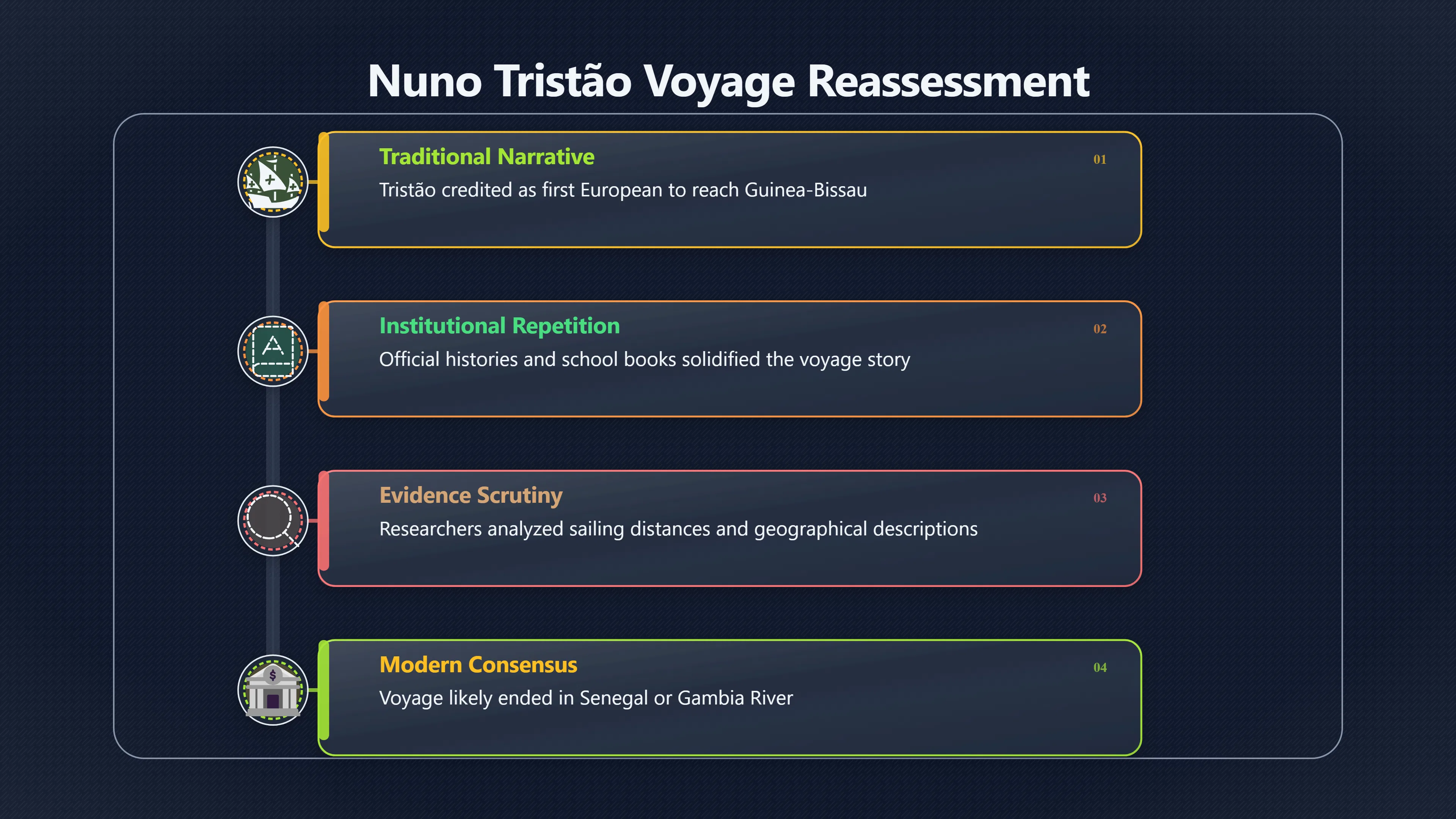
Did Nuno Tristão really reach Guinea-Bissau? Modern historical research increasingly suggests that he probably did not. Yet for much of the colonial period, Portuguese authorities presented the fifteenth-century navigator as the “discoverer” of what later became Portuguese Guinea, now Guinea-Bissau. The story appeared in official histories, school teaching, commemorations and public memory until it became accepted as a foundational fact. Recent scholarship argues that this was less a straightforward historical conclusion than a constructed colonial narrative built around a doubtful voyage. Rather than exposing a single fraud, the case shows how an uncertain event can be transformed into an official origin story through repetition, symbolism and political usefulness.[Taylor & Francis Online]tandfonline.comTaylor & Francis OnlineFull article: The Invention of Portuguese Guineaby V Barros · 2026 — This article scrutinizes how the historical a…

The controversy matters because the language of “discovery” did more than describe a voyage. It placed Portuguese explorers at the beginning of the territory’s history while obscuring the existence of long-established African societies, trade networks and political systems that were already present when Europeans arrived on the West African coast.[Taylor & Francis Online]tandfonline.comTaylor & Francis OnlineFull article: The Invention of Portuguese Guineaby V Barros · 2026 — This article scrutinizes how the historical a…
What Colonial Accounts Claimed
For generations, Portuguese colonial histories credited Nuno Tristão, a navigator working under Prince Henry the Navigator in the 1440s, with reaching the territory of modern Guinea-Bissau. In many versions of the story, he was celebrated as the first European to enter the region and therefore the symbolic founder of Portugal’s relationship with the territory.[Wikipedia]WikipediaNuno TristãoNuno Tristão
The claim gained authority because it was repeated across multiple forms of public memory. Colonial publications, maps, monuments and educational materials treated the voyage as a settled historical fact. Over time, the distinction between evidence and tradition faded. What began as an interpretation became an apparently unquestionable episode in the official history of Portuguese Guinea.[Taylor & Francis Online]tandfonline.comTaylor & Francis OnlineFull article: The Invention of Portuguese Guineaby V Barros · 2026 — This article scrutinizes how the historical a…
Importantly, the traditional account was never merely about navigation. It established a beginning point for Portuguese claims in the region. If Tristão had “discovered” the territory, later colonial rule could be presented as the continuation of a relationship stretching back centuries.[Taylor & Francis Online]tandfonline.comTaylor & Francis OnlineFull article: The Invention of Portuguese Guineaby V Barros · 2026 — This article scrutinizes how the historical a…
How the Discovery Story Served Portuguese Rule
The Tristão narrative functioned as what historians often call an invented tradition: a story about the past that helps legitimise power in the present. In colonial Guinea, the discovery legend offered several advantages.
First, it supplied Portugal with a founding myth. Colonial rule could be portrayed not as a relatively late and often contested process of conquest and administration, but as the natural outcome of exploration that supposedly began in the fifteenth century.[Taylor & Francis Online]tandfonline.comTaylor & Francis OnlineFull article: The Invention of Portuguese Guineaby V Barros · 2026 — This article scrutinizes how the historical a…
Second, the story centred Europeans as the principal actors in regional history. The term “discovery” implied that meaningful history began when a Portuguese sailor arrived, even though powerful African states and communities already occupied and governed the area. The Kingdom of Gabú and other regional political formations existed long before any Portuguese claim to the territory.[Austrian Foreign Ministry]bmeia.gv.at20160215 guide guinea bissau european union afectos enAustrian Foreign MinistryDiscovering Guinea-Bissauthe arrival of the Portuguese in Guinea-Bissau took place between 1445 and 1447 and is…
Third, the legend fit comfortably within broader Portuguese imperial narratives. Colonial ideology frequently celebrated explorers as heroic pioneers whose voyages supposedly justified later imperial authority. The Tristão story allowed Portuguese Guinea to be incorporated into that larger national mythology.[Taylor & Francis Online]tandfonline.comTaylor & Francis OnlineFull article: The Invention of Portuguese Guineaby V Barros · 2026 — This article scrutinizes how the historical a…
The persistence of the tale illustrates how colonial memory often depends less on historical certainty than on political usefulness. A story does not need strong evidence to become influential if institutions continually repeat it.
The Navigational Evidence That Challenged the Legend
The challenge to the discovery story did not come from a dramatic revelation. Instead, historians gradually re-examined the available evidence and compared different early accounts of Portuguese exploration.
Traditional versions placed Tristão far south on the West African coast, sometimes near the rivers of modern Guinea or Guinea-Bissau. However, later researchers scrutinised sailing distances, geographical descriptions and reports written by early travellers such as Diogo Gomes and Alvise Cadamosto. Their analysis suggested that the traditional route was implausible.[Wikipedia]WikipediaNuno TristãoNuno Tristão
A growing scholarly consensus concluded that Tristão probably reached only the Sine-Saloum area in present-day Senegal or, at the most generous estimate, the Gambia River. If that interpretation is correct, he never entered the territory of modern Guinea-Bissau at all.[Wikipedia]WikipediaNuno TristãoNuno Tristão
This reassessment also exposed a striking geographical problem. The enormous leap required by older colonial accounts would have placed Tristão far beyond other verified Portuguese advances of the period. Historians increasingly regarded such claims as unsupported by the documentary record.[Wikipedia]WikipediaNuno TristãoNuno Tristão
The result was not merely a correction of a map. Once the voyage itself became doubtful, the larger colonial narrative built upon it also became questionable.
Why the Story Survived for So Long
One reason the legend endured is that exploration history often rewards simple narratives. A single explorer and a single “discovery” make for a clear origin story. The reality of gradual contact, contested encounters and complex African political landscapes is much harder to reduce to a memorable national myth.
Another reason is institutional repetition. When governments, schools, museums and public commemorations all tell the same story, later generations often inherit it as common knowledge rather than as a claim requiring evidence. The authority of the institutions becomes part of the proof.[Taylor & Francis Online]tandfonline.comTaylor & Francis OnlineFull article: The Invention of Portuguese Guineaby V Barros · 2026 — This article scrutinizes how the historical a…
The story also survived because few people outside specialist historical circles revisited the original navigational evidence. Once the narrative entered textbooks and public memory, it acquired a momentum of its own.
A Discovery Myth Rather Than a Simple Hoax
Calling the Tristão story a hoax can be misleading if it suggests a deliberate plot by a single individual. The evidence points instead to a longer process of myth-making. Early uncertainties about where Tristão travelled were gradually converted into certainty by later writers and colonial institutions.[Taylor & Francis Online]tandfonline.comTaylor & Francis OnlineFull article: The Invention of Portuguese Guineaby V Barros · 2026 — This article scrutinizes how the historical a…
That makes the case especially revealing within the history of Guinea-Bissau. It demonstrates how historical myths can become more influential than ordinary deceptions. A fabricated photograph or newspaper stunt may last for days or years; an official origin story can shape public understanding for generations.
The modern reassessment of Nuno Tristão does not erase Portuguese exploration from West African history. What it does challenge is the specific claim that he “discovered” Guinea-Bissau. The strongest current evidence suggests that the celebrated colonial founder may never have reached the territory he was later credited with finding.[wikipedia.org]WikipediaNuno TristãoNuno Tristão
Amazon book picks
Further Reading
Books and field guides related to Did Nuno Tristao Really Reach Guinea-Bissau?. Use these as the next step if you want deeper reading beyond the article.
The Scramble For Africa
Explains how colonial narratives became embedded in historical memory.
The Fortunes of Africa
Places West African history before and after European arrival in context.

The scramble for Africa, 1876-1912
First published 1990. Subjects: History, Colonies, Colonization, Colonización, Kolonisatie.
eBay marketplace picks
Marketplace Samples
Example marketplace items related to this page. Use the search link to explore similar finds on eBay.
Endnotes
1.
Source: Wikipedia
Title: Nuno Tristão
Link:https://en.wikipedia.org/wiki/Nuno_Trist%C3%A3o
2.
Source: Wikipedia
Title: Nuno Tristão
Link:https://pt.wikipedia.org/wiki/Nuno_Trist%C3%A3o
3.
Source: Wikipedia
Link:https://pt.wikipedia.org/wiki/Guin%C3%A9-Bissau
4.
Source: Wikipedia
Title: Nuno Tristão
Link:https://es.wikipedia.org/wiki/Nuno_Trist%C3%A3o
5.
Source: Wikipedia
Title: European exploration of Africa
Link:https://en.wikipedia.org/wiki/European_exploration_of_Africa
6.
Source: Wikipedia
Title: Nuno Tristão
Link:https://nl.wikipedia.org/wiki/Nuno_Trist%C3%A3o
7.
Source: youtube.com
Title: The Untold Story of Portuguese Explorations in Africa
Link:https://www.youtube.com/watch?v=iYqYt7vAyQs
Source snippet
Prince Henry the Navigator | The Man Who Launched the Age of Discovery...
8.
Source: youtube.com
Title: Prince Henry the Navigator | The Man Who Launched the Age of Discovery
Link:https://www.youtube.com/watch?v=bBShJ1p-MUc
9.
Source: tandfonline.com
Link:https://www.tandfonline.com/doi/full/10.1080/13688790.2026.2682004
Source snippet
Taylor & Francis OnlineFull article: The Invention of Portuguese Guineaby V Barros · 2026 — This article scrutinizes how the historical a...
10.
Source: bmeia.gv.at
Title: 20160215 guide guinea bissau european union afectos en
Link:https://www.bmeia.gv.at/fileadmin/user_upload/Vertretungen/Dakar/Dokumente/20160215_guide_guinea_bissau_european_union_afectos_en.pdf
Source snippet
Austrian Foreign MinistryDiscovering Guinea-Bissauthe arrival of the Portuguese in Guinea-Bissau took place between 1445 and 1447 and is...
11.
Source: geognos.com
Link:https://www.geognos.com/en/place/guinea-bissau/history
Source snippet
Guinea-Bissau Historiography — Africa Historical Timeline30 Jun 2026 — Nuno Tristão's voyage is traditionally cited as the starting point...
12.
Source: kids.kiddle.co
Title: Nuno Tristão
Link:https://kids.kiddle.co/Nuno_Trist%C3%A3o
13.
Source: tandfonline.com
Link:https://www.tandfonline.com/doi/abs/10.1080/13688790.2026.2682004
Additional References
14.
Source: encyclopedia.com
Link:https://www.encyclopedia.com/science/encyclopedias-almanacs-transcripts-and-maps/nuno-tristao-early-portuguese-explorer
Source snippet
Nuño Tristão: Early Portuguese ExplorerTristão, one of Prince Henry's most trusted sea captains, is credited with the discovery of Cape B...
15.
Source: facebook.com
Link:https://www.facebook.com/UTGSU16/posts/utgsu-students-present-gamsal-research-findings-at-gaston-berger-university-issu/1500897255373847/
Source snippet
STUDENTS PRESENT GAMSAL RESEARCH FINDINGS...GAMSAL Research Trip, aimed at strengthening academic collaboration, promoting regional scho...
16.
Source: facebook.com
Link:https://www.facebook.com/papermoneyworlds/posts/portuguese-guinea-guinea-bissau-50-escudos-1971nuno-trist%C3%A3o-was-a-15th-century-p/890715690150243/
Source snippet
Portuguese Guinea (Guinea-Bissau) 50 Escudos 1971...Using the caravel, he reached the Gambia River and Cape Blanc. His voyages transitio...
17.
Source: youtube.com
Title: The Untold Story: Portugal’s Race to Explore Africa
Link:https://www.youtube.com/watch?v=SdMyUgnO7CQ
Source snippet
The Untold Story of Portuguese Explorations in Africa...
18.
Source: facebook.com
Link:https://www.facebook.com/groups/1195271791129874/posts/1440370009953383/
19.
Source: facebook.com
Link:https://www.facebook.com/groups/1400626837265016/posts/1881721949155500/
20.
Source: maryevans.com
Link:https://www.maryevans.com/contributors/grc/landing-nuno-tristao-guinea-45712874.html
21.
Source: ndl.ethernet.edu.et
Link:https://ndl.ethernet.edu.et/bitstream/123456789/9706/1/116.pdf.pdf
22.
Source: youtube.com
Title: Nuno Tristão ⛵️ WORLD EXPLORERS
Link:https://www.youtube.com/watch?v=vnXckG-DPoE
Source snippet
Why Are They Trying to Erase the Portuguese Discoveries?...
23.
Source: jarniascyril.com
Title: history guinea bissau kaabu empire paigc colonization
Link:https://www.jarniascyril.com/expatriation/setting-up-in-guinea-bissau-as-an-expat-complete-guide/history-guinea-bissau-kaabu-empire-paigc-colonization/
Topic Tree