Within Malawi
Did Malawi Export Blood to South Africa?
Real unsolved killings gave force to a false claim that Malawi's government was secretly exporting victims' blood to South Africa.
On this page
- The killings that created public fear
- How the blood export story took shape
- Why the trials failed to settle the case
Page outline Jump by section
Introduction
Did Malawi export the blood of murder victims to South Africa? The short answer is no. No credible investigation ever found evidence that the Malawian government collected blood from victims and shipped it across the border. Yet the story became one of the most powerful conspiracy theories in Malawi’s modern history because it attached itself to something very real: a wave of terrifying unsolved murders around Chilobwe, near Blantyre, between 1968 and 1970. More than thirty people were killed, often in brutal circumstances, and the authorities struggled to provide convincing answers. In that atmosphere of fear, political suspicion and rumour, a blood-export story emerged that seemed to explain both the killings and Malawi’s controversial relationship with apartheid South Africa.[Wikipedia]WikipediaChilobwe murdersChilobwe murders
The Chilobwe murders occupy an unusual place in Malawi’s history of contested truths. The murders themselves were real. The conspiracy explanation was not. But the inability of the police, courts and government to settle public doubts allowed the rumour to outlive the crimes and influence later “bloodsucker” scares for decades.[Wikipedia]WikipediaChilobwe murdersChilobwe murders
The killings that created public fear
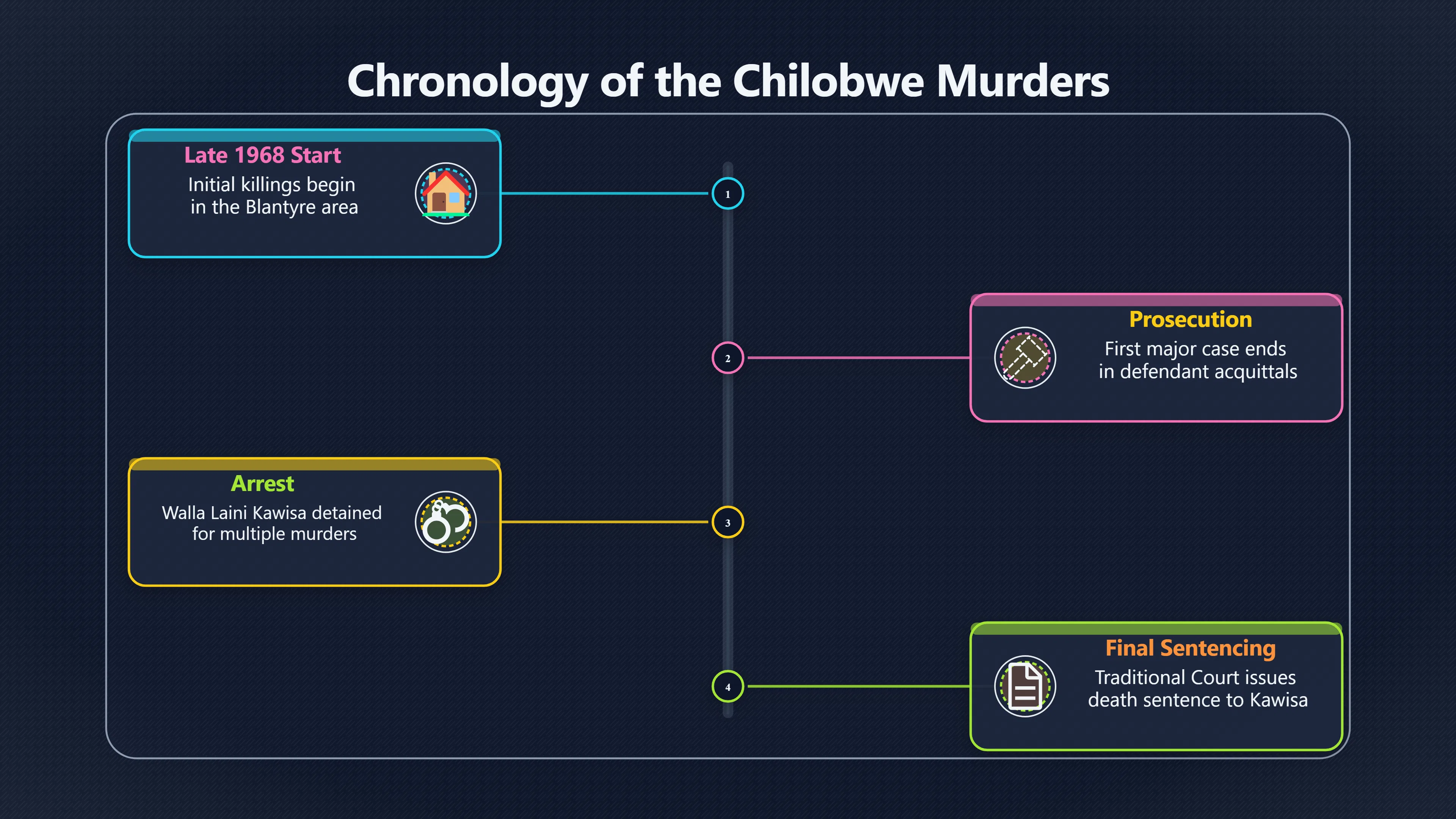
The murders began in the Blantyre area in late 1968 and continued into 1970. At least thirty-one killings were eventually linked together as the “Chilobwe murders”. Many occurred at night in victims’ homes. Some bodies showed mutilations that encouraged speculation about ritual motives, witchcraft or organised criminal activity. The victims were often poor residents living in houses that could be entered relatively easily, adding to a sense of vulnerability throughout the community.[Wikipedia]WikipediaChilobwe murdersChilobwe murders
As the death toll rose, public confidence in the authorities weakened. Police investigations produced few convincing results, and each new killing reinforced the impression that the perpetrators were operating with unusual freedom. In a newly independent country still defining its political institutions, the inability to stop the murders became a national issue rather than merely a criminal investigation.[Wikipedia]WikipediaChilobwe murdersChilobwe murders
What made the case especially fertile ground for rumour was the absence of a clear explanation. The public knew people were dying. They knew the government had not solved the crimes. Between those two facts lay a vacuum that competing theories rushed to fill.
How the blood-export story took shape
The most famous rumour claimed that the victims’ blood was being collected and sent to South Africa. Different versions circulated. Some alleged that the blood was repayment for loans or assistance received from Pretoria. Others claimed white South Africans required African blood for mysterious medical, commercial or occult purposes.[Wikipedia]WikipediaChilobwe murdersChilobwe murders
To modern readers the story may sound implausible, but it emerged from a specific political context. President Hastings Banda maintained unusually close relations with apartheid South Africa at a time when many African governments were isolating the white-minority regime. For critics and ordinary citizens alike, the relationship generated suspicion. A rumour linking murder victims to secret dealings with South Africa transformed an abstract geopolitical concern into a vivid and frightening narrative.[Wikipedia]WikipediaChilobwe murdersChilobwe murders
The conspiracy theory also drew strength from older beliefs and anxieties surrounding blood. Across parts of central and southern Africa, stories about outsiders taking blood had appeared during colonial and post-colonial periods. Blood symbolised life, power and exploitation. In that cultural environment, claims about blood extraction could function as explanations for wider fears about domination, inequality and hidden authority.[African Arguments]africanarguments.orgAfrican Arguments"A symbolic representation of life": Behind Malawi's blood-…9 Nov 2017 — Nine people have been killed by vigilantes r…
Importantly, the rumour did not arise because people imagined murders that never happened. It arose because genuine killings lacked a convincing public explanation. The conspiracy theory attempted to provide one.
Why many people found the rumour believable
Several factors made the blood-export story persuasive despite the lack of evidence.
The murders were real. Unlike many classic hoaxes, the underlying event was not invented. Communities were responding to actual deaths and genuine fear.[Wikipedia]WikipediaChilobwe murdersChilobwe murders
The government appeared secretive. Banda’s administration was increasingly authoritarian, and public criticism could be risky. Limited transparency encouraged speculation about what officials might be hiding.[Human Rights Watch]hrw.orgHuman Rights WatchMALAWIThe 25 years of Life-President Hastings Kamuzu Banda's rule in Malawi have been synonymous with torture, extrajud…
Relations with South Africa were controversial. Because Malawi maintained ties that many other African states rejected, rumours involving Pretoria had a ready-made audience.[Wikipedia]WikipediaChilobwe murdersChilobwe murders
The crimes seemed inexplicable. The brutality of the attacks and the apparent inability of police to stop them encouraged extraordinary explanations. When ordinary explanations fail, extraordinary ones often gain ground.[Wikipedia]WikipediaChilobwe murdersChilobwe murders
The result was a conspiracy theory that connected several public anxieties at once: murder, state power, foreign influence and social inequality.

Why the trials failed to settle the case
The legal response became almost as important as the murders themselves.
In 1969, several suspects were prosecuted in what became known as the first major Chilobwe murders case. The defendants were acquitted because the evidence was judged insufficient. From a legal standpoint, this reflected the principle that guilt must be proven. From the perspective of many frightened citizens, however, the verdict looked like proof that the justice system could not deliver answers.[Wikipedia]WikipediaJudiciary of MalawiJudiciary of Malawi
The acquittals triggered fierce political criticism. Government figures attacked the courts and questioned legal safeguards that had prevented convictions. The controversy helped justify major changes to Malawi’s judicial system, including the expansion of Traditional Courts with broader powers over serious criminal cases.[Wikipedia]WikipediaJudiciary of MalawiJudiciary of Malawi
The second major prosecution centred on Walla Laini Kawisa, arrested in 1970. During detention he made multiple confessions that contradicted one another. At different times he claimed to have acted with accomplices, as part of a larger group, and alone. Eventually a Traditional Court accepted a version of events in which he bore responsibility for thirty-one murders and fifteen attempted murders. He was sentenced to death.[wikipedia.org]WikipediaChilobwe murdersChilobwe murders
Yet the conviction did not resolve public doubts.
Several aspects of the case remained troubling:
- Kawisa’s confessions changed repeatedly.
- He lacked legal representation at trial.
- Some evidence appeared insufficient without the confessions.
- Even reviewing judges questioned whether he could truly have acted alone.
- No comprehensive explanation emerged for possible accomplices or organisers.[wikipedia.org]WikipediaChilobwe murdersChilobwe murders
Instead of closing the story, the trial left many observers with lingering questions. The government had obtained a conviction, but not a universally accepted explanation.
What evidence existed for the blood-export claim?
Despite its influence, the blood-export allegation never produced credible supporting evidence.
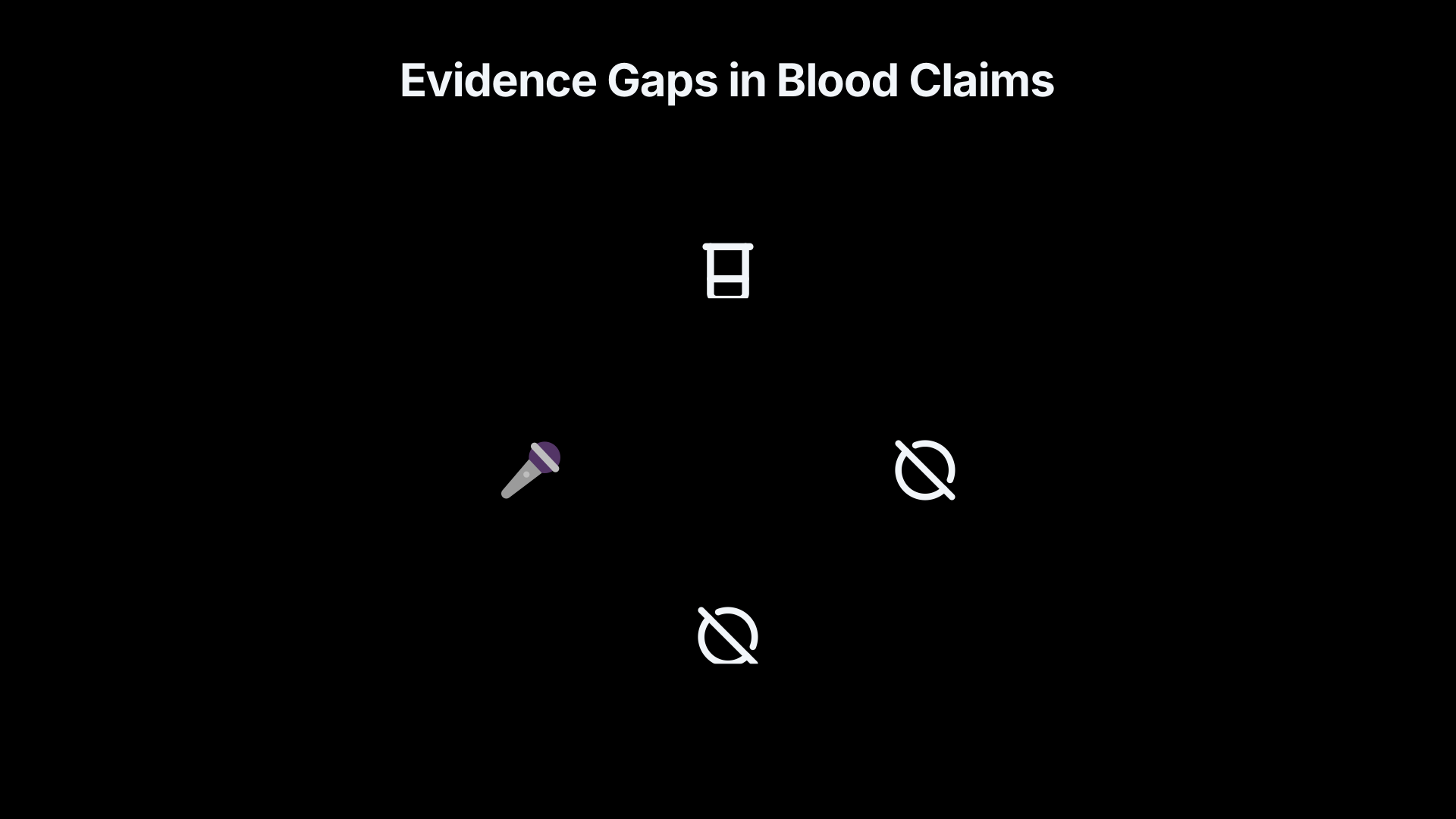
Investigators found no verified blood-collection operation, no transport network, no documentary proof of shipments to South Africa and no reliable witness testimony demonstrating that victims’ blood had been exported. Academic studies of the murders consistently treat the blood story as a rumour that emerged around the killings rather than as a substantiated finding.[wikipedia.org]WikipediaChilobwe murdersChilobwe murders
The rumour persisted because it helped explain circumstances that otherwise seemed baffling. It converted uncertainty into a narrative with identifiable villains and motives. That psychological function often allows conspiracy theories to survive even when evidence is lacking.
For historians, the key distinction is clear: the murders were real and remain only partially understood; the blood-export allegation was never demonstrated.[Wikipedia]WikipediaChilobwe murdersChilobwe murders
What Chilobwe reveals about belief and deception
The Chilobwe episode became a template for later Malawian rumours about blood theft and secret extraction. Subsequent “bloodsucker” panics, including major scares in the early 2000s and again in 2017, drew on themes that had already become familiar during the Chilobwe murders: hidden networks, vulnerable victims, distrust of authorities and the symbolic importance of blood.[African Arguments]africanarguments.orgAfrican Arguments"A symbolic representation of life": Behind Malawi's blood-…9 Nov 2017 — Nine people have been killed by vigilantes r…
The case is therefore significant not only as an unsolved murder mystery but also as a lesson in how conspiracy theories emerge. The blood-export story did not succeed because it offered evidence. It succeeded because it offered meaning at a moment when official explanations appeared inadequate.
For students of hoaxes, rumours and moral panics, Chilobwe demonstrates a recurring pattern: when real tragedies remain unexplained, false explanations can become more durable than verified facts. The conspiracy theory surrounding the murders was never proven, but the conditions that made it believable—fear, uncertainty and distrust—ensured that it became one of the most enduring stories in Malawi’s history.[wikipedia.org]WikipediaChilobwe murdersChilobwe murders
Amazon book picks
Further Reading
Books and field guides related to Did Malawi Export Blood to South Africa?. Use these as the next step if you want deeper reading beyond the article.
Extraordinary Popular Delusions and the Madness of Crowds
Rating: 4.0/5 from 5 Google Books ratings
Illustrates how collective fears can become entrenched social narratives.
Suspicious Minds
Closely matches the page's focus on a long-lived blood-export conspiracy.
The Psychology of Conspiracy Theories
Explains why rumours can outlive the events that spawned them.
The Demon-Haunted World
Rating: 4.5/5 from 43 Google Books ratings
Focuses on evidence, skepticism and extraordinary claims.
eBay marketplace picks
Marketplace Samples
Live-tested eBay searches with available results related to this page.
Endnotes
1.
Source: Wikipedia
Title: Chilobwe murders
Link:https://en.wikipedia.org/wiki/Chilobwe_murders
2.
Source: Wikipedia
Title: Judiciary of Malawi
Link:https://en.wikipedia.org/wiki/Judiciary_of_Malawi
3.
Source: cambridge.org
Link:https://www.cambridge.org/core/journals/african-studies-review/article/chilobwe-murders-trial/F7A61344F86401A7D648C8A66DD76A35
Source snippet
The Prosecutor told the Court that the accused had agreed...
4.
Source: africanarguments.org
Link:https://africanarguments.org/2017/11/a-symbolic-representation-of-life-behind-malawis-blood-sucking-beliefs/
Source snippet
African Arguments"A symbolic representation of life": Behind Malawi's blood-...9 Nov 2017 — Nine people have been killed by vigilantes r...
5.
Source: hrw.org
Link:https://www.hrw.org/reports/1989/WR89/Malawi.htm
Source snippet
Human Rights WatchMALAWIThe 25 years of Life-President Hastings Kamuzu Banda's rule in Malawi have been synonymous with torture, extrajud...
6.
Source: youtube.com
Link:https://www.youtube.com/watch?v=xNrsOBoGqjA
Additional References
7.
Source: dokumen.pub
Title: historical dictionary of malawi 0810812878
Link:https://dokumen.pub/historical-dictionary-of-malawi-0810812878.html
Source snippet
CHILOBWE MURDERS. Beginning in November 1968, and continuing for many months thereafter, a grisly series of murders took place in this Bl...
Published: November 1968
8.
Source: brill.com
Title: 9789004484351 webready content text
Link:https://brill.com/display/book/9789004484351/9789004484351_webready_content_text.pdf?srsltid=AfmBOoqfbd0Nz5ZK2UtG1wHNggHxeqYqrYFeWCgKi9VEYUaEu7Fhw_8G
Source snippet
US/THEM... murders which took place in the Blantyre township of Chilobwe and elsewhere between 1968 and 1970. There was a widespread...
9.
Source: youtube.com
Title: Scores arrested in Malawi after mobs kill 8 suspected ‘vampires’
Link:https://www.youtube.com/watch?v=0ho-xGJsdkA
Source snippet
Vigilante 'Vampire-Hunters' Kill 5 People In Malawi, Rumors Of Witchcraft Continue To Spread | TIME...
10.
Source: alternation.ukzn.ac.za
Link:https://alternation.ukzn.ac.za/wp-content/uploads/2025/11/04-Mthatiwa-F-min.pdf
Source snippet
RegistrationBird Metaphors in Jack Mapanje's The Chattering Wagtails...by S Mthatiwa · Cited by 11 — One rumour held that the Government...
11.
Source: youtube.com
Title: At least eight people lynched on suspicion of blood sucking traits
Link:https://www.youtube.com/watch?v=RTz7VNi_FV0
Source snippet
Scores arrested in Malawi after mobs kill 8 suspected 'vampires'...
12.
Source: cia.gov
Link:https://www.cia.gov/readingroom/docs/CIA-RDP84S00552R000300120004-1.pdf
13.
Source: africabib.org
Link:https://www.africabib.org/rec.php?RID=183761634
Source snippet
The Chilobwe murders trialby P Brietzke · 1974 · Cited by 20 — Abstract: The case against Walla Laini Kawisa, who was found to b...
14.
Source: academia.edu
Link:https://www.academia.edu/104511344/Corruption_and_Development_The_Anti_Corruption_Campaigns
15.
Source: semanticscholar.org
Link:https://www.semanticscholar.org/paper/Murder-and-Manslaughter-in-Malawi%27s-Traditional-Brietzke/94b6b284b63cfa0c6c3d1ffc1349c420796c0b04
16.
Source: semanticscholar.org
Link:https://www.semanticscholar.org/paper/The-Chilobwe-Murders-Trial-Brietzke/762d5e8e0bc3363a803e5b8997cae11a4f11f36a
Topic Tree