Within Nepal Hoaxes
Which Buddhist Discoveries Did Fuhrer Actually Fake?
A disgraced archaeologist mixed genuine monuments with invented inscriptions and false relics, leaving later scholars to separate fact from fraud.
On this page
- How Fuhrer gained archaeological authority
- The inscriptions and relics that failed scrutiny
- Why the Lumbini pillar remains credible
Page outline Jump by section
Introduction
Few figures in the history of Buddhist archaeology have done more to complicate the search for the Buddha’s historical landscape than Alois Anton Führer. Working in the late nineteenth century, the German archaeologist helped draw international attention to important sites in the Nepal–India borderlands, including Lumbini, traditionally regarded as the Buddha’s birthplace. Yet his career ended in scandal after investigators discovered that he had fabricated inscriptions, promoted forged relics and exaggerated or invented archaeological finds. The result was a lasting puzzle for later scholars: which discoveries were genuine, and which had been manufactured to satisfy the era’s hunger for dramatic Buddhist revelations?[Wikipedia]WikipediaAlois Anton FührerAlois Anton Führer

Führer’s story matters because it shows how fraud can become entangled with authentic evidence. His misconduct damaged confidence in legitimate discoveries and forced generations of researchers to re-examine some of the most important Buddhist sites in Nepal. At the same time, the scandal demonstrated that a dishonest archaeologist does not automatically invalidate every monument associated with him. Separating fact from fiction became one of the great detective stories of South Asian archaeology.[Wikipedia]WikipediaAlois Anton FührerAlois Anton Führer
How Führer Gained Archaeological Authority
By the 1890s, colonial archaeology was racing to identify places connected with the life of the Buddha. Ancient travel accounts written by Chinese pilgrims such as Faxian and Xuanzang offered clues, while governments, scholars and Buddhist communities all had strong reasons to welcome major discoveries. Finding the historical locations of Lumbini, Kapilavastu and other sacred places promised academic prestige, political influence and religious significance.[Wikipedia]WikipediaAlois Anton FührerAlois Anton Führer
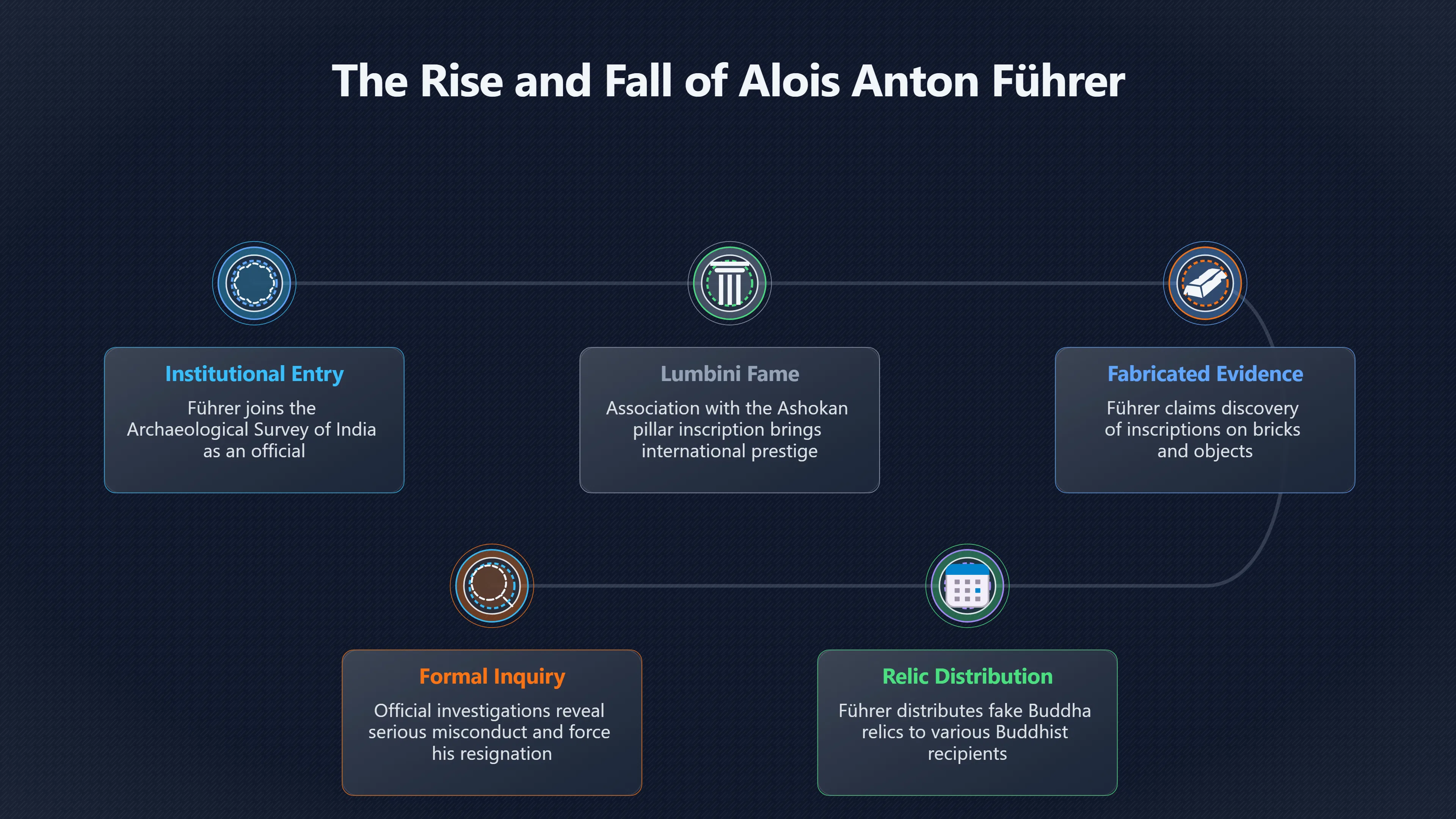
Führer was well positioned to benefit from this environment. As an employee of the Archaeological Survey of India, he possessed the credentials and institutional authority that made his claims appear trustworthy. His reports circulated among officials, scholars and Buddhist leaders across Asia. When he announced discoveries linked to the Buddha’s life, many people accepted them because they came from a recognised archaeological expert rather than an unknown enthusiast.[Wikipedia]WikipediaAlois Anton FührerAlois Anton Führer
His reputation rose dramatically in 1896 when he became associated with the discovery of the Ashokan pillar inscription at Lumbini. The inscription provided powerful evidence connecting the site with the Buddha’s birthplace. For a time, the find seemed to place Führer among the most important archaeologists working in Buddhist history.[Wikipedia]WikipediaAlois Anton FührerAlois Anton Führer
The Inscriptions and Relics That Failed Scrutiny
The discoveries that ultimately destroyed Führer’s career were not the famous monuments themselves but a series of supposed supporting finds that collapsed under examination.
Forged inscriptions near Buddhist sites
After the excitement generated by Lumbini, Führer searched for additional evidence around sites linked to the Buddha’s clan and early Buddhist history. According to later investigations, he began attributing extraordinary significance to structures and claiming that inscriptions had been found on bricks and other objects. These inscriptions supposedly connected ancient monuments to named figures from Buddhist tradition.[Wikipedia]WikipediaAlois Anton FührerAlois Anton Führer
Other scholars became suspicious. Vincent Arthur Smith, one of the leading historians and archaeologists of the period, examined some of the claims and concluded that several inscriptions were outright fabrications. Smith described certain discoveries as “impudent forgeries” and later stated that descriptions of archaeological remains published by Führer were fundamentally unreliable. Investigators also found that some of his published accounts borrowed heavily from earlier reports while presenting the material as original discovery.[Wikipedia]WikipediaAlois Anton FührerAlois Anton Führer
The scandal was particularly damaging because inscriptions were central to archaeological proof. A genuine ancient inscription could securely identify a site. A forged inscription could manufacture an entire historical narrative.
The fake Buddha relics
Even more damaging were the relics Führer distributed to Buddhist recipients. He claimed that these objects were authenticated by ancient inscriptions and linked directly to the Buddha or the early Buddhist community. Such relics carried immense spiritual value and attracted immediate attention.[Wikipedia]WikipediaAlois Anton FührerAlois Anton Führer
Subsequent investigation revealed that the claims did not withstand scrutiny. One supposed tooth relic of the Buddha was reportedly carved from ivory. Another alleged sacred tooth was identified as belonging to a horse. The inscriptions and chains of authentication that accompanied these relics proved equally dubious. Complaints reached colonial authorities, triggering a formal inquiry.[Wikipedia]WikipediaAlois Anton FührerAlois Anton Führer
By 1898 the accumulation of evidence had become impossible to ignore. Official investigations concluded that Führer had engaged in serious misconduct, and he was forced to resign from government service. His archaeological career ended in disgrace.[Wikipedia]WikipediaAlois Anton FührerAlois Anton Führer
Why the Lumbini Pillar Remains Credible
One of the most common misunderstandings about the scandal is the assumption that all discoveries associated with Führer must therefore be fraudulent. Historians and epigraphers have repeatedly argued that this conclusion goes too far.
The strongest example is the Ashokan pillar inscription at Lumbini. Although Führer became linked with its discovery, evidence suggests that the pillar was already known to Nepalese authorities before the excavation. Accounts from the period indicate that General Khadga Shamsher Rana played a central role in locating and exposing the buried inscription. Some reports even suggest that the inscription was uncovered before Führer arrived at the precise moment of discovery.[Wikipedia]WikipediaAlois Anton FührerAlois Anton Führer
More importantly, specialists who studied the inscription itself found characteristics that would have been extraordinarily difficult for Führer to fake. Scholars such as Harry Falk have argued that the script contains authentic features of third-century BCE Ashokan writing, including details that had not been properly understood in the nineteenth century and that later disappeared from use. Falk concluded that the inscription’s authenticity is effectively beyond dispute and that Führer lacked the linguistic and palaeographic expertise needed to create such a convincing forgery.[Wikipedia]WikipediaAlois Anton FührerAlois Anton Führer
Vincent Arthur Smith, despite exposing many of Führer’s deceptions, also accepted the authenticity of the Lumbini inscription. The distinction is crucial. The fraud lay in Führer’s invented supporting evidence, not necessarily in the major monuments themselves.[Wikipedia]WikipediaLumbini pillar inscriptionLumbini pillar inscription
Why People Believed Him
Führer’s success illustrates how archaeological fraud often exploits existing expectations rather than creating belief from nothing.
Several factors worked in his favour:
- Institutional authority: He spoke as a government archaeologist attached to a respected survey organisation.[Wikipedia]WikipediaAlois Anton FührerAlois Anton Führer
- Demand for discoveries: Scholars were actively searching for sites mentioned in Buddhist texts, making dramatic claims especially attractive.[Wikipedia]WikipediaAlois Anton FührerAlois Anton Führer
- Religious significance: Relics associated with the Buddha carried immense spiritual prestige and emotional power.[Wikipedia]WikipediaAlois Anton FührerAlois Anton Führer
- Limited verification: Archaeological communication was slower than today, making independent checking more difficult.[Wikipedia]WikipediaAlois Anton FührerAlois Anton Führer
The fraud therefore emerged at the intersection of scholarship, faith and prestige. People did not believe the claims simply because they were sensational; they believed them because they appeared to be supported by expertise and material evidence.
A Lasting Warning for Nepal’s Archaeological History
The Führer affair remains one of the most influential fraud scandals connected with Nepal’s Buddhist heritage. It demonstrates how forged inscriptions and fake relics can distort historical understanding long after the original deception is exposed. At the same time, it offers a caution against dismissing genuine evidence merely because a dishonest figure once stood nearby.[Wikipedia]WikipediaAlois Anton FührerAlois Anton Führer
Later researchers had to disentangle authentic monuments from fabricated discoveries, a process that ultimately strengthened the study of Buddhist archaeology. The scandal encouraged stricter standards of documentation, greater scepticism toward spectacular claims and closer examination of inscriptions, relics and excavation records. In that sense, Führer’s fraud left behind an unexpected legacy: it helped teach archaeologists how to recognise the difference between a remarkable discovery and a remarkably convincing fake.[Wikipedia]WikipediaAlois Anton FührerAlois Anton Führer
Amazon book picks
Further Reading
Books and field guides related to Which Buddhist Discoveries Did Fuhrer Actually Fake?. Use these as the next step if you want deeper reading beyond the article.
Frauds, Myths, and Mysteries: Science and Pseudoscience in Ar...
Explains how archaeological frauds are identified and corrected.
The Buddha and Dr. Führer
Focused on Führer, Buddhist archaeology, and forged discoveries.
The Search for the Buddha
Covers discovery and interpretation of sites linked to the historical Buddha.
The Archaeology of Knowledge
Provides broader context on how knowledge claims gain authority.
eBay marketplace picks
Marketplace Samples
Live-tested eBay searches with available results related to this page.

Endnotes
1.
Source: Wikipedia
Title: Alois Anton Führer
Link:https://en.wikipedia.org/wiki/Alois_Anton_F%C3%BChrer
2.
Source: Wikipedia
Title: Lumbini pillar inscription
Link:https://en.wikipedia.org/wiki/Lumbini_pillar_inscription
3.
Source: hamletram.blogspot.com
Title: Alois Anton Führer
Link:https://hamletram.blogspot.com/search/label/Alois%20Anton%20F%C3%BChrer
Source snippet
An "authentic tooth relics of the Buddha" sent by Führer in 1896 turned out to have been carved from a piece of ivory, and another sent i...
4.
Source: hamletram.blogspot.com
Link:https://hamletram.blogspot.com/search/label/Fake
Additional References
5.
Source: facebook.com
Title: the fascinating story of a single inscription on the ashoka pillar️the ashoka pi
Link:https://www.facebook.com/tilaurakot/posts/the-fascinating-story-of-a-single-inscription-on-the-ashoka-pillar%EF%B8%8Fthe-ashoka-pi/1655524729430957/
Source snippet
"Since Lumbini is the birthplace of the Buddha, the village...Lumbini pillar's authenticity disputed due to its discoverer's history of...
6.
Source: facebook.com
Title: The Ashokan pillar, discovered by Gen. Khadga S. Rana and Dr.Read more
Link:https://www.facebook.com/groups/HistorySeekers.Thailand/posts/2392817810980430/
Source snippet
Questioning the authenticity of Ashokan pillar in Lumbini...The pillar was lost until 1896 when a team of archaeologists rediscovered it...
7.
Source: facebook.com
Link:https://www.facebook.com/BuddhistArcheology/posts/the-nigali-sagar-inscriptions-earlier-but-still-important-work-in-the-asis-histo/1087409986721328/
Source snippet
of about twenty relic-caskets at sites close to Lumbini, which...
8.
Source: chandrashekharasandprints.wordpress.com
Title: the kapilavastu controversy part ii
Link:https://chandrashekharasandprints.wordpress.com/2012/11/30/the-kapilavastu-controversy-part-ii/
Source snippet
Kapilavastu Controversy: Part II - Sand Prints30 Nov 2012 — Anton Führer's real motives were unmasked and he was found to be a fraud, Arc...
9.
Source: kvramakrishnarao.wordpress.com
Title: comalois anton führer
Link:https://kvramakrishnarao.wordpress.com/category/alois-anton-fuhrer/
Source snippet
A. Führer, an archaeologist, who was accused of fabricating archaeological evidence and inscriptions, particularly those related to the...
10.
Source: facebook.com
Link:https://www.facebook.com/groups/208332826391090/posts/342456429645395/
Source snippet
This is...Read more...
11.
Source: academia.edu
Link:https://www.academia.edu/83952744/Examination_of_the_Authenticity_of_Rummindei_Pillar_Inscription_in_the_Light_of_an_Alternate_Interpretation_of_the_Inscription
12.
Source: scribd.com
Link:https://www.scribd.com/document/949468367/Rummindei-Pillar-Inscription-Comprehensive-Analysi
13.
Source: dakinitranslations.com
Link:https://dakinitranslations.com/wp-content/uploads/2021/09/bfb85-whathappenedatpiprahwabycharlesallen.pdf
14.
Source: vtourmap.com
Link:https://www.vtourmap.com/static/h/loc/en/nepaltour/Lumbini_pillar_inscription_nepaltour_en.html
Topic Tree