Within Tuvalu
How a Tuvalu Phone Number Hid an Internet Scam
Malicious software routed dial-up users through costly Tuvalu numbers while disguising the connection as ordinary internet access.
On this page
- How the malicious diallers were installed
- Why expensive Tuvalu numbers were useful
- How regulators and consumers uncovered the fraud
Page outline Jump by section
Introduction
In the final years of dial-up internet, one of the strangest telecommunications frauds linked to Tuvalu had little to do with the country itself. Criminals distributed malicious software known as “diallers” that secretly changed a user’s internet connection settings. Instead of connecting through a normal local internet service provider, the infected computer dialled an expensive international telephone number, often in a remote location such as Tuvalu. The victim could continue browsing the web as normal while hidden charges accumulated on the telephone bill. By the time the fraud was discovered, some households and businesses faced bills running into hundreds or even thousands of pounds. The episode became a notable example of how obscure international telephone routes could be exploited for profit while concealing the true organisers of the scam.[The Guardian]theguardian.comIt appears the scam is "migrating" to other countries such as Austria.Read moreThe GuardianBeware desert island risks | MoneyFebruary 19, 2005 — 18 Feb 2005 — BT is now seeing a decline in the numbers of calls to pla…
How the Malicious Diallers Were Installed
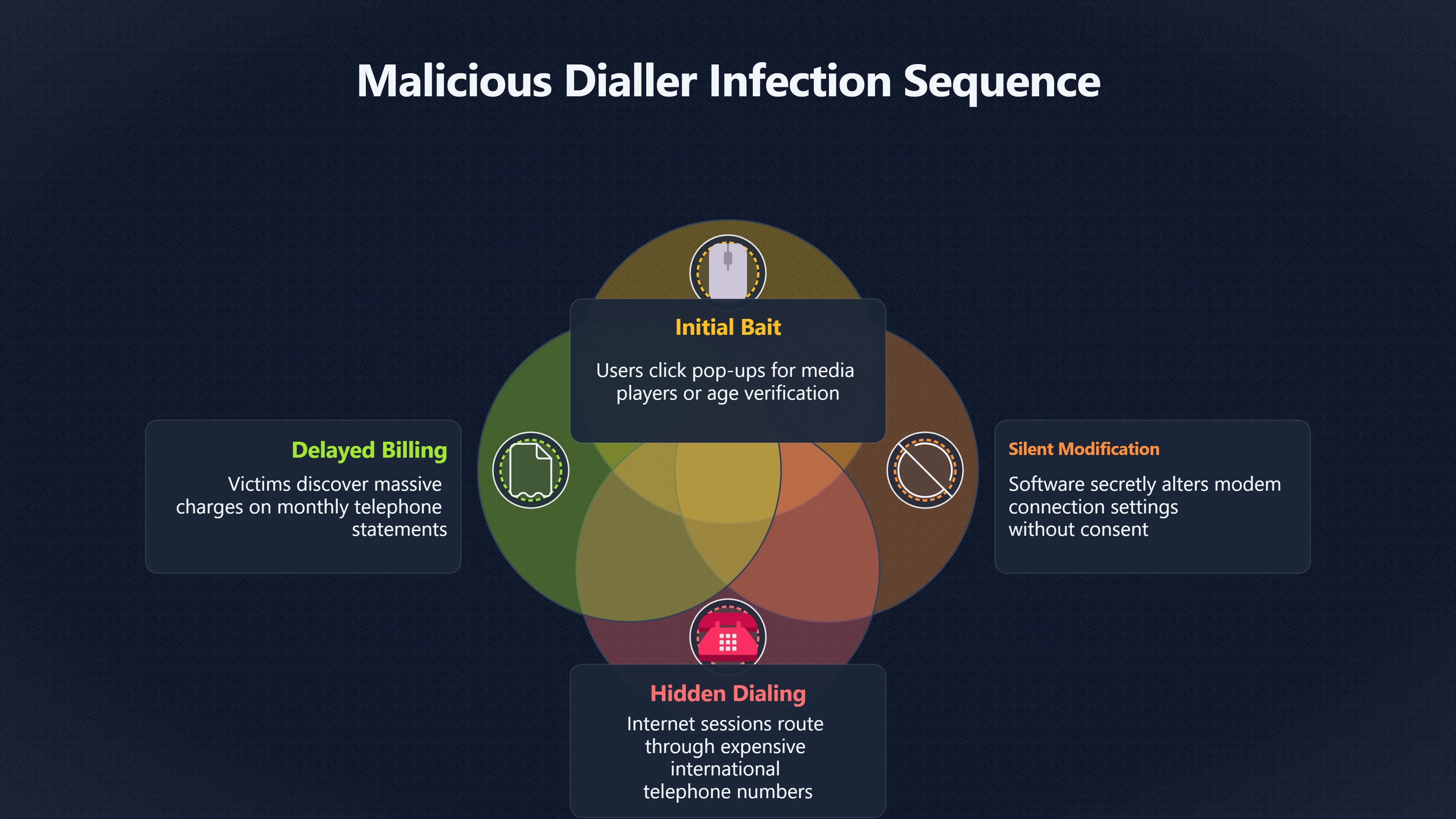
The fraud relied on a weakness of dial-up internet access. Before broadband became widespread, many users connected to the internet by instructing their computer modem to call a telephone number provided by their internet service provider. A dialler program could alter that number without the user’s informed consent.
In many cases the software arrived through pop-up advertisements, file-sharing websites, or pages offering adult content. Users were encouraged to click a button labelled as an age verification, media player installation, or routine software download. Behind the scenes, the program changed the modem settings and inserted a new international access number. Once installed, every internet session generated a long-distance call rather than a local one.[Hansard]hansard.parliament.ukHansard Premium Telephone NumbersPremium Telephone Numbers - Hansard - UK Parliament29 Jun 2004 — Not all those scams involve premium rate numbers, as some operate…
The deception was effective because nothing appeared obviously wrong. The internet connection still worked. Websites loaded normally. Email could still be sent and received. The only visible difference might have been a briefly displayed connection number that most users never examined. The real evidence arrived weeks later in the form of a telephone bill. As members of the UK Parliament noted when discussing premium-rate telephone frauds in 2004, victims often did not realise they had been charged until the next billing cycle, by which point substantial sums had already accumulated.[Hansard]hansard.parliament.ukHansard Premium Telephone NumbersPremium Telephone Numbers - Hansard - UK Parliament29 Jun 2004 — Not all those scams involve premium rate numbers, as some operate…
Consumer reports from the period show how bewildering the bills could be. One UK complainant described discovering that internet sessions had apparently been redirected to a Tuvalu number over several months, resulting in unexpectedly large charges and warnings of even higher future bills.[MoneySavingExpert Forum]forums.moneysavingexpert.combeware tuvalu internet scamMoneySavingExpert ForumBeware: Tuvalu internet scam2 Jan 2005 — Can anyone help? My sister has fallen victim to an internet scam. Appare…
Why Expensive Tuvalu Numbers Were Useful
The key to the scam was not Tuvalu’s geography but its telecommunications economics.[forums.moneysavingexpert.com]forums.moneysavingexpert.combeware tuvalu internet scamMoneySavingExpert ForumBeware: Tuvalu internet scam2 Jan 2005 — Can anyone help? My sister has fallen victim to an internet scam. Appare…
Tuvalu is a small Pacific nation with a tiny population and a limited telecommunications network. International calls to such destinations were often expensive because carriers had to route traffic through specialised international agreements. Fraudsters realised that remote destinations could be used in a way similar to premium-rate services: the owner of the receiving number could receive a share of the revenue generated by incoming calls.[Hansard]hansard.parliament.ukHansard Premium Telephone NumbersPremium Telephone Numbers - Hansard - UK Parliament29 Jun 2004 — Not all those scams involve premium rate numbers, as some operate…
For a criminal operation, this created several advantages:
- High charges accumulated quickly. International call rates to remote destinations could be far higher than ordinary local internet access charges.
- Victims rarely recognised the destination. Most users had never heard of Tuvalu or knew little about its telecommunications system.
- The billing trail was confusing. Consumers saw charges associated with a distant country rather than with the software distributor that had installed the dialler.
- Jurisdictional complexity slowed investigations. The call originated in one country, passed through international carriers, and terminated in another, making responsibility difficult to trace.[The Guardian]theguardian.comIt appears the scam is "migrating" to other countries such as Austria.Read moreThe GuardianBeware desert island risks | MoneyFebruary 19, 2005 — 18 Feb 2005 — BT is now seeing a decline in the numbers of calls to pla…
Importantly, the existence of Tuvalu numbers on a bill did not mean the fraud originated in Tuvalu. The country functioned as a profitable destination within an international revenue-sharing arrangement rather than as the proven source of the criminal activity. This distinction was often lost in media coverage and consumer discussions.

The Hidden Charges That Shocked Consumers
The financial harm came from the difference between what users thought they were paying and what they were actually paying.
A normal dial-up internet session might involve a local call charged at standard telephone rates or covered by an internet package. A dialler-infected connection, however, could generate premium international charges for every minute spent online. A user who remained connected for hours each evening could unknowingly rack up extraordinary costs.[Hansard]hansard.parliament.ukHansard Premium Telephone NumbersPremium Telephone Numbers - Hansard - UK Parliament29 Jun 2004 — Not all those scams involve premium rate numbers, as some operate…
The charges were especially difficult to detect because:
- Bills often arrived monthly or quarterly.
- The connection itself remained functional.
- Many users did not routinely inspect modem settings.
- Telephone providers initially treated the calls as genuine completed connections.
Reports from Ireland and the United Kingdom described businesses and households receiving unexpectedly huge invoices. Irish authorities reported complaints involving very large bills, with some business accounts allegedly reaching tens of thousands of dollars before the pattern was identified.[The Guardian]theguardian.comIt appears the scam is "migrating" to other countries such as Austria.Read moreThe GuardianBeware desert island risks | MoneyFebruary 19, 2005 — 18 Feb 2005 — BT is now seeing a decline in the numbers of calls to pla…
For victims, the scam created a frustrating problem. The calls had technically been made from their telephone line, yet they had not knowingly authorised them. Determining liability became a contentious issue between consumers, telecommunications companies and regulators.
How Regulators and Consumers Uncovered the Fraud
The scam became visible only after complaints began to cluster around unusual international destinations.
Telecommunications companies noticed repeated patterns of long-duration calls to a small group of countries associated with dialler abuse. Consumer organisations and technology publications started warning internet users about rogue diallers, while regulators examined whether existing premium-rate rules were adequate for international destinations that sat outside traditional premium-rate number ranges.[theregister]theregister.comOfcom to crack down on premium rate scamstersOfcom to crack down on premium rate scamstersAugust 3, 2004 — 3 Aug 2004 — BT cuts off dialler scammers · MPs slam premium-rat…
A significant response came in Ireland in 2004, when telecommunications authorities moved to restrict direct-dial access to several countries that had become associated with dialler fraud. Tuvalu was among the destinations affected. The restrictions did not prevent legitimate communication entirely, but they made automatic modem connections far more difficult, reducing the usefulness of those routes for scammers.[The Guardian]theguardian.comIt appears the scam is "migrating" to other countries such as Austria.Read moreThe GuardianBeware desert island risks | MoneyFebruary 19, 2005 — 18 Feb 2005 — BT is now seeing a decline in the numbers of calls to pla…
In Britain, consumer advisers highlighted a loophole that many people had not considered: blocking domestic premium-rate services did not necessarily stop a computer from dialling a costly international number. As awareness increased, users were encouraged to inspect modem settings, install security software and challenge suspicious charges.[The Guardian]theguardian.comIt appears the scam is "migrating" to other countries such as Austria.Read moreThe GuardianBeware desert island risks | MoneyFebruary 19, 2005 — 18 Feb 2005 — BT is now seeing a decline in the numbers of calls to pla…
The combination of regulatory intervention, growing public awareness and the rapid spread of broadband internet eventually undermined the business model. Broadband connections did not rely on repeatedly dialling telephone numbers, eliminating the technical mechanism on which the scam depended.
How Dialler Scam entered public memory
The Tuvalu dialler scam belongs to a transitional moment in internet history, but its underlying logic survives.
Modern frauds rarely hijack dial-up modems, yet many still depend on concealing expensive telecommunications charges behind apparently ordinary interactions. Later schemes such as international callback frauds and “Wangiri” missed-call scams use a similar principle: trick the victim into creating a connection that generates revenue for the scammer while disguising the true cost until after the event.[ofcom.org.uk]ofcom.org.ukwww.ofcom.org.uk'Wangiri' missed call scamsSeptember 5, 2019 — 5 Sept 2019 — We have received reports of a rise in a type of scam known as 'Wangiri' phone calls. Here's what you sh…
The Tuvalu episode also illustrates a broader lesson about fraud and reputation. A remote country became publicly associated with a scam largely because its telephone numbers appeared on victims’ bills. The mechanism of the fraud depended on international telecommunications arrangements, but the presence of Tuvalu in the billing records sometimes obscured the fact that the organisers, software distributors and beneficiaries could be located elsewhere entirely.
As a case study in hidden charges, misdirection and the exploitation of unfamiliar infrastructure, the dialler scam remains one of the most distinctive deception stories connected to Tuvalu’s place in the global communications network.
Amazon book picks
Further Reading
Books and field guides related to How a Tuvalu Phone Number Hid an Internet Scam. Use these as the next step if you want deeper reading beyond the article.
This Is How They Tell Me the World Ends
Shows how digital vulnerabilities become profitable criminal enterprises.
Ghost in the Wires
Illustrates social engineering and exploitation of communications systems.
eBay marketplace picks
Marketplace Samples
Live-tested eBay searches with available results related to this page.

Endnotes
1.
Source: hansard.parliament.uk
Title: Hansard Premium Telephone Numbers
Link:https://hansard.parliament.uk/commons/2004-06-29/debates/5d21b1da-c8e0-466d-a7e0-3fd399201eec/PremiumTelephoneNumbers
Source snippet
Premium Telephone Numbers - Hansard - UK Parliament29 Jun 2004 — Not all those scams involve premium rate numbers, as some operate...
2.
Source: forums.moneysavingexpert.com
Title: beware tuvalu internet scam
Link:https://forums.moneysavingexpert.com/discussion/19570/beware-tuvalu-internet-scam
Source snippet
MoneySavingExpert ForumBeware: Tuvalu internet scam2 Jan 2005 — Can anyone help? My sister has fallen victim to an internet scam. Appare...
3.
Source: theregister.com
Title: Ofcom to crack down on premium rate scamsters
Link:https://www.theregister.com/a/1049890
Source snippet
Ofcom to crack down on premium rate scamstersAugust 3, 2004 — 3 Aug 2004 — BT cuts off dialler scammers · MPs slam premium-rat...
Published: August 3, 2004
4.
Source: theregister.com
Title: ofcom accused of helping premium rate scammers
Link:https://www.theregister.com/on-prem/2004/10/25/ofcom-accused-of-helping-premium-rate-scammers/585012
Source snippet
numbers to rogue operators that rip off punters with premium-rate phone scams.... ICSTIS on cracking down on scammers. The bureaucratic...
5.
Source: ofcom.org.uk
Title: www.ofcom.org.uk’Wangiri’ missed call scams
Link:https://www.ofcom.org.uk/phones-and-broadband/scam-calls-and-messages/advice-wangiri-missed-call-scams
Source snippet
September 5, 2019 — 5 Sept 2019 — We have received reports of a rise in a type of scam known as 'Wangiri' phone calls. Here's what you sh...
Published: September 5, 2019
6.
Source: ofcom.org.uk
Title: cracking down on scam calls from abroad
Link:https://www.ofcom.org.uk/phones-and-broadband/scam-calls-and-messages/cracking-down-on-scam-calls-from-abroad
7.
Source: ofcom.org.uk
Link:https://www.ofcom.org.uk/siteassets/resources/documents/consultations/uncategorised/8379-prs_scope/statement/summary/annex7.pdf?v=331846
8.
Source: ofcom.org.uk
Title: ofcom launches investigation into telecoms company primo dialler
Link:https://www.ofcom.org.uk/phones-and-broadband/telecoms-infrastructure/ofcom-propels-full-fibre-rollout-revolution-into-final-phase/ofcom-launches-investigation-into-telecoms-company-primo-dialler
9.
Source: theguardian.com
Title: It appears the scam is “migrating” to other countries such as Austria.Read more
Link:https://www.theguardian.com/money/2005/feb/19/scamsandfraud.jobsandmoney
Source snippet
The GuardianBeware desert island risks | MoneyFebruary 19, 2005 — 18 Feb 2005 — BT is now seeing a decline in the numbers of calls to pla...
Published: February 19, 2005
10.
Source: pickr.com.au
Title: why you shouldnt return random international phone calls
Link:https://www.pickr.com.au/qa/2019/why-you-shouldnt-return-random-international-phone-calls/
Source snippet
Why you shouldn't return random international phone calls13 Feb 2019 — It's likely to be a scam. Anyone who calls back will be sent...
Additional References
11.
Source: datcp.wi.gov
Link:https://datcp.wi.gov/Pages/Publications/IntlPhoneNumberScam201.aspx
Source snippet
DATCP Home International Phone Number ScamsConsumers are lured into calling international telephone numbers through missed calls, ad...
12.
Source: youtube.com
Title: The Computer Bug That Almost Ended The World | The Y2k Debacle
Link:https://www.youtube.com/watch?v=kyZDa09U7gc
Source snippet
History of Internet Fraud and Cybersecurity Threats...
13.
Source: yollacalls.com
Link:https://yollacalls.com/en-ie/rates/calls-to-tuvalu/
14.
Source: facebook.com
Link:https://www.facebook.com/SlidellPD/posts/getting-calls-from-tonga-or-russia-dont-answer-or-call-back-its-a-scam-and-you-c/2283214421724706/
15.
Source: comreg.ie
Link:https://www.comreg.ie/advice-information/scam-calls/
16.
Source: reddit.com
Link:https://www.reddit.com/r/Scams/comments/uiowby/just_got_this_unsolicited_package_from_funafuti/
17.
Source: youtube.com
Title: Why dial up sounds like that
Link:https://www.youtube.com/watch?v=dEXAgLjbcMw
Source snippet
How to protect yourself from internet dialer scams (archive/educational)...
18.
Source: youtube.com
Link:https://www.youtube.com/shorts/C2EqK4TLtUY
19.
Source: uk.finance.yahoo.com
Title: scam click to dial premium calls which google advice 122724989
Link:https://uk.finance.yahoo.com/news/scam-click-to-dial-premium-calls-which-google-advice-122724989.html
20.
Source: youtube.com
Title: What Were The Security Risks Of 90s Dial-up Internet?
Link:https://www.youtube.com/watch?v=R8doEMqG_1E
Source snippet
Why dial up sounds like that...
Topic Tree