Within South Sudan
The Real Photographs That Told False Stories
Authentic photographs from other countries were repeatedly relabelled as South Sudanese scenes, giving false claims emotional force.
On this page
- Images borrowed from hospitals, monuments and street scenes
- Why plausible captions defeated visual scepticism
- How fact checkers traced photographs to their origins
Page outline Jump by section
Introduction
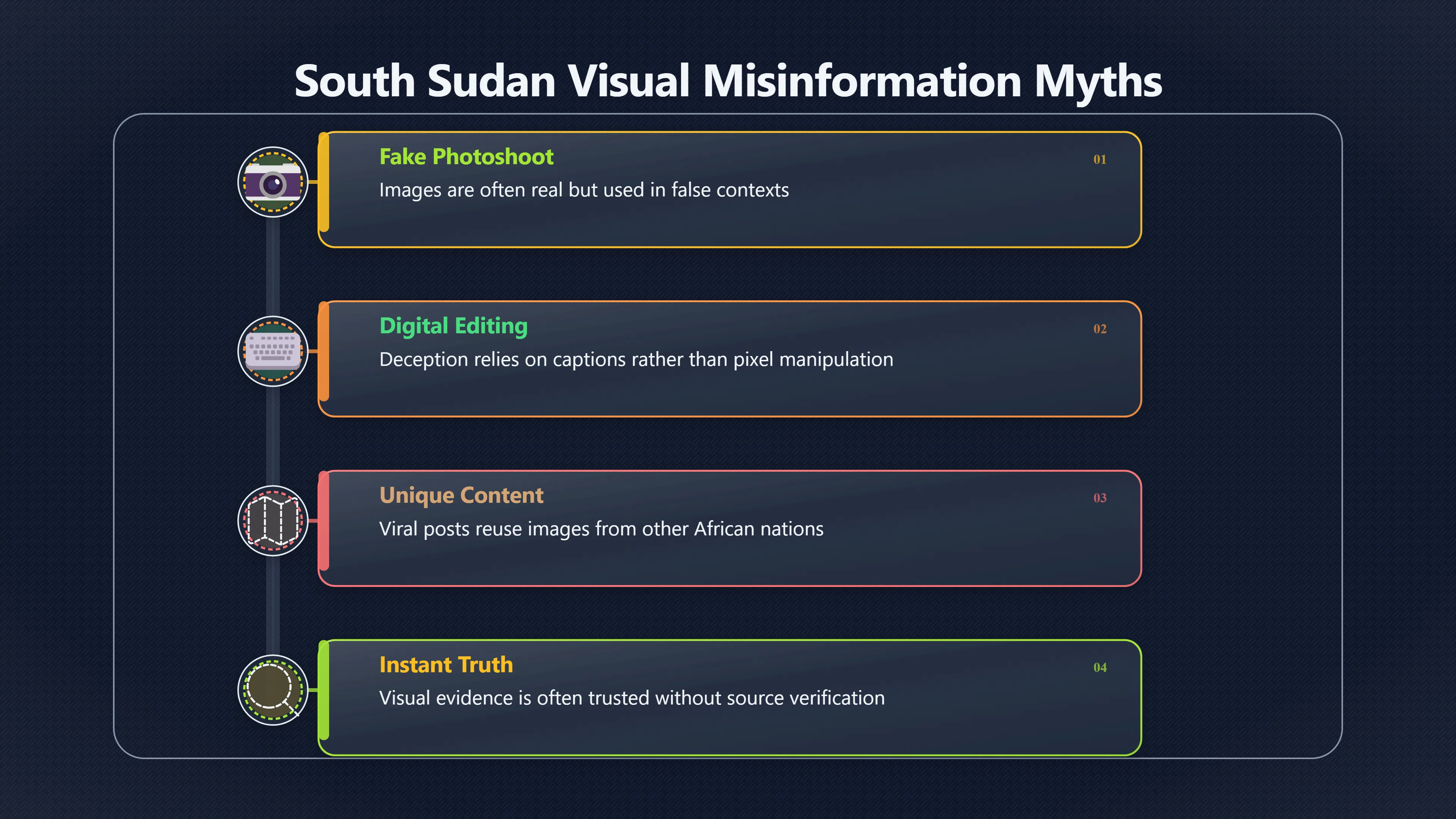
One of the most persistent forms of misinformation linked to South Sudan was not the creation of fake photographs but the reuse of real ones. During periods of civil war, political tension and humanitarian crisis, authentic images from other countries were repeatedly presented as scenes from South Sudan. The photographs themselves were genuine. The captions were not.

This distinction mattered. A convincing image of injured children, overcrowded hospital wards or alleged atrocities could spread far more quickly than a written rumour. Because the photograph was real, viewers often assumed the accompanying claim was real as well. Fact-checkers working on South Sudan-related misinformation found that many viral posts relied on images borrowed from elsewhere in Africa, from older conflicts, or from unrelated humanitarian emergencies, then relabelled to fit a current political narrative.[UNDP]undp.orgtackling misinformation hatefreesouthsudan during covid 19Tackling Misinformation for a #HateFreeSouthSudan…24 Feb 2021 — A growing network digitally savvy South Sudanese journalists, cont…
The result was a recurring pattern: true photographs telling false stories.
Images Borrowed from Hospitals, Monuments and Street Scenes
Many misleading South Sudan posts followed the same formula. A dramatic photograph was detached from its original context and attached to a new claim about violence, neglect or political wrongdoing.
One widely circulated example involved photographs of newborn babies reportedly left in desperate conditions in a South Sudanese public hospital. Fact-checkers traced the image back to Uganda’s Kawempe National Referral Hospital rather than South Sudan. The picture was genuine, but the location attached to it was false.[Facebook]facebook.comHOSSLatest: The images of the underground tunnels going…A photo of newborn babies laid on plastic chairs allegedly in a public…
Other viral claims used images of injured children, crowded medical facilities or distressed civilians from entirely different countries. During periods of heightened tension, such photographs were often shared with captions claiming they showed the latest atrocities, government failures or humanitarian disasters inside South Sudan. Similar patterns have been documented across neighbouring conflicts, where old images or photographs from different regions were repeatedly recycled and assigned new political meanings.[afp.com]factcheck.afp.comAFP Fact CheckOld pictures of suffering children falsely linked to Sudanese…18 Nov 2025 — After Sudan's paramilitary Rapid Support For…
Street scenes, public buildings and infrastructure photographs were also vulnerable to relabelling. An image of a location unfamiliar to most viewers could easily be presented as evidence of events in Juba, Malakal, Bentiu or another South Sudanese town. Once detached from its original source, the image acquired a new identity based entirely on the accompanying text.
The deception often required very little technical manipulation. No digital editing was necessary. Simply changing the caption transformed the meaning of the photograph.
Why Plausible Captions Defeated Visual Scepticism
Recycled photographs succeeded because they matched what many people already feared or expected to be true.
During civil conflict, reports of displacement, attacks, shortages and humanitarian suffering were unfortunately common. A photograph showing wounded civilians or overcrowded medical facilities therefore appeared plausible. Viewers often evaluated the image through the lens of existing events rather than asking where and when it had originally been taken.
The emotional force of visual evidence amplified the problem. Research on misinformation repeatedly shows that images are remembered more readily than text, especially when they provoke shock, anger or sympathy. In South Sudan’s information environment, where social media posts frequently moved through Facebook groups, WhatsApp messages and diaspora networks, a striking photograph could spread rapidly without any accompanying verification.[undp.org]undp.orgtackling misinformation hatefreesouthsudan during covid 19Tackling Misinformation for a #HateFreeSouthSudan…24 Feb 2021 — A growing network digitally savvy South Sudanese journalists, cont…
The structure of private messaging also helped these claims survive. Messages forwarded by relatives, friends or trusted community members often carried more credibility than anonymous public posts. By the time a photograph reached a wider audience, its original source had usually disappeared from view.
Another reason recycled images proved persuasive was that they exploited a genuine humanitarian backdrop. South Sudan has experienced real displacement crises, food insecurity and armed conflict. False captions therefore did not need to invent an entirely fictional world; they only needed to redirect an authentic image toward a different event, location or political argument.[UNHCR Operational Data Portal]data.unhcr.orgOperational Data Portal Situation Sudan situationOperational Data Portal Situation Sudan situation

How Fact-Checkers Traced Photographs to Their Origins
The exposure of these claims rarely depended on eyewitness testimony alone. Instead, investigators increasingly relied on digital verification techniques.
A common first step was reverse-image searching. Fact-checkers uploaded the disputed photograph into search tools designed to locate earlier appearances of the same image online. When the photograph appeared in news reports or social media posts years before the alleged South Sudan event, the new claim immediately became suspect.[UNDP]undp.orgtackling misinformation hatefreesouthsudan during covid 19Tackling Misinformation for a #HateFreeSouthSudan…24 Feb 2021 — A growing network digitally savvy South Sudanese journalists, cont…
Investigators also compared visual details within the image itself:
- Hospital signs and uniforms.
- Vehicle registration plates.
- Distinctive buildings or monuments.
- Language visible on walls, posters or advertisements.
- Weather conditions and landscape features.
These clues often revealed that a supposedly South Sudanese image had actually been taken elsewhere.
South Sudan’s growing fact-checking community adopted many of these methods through initiatives such as #211CHECK and related anti-misinformation projects. Participants used reverse-image searches, source verification and digital forensic techniques to challenge viral claims before they became accepted as fact.[UNDP]undp.orgtackling misinformation hatefreesouthsudan during covid 19Tackling Misinformation for a #HateFreeSouthSudan…24 Feb 2021 — A growing network digitally savvy South Sudanese journalists, cont…
The process demonstrated an important lesson: photographs are evidence, but they are not self-explanatory. Without accurate context, even a completely authentic image can become a vehicle for misinformation.
What These Cases Reveal About Conflict-Era Information
The most revealing feature of recycled-photograph misinformation is that it blurs the boundary between truth and falsehood. Unlike fabricated images, the visual content is often real. The deception lies in the story attached to it.
For audiences, this can be harder to detect than obvious digital manipulation. People are naturally inclined to trust their eyes. A photograph appears to provide direct proof, even when the accompanying caption has quietly changed the photograph’s meaning.
In South Sudan, where political loyalties, ethnic tensions and humanitarian concerns can make information highly consequential, miscaptioned photographs became a particularly effective form of conflict misinformation. They required little technical skill, travelled easily across social networks and often survived because they contained a kernel of truth: the image itself was genuine.[undp.org]undp.orgtackling misinformation hatefreesouthsudan during covid 19Tackling Misinformation for a #HateFreeSouthSudan…24 Feb 2021 — A growing network digitally savvy South Sudanese journalists, cont…
These episodes remain a useful reminder that visual evidence must be examined in full context. The central question is not only whether a photograph is real, but whether the story attached to it is. In many South Sudan misinformation cases, the photograph passed that first test while failing the second.

eBay marketplace picks
Marketplace Samples
Live-tested eBay searches with available results related to this page.
Endnotes
1.
Source: undp.org
Title: tackling misinformation hatefreesouthsudan during covid 19
Link:https://www.undp.org/south-sudan/stories/tackling-misinformation-hatefreesouthsudan-during-covid-19
Source snippet
Tackling Misinformation for a #HateFreeSouthSudan...24 Feb 2021 — A growing network digitally savvy South Sudanese journalists, cont...
2.
Source: facebook.com
Title: Misinformation spreads quickly like wildfire
Link:https://www.facebook.com/hotinjuba/posts/misinformation-spreads-quickly-like-wildfire-dont-just-believe-what-you-see-or-h/1256413363196873/
Source snippet
Don't just...Some people might use graphic videos or images of past incidents from different locations and caption them to make it look...
3.
Source: facebook.com
Link:https://www.facebook.com/hossheartofsouthsudan/posts/hosslatest-the-images-of-the-underground-tunnels-going-around-on-social-media-ar/942630794797440/
Source snippet
HOSSLatest: The images of the underground tunnels going...A photo of newborn babies laid on plastic chairs allegedly in a public...
4.
Source: factcheck.afp.com
Link:https://factcheck.afp.com/doc.afp.com.83RU2CQ
Source snippet
AFP Fact CheckOld pictures of suffering children falsely linked to Sudanese...18 Nov 2025 — After Sudan's paramilitary Rapid Support For...
5.
Source: arxiv.org
Link:https://arxiv.org/abs/2308.14782
6.
Source: arxiv.org
Link:https://arxiv.org/abs/2005.02443
7.
Source: data.unhcr.org
Title: Operational Data Portal Situation Sudan situation
Link:https://data.unhcr.org/en/situations/sudansituation
8.
Source: facebook.com
Link:https://www.facebook.com/EastleighVoiceKe/posts/fact-check-how-fake-content-about-the-sudan-war-spreads/1352907856527765/
9.
Source: facebook.com
Link:https://www.facebook.com/AFPFactCheck/posts/pictures-of-suffering-children-have-circulated-in-social-media-posts-falsely-cla/1441322484663297/
10.
Source: facebook.com
Link:https://www.facebook.com/MSFSouthSudan/videos/a-lot-of-people-were-killed-not-just-men-everyone-children-women-elderly-people-/26992601080403499/
11.
Source: factcheck.afp.com
Link:https://factcheck.afp.com/doc.afp.com.867T8CV
12.
Source: swp-berlin.org
Link:https://www.swp-berlin.org/en/publication/mta-spotlight-70-the-weaponization-of-social-media-in-sudans-war
13.
Source: toolbox.google.com
Link:https://toolbox.google.com/factcheck
Additional References
14.
Source: ifri.org
Title: sudan wartime online propaganda
Link:https://www.ifri.org/en/studies/sudan-wartime-online-propaganda
Source snippet
Sudan Wartime Online Propaganda15 Apr 2026 — This paper explores the online propaganda battlefield in Sudan, where disinformation war...
15.
Source: youtube.com
Title: Al-Shabaab exploits Kenya’s divisions to wage war
Link:https://www.youtube.com/watch?v=j13wvZND5zk
Source snippet
Election info changes quickly. Verify responses with official sources...
16.
Source: youtube.com
Title: Inside Al Shabaab: The extremist group trying to seize Somalia
Link:https://www.youtube.com/watch?v=KVSw0E9Y1RI
Source snippet
How Al-Shabab is recruiting young men from Kenya...
17.
Source: youtube.com
Title: Somalia: Govt bans Al Shabaab ‘propaganda’ contents
Link:https://www.youtube.com/watch?v=Vean7jaorHc
Source snippet
Inside Al Shabaab: The extremist group trying to seize Somalia...
18.
Source: youtube.com
Link:https://www.youtube.com/watch?v=5hKAyQIc5rk
Source snippet
Al-Shabaab exploits Kenya's divisions to wage war...
19.
Source: youtube.com
Title: How Al-Shabab is recruiting young men from Kenya
Link:https://www.youtube.com/watch?v=xc6wfF9sV90
Source snippet
Inside Al Shabaab (2017): Terror group tackles drought...
20.
Source: reddit.com
Link:https://www.reddit.com/r/GoogleEarthFinds/comments/1onrd5b/psa_be_skeptical_of_images_that_claim_to_show/
21.
Source: abcnews.com
Link:https://abcnews.com/International/blood-visible-space-sudan-shows-evidence-darfur-genocide/story?id=126985544
22.
Source: doctorswithoutborders.org
Link:https://www.doctorswithoutborders.org/latest/photos-worlds-largest-displacement-crisis
23.
Source: instagram.com
Link:https://www.instagram.com/reel/DZnLn51ImEo/
Topic Tree