Within Argentina Hoaxes
Why Did Argentina Believe It Had Solved Fusion?
The Huemul affair reveals how secrecy, political backing and extraordinary claims combined in a failed fusion breakthrough.
On this page
- Ronald Richter and Peron's support
- The fusion announcement and reactions
- Inspection, collapse and lasting legacy
Page outline Jump by section
Introduction
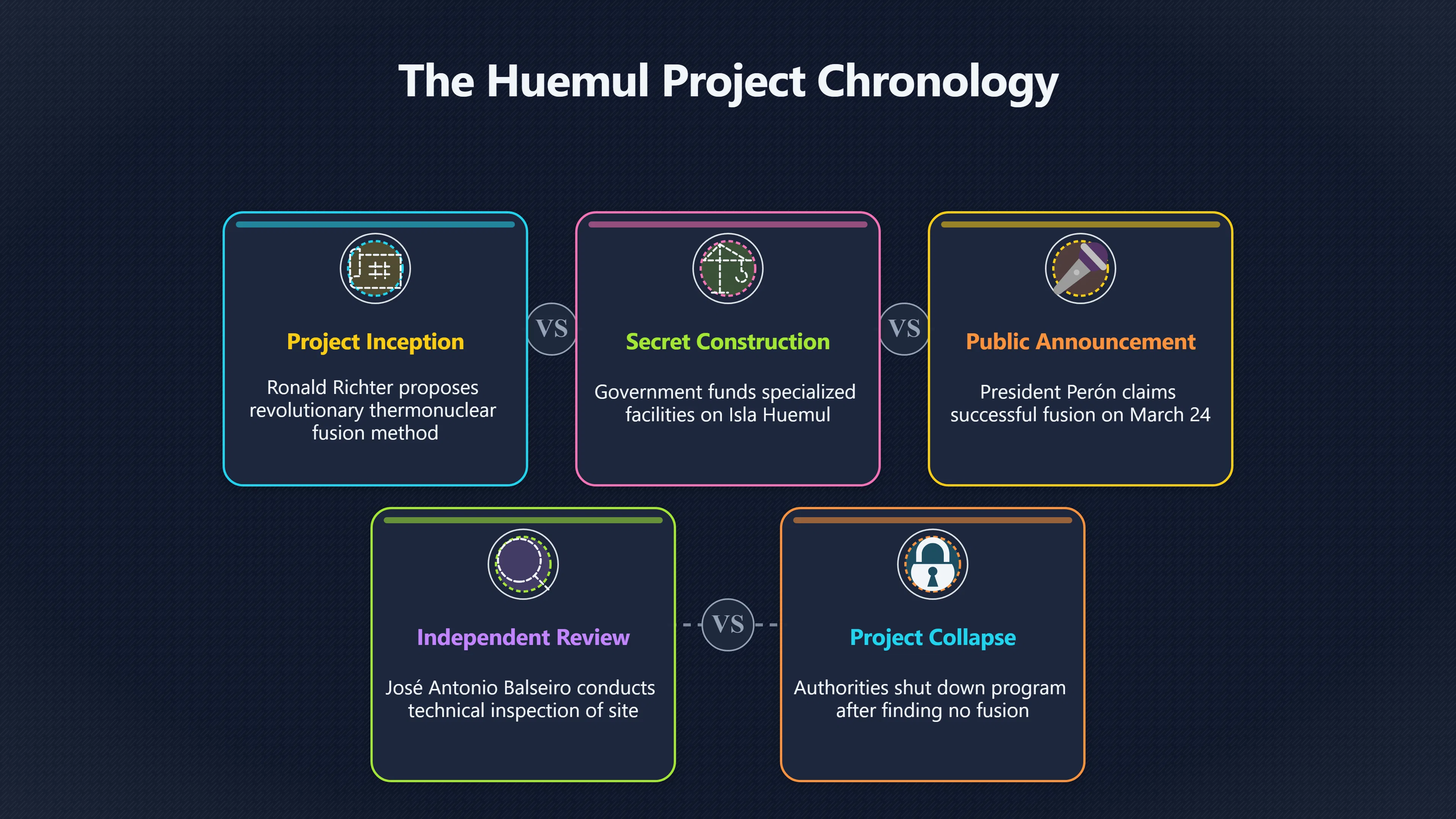
In March 1951, Argentina briefly appeared to have achieved one of the greatest scientific breakthroughs in history: controlled nuclear fusion. President Juan Perón announced that a secret project on Huemul Island in Patagonia had succeeded in reproducing the process that powers the Sun, promising a future of almost limitless energy. Around the world, newspapers reported the claim, while scientists reacted with a mixture of curiosity and disbelief. Within little more than a year, the project collapsed under investigation. No controlled fusion had occurred, and the episode became one of the most famous examples of how political ambition, secrecy and scientific prestige can combine to create a powerful but unsupported promise.[wikipedia.org]WikipediaHuemul ProjectHuemul Project
The Huemul affair is important not because it was a simple fraud in the ordinary sense, but because it occupied a grey area between scientific error, self-deception and political wishful thinking. It reveals how governments can become invested in extraordinary technological claims before adequate evidence exists, and how difficult it can be to challenge those claims once national prestige is attached to them.
Why Perón Backed Ronald Richter
The central figure in the story was Ronald Richter, an Austrian-born physicist and engineer who arrived in Argentina after the Second World War. Richter convinced Perón that he possessed a revolutionary method for achieving controlled thermonuclear fusion. At the time, fusion was widely regarded as the ultimate energy source, but no country had come close to mastering it.[Wikipedia]WikipediaHuemul ProjectHuemul Project
Perón’s support for Richter reflected more than scientific curiosity. His government wanted Argentina to be seen as a technologically advanced nation capable of competing with the world’s great powers. Post-war Argentina invested heavily in ambitious industrial and scientific projects, and fusion offered the possibility of a dramatic leap forward. Richter’s proposal fit perfectly with the image of a modernising “New Argentina” that could achieve what the United States and Soviet Union had not yet accomplished.[Wikipedia]WikipediaRonald RichterRonald Richter
The project was established on Isla Huemul, near Bariloche in Patagonia. Large sums of public money were committed to specialised laboratories and experimental facilities. Crucially, the work was conducted under extreme secrecy. Many established Argentine physicists were excluded from meaningful oversight, partly because Perón had strained relations with sections of the academic community. The combination of political sponsorship and limited scrutiny created conditions in which extraordinary claims could flourish without normal scientific checks.[wired.com]wired.comNuclear island: The secret post-WWII mega lab investigatedFebruary 14, 2011 — 14 Feb 2011 — Both Perón and Richter were keen that th…
The Announcement That Captivated the World
On 24 March 1951, Perón announced that experiments conducted on 16 February had successfully achieved controlled thermonuclear reactions. The claim was astonishing. If true, Argentina had solved a problem that leading scientists in the world’s most powerful countries were still struggling to understand.[wikipedia.org]WikipediaHuemul ProjectHuemul Project
Perón’s public statements were highly ambitious. Reports associated with the announcement suggested that fusion energy might one day be packaged and distributed in remarkably compact forms. The message was not merely scientific; it was political and symbolic. Argentina was being presented as a nation that had leapt ahead of the established powers through ingenuity and determination.[Wikipedia]WikipediaHuemul ProjectHuemul Project
Many ordinary observers found the story believable because fusion research was genuinely cutting-edge and largely inaccessible to the public. Few people possessed the expertise needed to judge Richter’s claims independently. The project’s secrecy added an aura of importance rather than suspicion. To supporters, the lack of detailed evidence appeared consistent with a major national achievement rather than a warning sign.[WIRED]wired.comNuclear island: The secret post-WWII mega lab investigatedFebruary 14, 2011 — 14 Feb 2011 — Both Perón and Richter were keen that th…
Internationally, however, scientists quickly became sceptical. Richter published little verifiable information, and outside experts could not inspect the facilities or reproduce the results. In science, extraordinary claims generally require transparent evidence. Huemul offered the claim but not the proof.[wikipedia.org]WikipediaHuemul ProjectHuemul Project
Why Scientists Doubted the Fusion Claim
The core scientific problem was that Richter’s reported observations did not demonstrate nuclear fusion. Fusion requires extraordinarily high temperatures and carefully controlled conditions. Critics argued that the equipment described by Richter was incapable of reaching the necessary regime.[Wikipedia]WikipediaHuemul ProjectHuemul Project
Warning signs emerged even inside the project. Technicians questioned whether some of the measurements interpreted as evidence of fusion were actually artefacts produced by faulty instrumentation. According to later accounts, concerns were raised that experimental readings could be explained by errors in the measuring apparatus rather than by nuclear reactions. Richter resisted calls for straightforward verification and instead moved towards redesigning equipment and facilities.[Wikipedia]WikipediaHuemul ProjectHuemul Project
This pattern is common in episodes of scientific overclaim. Instead of producing independent confirmation, setbacks generate new explanations, revised apparatus and promises that success lies just beyond the next modification. The claim becomes increasingly difficult to test because it continually shifts into the future.
The Investigation That Brought Huemul Down
By 1952, doubts had become impossible to ignore. Perón authorised an investigation into Richter’s work. Significantly, one of the key figures brought in was the young physicist José Antonio Balseiro, who had been studying abroad and possessed the technical expertise needed to assess the claims independently.[Wikipedia]WikipediaHuemul ProjectHuemul Project
The inspection team examined the facilities and analysed Richter’s evidence. Balseiro concluded that the experiments could not have produced the temperatures required for fusion and that the reported measurements did not demonstrate nuclear reactions. The investigators also found serious discrepancies between the claimed results and the actual operation of the equipment.[Wikipedia]WikipediaHuemul ProjectHuemul Project
A second review supported the same conclusion. The project had failed to provide convincing scientific evidence for controlled fusion. When authorities took control of the site, they reportedly discovered that some instruments were not even functioning in the way implied by Richter’s presentations. The government shut the programme down later in 1952.[Wikipedia]WikipediaHuemul ProjectHuemul Project
The collapse was embarrassing for Perón’s administration. A breakthrough that had been announced to the world as a historic triumph had not survived independent examination.
Was It a Hoax, a Fraud or a Sincere Mistake?
The Huemul Project occupies an unusual place in the history of deception because historians and commentators do not always describe it in exactly the same way.
Some accounts portray Richter as a fraud who knowingly misrepresented his results in order to obtain funding, prestige and influence. Later investigations and legal scrutiny reinforced this interpretation for many observers.[Wikipedia]WikipediaRonald RichterRonald Richter
Others argue that the affair involved a mixture of genuine belief and scientific incompetence rather than a straightforward con. Richter may have convinced himself that ambiguous measurements indicated fusion. In this interpretation, the project became dangerous because political leaders accepted claims that had not undergone rigorous scientific testing.[researchgate.net]researchgate.netResearch Gate(PDF) Argentina Atomic Power. 70 years after the mostResearch Gate(PDF) Argentina Atomic Power. 70 years after the most
What is less disputed is that the public announcement dramatically outran the available evidence. Whether Richter was deliberately deceptive, sincerely mistaken or some combination of both, the result was the same: an unsupported claim acquired official authority and national prestige before it had earned scientific credibility.

The Lasting Legacy of Huemul
Paradoxically, one of Argentina’s most famous scientific failures helped shape its later scientific success. The investigations that exposed Huemul strengthened the argument for professional peer review, institutional oversight and a more rigorous research culture. Facilities associated with the project were eventually repurposed, and the scientific infrastructure that emerged afterwards contributed to the development of Argentina’s nuclear programme. Balseiro himself became a central figure in that transformation, and the prestigious Instituto Balseiro later carried his name.[Wikipedia]WikipediaJosé Antonio BalseiroJosé Antonio Balseiro
The affair also had an international impact. Although scientists rejected Richter’s claims, the publicity surrounding Huemul drew attention to the possibility of controlled fusion and coincided with the early expansion of serious fusion research programmes elsewhere. In an ironic twist, a failed breakthrough helped encourage genuine research into the same goal.[Wikipedia]WikipediaHistory of nuclear fusionHistory of nuclear fusion
Today, the Huemul Project remains a revealing episode in Argentina’s history of contested truth. Unlike a forged artefact or a fabricated monster story, it emerged from the prestige of modern science itself. The lesson is not that science is unreliable, but that scientific authority can be misused when secrecy, political enthusiasm and national ambition replace open scrutiny. Huemul endures as a cautionary tale about the politics of scientific promises: the greater the claimed breakthrough, the greater the need for evidence before belief.[wired.com]wired.comNuclear island: The secret post-WWII mega lab investigatedFebruary 14, 2011 — 14 Feb 2011 — Both Perón and Richter were keen that th…
Amazon book picks
Further Reading
Books and field guides related to Why Did Argentina Believe It Had Solved Fusion?. Use these as the next step if you want deeper reading beyond the article.
The Demon-Haunted World
Rating: 4.5/5 from 43 Google Books ratings
Helps explain how unsupported scientific claims can gain public acceptance.
The Making of the Atomic Bomb
Places the Huemul episode within the era's intense interest in atomic science.
Dark Sun
Explains the race toward thermonuclear technology that made fusion claims attractive.
Surely You're Joking Mr Feynman
Illustrates scientific culture and the importance of testing claims.
eBay marketplace picks
Marketplace Samples
Live-tested eBay searches with available results related to this page.




Endnotes
1.
Source: Wikipedia
Title: Huemul Project
Link:https://en.wikipedia.org/wiki/Huemul_Project
2.
Source: iter.org
Title: proyecto huemul prank started it all
Link:https://www.iter.org/node/20687/proyecto-huemul-prank-started-it-all
Source snippet
the way to new energy"Proyecto Huemul:" the prank that started it allOct 26, 2011 — Proyecto Huemul today is the 40-foot-high conc...
3.
Source: arxiv.org
Link:https://arxiv.org/abs/2103.10551
Source snippet
Argentina Atomic Power. 70 years after the most spectacular announcement: a dream, a disappointment and the origins of national nucl...
4.
Source: Wikipedia
Title: Ronald Richter
Link:https://en.wikipedia.org/wiki/Ronald_Richter
5.
Source: wired.com
Link:https://www.wired.com/story/nuclear-island/
Source snippet
Nuclear island: The secret post-WWII mega lab investigatedFebruary 14, 2011 — 14 Feb 2011 — Both Perón and Richter were keen that th...
Published: February 14, 2011
6.
Source: Wikipedia
Title: National Atomic Energy Commission
Link:https://en.wikipedia.org/wiki/National_Atomic_Energy_Commission
7.
Source: Wikipedia
Title: Juan Perón
Link:https://en.wikipedia.org/wiki/Juan_Per%C3%B3n
8.
Source: Wikipedia
Title: José Antonio Balseiro
Link:https://en.wikipedia.org/wiki/Jos%C3%A9_Antonio_Balseiro
9.
Source: researchgate.net
Title: Research Gate(PDF) Argentina Atomic Power. 70 years after the most
Link:https://www.researchgate.net/publication/350253609_Argentina_Atomic_Power_70_years_after_the_most_spectacular_announcement_a_dream_a_disappointment_and_the_origins_of_national_nuclear_development
10.
Source: Wikipedia
Title: History of nuclear fusion
Link:https://en.wikipedia.org/wiki/History_of_nuclear_fusion
11.
Source: newyorker.com
Title: a star in a bottle
Link:https://www.newyorker.com/magazine/2014/03/03/a-star-in-a-bottle
Source snippet
The New YorkerA Star in a Bottle23 Feb 2014 — In 1951, Argentina's President, Juan Perón, announced that, on the island of Huemul, his sc...
12.
Source: large.stanford.edu
Title: The Huemul Project
Link:https://large.stanford.edu/courses/2017/ph241/allman2/
Additional References
13.
Source: dispatchesviifoundation.substack.com
Link:https://dispatchesviifoundation.substack.com/p/the-political-price-of-dreams-pablo
Source snippet
Dispatches VII FoundationThe Political Price of Dreams: Pablo Cabado's "Little Suns on...Perón saw the Huemul Project as a risk worth ta...
14.
Source: fire.pppl.gov
Link:https://fire.pppl.gov/rf_shafranov.pdf
Source snippet
March 25, 1951, Argentina's President Juan Peron made an announcement that experiments by a German physicist Ronald Richter succeeded in...
Published: March 25, 1951
15.
Source: youtube.com
Title: INVESTIGATE Argentina’s ABANDONED NUCLEAR ISLAND
Link:https://www.youtube.com/watch?v=pLz-YUM4t1I
Source snippet
History of the Huemul Project (1948 - 1952), the Peronist atomic energy project...
16.
Source: linkedin.com
Link:https://www.linkedin.com/pulse/why-limiting-scale-strengthened-argentinas-nuclear-program-dorao-ltqme
17.
Source: youtube.com
Link:https://www.youtube.com/watch?v=LLg0GaPLCVo
Source snippet
Argentina's Secret Nazi Fusion Lab...
18.
Source: youtube.com
Title: The Mad Scientist Who Fooled Perón with an Impossible Nuclear Project
Link:https://www.youtube.com/watch?v=0c0Y661L2yw
Source snippet
Report: Visit to Huemul Island...
19.
Source: youtube.com
Title: Report: Visit to Huemul Island
Link:https://www.youtube.com/watch?v=0RDbIFezZ3c
Source snippet
INVESTIGATE Argentina's ABANDONED NUCLEAR ISLAND...
20.
Source: neomano.com
Title: Project Huemul: the secret Argentine experiment
Link:https://neomano.com/en/project-huemul-the-secret-argentine-experiment-that-promised-to-master-nuclear-fusion/
21.
Source: tandfonline.com
Link:https://www.tandfonline.com/doi/full/10.1080/02684527.2021.1992153
22.
Source: youtube.com
Title: Argentina’s Secret Nazi Fusion Lab
Link:https://www.youtube.com/watch?v=isYzYoXMkCI
Topic Tree