Why Canada's Most Convincing Hoaxes Worked
Canada’s most revealing hoax stories are not simply tales of unusually credulous people. They are episodes in which a convincing object, image, witness or authority met an audience already prepared to believe.
Page outline Jump by section
Introduction
The important question is therefore not merely whether a claim was “fake”. It is how the claim acquired credibility. Museums, newspapers, government employers, scientific language, photography and patriotic emotion could all lend authority to weak evidence. Canada’s hoax history also includes deliberate antidotes to deception, most famously the House Hippo television campaign, which used an invented animal to teach viewers not to trust everything they saw on a screen.
The Viking relics that rewrote Ontario’s past
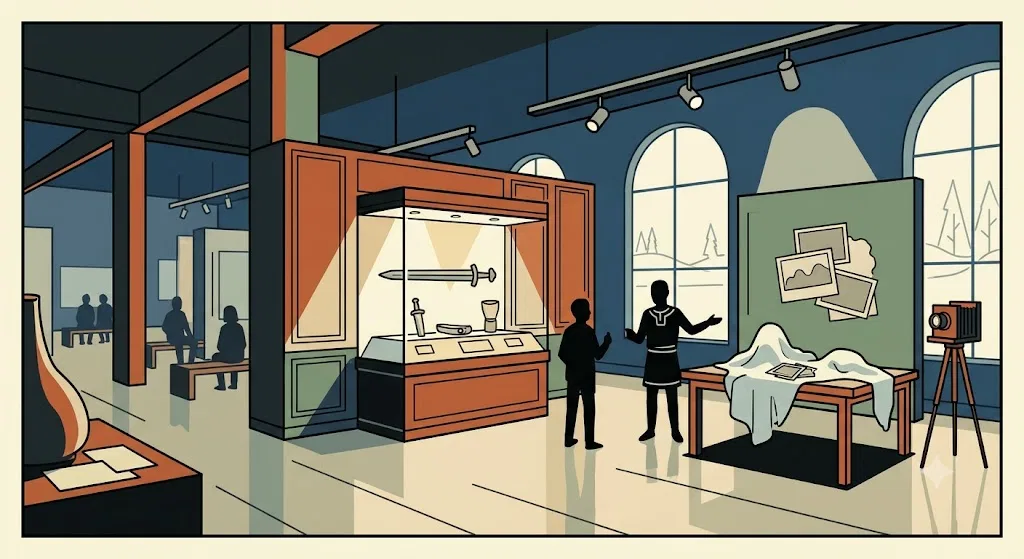
The Beardmore relics are Canada’s classic archaeological hoax because the objects themselves were probably genuine. The deception concerned where they had been found.
In 1936, prospector and railway worker James Edward “Eddy” Dodd sold a broken Norse sword, an axe head and another iron object to the Royal Ontario Museum. Dodd claimed that he had dug them from the ground near Beardmore, in northern Ontario, several years earlier. The museum’s founding director, Charles Trick Currelly, accepted the discovery account after European specialists identified the pieces as authentic Norse artefacts. The weapons were then displayed as evidence that Vikings had reached deep into the North American interior centuries before later European exploration.[Wikipedia]WikipediaBeardmore RelicsBeardmore Relics
The story was persuasive because it combined a remarkable claim with respectable material evidence. The sword was not an obvious modern reproduction. Experts who examined photographs could confirm its Scandinavian type, but they could not independently confirm the place where it had supposedly been unearthed. A genuine old object had been supplied with a false provenance — the documented chain of ownership and discovery that allows archaeologists to place an artefact in context.
The claim also arrived at a receptive moment. Norse exploration of North America was a serious historical question, and a dramatic Ontario discovery promised to reposition the province within that larger story. Newspaper editor James Watson Curran promoted the supposed find in lectures and writing, while the museum’s endorsement transformed a prospector’s account into an apparently established historical fact.[Wikipedia]WikipediaBeardmore RelicsBeardmore Relics
Archaeologists raised doubts early. Dodd’s descriptions of the discovery changed, and there was no secure excavation record, associated settlement or supporting material from the site. The decisive break came in the 1950s, when Dodd’s son Walter gave a sworn statement saying that his father had obtained the objects elsewhere and planted them at the alleged discovery site. Later historical work traced the likely route of the weapons through Norwegian immigrants in the Port Arthur area, now part of Thunder Bay.[Wikipedia]WikipediaBeardmore RelicsBeardmore Relics
The Beardmore affair demonstrates why authentic objects can be more dangerous than crude fakes. Scientific examination could establish the age and cultural origin of the metalwork, but it could not prove Dodd’s story. Currelly and the museum had invested professional prestige in the discovery, making retreat increasingly difficult as criticism accumulated. The scandal was therefore not just about one man planting antiques. It was also about institutional authority, confirmation bias and the reluctance of respected organisations to admit that an exciting conclusion had outrun the evidence.
Grey Owl and the authority of an invented identity
In the 1930s, Grey Owl became an internationally famous writer and lecturer on wilderness conservation. He appeared to be an Indigenous woodsman speaking from inherited cultural knowledge. In reality, he was Archibald Belaney, born in Hastings, England.
Belaney had moved to Canada as a young man and acquired genuine experience as a trapper, guide and back-country traveller. He later abandoned trapping and became an eloquent advocate for beavers and forest conservation. His books, lectures and films attracted large audiences in Canada and Britain, and he worked for the Dominion Parks Branch at Riding Mountain and Prince Albert national parks. His environmental message was not necessarily fraudulent: he had direct knowledge of the landscape, and his campaign helped popularise wildlife protection. The fraud lay in the ancestry and authority he claimed for himself.[Parks Canada]parks.canada.cahistoire historyArchibald Belaney and Gertrude Bernard (Grey Owl and…3 Sept 2025 — Upon his death in 1938, a newspaper revealed Belaney's…
Belaney presented himself as the child of an Indigenous mother and a Scottish father. His appearance, clothing, speech and personal history were shaped into the romantic figure that many non-Indigenous audiences expected an “Indian” conservationist to be. Parks Canada notes that he believed his arguments would carry greater force if the public thought they came from an Indigenous person. That calculation proved correct: his assumed identity made him both more marketable and more persuasive.[Parks Canada]parks.canada.cahistoire historyArchibald Belaney and Gertrude Bernard (Grey Owl and…3 Sept 2025 — Upon his death in 1938, a newspaper revealed Belaney's…
Some journalists and acquaintances suspected the truth before his death, but the full exposure was delayed. After Belaney died in April 1938, the North Bay Nugget published the story that Grey Owl was an Englishman named Archie Belaney. His publishers, employers and admirers were forced to reassess how much of his public persona had been manufactured.[Wikipedia]WikipediaGrey OwlGrey Owl
The case remains more complicated than a simple confidence trick. Belaney’s conservation work influenced real audiences, and Gertrude Bernard, known as Anahareo, played a crucial role in changing his attitude towards beavers and in advancing animal protection herself. Yet the false identity allowed Belaney to speak over Indigenous people while receiving opportunities that were denied to them. Parks Canada now places his success beside the discriminatory policies that restricted Indigenous access to traditional territories within national parks.[Parks Canada]parks.canada.cahistoire historyArchibald Belaney and Gertrude Bernard (Grey Owl and…3 Sept 2025 — Upon his death in 1938, a newspaper revealed Belaney's…
Grey Owl’s story persists because it poses an uncomfortable question: can a valuable cause excuse a fabricated identity? His defenders have often emphasised the environmental results. His critics point out that a compelling message does not erase cultural appropriation, false representation or the commercial advantages gained through deception. The case is therefore both an imposture and a warning about how audiences assign authority to identity.
The unqualified doctor aboard a Canadian warship
Ferdinand Waldo Demara’s impersonation of a Royal Canadian Navy surgeon sounds like farce until the wartime consequences are considered. In 1951, during the Korean War, the American impostor assumed the identity of Canadian doctor Joseph Cyr and presented himself for naval service.
Canada needed medical officers, and Demara arrived with exactly the qualifications the service wanted to see. According to the CFB Esquimalt Naval and Military Museum, the normal checking process was compressed from months into days and his credentials were not adequately verified. He was accepted into the navy and assigned to HMCS Cayuga.[CFB Esquimalt Naval and Military Museum]navalandmilitarymuseum.orgCFB Esquimalt Naval and Military MuseumFerdinand "Waldo" DemaraFerdinand “Waldo” Demara, an American by birth, joined the Royal Canadian…
The fraud became especially dangerous when wounded Korean combatants were brought aboard. Demara had no recognised medical training, but he studied surgical manuals, relied on support staff and carried out emergency treatment. Accounts of the episode report that his patients survived, a fact that later helped transform the story into an entertaining legend about a brilliant natural impostor.[MMBC]mmbc.bc.caA Story from the Collection: The Great ImposterNovember 11, 2024 — 11 Nov 2024 — Surgeon Lieutenant Joseph Cyr was the stolen identit…
That framing can obscure the risk. Success did not validate the deception. Demara had placed patients, colleagues and the navy in a situation where failure could easily have been fatal. His apparent competence also depended on trained assistants, medical reference material and circumstances in which no properly credentialled alternative was immediately available.
The masquerade was exposed not by a failed operation but by publicity. Reports praising “Dr Cyr” reached the real Joseph Cyr, whose family recognised that someone else was using his name. The episode revealed a familiar weakness in large organisations: an urgent need, plausible paperwork and confident behaviour can sometimes substitute for proper verification.
Demara benefited from the gap between credentials as documents and competence as performance. Once inside the institution, his uniform and appointment made others less likely to question him. The story remains fascinating because the impostor did not merely pretend in private; he occupied a role whose authority was continuously reinforced by the organisation he had deceived.
Winnipeg’s photographed spirits
Between the 1920s and 1930s, physician Thomas Glendenning Hamilton and his wife, nurse Lillian Hamilton, conducted séances in their Winnipeg home. Their photographs showed levitating tables, entranced mediums and pale masses described as “ectoplasm” or “teleplasm” emerging from bodies and forming spirit faces.
The Hamiltons approached the subject in the language of experimental investigation. They used cameras, notes, diagrams, controlled rooms and multiple observers. Their archive contains more than 700 digitised images and extensive documentation, giving the séances an appearance of careful scientific procedure. Some international spiritualist circles treated the photographs as serious evidence that personality survived bodily death.[digitalcollections.lib.umanitoba.ca]digitalcollections.lib.umanitoba.caOpen source on umanitoba.ca.
The emotional setting mattered. The Hamiltons began their investigations after the death of their young son during the influenza era, at a time when war and pandemic had left many families searching for assurance that the dead remained reachable. Spiritualism offered both comfort and a programme of seemingly empirical inquiry. Cameras appeared capable of registering phenomena too fleeting for ordinary sight, while medical and scientific vocabulary gave the proceedings additional prestige.[University of Manitoba]umanitoba.caOpen source on umanitoba.ca.
Yet extensive documentation is not the same as effective fraud control. The séances relied on mediums operating in dim conditions, and the supposed ectoplasm resembles the cloth, paper, photographs and other concealed materials used in exposed spiritualist performances elsewhere. Modern scholarship generally treats the Hamilton laboratory’s methods as insufficiently rigorous, while stopping short of claiming that every participant shared the same intentions. The mediums may have produced fraudulent effects even if Hamilton sincerely believed he was observing paranormal events.[mspace.lib.umanitoba.ca]mspace.lib.umanitoba.caExhibi on Review: “The Undead Archive: 100 YearsExhibi on Review: “The Undead Archive: 100 Years
This distinction matters. A séance can contain deliberate trickery without every organiser or witness being a conscious conspirator. Believers may overlook suspicious behaviour, reinterpret failures as interference and preserve only the most striking photographs. Once the images enter an archive, they acquire a new kind of authority: viewers see a formal historical record, not the uncontrolled conditions around the instant of exposure.
The Hamilton photographs remain culturally important even without accepting their supernatural explanation. They document grief, scientific ambition, religious hope and the enormous evidential power once attached to photography. Their survival also shows that a debunked or doubtful image can continue to matter as art and social history long after it loses force as proof.
Ogopogo: monster hoax, folklore or mistaken wildlife?
Ogopogo is often included in lists of Canadian hoaxes, but that label is too blunt. There is no single Ogopogo fraud whose exposure ended the story. Instead, the Okanagan Lake monster developed through Indigenous tradition, settler reinterpretation, newspaper reports, tourist promotion, ambiguous films and repeated misidentifications.
Modern popular descriptions often treat Ogopogo as a long, serpent-like animal comparable to Scotland’s Loch Ness Monster. That image should not be casually projected backwards onto Syilx cultural traditions. Sceptical researchers have argued that settler monster lore transformed accounts of a powerful water being into a supposedly zoological creature that might be photographed, hunted or advertised.[Wikipedia]WikipediaOpen source on wikipedia.org.
Many sightings can be explained without assuming either dishonesty or an unknown species. Lines of otters can appear to form a single undulating animal; beavers, water birds, floating logs, boat wakes and unusual wave patterns can look much larger when distance is difficult to judge. Poor film and shaky video remove precisely the details needed for identification, while leaving enough suggestive movement for the viewer to imagine a head, back or tail.[Wikipedia]WikipediaOpen source on wikipedia.org.
Some celebrated images may involve exaggeration or staging, but many witnesses probably reported what they sincerely thought they had seen. That makes Ogopogo a case of cumulative legend rather than one clean deception. Each indistinct photograph renews the story without resolving it. The absence of a specimen becomes part of the mystery rather than a reason to abandon the claim.
Tourism also helps keep the creature alive. A lake monster gives a region a memorable symbol, supports souvenirs and attractions, and turns ordinary patches of disturbed water into potential news. Commercial benefit does not prove that individual witnesses are lying, but it creates an environment in which ambiguous evidence receives attention.
The fairest conclusion is that no reliable zoological evidence has established the existence of a large unknown animal in Okanagan Lake. The legend survives because it can absorb almost any outcome: a blurred shape counts as support, a failed search proves the creature is elusive, and a mundane explanation applies only to that particular sighting. Ogopogo belongs at the boundary where folklore, visual error, publicity and occasional possible trickery reinforce one another.
The “crucified Canadian” and the machinery of wartime belief
During the First World War, stories circulated that German soldiers had captured and crucified a Canadian serviceman near Ypres in Belgium. Accounts differed over the location, the victim and whether he had been fixed to a barn door, wall or tree. No body was produced and no identity was securely established.
The rumour emerged after the Second Battle of Ypres in 1915, where Canadian troops had suffered heavily and faced Germany’s first large-scale use of poison gas on the Western Front. In that atmosphere, a story of deliberate ritualised cruelty seemed consistent with genuine wartime horrors. It was repeated in newspapers, speeches and testimony, eventually becoming a powerful Allied propaganda image.[Wikipedia]WikipediaThe Crucified SoldierThe Crucified Soldier
Canadian censor Ernest Chambers investigated the claims in 1915 but found no credible corroboration. Witness accounts conflicted, and some could be disproved. A post-war Canadian inquiry also failed to establish that the event had occurred. The story was never conclusively tied to a named victim or verifiable site.[Great War Forum]greatwarforum.org2763 the case of the crucified canadian2763 the case of the crucified canadian
Nevertheless, the image acquired a cultural life independent of the evidence. Francis Derwent Wood’s sculpture Canada’s Golgotha depicted the alleged atrocity, translating rumour into a physical memorial object. Once represented in art, film and official-seeming narratives, the story appeared less like battlefield hearsay and more like remembered history.[Great War 100 Reads]greatwar100reads.wordpress.comGreat War 100 Reads Monday Monuments and Memorials – Canada's GolgothaGreat War 100 Reads Monday Monuments and Memorials – Canada's Golgotha
It is best described as an unsubstantiated wartime atrocity story rather than a proven centrally organised fabrication. Rumours can serve propaganda without being invented by a propaganda office. Soldiers may repeat fragments heard from others; journalists may reconcile contradictory versions into a vivid narrative; officials may circulate an allegation because it supports mobilisation and hatred of the enemy.
The case shows why true surrounding events make false or unverified details more persuasive. German forces did commit serious violations, and the war produced suffering on a scale that made almost any individual atrocity seem possible. Correctly rejecting the crucifixion story does not minimise those realities. It demonstrates the need to separate documented crimes from emotionally effective claims that could not be substantiated.
When a joke moved the Canadian dollar
Not all hoaxes grow slowly. On 1 April 2002, the Canadian political website Bourque Newswatch published a spoof report that federal finance minister Paul Martin was resigning to raise cattle and ducks. The agricultural details were intended to signal an April Fools’ joke.
Currency traders did not all recognise the humour. The report circulated through financial information networks, and selling pressure briefly pushed the Canadian dollar to a one-month low against the United States dollar before the claim was identified as false.[The Guardian]theguardian.comThe Guardian Ducks force dive in Canadian dollarThe Guardian Ducks force dive in Canadian dollar
The episode illustrates how specialist audiences can be fooled by speed rather than ignorance. Traders are trained to respond rapidly to information that could affect political stability, interest-rate expectations or economic policy. In that environment, waiting for complete verification may appear more costly than acting immediately.
The joke also escaped its original context. A reader visiting a political gossip site on April Fools’ Day might notice the absurdities. A stripped-down alert passed through another service can lose the date, tone and surrounding clues that mark it as satire. Modern misinformation often spreads in the same way: content designed for one audience is copied into systems where its intended signals disappear.
Unlike the Beardmore relics or Grey Owl’s identity, the deception was quickly admitted. Yet its real-world effect was immediate. It demonstrated that a hoax does not need widespread public belief to matter; it may only need to reach a small group with the power to move money or make decisions.
The House Hippo: a hoax designed to expose hoaxes
In 1999, Canadian television viewers were introduced to the North American house hippo, a tiny nocturnal animal said to live in cupboards and sleep in nests made from lost mittens. The footage imitated a serious wildlife documentary, showing the miniature creature moving through an ordinary home.
The advertisement then revealed its purpose: the house hippo was not real, and children should think critically about what television showed them. It was a deliberate, harmless deception constructed as a lesson in visual literacy.
The campaign became memorable partly because its fake was charming and technically convincing. Viewers understood the general warning, yet many later recalled that, as young children, they had briefly wanted or believed in the animal. That reaction was not necessarily a failure. The experience of being fooled gave the lesson emotional force: realistic pictures, confident narration and familiar documentary conventions could manufacture credibility.[Wikipedia]WikipediaHouse hippoHouse hippo
MediaSmarts revived the character in 2019 for its Break the Fake campaign, shifting the warning from television effects to online misinformation and manipulated media. The organisation has since used the house hippo to discuss source checking, fact-checking, reverse image searches and artificial-intelligence-generated content.[MediaSmarts]mediasmarts.caOpen source on mediasmarts.ca.
The House Hippo occupies an unusual place in Canadian hoax history. It was fake by design, but its creators clearly disclosed the trick within the same broadcast. Unlike fraud, its success did not depend on preserving belief. The reveal was the point.
It also provides a useful test for older cases. Before asking whether a claim feels believable, ask what created that feeling. Was it the object itself, the reputation of a museum, the authority of a uniform, the apparent honesty of a witness, the emotional force of wartime suffering or the supposed neutrality of a camera? The house hippo’s enduring lesson is that presentation can supply the credibility that evidence lacks.
Why these stories endure
Canada’s best-known hoaxes and contested legends differ greatly, but several recurring mechanisms connect them.
A real element anchors the false claim. The Beardmore weapons were old Norse objects. Grey Owl had genuine wilderness knowledge. Demara performed real medical procedures. The Hamilton photographs recorded real people and physical materials. A mixture of truth and deception is harder to dismiss than a wholly invented story.
Authority travels faster than verification. Museum labels, military appointments, newspaper reports and scientific-looking documentation tell audiences that someone competent has already checked the claim. Once an institution endorses a story, later sceptics appear to be challenging not only the evidence but the institution itself.
Emotion changes the standard of proof. Grief made spirit communication attractive. Patriotism and horror sustained the crucified-soldier rumour. Excitement about early exploration favoured the Beardmore interpretation. Conservation-minded audiences wanted Grey Owl’s message and public persona to be authentic.
Ambiguous evidence invites narrative. A blurred shape on a lake, an indistinct photograph or an artefact without secure excavation records does not explain itself. People supply the missing context from folklore, expectation and desire.
Exposure rarely erases the original story. Corrections are usually less vivid than the claim they replace. “A Viking sword was planted in Ontario” is more memorable than a technical discussion of provenance. A monster-shaped wake remains more shareable than an explanation involving perspective and otters. Even after debunking, the original image continues to circulate.
The lasting value of these cases is therefore not that they prove Canadians are especially easy to fool. They show how ordinary systems of trust can be redirected. Hoaxes succeed when evidence, authority and expectation appear to agree — and they are exposed when investigators separate those elements and test each one independently.
Amazon book picks
Further Reading
Books and field guides related to Why Canada's Most Convincing Hoaxes Worked. Use these as the next step if you want deeper reading beyond the article.
A Short History of Nearly Everything
Provides context for how mistaken beliefs gain authority.

Le légendaire Grey Owl
First published 1999. Subjects: Conservationists, Biography, Authors, Canadian (English), Écologistes (Défenseurs de l'environnement), Bi...
The Vinland Map and the tartar relation
Parallels archaeological and historical credibility disputes.
eBay marketplace picks
Marketplace Samples
Live-tested eBay searches with available results related to this page.
Endnotes
1.
Source: Wikipedia
Title: Beardmore Relics
Link:https://en.wikipedia.org/wiki/Beardmore_Relics
2.
Source: parks.canada.ca
Title: histoire history
Link:https://parks.canada.ca/pn-np/sk/princealbert/culture/histoire-history
Source snippet
Archibald Belaney and Gertrude Bernard (Grey Owl and...3 Sept 2025 — Upon his death in 1938, a newspaper revealed Belaney's...
3.
Source: Wikipedia
Title: Grey Owl
Link:https://en.wikipedia.org/wiki/Grey_Owl
4.
Source: digitalcollections.lib.umanitoba.ca
Link:https://digitalcollections.lib.umanitoba.ca/islandora/object/uofm%3Ahamilton_family
5.
Source: umanitoba.ca
Link:https://umanitoba.ca/art/undead-archive
6.
Source: umanitoba.ca
Title: UMRA News Spring 2024
Link:https://umanitoba.ca/um-retirees-association/sites/um-retirees-association/files/2024-04/UMRA%20News%20Spring%202024.pdf
7.
Source: mspace.lib.umanitoba.ca
Title: Exhibi on Review: “The Undead Archive: 100 Years
Link:https://mspace.lib.umanitoba.ca/bitstreams/b3f6e12e-43d1-4d57-aab7-1068385d85fb/download
8.
Source: Wikipedia
Link:https://en.wikipedia.org/wiki/Ogopogo
9.
Source: Wikipedia
Title: The Crucified Soldier
Link:https://en.wikipedia.org/wiki/The_Crucified_Soldier
10.
Source: Wikipedia
Title: House hippo
Link:https://en.wikipedia.org/wiki/House_hippo
11.
Source: mediasmarts.ca
Link:https://mediasmarts.ca/break-fake
12.
Source: mediasmarts.ca
Title: those tiny hippos your house they’re back teach us about ‘fake news’
Link:https://mediasmarts.ca/press-centre/press-releases/those-tiny-hippos-your-house-they%E2%80%99re-back-teach-us-about-%E2%80%98fake-news%E2%80%99
13.
Source: mediasmarts.ca
Title: i was tricked ai image online
Link:https://mediasmarts.ca/blog/i-was-tricked-ai-image-online
14.
Source: Wikipedia
Title: Ferdinand Waldo Demara
Link:https://en.wikipedia.org/wiki/Ferdinand_Waldo_Demara
15.
Source: search.open.canada.ca
Link:https://search.open.canada.ca/opendata/?page=4630&search_text=&sort=score+desc
16.
Source: canada.ca
Link:https://www.canada.ca/en/canadian-heritage.html
17.
Source: canada.ca
Title: indigenous heritage
Link:https://www.canada.ca/en/canadian-heritage/services/funding/museums-assistance/indigenous-heritage.html
18.
Source: search.open.canada.ca
Title: ca Open Government Portal
Link:https://search.open.canada.ca/opendata/?owner_org=rcmp-grc&page=3&sort=metadata_modified+desc
19.
Source: canada.ca
Title: collections management
Link:https://www.canada.ca/en/canadian-heritage/services/funding/museums-assistance/collections-management.html
20.
Source: search.open.canada.ca
Title: ca Open Government Portal
Link:https://search.open.canada.ca/opendata/?owner_org=cfia-acia&page=3&sort=metadata_modified+desc&wbdisable=false
21.
Source: search.open.canada.ca
Title: ca Notice: Basic HTML
Link:https://search.open.canada.ca/opendata/?frequency=not_planned&page=539&sort=metadata_modified+desc&subject=labour&wbdisable=true
22.
Source: canada.ca
Title: reopening fund heritage organizations
Link:https://www.canada.ca/en/canadian-heritage/services/funding/museums-assistance/reopening-fund-heritage-organizations.html
23.
Source: canada.ca
Title: cultural spaces fund
Link:https://www.canada.ca/en/canadian-heritage/services/funding/cultural-spaces-fund.html
24.
Source: search.open.canada.ca
Title: ca Notice: Basic HTML
Link:https://search.open.canada.ca/opendata/?frequency=as_needed&jurisdiction=federal&topic_category=location&wbdisable=true
25.
Source: libguides.lib.umanitoba.ca
Title: ca Program
Link:https://libguides.lib.umanitoba.ca/c.php?g=736261&p=5303374
26.
Source: digitalcollections.lib.umanitoba.ca
Link:https://digitalcollections.lib.umanitoba.ca/islandora/object/uofm%3Ahamilton_family?display=list&f%5B0%5D=-facet_group_title_ms%3A%22Group%5C+I%5C+%5C-%5C+Photographs%5C%3A%5C+Large%5C+Ectoplasm%5C+on%5C+Mary%5C+Marshall%27s%5C+Face%22&f%5B1%5D=facet_group_title_ms%3A%22Group%5C+III%2C%5C+%2314%5C+%5C-%5C+Unorganized%2C%5C+Compacted%5C+Teleplasm%5C+%5C%28Stereo%5C+View%5C%29%22
27.
Source: umtoday-wordpress.ad.umanitoba.ca
Title: ca Video: The Undead Archive
Link:https://umtoday-wordpress.ad.umanitoba.ca/video-the-undead-archive/
28.
Source: libguides.lib.umanitoba.ca
Title: ca Presenters
Link:https://libguides.lib.umanitoba.ca/c.php?g=736261&p=5303375
29.
Source: digitalcollections.lib.umanitoba.ca
Title: ca Search results | digitalcollections.lib.umanitoba.ca Group I
Link:https://digitalcollections.lib.umanitoba.ca/islandora/search/type_of_resource_facet_ms%3A%28%22Glass%20lantern%20slide%22%20OR%20%22Photograph%22%20OR%20%22Slide%22%20OR%20%22Stereo%20photograph%22%20OR%20%22Still%20image%22%29
30.
Source: mediasmarts.ca
Title: everything house hippo
Link:https://mediasmarts.ca/blog/everything-house-hippo
31.
Source: mediasmarts.ca
Link:https://mediasmarts.ca/sites/mediasmarts/files/guides/facilitator_guide_break_the_fake.pdf
32.
Source: mediasmarts.ca
Title: press releases
Link:https://mediasmarts.ca/press-releases?page=2
33.
Source: mediasmarts.ca
Link:https://mediasmarts.ca/about-us/history
34.
Source: mediasmarts.ca
Link:https://mediasmarts.ca/sites/default/files/2025-05/mediasmarts-annual-report-2024_0.pdf
35.
Source: mediasmarts.ca
Link:https://mediasmarts.ca/sites/default/files/2025-04/report_motives_methods.pdf
36.
Source: dwhauthor.wordpress.com
Title: beardmore revisited jens blochs dark norwegian past
Link:https://dwhauthor.wordpress.com/2020/04/28/beardmore-revisited-jens-blochs-dark-norwegian-past/
Source snippet
Douglas Hunter“Beardmore” revisited: Jens Bloch's dark Norwegian past28 Apr 2020 — In my 2018 book Beardmore, which investigates the Viki...
37.
Source: navalandmilitarymuseum.org
Link:https://navalandmilitarymuseum.org/article/ferdinand-waldo-demara/
Source snippet
CFB Esquimalt Naval and Military MuseumFerdinand "Waldo" DemaraFerdinand “Waldo” Demara, an American by birth, joined the Royal Canadian...
38.
Source: mmbc.bc.ca
Link:https://mmbc.bc.ca/the-great-imposter-a-story-from-the-collection/
Source snippet
A Story from the Collection: The Great ImposterNovember 11, 2024 — 11 Nov 2024 — Surgeon Lieutenant Joseph Cyr was the stolen identit...
Published: November 11, 2024
39.
Source: greatwar.nl
Link:https://greatwar.nl/weekpictures/crucifiedcanadian.html
40.
Source: greatwarforum.org
Title: 2763 the case of the crucified canadian
Link:https://www.greatwarforum.org/blogs/entry/2763-the-case-of-the-crucified-canadian/
41.
Source: greatwar100reads.wordpress.com
Title: Great War 100 Reads Monday Monuments and Memorials – Canada’s Golgotha
Link:https://greatwar100reads.wordpress.com/2020/06/08/monday-monuments-and-memorials-canadas-golgotha-canadian-war-museum-ottawa/
42.
Source: theguardian.com
Title: The Guardian Ducks force dive in Canadian dollar
Link:https://www.theguardian.com/world/2002/apr/02/julianborger
43.
Source: dwhauthor.wordpress.com
Link:https://dwhauthor.wordpress.com/portfolio/beardmore/
44.
Source: martinezbeavers.org
Title: grey owl
Link:https://martinezbeavers.org/tag/grey-owl/
45.
Source: hmag.org.uk
Title: grey owl
Link:https://www.hmag.org.uk/explore/stories/grey-owl/
46.
Source: ripleys.com
Link:https://www.ripleys.com/stories/ogopogo
Additional References
47.
Source: reviewcanada.ca
Link:https://reviewcanada.ca/magazine/2018/11/the-sword-in-the-stones/
Source snippet
The Sword in the StonesLessons from a spectacular museum fraud. Victor Rabinovitch. Beardmore: The Viking Hoax that Rewrote History. Doug...
48.
Source: youtube.com
Title: You Bet Your Life #59-08 Ferdinand Demara, “The Great Imposter”
Link:https://www.youtube.com/watch?v=33Rz5yYCeks
Source snippet
'Ogopogo': Is The Legendary Monster in Okanagan Lake Real?...
49.
Source: jstor.org
Link:https://www.jstor.org/stable/j.ctv4t7z9h
Source snippet
Beardmore: The Viking Hoax That Rewrote HistoryIn 1956 the discovery was exposed as an unquestionable hoax, tarnishing the reputatio...
50.
Source: youtube.com
Title: Beardmore’s Viking Discovery
Link:https://www.youtube.com/watch?v=46P3wNKmBaM
Source snippet
AI restored, Grey Owl's Strange Guests (1936 documentary)...
51.
Source: instagram.com
Link:https://www.instagram.com/reel/DXdJOhHjj6P/
52.
Source: aci-iac.ca
Link:https://www.aci-iac.ca/art-books/war-art-in-canada/critical-issues/
53.
Source: nnels.ca
Link:https://nnels.ca/items/beardmore-viking-hoax-rewrote-history
54.
Source: nqonline.ca
Link:https://nqonline.ca/article/beardmore-the-viking-hoax-that-rewrote-history-by-douglas-hunter/
55.
Source: writinguptheancestors.ca
Link:https://www.writinguptheancestors.ca/category/thomas-glendenning-hamilton
56.
Source: x.com
Link:https://x.com/Dr_TheHistories/status/2067517273938792694
Topic Tree
Follow this branch
Related pages 192
- Albanian Hoaxes
- Algerian Hoaxes
- Antigua Deceptions
- Argentina Hoaxes
- Armenian Hoaxes
- +187 more in sidebar