Within Belize Hoaxes
Was the Crystal Skull Really Found in Belize?
Archive records and modern tool marks dismantle the claim that the famous quartz skull was excavated at Lubaantun.
On this page
- The changing story of the Lubaantun discovery
- Auction records and the skull's London provenance
- Tool marks, modern manufacture and later mythology
Page outline Jump by section
Introduction
The Mitchell-Hedges crystal skull is one of the most famous alleged archaeological discoveries ever linked to Belize. For decades, books, television programmes and New Age writers repeated the story that Anna Mitchell-Hedges found a remarkable quartz skull at the Maya site of Lubaantun in southern Belize during excavations in the 1920s. The tale helped transform the object into a global mystery, often presented as evidence of lost knowledge, supernatural powers or forgotten ancient technologies.
Yet the evidence behind the discovery story steadily collapsed under archival and scientific scrutiny. Excavation records from Lubaantun do not document the skull, contemporary witnesses did not report its discovery, and ownership records place the object in London years later. Modern microscopic analysis has also revealed tool marks inconsistent with ancient Maya manufacture. Today, the strongest evidence suggests that the famous crystal skull was not excavated at Lubaantun at all and that its Belizean provenance was a later invention.[Archaeology Magazine]archive.archaeology.orgMagazine Archaeology MagazineArchaeology MagazineArchaeology Magazine - The Skull of Doom27 May 2010 — Mitchell-Hedges claimed to have found the skull somewhere in Ce…
Was the Crystal Skull Really Found in Belize?
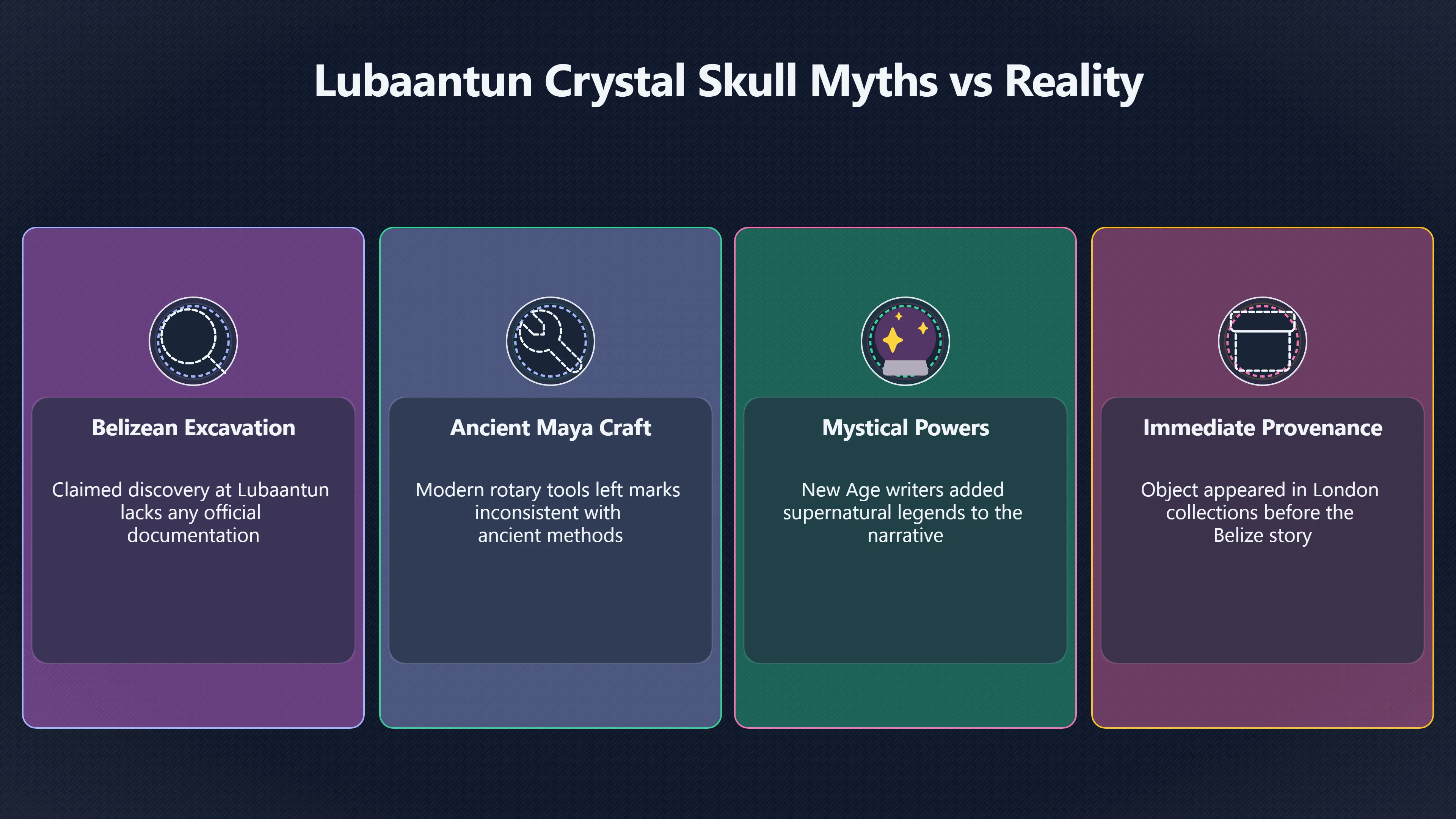
The claim most people know is straightforward: Anna Mitchell-Hedges supposedly discovered a crystal skull beneath a fallen altar or within a ruined structure at Lubaantun, a genuine Maya city in what was then British Honduras, now Belize. Different versions of the story place the discovery in different years, usually between 1924 and 1927. Over time the account became increasingly dramatic, with references to ancient priests, mystical powers and the object’s alleged ability to bring death.[Archaeology Magazine]archive.archaeology.orgMagazine Archaeology MagazineArchaeology MagazineArchaeology Magazine - The Skull of Doom27 May 2010 — Mitchell-Hedges claimed to have found the skull somewhere in Ce…
The problem is that the discovery story appeared long after the supposed event. Contemporary archaeological reports from Lubaantun do not mention such a spectacular find. Other people associated with the excavations did not record the discovery, and researchers later noted that evidence for Anna Mitchell-Hedges even being present at the relevant excavations is extremely weak. Given the extraordinary nature of the object, its complete absence from excavation records is difficult to explain if it had genuinely been unearthed there.[archaeology.org]archive.archaeology.orgMagazine Archaeology MagazineArchaeology MagazineArchaeology Magazine - The Skull of Doom27 May 2010 — Mitchell-Hedges claimed to have found the skull somewhere in Ce…
An additional difficulty is Frederick Albert Mitchell-Hedges himself. He was a prolific adventurer, author and self-publicist who rarely missed an opportunity to describe remarkable discoveries. Yet he did not publicly discuss the crystal skull during the years when he was writing about Lubaantun and his Central American travels. The skull only became central to his story decades later.[Archaeology Magazine]archive.archaeology.orgMagazine Archaeology MagazineArchaeology MagazineArchaeology Magazine - The Skull of Doom27 May 2010 — Mitchell-Hedges claimed to have found the skull somewhere in Ce…
The Changing Story of the Lubaantun Discovery
One reason historians and sceptical investigators became suspicious is that the story changed repeatedly.
Early accounts associated with Frederick Mitchell-Hedges were vague about how he obtained the skull. Later narratives shifted attention to Anna Mitchell-Hedges, who increasingly described herself as its discoverer. The location, date and circumstances of the find varied across interviews, letters and publications. In some versions she found it on her seventeenth birthday. In others, it emerged from beneath a collapsed altar or from within a temple structure.[Archaeology Magazine]archive.archaeology.orgMagazine Archaeology MagazineArchaeology MagazineArchaeology Magazine - The Skull of Doom27 May 2010 — Mitchell-Hedges claimed to have found the skull somewhere in Ce…
These inconsistencies matter because archaeologists rely heavily on provenance: the documented history of where an object came from and how it was recovered. Genuine excavations normally generate field notes, photographs, reports and witness testimony. In the crystal skull’s case, the discovery narrative expanded only after the object had already become famous. The more researchers examined the record, the less evidence they found for the original Belize story.[Archaeology Magazine]archive.archaeology.orgMagazine Archaeology MagazineArchaeology MagazineArchaeology Magazine - The Skull of Doom27 May 2010 — Mitchell-Hedges claimed to have found the skull somewhere in Ce…
The result is a classic pattern in the history of disputed artefacts: a dramatic origin story becomes better known than the documentary record supporting it.
Auction Records and the Skull’s London Provenance
The most damaging evidence against the Lubaantun claim came not from archaeology but from archives.
Researchers tracing the skull’s history found that it was publicly documented in 1936, when it appeared in the British anthropological journal Man. At that time the skull was identified as being in the possession of London art dealer Sydney Burney. This is a crucial detail because it places the object in a documented European collection years after the supposed Belize discovery but before it entered the Mitchell-Hedges legend.[Archaeology Magazine]archive.archaeology.orgMagazine The Skull of DoomArchaeology MagazineThe Skull of Doom - Acquisition HistoryThe Mitchell-Hedges skull was first publicly known in 1936, when it was publis…
The paper trail becomes even clearer in 1943. Sotheby’s auction records show that the skull was offered for sale from the Burney collection. Evidence uncovered by researchers demonstrates that Frederick Mitchell-Hedges acquired the object after that sale, paying approximately £400. A contemporary letter written by Mitchell-Hedges acknowledged that he had obtained the skull from Burney.[archaeology.org]archive.archaeology.orgMagazine The Skull of DoomArchaeology MagazineThe Skull of Doom - Acquisition HistoryThe Mitchell-Hedges skull was first publicly known in 1936, when it was publis…
This provenance effectively reverses the traditional narrative. Rather than travelling from a Belize excavation to a London collection, the documented evidence shows the skull moving from the London art market into the possession of Mitchell-Hedges. The supposed archaeological origin appears only later.[Archaeology Magazine]archive.archaeology.orgMagazine The Skull of DoomArchaeology MagazineThe Skull of Doom - Acquisition HistoryThe Mitchell-Hedges skull was first publicly known in 1936, when it was publis…
For historians, this is the decisive turning point in the case. Provenance records are not infallible, but a documented ownership trail carries far more weight than recollections recorded decades after the alleged discovery.
What Modern Tool Marks Revealed
Even if the discovery story were uncertain, the skull would still need to be shown to be an authentic ancient Maya artefact. Scientific examination has made that increasingly difficult.
Because quartz cannot easily be dated through conventional archaeological methods, researchers focused on manufacturing techniques. Jane MacLaren Walsh of the Smithsonian Institution and specialists at the British Museum examined crystal skulls using scanning electron microscopy, computerised imaging and other analytical methods. Their investigations identified traces of modern rotary tools and industrial abrasives.[smithsonianmag.com]smithsonianmag.comSmithsonian MagazineWhy the Smithsonian Has a Fake Crystal SkullMay 29, 2008 — Margaret Sax, a materials expert there, used scanning elec…
Ancient Maya craftspeople were highly skilled stone workers, but the marks found on the skull are consistent with high-speed mechanical equipment rather than pre-Columbian carving methods. Researchers also noted strong similarities between the Mitchell-Hedges skull and other crystal skulls that appeared in European collections during the nineteenth and early twentieth centuries.[smithsonianmag.com]smithsonianmag.comSmithsonian MagazineWhy the Smithsonian Has a Fake Crystal SkullMay 29, 2008 — Margaret Sax, a materials expert there, used scanning elec…
The Smithsonian concluded that modern stone-carving technology had been used, making a pre-Columbian origin impossible. Walsh’s examination of the Mitchell-Hedges skull specifically found evidence that it had been worked with modern rotary equipment coated with hard abrasives such as diamond.[si.edu]si.eduSmithsonian InstitutionMysterious Crystal Skull on Exhibit for the First Time at…Jul 2, 2008 — Modern stone-carving tool marks have be…
Scientific analysis therefore undermined two separate claims at once:
- The skull was not demonstrably ancient Maya.
- The skull’s supposed archaeological discovery at Lubaantun lacked supporting evidence.
Together, those findings transformed the object from a celebrated archaeological mystery into a case study in disputed provenance and modern forgery research.[smithsonianmag.com]smithsonianmag.comSmithsonian MagazineWhy the Smithsonian Has a Fake Crystal SkullMay 29, 2008 — Margaret Sax, a materials expert there, used scanning elec…
Why the Myth Survived
The collapse of the Lubaantun discovery story did not end public fascination with the skull.
Part of the appeal lies in the setting. Lubaantun is a real Maya site in Belize, and the image of a crystal skull emerging from jungle ruins is far more memorable than auction catalogues and laboratory reports. The story also benefited from the reputation of Frederick Mitchell-Hedges, who cultivated an image as an explorer of lost worlds and unusual mysteries.[Archaeology Magazine]archive.archaeology.orgMagazine Archaeology MagazineArchaeology MagazineArchaeology Magazine - The Skull of Doom27 May 2010 — Mitchell-Hedges claimed to have found the skull somewhere in Ce…
From the late twentieth century onward, New Age writers and television documentaries expanded the mythology further. The skull became linked to psychic powers, ancient wisdom, prophecies and claims about a group of mysterious crystal skulls scattered around the world. These stories often repeated the Belize discovery narrative without examining the documentary evidence behind it.[Wikipedia]WikipediaCrystal skullCrystal skull
The result is a familiar pattern in the history of famous hoaxes and disputed artefacts. A compelling story spreads because it satisfies popular expectations about hidden knowledge and lost civilisations, while the archival evidence disproving it receives less attention.

What the Crystal Skull Case Reveals
The Mitchell-Hedges skull remains closely associated with Belize because the Lubaantun discovery story gave the object its mystique. Yet the evidence now points in a very different direction. Contemporary excavation records fail to support the claim, ownership documents place the skull in the London art trade before Mitchell-Hedges acquired it, and scientific examination indicates modern manufacture rather than ancient Maya craftsmanship.[Archaeology Magazine]archive.archaeology.orgMagazine The Skull of DoomArchaeology MagazineThe Skull of Doom - Acquisition HistoryThe Mitchell-Hedges skull was first publicly known in 1936, when it was publis…
For the history of Belize’s most famous archaeological mystery, the important lesson is not that the skull exists—it plainly does—but that provenance matters. The case demonstrates how a dramatic excavation story can overshadow documentary records for decades, and how archives and scientific analysis can eventually reconstruct a more reliable history than legend alone.[archaeology.org]archive.archaeology.orgMagazine The Skull of DoomArchaeology MagazineThe Skull of Doom - Acquisition HistoryThe Mitchell-Hedges skull was first publicly known in 1936, when it was publis…
Amazon book picks
Further Reading
Books and field guides related to Was the Crystal Skull Really Found in Belize?. Use these as the next step if you want deeper reading beyond the article.
Frauds, Myths, and Mysteries: Science and Pseudoscience in Ar...
Examines archaeological claims that fail under scrutiny.
The Demon-Haunted World
Rating: 4.5/5 from 43 Google Books ratings
Encourages evidence-based evaluation of extraordinary claims.
Fingerprints of the Gods
Represents the style of mystery narratives that helped sustain interest in artifacts like crystal skulls.
eBay marketplace picks
Marketplace Samples
Live-tested eBay searches with available results related to this page.




Endnotes
1.
Source: archive.archaeology.org
Title: Magazine Archaeology Magazine
Link:https://archive.archaeology.org/online/features/mitchell_hedges/
Source snippet
Archaeology MagazineArchaeology Magazine - The Skull of Doom27 May 2010 — Mitchell-Hedges claimed to have found the skull somewhere in Ce...
Published: May 2010
2.
Source: archive.archaeology.org
Title: Magazine The Skull of Doom
Link:https://archive.archaeology.org/online/features/mitchell_hedges/acquisition_history.html
Source snippet
Archaeology MagazineThe Skull of Doom - Acquisition HistoryThe Mitchell-Hedges skull was first publicly known in 1936, when it was publis...
3.
Source: Wikipedia
Title: Crystal skull
Link:https://en.wikipedia.org/wiki/Crystal_skull
4.
Source: Wikipedia
Link:https://en.wikipedia.org/wiki/Lubaantun
5.
Source: Wikipedia
Title: F. A. Mitchell-Hedges
Link:https://en.wikipedia.org/wiki/F._A._Mitchell-Hedges
6.
Source: archive.archaeology.org
Title: Magazine Legend of the Crystal Skulls
Link:https://archive.archaeology.org/0805/etc/indy.html
7.
Source: archive.archaeology.org
Title: fictionalized history
Link:https://archive.archaeology.org/online/features/mitchell_hedges/fictionalized_history.html
8.
Source: smithsonianmag.com
Link:https://www.smithsonianmag.com/history/the-smithsonians-crystal-skull-51638609/
Source snippet
Smithsonian MagazineWhy the Smithsonian Has a Fake Crystal SkullMay 29, 2008 — Margaret Sax, a materials expert there, used scanning elec...
Published: May 29, 2008
9.
Source: si.edu
Link:https://www.si.edu/newsdesk/releases/mysterious-crystal-skull-exhibit-first-time-smithsonian-s-national-museum-natural-history
Source snippet
Smithsonian InstitutionMysterious Crystal Skull on Exhibit for the First Time at...Jul 2, 2008 — Modern stone-carving tool marks have be...
10.
Source: 6abc.com
Link:https://6abc.com/archive/6256209/
Additional References
11.
Source: academia.edu
Link:https://www.academia.edu/29182641/The_Skull_of_Doom_of_Lubaantun_and_other_spectacular_forgeries
Source snippet
The "Skull of Doom of Lubaantun" and other spectacular...Mitchell-Hedges, purchased the skull at auction from Sotheby's of Londo...
12.
Source: youtube.com
Link:https://www.youtube.com/watch?v=wuBbFEqDpsE
Source snippet
The Crystal Skull and Anna Mitchell-Hedges - One Minute History...
13.
Source: youtube.com
Title: The Legend Of The Ancient Crystal Skulls | Myth Hunters
Link:https://www.youtube.com/watch?v=CgczRKNTnOg
Source snippet
The Crystal Skull Mystery: Was the World's Most Famous Artifact a Fake? | Myth Hunters...
14.
Source: stlreporter.com
Link:https://stlreporter.com/tag/mitchell-hedges-crystal-skull/
Source snippet
Mitchell-Hedges crystal skull - stlreporterA clue to the provenance of the Mitchell-Hedges crystal skull appears in a July 193...
15.
Source: youtube.com
Title: The Crystal Skull and Anna Mitchell-Hedges
Link:https://www.youtube.com/watch?v=704bYbUuI68
Source snippet
The 13 Crystal Skulls Said To Bestow Mystical Powers...
16.
Source: youtube.com
Title: The 13 Crystal Skulls Said To Bestow Mystical Powers
Link:https://www.youtube.com/watch?v=ddPPdxeOgSU
Source snippet
Mystery of the Crystal Skulls | National Geographic...
17.
Source: ahotcupofjoe.net
Link:https://ahotcupofjoe.net/2016/12/crystal-skulls-a-little-clarity/
18.
Source: berghahnbooks.com
Link:https://www.berghahnbooks.com/downloads/intros/WalshMan_intro.pdf
19.
Source: skyjems.ca
Link:https://skyjems.ca/pages/encyclopedia-mitchell-hedges-skull?srsltid=AfmBOoq8DQiXs4K_Ew9MdzKp-hE3USr2SqVEXp84RA6qx8l4uFp7hkQc
20.
Source: skyjems.ca
Link:https://skyjems.ca/pages/encyclopedia-mitchell-hedges-skull?srsltid=AfmBOorxd9MQs85HJAuy1WnVy252vqfHDF2teAvBcsvaFXuSrPJEQBDe
Topic Tree