How Japan's Most Famous Hoaxes Fell Apart
Japan’s best-known hoaxes range from stone tools secretly buried at archaeological sites to “mermaid” bodies assembled for display, miraculous stem-cell claims that collapsed under replication, and disaster rumours with lethal consequences. They did not succeed because Japanese society was unusually credulous.
Page outline Jump by section
Introduction
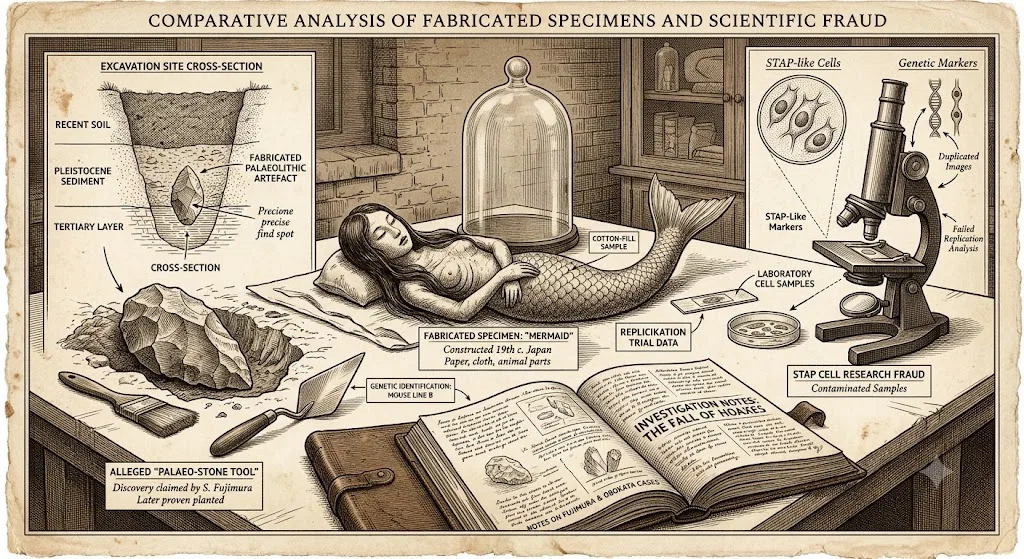
The cases also differ sharply. Archaeologist Shinichi Fujimura deliberately planted artefacts. Some mermaid specimens were manufactured curiosities whose makers and original purpose remain uncertain. The famous tale of women dying from modesty in a Tokyo department-store fire is better understood as an embellished urban legend. The 1923 earthquake rumours were false accusations spread in a climate of panic and prejudice. Understanding those differences matters, because “hoax” can otherwise blur fraud, folklore, propaganda, scientific misconduct and sincere error into one misleading category.
The planted past that rewrote Japanese prehistory
The most consequential archaeological fraud in modern Japan centred on Shinichi Fujimura, an amateur investigator celebrated for an apparently extraordinary ability to locate ancient stone tools. From the 1970s onwards, his discoveries seemed to push human occupation of the Japanese islands further and further into the past. His success earned him a reputation as a man with almost supernatural archaeological instincts, while sites associated with his work attracted academic attention, public funding and local tourism.
The claims were attractive because they answered a question with national and scientific importance: how early had humans lived in Japan? Fujimura repeatedly produced artefacts from geological layers thought to be hundreds of thousands of years old. Once influential researchers accepted the broad outline, each new find appeared to confirm the previous ones. Volcanic deposits could date the surrounding layer, but that did not prove that an object had originally entered the layer in antiquity. Critics pointed to inconsistencies, yet their objections did not overcome the authority and momentum surrounding the discoveries.[J-STAGE]jstage.jst.go.jpJ-STAGEpostwar Japanese archaeology and the Early Paleolithic…For the people, by the people: postwar Japanese archaeology and the Earl…
The fraud collapsed in November 2000, when journalists from the Mainichi Shimbun secretly filmed Fujimura burying stone objects at excavation sites before their supposed discovery. He admitted planting artefacts. Subsequent investigations reviewed sites connected with him and concluded that the finds lacked scientific value. The scandal did not merely remove a few doubtful objects from museum cases: it erased much of the proposed Japanese “early Palaeolithic” record that had been constructed around his work.[The Guardian]theguardian.comThe GuardianNewspaper unearths archaeologist's fake find | World news5 Nov 2000 — But 61 of the 65 stone items dug up were from Mr Fujimu…
The deeper failure was institutional. Fujimura supplied spectacular results that fitted hopes for a longer national prehistory, while researchers, museums, government bodies and communities had incentives to treat those results as genuine. Archaeologist Mark Hudson has argued that post-war enthusiasm for archaeology as a democratic “people’s history” helped create a receptive climate. The lesson was not that amateur researchers were inherently unreliable, but that charisma, repeated success and an appealing historical story had substituted for independent verification.[J-STAGE]jstage.jst.go.jpJ-STAGEpostwar Japanese archaeology and the Early Paleolithic…For the people, by the people: postwar Japanese archaeology and the Earl…
The scandal changed later practice. Japanese archaeological discussions of exceptionally early sites became more cautious, with researchers more attentive to excavation context, independent confirmation and the possibility that an impressive object may be genuine but improperly placed. The case remains a warning about discoveries that depend too heavily on one remarkably fortunate finder.[archaeology.jp]archaeology.jpOverview: Japanese Archaeological Research Trends 2020Discussions have proceeded with caution, due to critical reflection following the P…

Mermaids made from paper, cloth and fish
Japan’s manufactured mermaid bodies belong to a murkier category. They are clearly artificial objects, but it is often difficult to establish whether they began as deliberate frauds, religious or folkloric images, travelling curiosities, commercial souvenirs, or some combination of these.
Small dried creatures resembling a human or monkey torso attached to a fish tail circulated in Japan and entered foreign collections, especially during the nineteenth century. Western showmen later promoted similar specimens as genuine zoological marvels. Their disturbing appearance worked because they incorporated recognisable biological details: teeth, hair, scales, fins or claws. Seen in a dim cabinet and accompanied by a story of capture in distant waters, a composite object could feel more persuasive than a painting of a mythical animal.
Modern imaging has shown how such specimens were constructed. Examination of a “merman” at London’s Horniman Museum found wooden supports, wire framing, animal jaws and genuine fish fin rays rather than the skeleton of an unknown species. The object was not simply half a monkey sewn to half a fish, as popular summaries often claim; it was a carefully fabricated figure combining animal material with sculptural components.[Horniman Museum and Gardens]horniman.ac.ukHorniman Museum and GardensUnmasking the mysterious mermanFeb 21, 2012 — There is no skull, although there are bony jaws and teeth indica…
A specimen kept at Enjuin temple in western Japan underwent X-rays, computed tomography, radiocarbon dating and material analysis in 2022–23. Despite a story that it had been caught in the eighteenth century, researchers found no complete internal skeleton. Its body was largely constructed from cloth, paper and cotton-like material, coated with a substance containing powdered charcoal and sand. Fish scales and other animal parts had been attached to the surface, while a real jaw was incorporated into the head. Dating suggested that some components came from the nineteenth century.[Jerusalem Post]jpost.comJerusalem Post'Mermaid' mummy worshipped in Japan found to be a dollFebruary 20, 2023 — 20 Feb 2023 — A creature resembling a mummified mermaid, which has been worshipped by Japanese people for decades, ha…
These objects reveal how deception can outlive its original sales pitch. A manufactured creature may begin as a curiosity sold to travellers, become a religiously significant possession, enter a museum as ethnographic material and finally be retold online as a “mummy mystery”. Scientific investigation can establish what it is made from, but not always who made it or whether every viewer was expected to believe it was literally real. That uncertainty is part of the story rather than a reason to label every owner or worshipper a participant in fraud. Scholarship on Japanese mermaid mummies places them within early-modern commerce, craft and changing encounters between folklore and natural science.[Brill]brill.comOpen source on brill.com.
The stem-cell breakthrough that would not reproduce
The 2014 stem-cell affair showed how a questionable claim can spread through elite science rather than sideshows or popular folklore. Two papers in Nature reported a remarkably simple method for producing versatile stem cells from ordinary mouse cells. According to the claim, exposing cells to severe stress, including an acidic solution, could return them to a state capable of developing into many tissue types. The proposed phenomenon was called stimulus-triggered acquisition of pluripotency, or STAP.
The claim was persuasive because it promised to make cellular reprogramming dramatically easier. Haruko Obokata, the lead researcher at the government-backed RIKEN institute, became the public face of a discovery presented as a major Japanese scientific achievement. Prestigious co-authors, a leading research centre and publication in one of the world’s foremost journals all acted as signals of reliability.
Problems emerged rapidly. Other laboratories could not reproduce the results, while researchers and online commentators identified duplicated or improperly altered images and inconsistencies between the papers and Obokata’s earlier work. RIKEN’s investigation concluded in April 2014 that two instances amounted to research misconduct. The papers were retracted that July.[riken.jp]riken.jpOpen source on riken.jp.
Failure to reproduce the method was ultimately more important than any single suspicious image. Controlled attempts by several laboratories could not confirm the phenomenon. Genetic analysis indicated that material described as STAP cells was consistent with contamination by established embryonic stem-cell lines. Differences in the sex and genetic identity of the mice and cells provided especially strong evidence that the reported transformations had not occurred as claimed.[nature.com]nature.comOpen source on nature.com.
The affair is sometimes described simply as a hoax, but the scientific record supports more precise wording. Investigators established misconduct in the presentation of evidence and found that the central result was not reproducible. They did not produce a complete public reconstruction assigning personal responsibility for every contaminated sample and incorrect conclusion. Obokata continued to dispute important aspects of the findings. The safe conclusion is that the celebrated breakthrough collapsed, not that every participant knowingly conspired to invent it.
The case exposed vulnerabilities that extend well beyond Japan: journals reward novelty, institutions publicise breakthroughs before independent replication, and media narratives often centre on a charismatic individual. Retractions corrected the literature, but only after the claim had become international news and careers had been severely damaged. It demonstrated why peer review is a preliminary filter, not proof that an extraordinary result is true.
A fire tragedy turned into a story about women’s modesty
On 16 December 1932, a fire at the Shirokiya department store in Tokyo killed 14 people and injured many more. The documented disaster later acquired an enduring explanatory legend: women wearing traditional clothing supposedly refused to jump into fire-service safety nets because they were not wearing Western-style underwear and feared being seen from below. According to later versions, some chose death rather than embarrassment, and the incident persuaded Japanese women to adopt modern undergarments.
The story survives because it offers a neat cultural turning point. A single dramatic event appears to explain a visible change in clothing, while contrasting “traditional” Japanese modesty with Western modernity. It also appealed to foreign writers looking for picturesque stories about social change.
The evidence does not support the tale in that form. People did jump or use ropes improvised from fabric, and some died after falling during attempts to escape. There is no sound evidence that women knowingly refused rescue because of underwear. Research by cultural historian Shoichi Inoue traced the modesty explanation as a later fabrication or embellishment rather than a reliable account of the victims’ decisions. Even official and reference publications repeated it, showing how institutional repetition can turn an anecdote into accepted history.[Wikipedia]WikipediaShirokiya Department Store fireShirokiya Department Store fire
This is not a conventional hoax with a clearly identified inventor. It is an urban legend built around a real catastrophe. Its persistence illustrates a common pattern: later generations remember the symbolic story more readily than the confused physical realities of smoke, height, inadequate equipment and desperate escape. Debunking it does not minimise the fire. It restores the victims’ actions from a stereotype that portrayed them as fatally irrational.
When false earthquake rumours became deadly
The false rumours following the Great Kanto Earthquake of 1 September 1923 belong in a history of deception, but not as an amusing curiosity. After the earthquake and the fires that devastated Tokyo, Yokohama and surrounding districts, claims spread that ethnic Koreans were poisoning wells, setting fires, carrying bombs or preparing an uprising.
These accusations drew credibility from existing colonial racism and political suspicion. Japan had annexed Korea in 1910, and Koreans living in Japan were already vulnerable to discrimination. In the disorder after the earthquake, damaged communications made verification difficult, while people were desperate for explanations and enemies. Police statements, newspaper reporting and word of mouth helped transform unsupported allegations into apparent emergency intelligence.[JSTOR]jstor.orgThe Great Kanto EarthquakeThe Great Kanto Earthquake
Vigilante groups, police and military personnel killed thousands of Koreans; Chinese residents and Japanese people mistaken for Koreans were also attacked. Exact totals remain disputed, but the relationship between baseless rumours and mass violence is firmly documented. Accounts preserved by Brown University and later historical research describe repeated allegations of poisoned water and coordinated arson for which no evidence existed.[Brown University Library]library.brown.eduOpen source on brown.edu.
Unlike Fujimura’s planted artefacts, the rumours cannot be reduced to one author executing a carefully designed hoax. Some people may have knowingly invented accusations; others repeated them from fear or prejudice; officials gave false reports greater authority. The episode shows why the boundary between rumour, propaganda and deliberate deception matters less than the machinery of amplification. Once an allegation matched existing hostility and appeared to come from several sources, denial became dangerous and evidence was no longer required.
The same pattern remains relevant during later disasters. False reports spread quickly when official information is delayed, images are difficult to verify and people seek immediate explanations. Recent Japanese disaster coverage has documented fabricated rescue requests, recycled photographs and artificial-intelligence-generated images circulating through social media, sometimes diverting attention from genuine emergencies.[Nippon]nippon.comDisaster and Disinformation: Spotting Fake News to SaveDisaster and Disinformation: Spotting Fake News to Save
Satire, folklore and fraud are not the same thing
Japan’s history of questionable claims is most useful when the cases are separated by intent and evidence rather than grouped as a parade of oddities.
Deliberate fraud involves a conscious effort to create false evidence or obtain trust under false pretences. Fujimura’s planted tools are the clearest example because the physical act of deception was filmed and admitted.
Scientific misconduct concerns unreliable research practices, manipulated evidence or fabricated results. The STAP affair belongs here. The central scientific claim failed, but responsibility must be described according to the findings of investigations rather than expanded into an unsupported conspiracy.
Manufactured curiosities may deceive purchasers while also functioning as artworks, devotional objects or entertainment. Japanese mermaid mummies are artificial, yet the intentions of their original makers are often undocumented.
Urban legends grow through repetition and narrative appeal. The Shirokiya underwear story lacks a proven mastermind; it attached a culturally satisfying explanation to a genuine tragedy.
Rumours and propaganda can combine sincere fear with intentional incitement. The 1923 accusations against Koreans were false and devastating even though every person who repeated them did not necessarily know they were false.
Satire openly fabricates for comic or critical effect. Problems arise when headlines are detached from their original setting and recirculated as reporting. Japan’s long-running satirical news site Kyoko Shimbun, for example, has repeatedly had fictional stories mistaken for genuine news despite labelling intended to signal their nature. That is a failure of context and distribution rather than proof that satire itself is fraudulent.[Wikipedia]WikipediaKyoko ShimbunKyoko Shimbun
This classification prevents two opposite mistakes. One is treating every legend as a malicious plot. The other is assuming that false claims are harmless because their origins are uncertain or playful. Intent helps explain a case, but consequences depend on who repeats the claim, which institutions validate it and whether correction arrives before money, reputations or lives are lost.
Why the stories keep returning
Japan’s famous hoaxes endure because each offers more than a false fact. Fujimura’s tools promised an ancient national past. Mermaid bodies made folklore tangible. STAP cells promised a scientific revolution. The department-store legend compressed social modernisation into one memorable incident. Earthquake rumours turned chaos into a story with identifiable villains.
Exposure rarely destroys those underlying attractions. Photographs of Fujimura planting artefacts ended the archaeological claims, yet the scandal remains compelling as a study of expert failure. Scans showing paper and fish scales inside a mermaid do not make the object less fascinating; they redirect attention towards craft, commerce and belief. The STAP papers were retracted, but simplified versions still circulate because miraculous medical breakthroughs are easier to remember than genetic analyses and failed replication trials.
The strongest protection is not blanket scepticism. It is a set of habits shaped by these cases: ask whether evidence was independently obtained, separate an object’s age from the age claimed for its discovery, check whether other laboratories can reproduce a result, distinguish a contemporary record from a later anecdote, and examine whether authorities are merely repeating one another. Japan’s hoax history is therefore not a catalogue of national gullibility. It is a record of how persuasive stories acquire institutional support—and how patient investigation can take that support away.
Amazon book picks
Further Reading
Books and field guides related to How Japan's Most Famous Hoaxes Fell Apart. Use these as the next step if you want deeper reading beyond the article.
The Demon-Haunted World
Rating: 4.5/5 from 43 Google Books ratings
Directly relevant to evaluating hoaxes, frauds and folklore.
People Who Eat Darkness
Demonstrates media narratives and public perception in modern Japan.
eBay marketplace picks
Marketplace Samples
Live-tested eBay searches with available results related to this page.

Endnotes
1.
Source: archaeology.jp
Link:https://archaeology.jp/overview/679
Source snippet
Overview: Japanese Archaeological Research Trends 2020Discussions have proceeded with caution, due to critical reflection following the P...
2.
Source: brill.com
Link:https://brill.com/edcollchap/book/9789004685208/BP000014.pdf?srsltid=AfmBOorKAMaxs8nC-YfY-3PbM9Ro8_icOKzYKNpRsHkLYYVVoFjIcBLr
3.
Source: riken.jp
Link:https://www.riken.jp/en/news_pubs/research_news/pr/2014/20140401_2/
4.
Source: nature.com
Link:https://www.nature.com/articles/nature.2014.14974
5.
Source: nature.com
Link:https://www.nature.com/articles/nature13598
6.
Source: nature.com
Link:https://www.nature.com/articles/nature.2015.18412
7.
Source: Wikipedia
Title: Shirokiya Department Store fire
Link:https://en.wikipedia.org/wiki/Shirokiya_Department_Store_fire
8.
Source: jstor.org
Title: The Great Kanto Earthquake
Link:https://www.jstor.org/stable/3318287
9.
Source: library.brown.edu
Link:https://library.brown.edu/cds/kanto/denewa.html
10.
Source: nippon.com
Title: Disaster and Disinformation: Spotting Fake News to Save
Link:https://www.nippon.com/en/japan-topics/bg900565/
11.
Source: Wikipedia
Title: Kyoko Shimbun
Link:https://en.wikipedia.org/wiki/Kyoko_Shimbun
12.
Source: jstage.jst.go.jp
Link:https://www.jstage.jst.go.jp/article/ase/advpub/0/advpub_0_0502260021/_article/-char/en
Source snippet
J-STAGEpostwar Japanese archaeology and the Early Paleolithic...For the people, by the people: postwar Japanese archaeology and the Earl...
13.
Source: jstage.jst.go.jp
Link:https://www.jstage.jst.go.jp/article/ase/advpub/0/advpub_0_0502260021/_pdf/-char/en
Source snippet
J-STAGEpostwar Japanese archaeology and the Early Paleolithic...28 Feb 2005 — The Japanese Archaeological Association (JAA) recently pub...
14.
Source: theguardian.com
Link:https://www.theguardian.com/world/2000/nov/06/3
Source snippet
The GuardianNewspaper unearths archaeologist's fake find | World news5 Nov 2000 — But 61 of the 65 stone items dug up were from Mr Fujimu...
15.
Source: jstage.jst.go.jp
Link:https://www.jstage.jst.go.jp/article/ase/113/2/113_2_131/_article
Source snippet
J-STAGEpostwar Japanese archaeology and the Early Paleolithic...As a result of this hoax, the existence of an Early Paleolithic stretchi...
16.
Source: horniman.ac.uk
Link:https://www.horniman.ac.uk/story/unmasking-the-mysterious-merman/
Source snippet
Horniman Museum and GardensUnmasking the mysterious mermanFeb 21, 2012 — There is no skull, although there are bony jaws and teeth indica...
17.
Source: jpost.com
Title: Jerusalem Post’Mermaid’ mummy worshipped in Japan found to be a doll
Link:https://www.jpost.com/archaeology/article-732116
Source snippet
February 20, 2023 — 20 Feb 2023 — A creature resembling a mummified mermaid, which has been worshipped by Japanese people for decades, ha...
Published: February 20, 2023
18.
Source: pubmed.ncbi.nlm.nih.gov
Link:https://pubmed.ncbi.nlm.nih.gov/26399835/
Additional References
19.
Source: apnews.com
Link:https://apnews.com/article/64e84452dacfec3b7b6024b107b1a77d
20.
Source: newyorker.com
Link:https://www.newyorker.com/magazine/2016/02/29/the-stem-cell-scandal
21.
Source: youtube.com
Title: The Biggest Fraud in Stem Cell History
Link:https://www.youtube.com/watch?v=aYvnpezbpKE
Source snippet
The Most Fraudulent Medical 'Breakthrough' in History?...
22.
Source: youtube.com
Title: The Most Fraudulent Medical ‘Breakthrough’ in History?
Link:https://www.youtube.com/watch?v=e6ivl_NkNAQ
Source snippet
Japan: Mysteries Caught on Camera...
23.
Source: jref.com
Title: underwear and shame in japan.122
Link:https://jref.com/articles/underwear-and-shame-in-japan.122/
24.
Source: youtube.com
Title: Japan: Mysteries Caught on Camera
Link:https://www.youtube.com/watch?v=vYV8EiBNSDU
Source snippet
Harvard's FeeJee mermaid...
25.
Source: explorersweb.com
Title: mermaid mummy japanese temple
Link:https://explorersweb.com/mermaid-mummy-japanese-temple/
26.
Source: youtube.com
Title: Harvard’s Fee Jee mermaid
Link:https://www.youtube.com/watch?v=MeK40LXEIO4
Source snippet
Feejee Mermaid & Centaur of Tymfi...
27.
Source: youtube.com
Title: Feejee Mermaid & Centaur of Tymfi
Link:https://www.youtube.com/watch?v=qQL5pJgM-XM
28.
Source: icu.repo.nii.ac.jp
Title: S31 07Ishiguro
Link:https://icu.repo.nii.ac.jp/record/2784/files/ACS31_07Ishiguro.pdf
Topic Tree
Follow this branch
Related pages 192
- Albanian Hoaxes
- Algerian Hoaxes
- Antigua Deceptions
- Argentina Hoaxes
- Armenian Hoaxes
- +187 more in sidebar