Within Guinea Deceptions
How Rumours and Fake Images Shape Political Crises
Modern Guinea has seen rumours and doctored images circulate rapidly during moments of national uncertainty and political change.
On this page
- The School Vaccination Panic
- Doctored Images and Social Media
- Verifying Claims During Upheaval
Page outline Jump by section
Introduction
In modern Guinea, some of the most influential false stories have not been elaborate hoaxes but fast-moving rumours and misleading images that spread during moments of fear and political uncertainty. The Ebola epidemic of 2014–16 and the military coup of September 2021 created environments in which many people struggled to distinguish verified information from speculation, propaganda and outright fabrication. In both cases, uncertainty itself became a resource. During the Ebola crisis, rumours claimed that health workers were infecting children, spreading disease deliberately or hiding sinister motives. During the coup and its aftermath, social media users circulated old photographs, altered images and misleading captions that appeared to offer dramatic evidence of events on the ground. These episodes show how misinformation flourishes when trust is fragile, information is scarce and emotions are running high.[ReliefWeb]reliefweb.intguinea scrambles shut down false vaccination rumorGuinea Scrambles to Shut Down False Vaccination Rumor15 Feb 2015 — Health Minister Colonel Remy Lamah told VOA the rumors were “…
The School Vaccination Panic
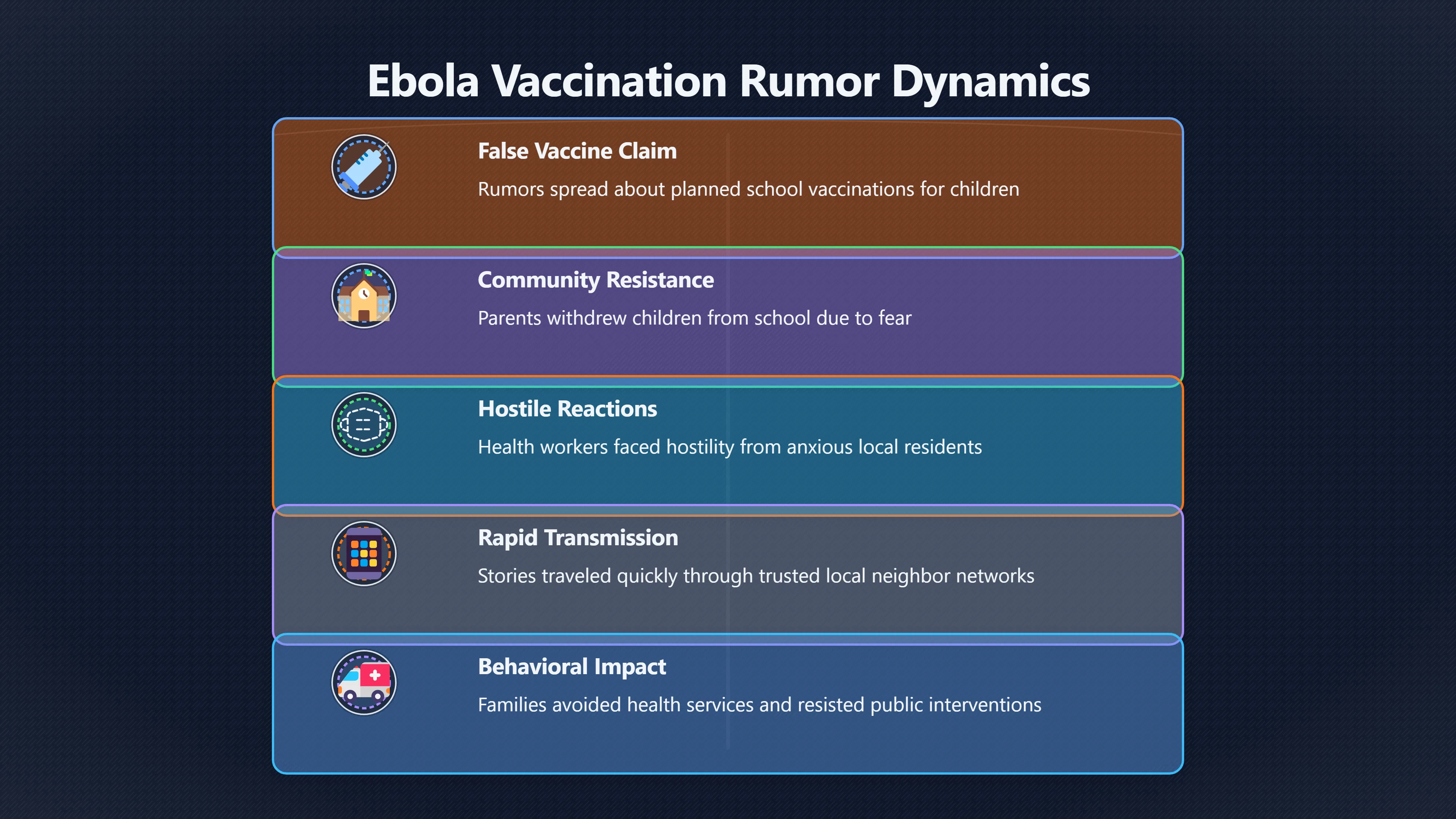
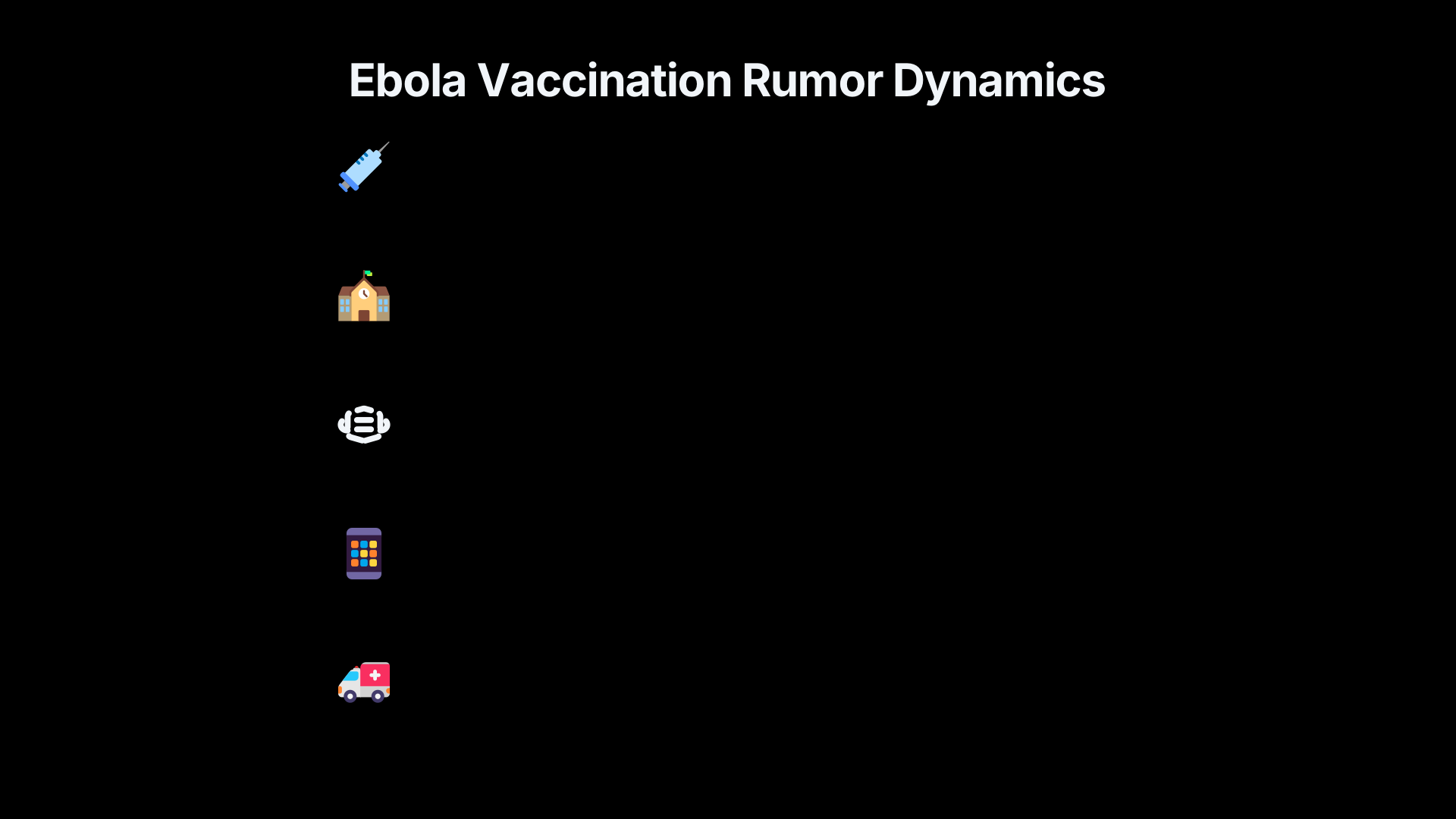
One of the clearest examples of Ebola-era misinformation emerged in early 2015, when rumours spread that international organisations were preparing to vaccinate Guinean schoolchildren against Ebola. The claim was false. Authorities repeatedly stated that no such school vaccination campaign was planned, yet the rumour spread rapidly through communities and social networks. Parents withdrew children from school, students protested, and some health workers became targets of hostility.[Voice of America]voanews.comVoice of America Guinea Scrambles to Shut Down False Vaccination RumorVoice of AmericaGuinea Scrambles to Shut Down False Vaccination RumorFebruary 15, 2015 — 15 Feb 2015 — Man is accused of spreading vaccin…
The story succeeded because it fitted existing fears. Ebola treatment centres were unfamiliar institutions. Protective suits, quarantine measures and restrictions on traditional burial practices all appeared strange and threatening to many communities experiencing the epidemic for the first time. Rumours that outsiders were using children for medical experiments or deliberately spreading disease therefore found an audience among people already anxious about the crisis.[Wikipedia]WikipediaEbola virus epidemic in GuineaEbola virus epidemic in Guinea
Researchers studying Ebola-related rumours in West Africa found that stories involving schools and children were especially powerful because they touched on parental fears. In some communities, claims circulated that Ebola had been placed on school furniture or that educational institutions were becoming sites of infection. Such stories often travelled faster than official health messages because they were passed between trusted relatives, neighbours and local networks.[Wiley Online Library]onlinelibrary.wiley.comNew Ebola cases, Reports of the next outbreak…Read more…
The consequences were not merely informational. Rumours affected behaviour. Families avoided health services, some communities resisted public-health interventions, and disease-control efforts became more difficult. Public-health agencies increasingly recognised that fighting Ebola required not only medical resources but also active responses to misinformation and mistrust.[Wikipedia]WikipediaWestern African Ebola epidemicWestern African Ebola epidemic
Why Ebola Rumours Became So Persuasive
The Ebola epidemic generated a broader ecosystem of misinformation beyond the vaccination scare. Some rumours claimed that the disease did not exist. Others alleged that health workers were intentionally infecting people, harvesting organs or profiting from the emergency. In several locations, suspicion of medical teams led to protests, attacks and resistance to containment measures.[Wikipedia]WikipediaEbola virus epidemic in GuineaEbola virus epidemic in Guinea
These stories did not emerge in a vacuum. Several factors made them believable:
- Limited trust in state institutions after decades of political tension and uneven public services.
- Unfamiliar medical practices, including isolation wards and protective equipment.
- Fear of death and contagion, which encouraged people to seek explanations outside official channels.
- Rapid word-of-mouth transmission, often amplified by local radio, mobile phones and community gossip.[wikipedia.org]WikipediaEbola virus epidemic in GuineaEbola virus epidemic in Guinea
Importantly, many of these claims were not coordinated propaganda campaigns. They often represented sincere attempts by frightened people to interpret confusing events. That distinction matters. A rumour can be false and damaging without having a single identifiable creator. Yet once such stories circulated widely, they could be exploited by political actors, opportunists or groups seeking to undermine official responses.[ReliefWeb]reliefweb.intguinea scrambles shut down false vaccination rumorGuinea Scrambles to Shut Down False Vaccination Rumor15 Feb 2015 — Health Minister Colonel Remy Lamah told VOA the rumors were “…
Doctored Images and Social Media During Political Upheaval
The military overthrow of President Alpha Condé on 5 September 2021 created a different but equally fertile environment for misinformation. In the hours after gunfire erupted in Conakry and uncertainty surrounded the fate of the president, social media became a primary source of information for many observers inside and outside Guinea.[Wikipedia]Wikipedia2021 Guinean coup d'étatSeptember 5, 2021 — On 5 September 2021, President of Guinea Alpha Condé was captured by the country's armed forces in a coup d'état afte…
During fast-moving political crises, dramatic images often travel further than verified reporting. Users circulated photographs claiming to show battles, arrests, crowds or military movements. Some images were genuine but taken out of context. Others were old photographs from unrelated events, sometimes from different countries entirely. In several cases, images acquired new meanings simply through misleading captions attached after the coup. Such material could create the impression that events were larger, more violent or more organised than evidence supported.[wikipedia.org]Wikipedia2021 Guinean coup d'étatSeptember 5, 2021 — On 5 September 2021, President of Guinea Alpha Condé was captured by the country's armed forces in a coup d'état afte…
This pattern is common during political shocks. A striking photograph shared thousands of times can shape public perceptions before journalists or investigators have time to verify it. Once a visual claim becomes emotionally compelling, corrections often struggle to reach the same audience.

How Misleading Political Images Work
The most effective political image misinformation rarely involves sophisticated forgery. Instead, it often relies on simpler techniques:
- Recycling old photographs and presenting them as current events.
- Removing context so that a genuine image appears to depict something different.
- Misleading captions that transform the meaning of an otherwise authentic picture.
- Selective cropping that hides important details.
- Basic digital editing that inserts or removes people, objects or symbols.[arXiv]arxiv.orgOpen source on arxiv.org.
These methods succeed because photographs carry an aura of authenticity. Viewers tend to trust visual evidence, especially during crises when reliable information is scarce. The emotional impact of an image can outweigh caution about its origin.
In Guinea’s coup period, as in many other political transitions, the challenge was not simply identifying fabricated pictures. It was determining whether genuine images were being used honestly. An authentic photograph can become misinformation when detached from its original time, place or purpose.
Verifying Claims During Upheaval
The experiences of Ebola and the 2021 coup highlight several lessons about verification during national emergencies.
First, uncertainty should not be mistaken for proof. During both the epidemic and the coup, information gaps encouraged speculation. Claims often spread because people wanted immediate answers rather than because evidence existed.[ReliefWeb]reliefweb.intguinea scrambles shut down false vaccination rumorGuinea Scrambles to Shut Down False Vaccination Rumor15 Feb 2015 — Health Minister Colonel Remy Lamah told VOA the rumors were “…
Second, visual material requires context. A photograph showing soldiers, crowds or medical workers may be genuine while still supporting a false narrative if key details are omitted. Reverse-image searches, geolocation work and comparison with established reporting became increasingly important tools for journalists and fact-checkers during political crises.[arXiv]arxiv.orgOpen source on arxiv.org.
Third, trusted local communication matters. Public-health researchers studying Ebola found that rumours were hardest to counter when official messages travelled through channels that communities did not trust. Information delivered by respected local figures often proved more effective than distant announcements.[Wiley Online Library]onlinelibrary.wiley.comNew Ebola cases, Reports of the next outbreak…Read more…
What These Episodes Reveal About Modern Guinea
The Ebola rumours and coup-era image distortions belong to different historical moments, yet they reveal a common pattern. False information gains strength when people face uncertainty, fear or abrupt political change. The decisive factor is usually not the sophistication of the deception but the conditions into which it arrives.
In Guinea, rumours about vaccines and fabricated or misleading political imagery became influential because they addressed urgent public anxieties. Parents worried about their children. Citizens worried about disease, violence and political power. When reliable information struggled to keep pace with events, alternative explanations filled the gap.[voanews.com]voanews.comVoice of America Guinea Scrambles to Shut Down False Vaccination RumorVoice of AmericaGuinea Scrambles to Shut Down False Vaccination RumorFebruary 15, 2015 — 15 Feb 2015 — Man is accused of spreading vaccin…
These episodes therefore illuminate more than individual falsehoods. They show how trust, communication and public credibility become crucial battlegrounds during crises. Whether the medium is a whispered rumour, a viral social-media post or a doctored photograph, misinformation succeeds most readily when uncertainty leaves people searching for answers.[arxiv.org]arxiv.orgOpen source on arxiv.org.
Amazon book picks
Further Reading
Books and field guides related to How Rumours and Fake Images Shape Political Crises. Use these as the next step if you want deeper reading beyond the article.
The Misinformation Age
Directly relevant to rumors, false claims and information cascades.
eBay marketplace picks
Marketplace Samples
Live-tested eBay searches with available results related to this page.
Endnotes
1.
Source: reliefweb.int
Title: guinea scrambles shut down false vaccination rumor
Link:https://reliefweb.int/report/guinea/guinea-scrambles-shut-down-false-vaccination-rumor
Source snippet
Guinea Scrambles to Shut Down False Vaccination Rumor15 Feb 2015 — Health Minister Colonel Remy Lamah told VOA the rumors were “...
2.
Source: Wikipedia
Title: Ebola virus epidemic in Guinea
Link:https://en.wikipedia.org/wiki/Ebola_virus_epidemic_in_Guinea
3.
Source: onlinelibrary.wiley.com
Link:https://onlinelibrary.wiley.com/doi/10.1111/disa.12552
Source snippet
New Ebola cases, Reports of the next outbreak...Read more...
4.
Source: Wikipedia
Title: Western African Ebola epidemic
Link:https://en.wikipedia.org/wiki/Western_African_Ebola_epidemic
5.
Source: Wikipedia
Title: Health in Guinea
Link:https://en.wikipedia.org/wiki/Health_in_Guinea
6.
Source: Wikipedia
Title: Cultural effects of the Western African Ebola virus epidemic
Link:https://en.wikipedia.org/wiki/Cultural_effects_of_the_Western_African_Ebola_virus_epidemic
7.
Source: Wikipedia
Title: 2021 Guinean coup d’état
Link:https://en.wikipedia.org/wiki/2021_Guinean_coup_d%27%C3%A9tat
Source snippet
September 5, 2021 — On 5 September 2021, President of Guinea Alpha Condé was captured by the country's armed forces in a coup d'état afte...
Published: September 5, 2021
8.
Source: arxiv.org
Link:https://arxiv.org/pdf/2407.07695
9.
Source: voanews.com
Title: Voice of America Guinea Scrambles to Shut Down False Vaccination Rumor
Link:https://www.voanews.com/a/guinea-scrambles-to-shut-down-false-vaccination-rumor/2644744.html
Source snippet
Voice of AmericaGuinea Scrambles to Shut Down False Vaccination RumorFebruary 15, 2015 — 15 Feb 2015 — Man is accused of spreading vaccin...
Published: February 15, 2015
10.
Source: theguardian.com
Title: guinean soldiers claim to have seized power in coup attempt
Link:https://www.theguardian.com/world/2021/sep/05/guinean-soldiers-claim-to-have-seized-power-in-coup-attempt
Source snippet
The GuardianGuinean soldiers claim to have seized power in coup attempt5 Sept 2021 — An elite army unit has announced it has seized power...
Additional References
11.
Source: youtube.com
Title: What’s behind the wave of military coups in Africa? | DW News Africa
Link:https://www.youtube.com/watch?v=NS4aF11yWVQ
Source snippet
Guinea coup 2021 misinformation fake news Mali: Misinformation circulates on social media in aftermath of coup | #TheCube euronews...
12.
Source: youtube.com
Title: ‘The president is with us,’ Guinea’s coup leader tells FRANCE 24
Link:https://www.youtube.com/watch?v=5PNjB2LzCZQ
Source snippet
What's behind the wave of military coups in Africa? | DW News Africa...
13.
Source: youtube.com
Title: Former African presidents dogged by fake news • FRANCE 24 English
Link:https://www.youtube.com/watch?v=1fkf5ewveAs
Source snippet
Guinea coup leader bars foreign travel for government officials...
14.
Source: youtube.com
Title: Guinea coup leader bars foreign travel for government officials
Link:https://www.youtube.com/watch?v=z9RwKWtS1UA
Source snippet
'The president is with us,' Guinea's coup leader tells FRANCE 24...
15.
Source: youtube.com
Title: Exposing Rumors, Suspicions Key to Ebola Fight
Link:https://www.youtube.com/watch?v=WPQm3lora-k
Source snippet
Former African presidents dogged by fake news • FRANCE 24 English...
16.
Source: reddit.com
Link:https://www.reddit.com/r/pics/comments/pik0ty/a_coup_detat_is_happening_in_guinea_the_military/
17.
Source: instagram.com
Link:https://www.instagram.com/reel/DRyr1agAaef/
18.
Source: facebook.com
Link:https://www.facebook.com/UN.News.Centre/posts/ebola-is-more-than-a-health-emergency-its-a-development-and-economic-crisis-the-/1444138281085103/
19.
Source: cdcmuseum.org
Link:https://cdcmuseum.org/exhibits/show/ebola/ebola-us/fear-rumors
20.
Source: facebook.com
Link:https://www.facebook.com/WHOAFRO/posts/in-an-ebola-outbreak-a-message-that-is-technically-correct-is-not-always-enough-/1321122430194807/
Topic Tree