Within Swiss Hoaxes
Did William Tell Really Exist?
William Tell's story cannot be securely verified, yet its power as a symbol of liberty made it more durable than documentary fact.
On this page
- Where the Tell story first appears
- Why historians remain cautious
- How the legend became national memory
Page outline Jump by section
Introduction
Did William Tell really exist? The honest answer is that nobody knows. The famous Swiss archer who supposedly shot an apple from his son’s head and helped spark resistance against Habsburg rule occupies a space between folklore, political memory and history. Historians have never found contemporary records proving that Tell lived in the early fourteenth century, and the story only appears in surviving written sources roughly 150 years after the events it describes. Yet the legend became one of the most powerful narratives in Swiss culture, shaping ideas of liberty, independence and civic courage long after questions about its factual basis emerged. The story’s importance therefore lies not only in whether Tell was a real person, but in how a disputed tale became accepted as part of a nation’s historical identity.[nationalmuseum.ch]blog.nationalmuseum.chtells birth in the white book of sarnenSwiss History BlogThe White Book of Sarnen1 Apr 2019 — The oldest picture of William Tell, printed and reproduced in 1507 in Petermann Et…

Where the Tell Story First Appears
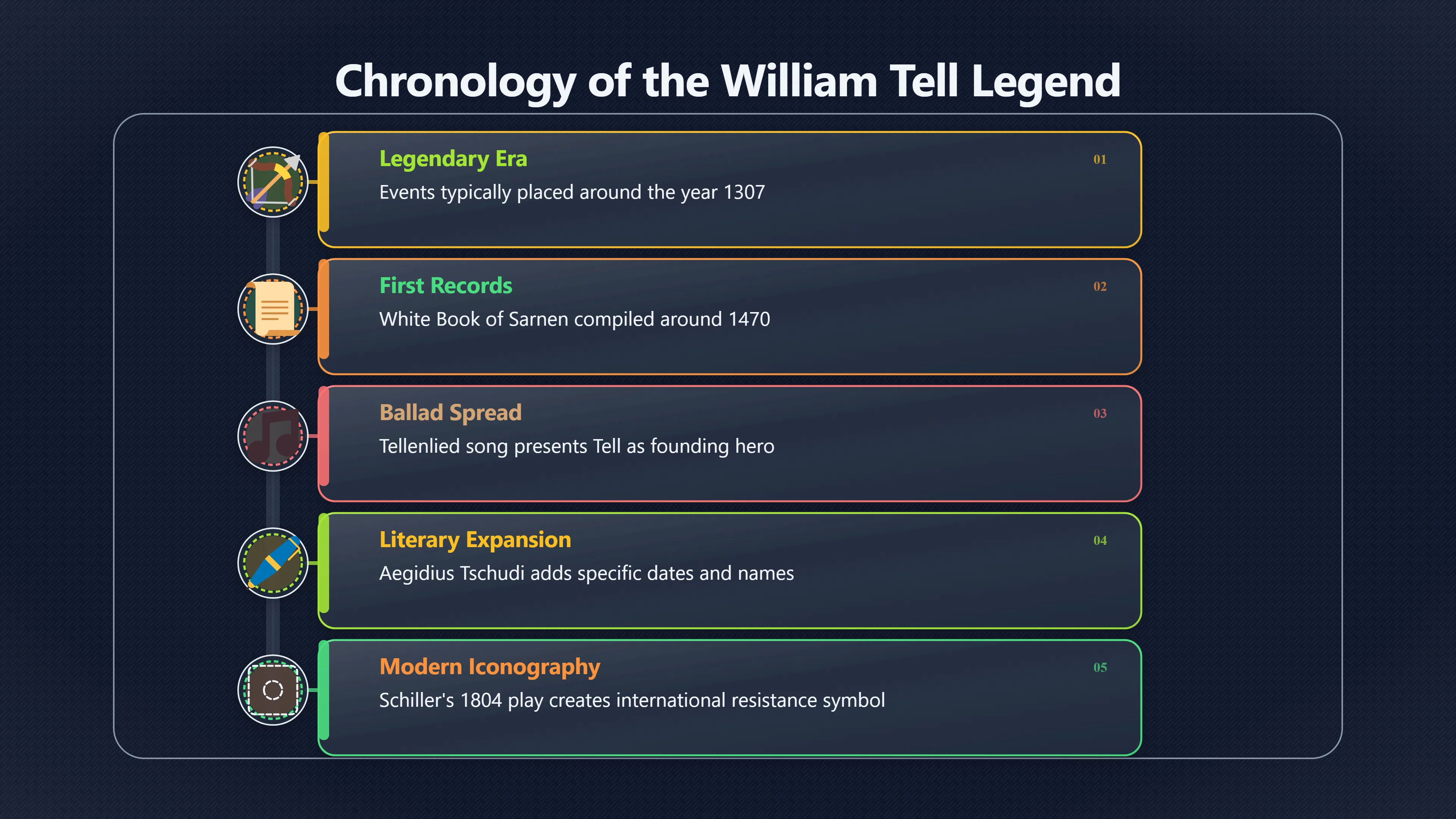
One of the most important facts about William Tell is that he arrives surprisingly late in the historical record. The earliest surviving reference appears in the White Book of Sarnen, a collection of documents and historical traditions compiled by the Obwalden state secretary Hans Schriber around 1470–1474. The manuscript combines official records with stories about the origins of the Swiss Confederation, including Tell’s defiance of a tyrannical ruler.[nationalmuseum.ch]blog.nationalmuseum.chtells birth in the white book of sarnenSwiss History BlogThe White Book of Sarnen1 Apr 2019 — The oldest picture of William Tell, printed and reproduced in 1507 in Petermann Et…
This timing matters. The legendary events are usually placed around 1307, meaning the earliest surviving written account was recorded about a century and a half later. Such a gap does not automatically make a story false. Oral traditions can preserve memories for generations. However, it does make verification difficult because there are no contemporary chronicles, government records or eyewitness accounts that clearly mention William Tell.[Wikipedia]WikipediaWhite Book of SarnenWhite Book of Sarnen
The story spread further through late fifteenth-century songs and chronicles. A ballad known as the Tellenlied presented Tell as a founding hero of the Confederation. Later writers expanded the tale, adding details that many readers now assume were ancient traditions. The sixteenth-century chronicler Aegidius Tschudi supplied much of the familiar narrative, including Tell’s full name, specific dates and additional dramatic episodes. Historians note that Tschudi often elaborated on earlier material, making it difficult to separate inherited tradition from later literary invention.[Wikipedia]WikipediaWilliam TellWilliam Tell
Why Historians Remain Cautious
The main reason historians hesitate to treat Tell as a proven historical figure is the lack of direct evidence. No reliable contemporary source from the period of the early Swiss Confederation confirms his existence. The legend emerges only after Swiss political identity had begun to strengthen, raising the possibility that the story developed as a symbolic explanation for real historical struggles.[History Extra]historyextra.comHistory ExtraWilliam Tell: was the legendary Swiss hero a real person?17 Jan 2025 — Despite a reputation enjoyed in Switzerland for centu…
Another difficulty is that key elements of the tale appear elsewhere in European folklore. The most famous example is the apple-shot episode. Long before William Tell appeared in Swiss texts, Scandinavian traditions told of master archers forced by rulers to shoot an object from a child’s head. The Danish hero Palnatoke provides the closest parallel. Like Tell, he prepares extra arrows and explains that they would have been used against the ruler if his child had been killed. Such similarities suggest that the Swiss story may have absorbed an older and widely shared folktale motif.[Wikipedia]WikipediaWilliam TellWilliam Tell
Scepticism is not a modern invention. As early as the seventeenth century, some scholars doubted the story’s authenticity. In the eighteenth century, the pastor Simeon Uriel Freudenberger argued that the Tell legend probably derived from Danish traditions. His conclusions proved deeply unpopular. Copies of a work promoting this interpretation were publicly burned in Altdorf, demonstrating how closely Tell had already become tied to Swiss identity.[Wikipedia]WikipediaWilliam TellWilliam Tell
For most historians today, the question is not whether every detail is inaccurate but whether enough evidence exists to treat Tell as a documented historical individual. The answer remains no. The available sources support the existence of a powerful legend, not a securely verified person.[History Extra]historyextra.comHistory ExtraWilliam Tell: was the legendary Swiss hero a real person?17 Jan 2025 — Despite a reputation enjoyed in Switzerland for centu…

Was It a Hoax, a Myth, or Something Else?
Within the broader history of Swiss hoaxes, disputed stories and invented traditions, William Tell occupies a special category. Unlike forged documents, fabricated relics or deliberate frauds, the Tell story is not generally regarded as a conscious hoax created to deceive people for financial gain. There is no evidence of a single inventor sitting down to fabricate the entire tale.[Swiss History Blog]blog.nationalmuseum.chtells birth in the white book of sarnenSwiss History BlogThe White Book of Sarnen1 Apr 2019 — The oldest picture of William Tell, printed and reproduced in 1507 in Petermann Et…
Instead, Tell is better understood as a national legend. Legends often combine fragments of real history, local memory, political aspirations and familiar folktale motifs. Over time, repetition can make such stories feel as authoritative as documented events. The boundary between symbolic truth and historical fact becomes blurred, especially when a narrative expresses values that communities want to preserve.[swisscommunity.org]swisscommunity.orgOpen source on swisscommunity.org.
This distinction matters because debates about Tell are not simply about proving or disproving a single claim. They concern how societies remember their origins. The story may not be verifiable history, but it helped generations of Swiss people explain ideas about resistance to oppression, local self-government and communal solidarity.[swisscommunity.org]swisscommunity.orgOpen source on swisscommunity.org.
How the Legend Became National Memory
The extraordinary durability of William Tell owes much to literature, art and politics. By the eighteenth and nineteenth centuries, the tale had become a powerful symbol of freedom. Friedrich Schiller’s 1804 play Wilhelm Tell transformed the Swiss archer into an international icon of resistance against tyranny. Many people encountered Tell through literature rather than historical scholarship, reinforcing the emotional power of the story.[About Switzerland]aboutswitzerland.eda.admin.chwilliam tell a symbol of switzerland known throughout the worldwilliam tell a symbol of switzerland known throughout the world
As modern nationalism developed across Europe, Switzerland found in Tell a figure who seemed to embody national virtues. Statues, paintings, school lessons and public commemorations elevated him from legendary archer to symbolic founder. The image proved useful because it offered a simple narrative of ordinary people standing up to powerful rulers.[Wikipedia]WikipediaWilliam TellWilliam Tell
The process illustrates how national memory often works. Historical accuracy is only one factor in determining whether a story survives. Emotional resonance, political usefulness and cultural repetition can be equally important. By the time historians began questioning Tell’s existence more systematically, the legend had already become woven into Swiss public culture.[Wikipedia]WikipediaWilliam TellWilliam Tell
What William Tell reveals about belief and deception
William Tell remains significant precisely because the historical verdict is uncertain. If historians had discovered definitive proof that he lived, the story would simply be biography. If they had found conclusive evidence that the legend was invented by a known author, it would be easier to dismiss. Instead, Tell occupies a fascinating middle ground where folklore, memory and history overlap.[History Extra]historyextra.comHistory ExtraWilliam Tell: was the legendary Swiss hero a real person?17 Jan 2025 — Despite a reputation enjoyed in Switzerland for centu…
The legend also serves as a reminder that national traditions are not always built on documentary certainty. Many societies possess founding stories that express shared values more clearly than they record verifiable events. Tell’s endurance reveals how narratives can become culturally true even when their historical status remains unresolved.[swisscommunity.org]swisscommunity.orgOpen source on swisscommunity.org.
For readers interested in Switzerland’s history of contested claims and enduring myths, William Tell is less a case of exposure than a case of persistence. Historians continue to question the evidence, yet the archer who first appeared in written form long after his supposed lifetime remains one of the most recognisable figures in Swiss history.[nationalmuseum.ch]blog.nationalmuseum.chtells birth in the white book of sarnenSwiss History BlogThe White Book of Sarnen1 Apr 2019 — The oldest picture of William Tell, printed and reproduced in 1507 in Petermann Et…
Amazon book picks
Further Reading
Books and field guides related to Did William Tell Really Exist?. Use these as the next step if you want deeper reading beyond the article.
A Concise History of Switzerland
Places the Tell story within Swiss national development.
The Invention of Tradition
Directly relevant to the creation and persistence of national legends.
Imagined Communities
Explains how national identities are built around shared stories and symbols.
eBay marketplace picks
Marketplace Samples
Live-tested eBay searches with available results related to this page.

Endnotes
1.
Source: Wikipedia
Title: White Book of Sarnen
Link:https://en.wikipedia.org/wiki/White_Book_of_Sarnen
2.
Source: Wikipedia
Title: William Tell
Link:https://en.wikipedia.org/wiki/William_Tell
3.
Source: Wikipedia
Title: Shooting an apple off one’s child’s head
Link:https://en.wikipedia.org/wiki/Shooting_an_apple_off_one%27s_child%27s_head
4.
Source: swisscommunity.org
Link:https://www.swisscommunity.org/en/news-media/swiss-revue/article/ein-einzig-land-von-mythen-warum-wilhelm-tell-und-der-ruetlischwur-so-wichtig-fuer-die-schweiz-sind
5.
Source: swiss.com
Title: Book flights with SWISS
Link:https://www.swiss.com/
6.
Source: youtube.com
Title: Uri | Did William Tell Really Exist?
Link:https://www.youtube.com/watch?v=N0qVOqJ1uj0
Source snippet
William Tell - The Arrow That Sparked A Nation...
7.
Source: youtube.com
Title: William Tell
Link:https://www.youtube.com/watch?v=3fae5Y3twNU
Source snippet
Myth or Reality?...
8.
Source: blog.nationalmuseum.ch
Title: tells birth in the white book of sarnen
Link:https://blog.nationalmuseum.ch/en/2019/04/tells-birth-in-the-white-book-of-sarnen/
Source snippet
Swiss History BlogThe White Book of Sarnen1 Apr 2019 — The oldest picture of William Tell, printed and reproduced in 1507 in Petermann Et...
9.
Source: historyextra.com
Link:https://www.historyextra.com/period/medieval/william-tell-real-person-apple-true-story/
Source snippet
History ExtraWilliam Tell: was the legendary Swiss hero a real person?17 Jan 2025 — Despite a reputation enjoyed in Switzerland for centu...
10.
Source: iiif.biblissima.fr
Link:https://iiif.biblissima.fr/collections/manifest/a2e7b9ee9a8d930dbc9b6a8cc6bdb604d96eac6e
Source snippet
Staatsarchiv Obwalden, Sig. A.02.CHR.00031 Description The "White Book of Sarnen" was written for the most part in the years 1470/1471. T...
11.
Source: applesandpeople.org.uk
Link:https://applesandpeople.org.uk/stories/tell/
Source snippet
Apples and PeopleThe Tale of William Tell18 Nov 2021 — The motif of an archer shooting an apple from his son's head is not uncommon – and...
12.
Source: aboutswitzerland.eda.admin.ch
Title: william tell a symbol of switzerland known throughout the world
Link:https://www.aboutswitzerland.eda.admin.ch/en/william-tell-a-symbol-of-switzerland-known-throughout-the-world
13.
Source: swissinfo.ch
Title: white book of sarnen
Link:https://www.swissinfo.ch/eng/culture/white-book-of-sarnen/251958
14.
Source: pdsh.fandom.com
Title: William Tell
Link:https://pdsh.fandom.com/wiki/William_Tell
Additional References
15.
Source: smithsonianmag.com
Link:https://www.smithsonianmag.com/history/in-search-of-william-tell-2198511/
Source snippet
Smithsonian MagazineIn Search of William TellSeven hundred years ago, William Tell shot an arrow through an apple on his son's head and l...
16.
Source: ebsco.com
Link:https://www.ebsco.com/research-starters/history/william-tell-folk-hero
Source snippet
William Tell (folk hero) | History | Research StartersBetween 1467 and 1474, Tell's story appeared again in a collection of document...
17.
Source: tell-film.com
Link:https://tell-film.com/en/history/
18.
Source: nidwalden.com
Link:https://www.nidwalden.com/en/poi/tell-museum
19.
Source: peelcompton.org
Link:https://peelcompton.org/the-legend-of-william-tell-history-education-recreation/
20.
Source: facebook.com
Link:https://www.facebook.com/groups/ancient10/posts/774771401954869/
21.
Source: facebook.com
Link:https://www.facebook.com/groups/historicalmarvels/posts/1583394842942656/
22.
Source: lebendige-traditionen.ch
Link:https://www.lebendige-traditionen.ch/tradition/en/home/traditions/wilhelm-tell-and-the-liberation-myths.html
23.
Source: facebook.com
Title: tʜᴇ sᴡɪss ʀᴇʙᴇʟ wɪʟʟɪᴀᴍ tᴇʟʟthe story of william tell is one of the myths surrou
Link:https://www.facebook.com/SwissEmbassyDhaka/posts/t%CA%9C%E1%B4%87-s%E1%B4%A1%C9%AAss-%CA%80%E1%B4%87%CA%99%E1%B4%87%CA%9F-w%C9%AA%CA%9F%CA%9F%C9%AA%E1%B4%80%E1%B4%8D-t%E1%B4%87%CA%9F%CA%9Fthe-story-of-william-tell-is-one-of-the-myths-surrou/359547852868693/
24.
Source: youtube.com
Title: William Tell – Separating Man and Myth
Link:https://www.youtube.com/watch?v=-n_7C_svDIw
Source snippet
Uri | Did William Tell Really Exist? - Part 2...
Topic Tree