Which Famous Mali Stories Survived the Evidence?
Mali does not have a long, neatly catalogued tradition of famous newspaper hoaxes or theatrical impostures.
Page outline Jump by section
Introduction
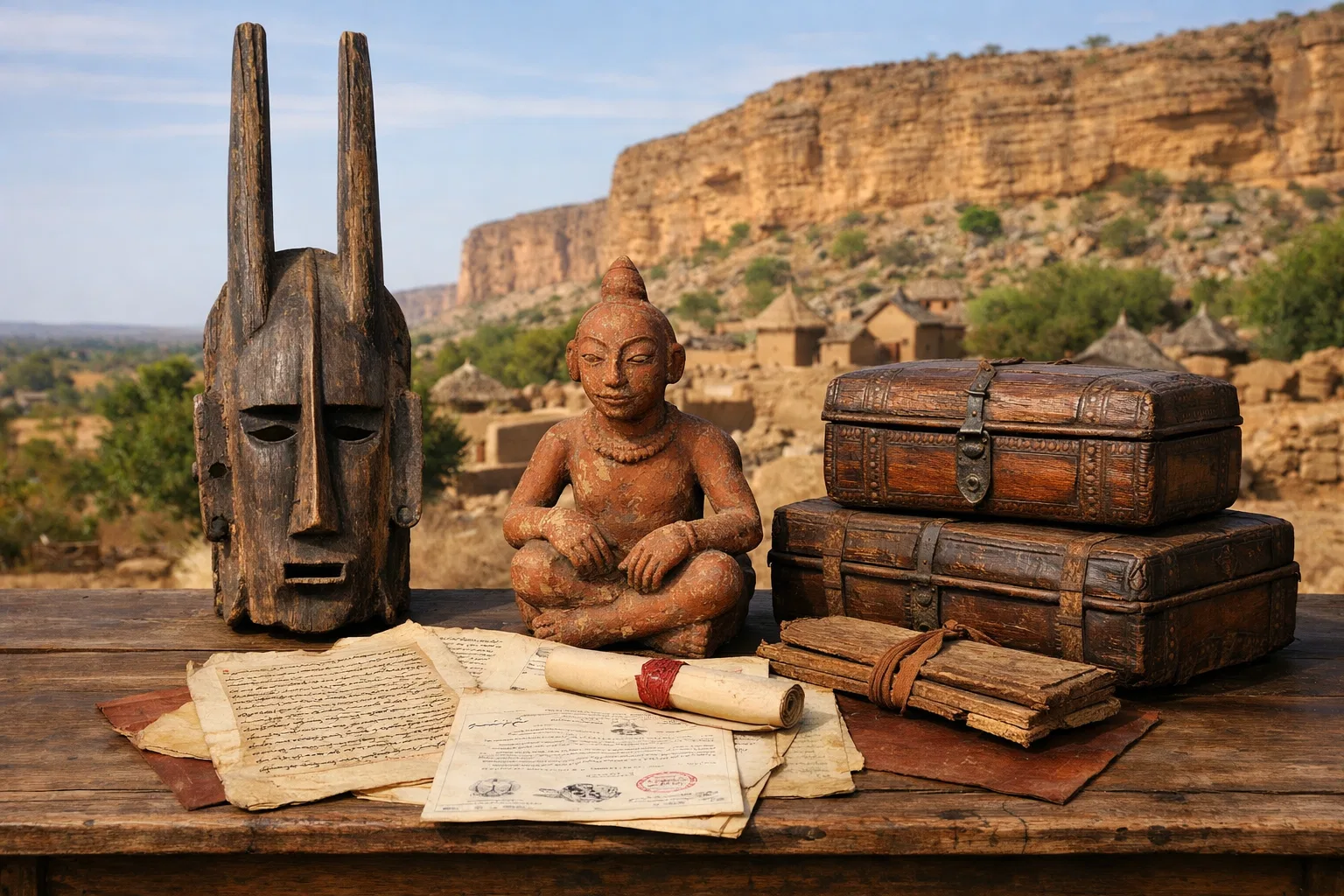
These cases do not show Malians being unusually credulous. Most were shaped by outsiders’ expectations, commercial demand, armed conflict or geopolitical rivalry. Western writers wanted evidence of ancient extraterrestrial contact; collectors wanted untouched “tribal” masterpieces; global media wanted a clear symbol of cultural catastrophe; and rival military powers wanted images that blamed the other side. The common thread is not national gullibility but the power of an attractive story when its evidence is distant, inaccessible or controlled by interested parties.
Did the Dogon know about an invisible star?
The most famous doubtful claim associated with Mali concerns the Dogon people and Sirius B, the dense companion of Sirius, the brightest star in the night sky. Sirius B cannot be seen with the unaided eye. Its existence was inferred by astronomers in the nineteenth century and it was first observed through a telescope in 1862.
French ethnographers Marcel Griaule and Germaine Dieterlen reported that Dogon informants possessed remarkably detailed knowledge of the Sirius system. Their published account appeared to describe an invisible, extremely heavy companion star travelling around Sirius in roughly 50 years. Later retellings added knowledge of Saturn’s rings and Jupiter’s moons. The astronomical core sounded uncannily close to modern science: Sirius B is indeed a white dwarf, and its measured orbital period is just over 50 years.[arXiv]arxiv.orgThe Sirius System and its Astrophysical Puzzles: Hubble Space Telescope and Ground-Based AstrometryMarch 30, 2017…
The claim became an international mystery after Robert Temple’s 1976 book The Sirius Mystery. Temple suggested that the knowledge might have originated with intelligent amphibious beings from the Sirius system. The book linked Dogon tradition to ancient Egypt, Mesopotamia and a supposed prehistoric history of extraterrestrial contact. What began as an unusual ethnographic report was transformed into one of the most persistent “ancient astronaut” stories in popular culture.[Wikipedia]WikipediaThe Sirius MysteryThe Sirius Mystery
Why the story seemed persuasive
Several features made the tale unusually durable. It combined a genuine scientific object, a real Malian people and the authority of respected European researchers. It also reversed a familiar colonial stereotype: rather than portraying Africans as scientifically backward, it appeared to credit the Dogon with knowledge that European astronomers had acquired only with sophisticated instruments.
Yet that apparent compliment carried another assumption. Many versions treated the Dogon as isolated from history, as though they could not have encountered European teachers, missionaries, administrators, books or scientific conversation. Once ordinary cultural contact was considered, the supposed impossibility became much less mysterious.
The astronomical details were also less exact than popular retellings suggested. Astronomer Ian Ridpath argued that the reported material contained ambiguities, contradictions and errors when interpreted literally. The information that resembled modern astronomy, he concluded, could have entered Dogon conversation through contact with Europeans rather than through an ancient independent tradition. A Harvard-linked Chandra Observatory discussion likewise noted that the controversy rested on reports of an invisible heavy star with a roughly 50-year orbit, not on independently dated evidence showing that this knowledge predated modern contact.[Chandra X-ray Observatory]chandra.harvard.eduChandra X-ray ObservatorySirius Matters: Alien Contact:: November 28, 200028 Nov 2000 — The cause of all the commotion was the claim tha…
What later fieldwork found
The most important challenge came from anthropologist Walter van Beek, who conducted extensive later fieldwork among Dogon communities. He could not reproduce Griaule’s elaborate cosmological system. Informants disagreed about which object the relevant star name described; some associated it with Venus, while others treated it as an unseen ceremonial star. Van Beek found no broadly shared understanding that Sirius was a double star and reported that people familiar with the subject connected it with Griaule himself.[Cambridge University Press & Assessment]cambridge.orgPublished online by Cambridge University Press: 09 May 2014. Walter E.A. van Beek.Read more…
This does not prove that Griaule deliberately fabricated his research. The likelier possibilities lie between fraud and straightforward discovery. His questions may have guided informants towards the answers he expected. A small circle of collaborators may have developed a specialised account through repeated conversations with him. European astronomical knowledge may already have circulated locally. Translation, symbolism and the desire to satisfy an influential visitor could all have affected what was recorded.
The case is therefore better described as a disputed ethnographic construction than as a simple Malian hoax. The extraordinary version was chiefly promoted by foreign authors and publishers, while the Dogon themselves were often presented as silent evidence for someone else’s theory. Its survival shows how easily a tentative field report can become “ancient knowledge” once later writers remove doubts, disagreements and the history of contact.
How fake antiquities acquired respectable paperwork
Mali’s Inland Niger Delta contains some of West Africa’s most important archaeological sites. Djenné-Djenno, an early urban settlement near modern Djenné, produced striking terracotta human and animal figures. Genuine examples offer evidence of a sophisticated society and artistic tradition that flourished long before the region’s better-known medieval empires.[The Metropolitan Museum of Art]metmuseum.orgThe Metropolitan Museum of Art Seated figureThe Metropolitan Museum of Art Seated figure
Their rarity and beauty also created a lucrative international market. Looted objects lost the archaeological context that might have established where, when and how they were used. At the same time, workshops and dealers could produce new figures, artificially age them or combine old and new pieces. A collector facing an undocumented sculpture therefore confronted two separate questions: was it genuinely old, and had it been legally excavated and exported?
Scientific methods such as thermoluminescence testing can estimate when clay was last fired, while computed tomography and close structural examination may reveal repairs, composite pieces or modern interventions. But tests do not automatically establish a lawful history of ownership. An authentically ancient object can still have been recently looted, and a plausible-looking provenance can be invented around a modern fake.
The counterfeit UNESCO certificates
In 2020 UNESCO issued a public warning about criminals using its name and logo to sell or supposedly authorise the export of African cultural objects. The false documents sometimes included counterfeit business cards or appropriated the names of genuine UNESCO officials. Victims were led to believe that the organisation had authenticated collections, approved transactions or certified their monetary value—services UNESCO does not provide. Reported losses exceeded €1 million.[UNESCO]unesco.orgOpen source on unesco.org.
Malian terracottas were among the kinds of objects associated with the scheme. The deception worked because paperwork supplied what the object itself lacked: institutional reassurance. A buyer who might hesitate before purchasing an unprovenanced figure could be persuaded by an official-looking seal, a formal valuation and a supposed international export permit.
The International Council of Museums issued a similar warning about people pretending to offer its certificates of authenticity or import and export documents. Its guidance makes the central point clear: ICOM does not issue certificates of origin or authenticity, and only the appropriate national authorities can provide official export documentation.[International Council of Museums]icom.museumscam alert icom false certificatesscam alert icom false certificates
This form of fraud benefits from several misunderstandings. Buyers may assume that an international cultural organisation acts like a commercial authentication service. They may also believe that familiarity with a French-speaking African country makes them less vulnerable, although UNESCO reported that many victims had personal or professional connections to the region. The scam exploited confidence as much as ignorance.[UNESCO]unesco.orgOpen source on unesco.org.
There is also a darker irony. Foreign demand helped make Malian heritage profitable to loot, while forged documentation imitated the institutions created to protect that heritage. The fake certificate did not merely disguise a questionable object; it borrowed the moral authority of preservation itself.

Were all Timbuktu’s manuscripts burned?
When French and Malian forces retook Timbuktu from Islamist armed groups in January 2013, early reports suggested that retreating fighters had burned the city’s priceless manuscript collections. Officials speaking from outside the city described the apparent destruction in catastrophic terms, and international headlines sometimes implied that an irreplaceable intellectual heritage had been almost completely lost.[The Guardian]theguardian.comThe Guardian Timbuktu mayor: Mali rebels torched library of historicThe Guardian Timbuktu mayor: Mali rebels torched library of historic
The reports were not invented from nothing. Fighters had set fires at the Ahmed Baba Institute, and thousands of manuscripts were destroyed, damaged or stolen. A later United Nations assessment put the loss at more than 4,000 manuscripts. The same occupation also brought the deliberate destruction of historic mausoleums and other religious monuments.[AP News]apnews.comOn August 11, 2025, the Malian military government transported the first batch—over 200 crates weighing 5.5 tons—back to Timbuktu, a city…
But the first sweeping version was wrong. Most of the manuscripts had already been hidden or moved by Malian librarians, private owners, drivers and residents. Some were concealed within Timbuktu; many others were transported south in boxes, sacks, vehicles and boats. Contemporary observers soon found intact storerooms and learned that empty shelves did not necessarily mean burned books.[mprnews.org]mprnews.orgMPR News Timbuktu manuscripts mostly safe, university saysMPR News Timbuktu manuscripts mostly safe, university says
The distinction matters. Saying that “the manuscripts of Timbuktu were burned” erases both the surviving collections and the organised Malian effort that protected them. Yet replacing the disaster story with the opposite claim—that none were destroyed—would also be false. Real losses occurred, alongside a much larger rescue.
This episode was primarily a wartime reporting failure rather than a deliberate hoax. Reliable information was scarce; officials repeated alarming second-hand accounts; images of ash and empty cases appeared to confirm the worst; and the idea of a single great library encouraged outsiders to overlook the many state, family and private collections scattered across the city.
The corrected story is more complicated and more impressive. Some manuscripts were deliberately burned, but most survived because custodians had anticipated the danger. More than a decade later, substantial collections began returning to Timbuktu after years in Bamako, with preservation and digitisation intended to reduce the risk of a future catastrophe.[AP News]apnews.comOn August 11, 2025, the Malian military government transported the first batch—over 200 crates weighing 5.5 tons—back to Timbuktu, a city…
The disputed mass grave at Gossi
On 19 April 2022 French forces handed the Gossi military base in northern Mali to Malian authorities as part of France’s withdrawal from the country. Soon afterwards, social-media posts claimed that a mass grave discovered near the base contained victims left by the French army.
France responded with surveillance-drone footage that it said showed men arriving with bodies and burying them near the base after the handover. French officials identified the men as Russian mercenaries and described the burial and subsequent online posts as a staged information operation intended to frame France for an atrocity.[theguardian.com]theguardian.comThe Guardian France says Russian mercenaries staged 'French atrocity' in MaliThe Guardian France says Russian mercenaries staged 'French atrocity' in Mali
Mali’s military government rejected the French account, accused France of spying and subversion, and said that Malian forces had discovered the grave while taking control of the site. The dispute therefore involved two hostile governments, an opaque security environment and bodies whose identities and causes of death were not publicly established at the time.[Al Jazeera]aljazeera.comAl Jazeera Mali accuses France of spying after video emerges of massAl Jazeera Mali accuses France of spying after video emerges of mass
The strongest public evidence for staging was the drone recording released by France. It appeared to show activity around the burial site before the accusations spread online. However, much of the interpretation—who the men were, where the bodies came from and who killed them—depended on French military intelligence. Independent access was severely limited.
For that reason, the Gossi affair should be described carefully. It was a documented attempt to attach a politically useful explanation to a newly revealed grave, and there is substantial visual evidence supporting France’s claim that the burial scene was manipulated. But the full history of the dead was not transparently resolved in public. The incident sits at the boundary between exposure and counter-propaganda: even strong debunking evidence came from one of the rival parties.
Why the accusation travelled
The false or misleading narrative did not emerge in a vacuum. Relations between Mali and France had deteriorated sharply, while Russian-linked influence networks promoted anti-French messages across parts of Africa. Researchers and journalists have documented coordinated social-media activity, local proxies and pro-Russian messaging designed to portray Moscow as a respectful security partner and France as an abusive former colonial power.[reuters.com]reuters.comFrance targets Russian and Wagner disinformation in AfricaFrance targets Russian and Wagner disinformation in Africa
That historical resentment gave the Gossi claim an audience before the evidence could be examined. A photograph or video of bodies near a recently abandoned French base fitted an existing political story. Social media then allowed the accusation to move faster than forensic investigation.
The episode also demonstrates a harsher form of fakery than an edited photograph or invented quotation. If the French account is correct, real bodies were used as props. The deception lay not in fabricating the existence of the grave, but in creating a false account of how it came to be there.
What Mali’s hoax stories have in common
Mali’s most notable cases occupy different positions on the spectrum of falsehood. The Dogon–Sirius story grew from contested fieldwork and was enlarged by speculative publishing. The antiquities trade includes deliberate forgery, false provenance and straightforward financial fraud. The Timbuktu story was an urgent but exaggerated wartime report. Gossi was an alleged military staging operation embedded in a wider contest for political influence.
Several patterns connect them.
Distance increases authority. Claims about remote villages, buried objects, closed archives or military zones are difficult for ordinary readers to check. Intermediaries—ethnographers, dealers, officials or armed forces—control what becomes visible.
Prestige can substitute for provenance. Griaule’s reputation, UNESCO’s stolen logo and military drone footage each carried institutional authority. The lesson is not to reject institutions automatically, but to ask whether the institution genuinely issued the claim and whether independent evidence supports it.
Good stories become cleaner as they circulate. A disputed ethnographic account became ancient alien contact. A collection containing looted, restored and forged objects became “authentic African art”. Partial manuscript destruction became the burning of an entire civilisation’s library. An unidentified grave became proof of a specific army’s guilt.
Correction rarely travels as far as the original. The Dogon mystery remains popular in books and online videos despite decades of criticism. The image of all Timbuktu’s books going up in flames still survives alongside the better-documented rescue. Dramatic first versions are easier to remember than later qualifications.
The most useful sceptical question is therefore not simply, “Is this a hoax?” It is: what kind of falsehood is involved, who had the power to frame the evidence, and what changed when independent investigators reached the people, objects or places at the centre of the claim?
Amazon book picks
Further Reading
Books and field guides related to Which Famous Mali Stories Survived the Evidence?. Use these as the next step if you want deeper reading beyond the article.
The Bad-Ass Librarians of Timbuktu
Covers one of Mali's most famous evidence-versus-myth stories.
Frauds, Myths, and Mysteries: Science and Pseudoscience in Ar...
Examines famous disputed claims and pseudoarchaeology.
Fingerprints of the Gods
Illustrates how speculative historical theories gain audiences.
eBay marketplace picks
Marketplace Samples
Live-tested eBay searches with available results related to this page.
Endnotes
1.
Source: arxiv.org
Link:https://arxiv.org/abs/1703.10625
Source snippet
The Sirius System and its Astrophysical Puzzles: Hubble Space Telescope and Ground-Based AstrometryMarch 30, 2017...
Published: March 30, 2017
2.
Source: Wikipedia
Title: Dogon people
Link:https://en.wikipedia.org/wiki/Dogon_people
3.
Source: Wikipedia
Title: The Sirius Mystery
Link:https://en.wikipedia.org/wiki/The_Sirius_Mystery
4.
Source: chandra.harvard.edu
Link:https://chandra.harvard.edu/chronicle/0400/sirius_part2.html
Source snippet
Chandra X-ray ObservatorySirius Matters: Alien Contact:: November 28, 200028 Nov 2000 — The cause of all the commotion was the claim tha...
5.
Source: cambridge.org
Link:https://www.cambridge.org/core/journals/history-in-africa/article/haunting-griaule-experiences-from-the-restudy-of-the-dogon/CADF822480EE1720D1B06E7B2D693F79
Source snippet
Published online by Cambridge University Press: 09 May 2014. Walter E.A. van Beek.Read more...
Published: May 2014
6.
Source: cambridge.org
Title: div class title haunting griaule experiences from the restudy of the dogon div
Link:https://www.cambridge.org/core/services/aop-cambridge-core/content/view/CADF822480EE1720D1B06E7B2D693F79/S0361541300003399a.pdf/div-class-title-haunting-griaule-experiences-from-the-restudy-of-the-dogon-div.pdf
Source snippet
Cambridge University Press & AssessmentEXPERIENCES FROM THE RESTUDY OF THE DOGONby WEA van Beek · 2004 · Cited by 52 — 4 The clue would b...
7.
Source: Wikipedia
Link:https://en.wikipedia.org/wiki/Sirius
8.
Source: unesco.org
Link:https://www.unesco.org/en/articles/unesco-cautions-against-false-certificates-claiming-authorize-export-african-cultural-artefacts
9.
Source: icom.museum
Title: scam alert icom false certificates
Link:https://icom.museum/en/news/scam-alert-icom-false-certificates/
10.
Source: icom.museum
Link:https://icom.museum/wp-content/uploads/2018/05/RL_AFO_EN_PAGES.pdf
11.
Source: reuters.com
Title: France targets Russian and Wagner disinformation in Africa
Link:https://www.reuters.com/world/africa-france-targets-russian-wagner-disinformation-2023-06-21/
12.
Source: 2021-2025.state.gov
Title: wagner group yevgeniy prigozhin and russias disinformation in africa
Link:https://2021-2025.state.gov/disarming-disinformation/wagner-group-yevgeniy-prigozhin-and-russias-disinformation-in-africa/
13.
Source: cambridge.org
Link:https://www.cambridge.org/core/journals/history-in-africa/most-cited?pageNum=5
14.
Source: cambridge.org
Title: History in Africa: Volume 31
Link:https://www.cambridge.org/core/journals/history-in-africa/volume/1A863B9446EA2DFE3511A54D680C3215
15.
Source: resolve.cambridge.org
Title: flashes of brilliance san rock paintings of heavens things
Link:https://resolve.cambridge.org/core/services/aop-cambridge-core/content/view/CFABDFD9459AD6B044FCE2D08C5D4DB3/9781868147168c2_p10-35_CBO.pdf/flashes_of_brilliance_san_rock_paintings_of_heavens_things.pdf
16.
Source: Wikipedia
Title: [Timbuktu Manuscripts]({{ ‘timbuktu-files/’ | relative_url }})
Link:https://en.wikipedia.org/wiki/Timbuktu_Manuscripts
17.
Source: Wikipedia
Title: Djenné Djenno
Link:https://en.wikipedia.org/wiki/Djenn%C3%A9-Djenno
18.
Source: reuters.com
Title: syria security mass graves methodology
Link:https://www.reuters.com/investigates/special-report/syria-security-mass-graves-methodology/
19.
Source: metmuseum.org
Title: The Metropolitan Museum of Art Seated figure
Link:https://www.metmuseum.org/art/collection/search/314362
20.
Source: africarenewal.un.org
Title: esco urges caution over fraudulent african artefacts sold its name
Link:https://africarenewal.un.org/en/magazine/unesco-urges-caution-over-fraudulent-african-artefacts-sold-its-name
21.
Source: theguardian.com
Title: The Guardian Timbuktu mayor: Mali rebels torched library of historic
Link:https://www.theguardian.com/world/2013/jan/28/mali-timbuktu-library-ancient-manuscripts
22.
Source: apnews.com
Link:https://apnews.com/article/785663f5854718cca7abdcc95ddeba66
Source snippet
On August 11, 2025, the Malian military government transported the first batch—over 200 crates weighing 5.5 tons—back to Timbuktu, a city...
Published: August 11, 2025
23.
Source: apnews.com
Link:https://apnews.com/article/5d67428058eeaadd9445a4d460fa78d2
Source snippet
Now, years later, the manuscripts have returned to Timbuktu amid renewed security threats from extremist groups like JNIM. While almost a...
24.
Source: mprnews.org
Title: MPR News Timbuktu manuscripts mostly safe, university says
Link:https://www.mprnews.org/story/2013/01/30/timbuktu-manuscripts-mostly-safe-university-says
25.
Source: humanities.uct.ac.za
Title: Faculty of Humanities Timbuktu manuscripts safely stored
Link:https://humanities.uct.ac.za/apc/articles/2013-02-18-timbuktu-manuscripts-safely-stored
26.
Source: theguardian.com
Title: The Guardian France says Russian mercenaries staged ‘French atrocity’ in Mali
Link:https://www.theguardian.com/world/2022/apr/22/france-says-russian-wagner-mercenaries-staged-french-atrocity-in-mali
27.
Source: voanews.com
Link:https://www.voanews.com/a/mali-accuses-france-of-spying-after-drone-video/6547332.html
28.
Source: aljazeera.com
Link:https://www.aljazeera.com/news/2022/4/22/russians-accused-of-staging-french-burial-of-bodies-in
29.
Source: aljazeera.com
Title: Al Jazeera Mali accuses France of spying after video emerges of mass
Link:https://www.aljazeera.com/news/2022/4/27/mali-accuses-france-of-spying-after-video-of-mass-grave
30.
Source: lemonde.fr
Link:https://www.lemonde.fr/en/international/article/2024/08/22/the-wagner-method-how-russia-crept-into-africa_6719672_4.html
Source snippet
In Mali, the influence expanded after the overthrow of President Ibrahim Boubacar Keïta, facilitated by Russian diplomatic maneuvers. Thi...
31.
Source: facebook.com
Link:https://www.facebook.com/groups/827611048652074/posts/1458079665605206/
32.
Source: redalyc.org
Link:https://www.redalyc.org/journal/147/14768130011/html/
33.
Source: theworld.org
Title: unesco says scammers are using agencys logo scam art collectors
Link:https://theworld.org/stories/2020/07/09/unesco-says-scammers-are-using-agencys-logo-scam-art-collectors
34.
Source: pace.coe.int
Link:https://pace.coe.int/files/10424/html
35.
Source: nigeria-del-unesco.org
Link:https://nigeria-del-unesco.org/unesco-cautions-against-false-certificates-claiming-to-authorize-export-of-african-cultural-artefacts/
36.
Source: theguardian.com
Title: destruction timbuktu manuscripts offence africa
Link:https://www.theguardian.com/world/2013/jan/28/destruction-timbuktu-manuscripts-offence-africa
Additional References
37.
Source: youtube.com
Title: The Sirius Mystery Revisited | Prof. Robert Temple | Origins Conference
Link:https://www.youtube.com/watch?v=j12Ea8Rvn3o
Source snippet
France says mercenaries from Russia's Wagner Group staged 'French atrocity' in Mali...
38.
Source: youtube.com
Link:https://www.youtube.com/watch?v=Eo-niRm6Lm0
Source snippet
France says Russian mercenaries buried bodies in Mali | DW News...
39.
Source: youtube.com
Title: The Stars They Shouldn’t Have Seen & Other African Sciences!
Link:https://www.youtube.com/watch?v=Ugq2bcCgNt8
Source snippet
The Sirius Mystery Revisited | Prof. Robert Temple | Origins Conference...
40.
Source: researchgate.net
Link:https://www.researchgate.net/publication/290997927_Combating_Illegal_trafficking_In_African_Cultural_Goods
41.
Source: researchgate.net
Link:https://www.researchgate.net/publication/354719154_The_Things_We_Now_Call_Fake_Will_in_the_Future_Become_Authentic_Objects_Global_African_Art_Markets_and_the_Space_and_Time_of_the_Fake
42.
Source: facebook.com
Link:https://www.facebook.com/groups/383995161664147/posts/9934643653265869/
43.
Source: iadaa.org
Link:https://iadaa.org/wp-content/uploads/2020/12/UNESCO-fake-advertising-campaign-2020.pdf
44.
Source: unicri.org
Link:https://unicri.org/sites/default/files/2024-07/Cultural%20Heritage%20Smuggling%20and%20the%20Nexus%20with%20Terrrorism.pdf
45.
Source: facebook.com
Link:https://www.facebook.com/USEmbassyGhana/posts/did-you-know-that-spreading-fake-news-is-punishable-by-law-and-you-can-be-held-l/567714712059363/
46.
Source: instagram.com
Link:https://www.instagram.com/reel/DQKWF3vDTft/?hl=en
Topic Tree
Follow this branch
Related pages 192
- Albanian Hoaxes
- Algerian Hoaxes
- Antigua Deceptions
- Argentina Hoaxes
- Armenian Hoaxes
- +187 more in sidebar