Within Somalia
How Real Suffering Became a Fundraising Scam
Old photographs of real suffering became tools for false medical stories, misattributed famine claims and fraudulent fundraising.
On this page
- Why Somalia's famine history makes false appeals believable
- The vulture photograph and the collapse of geographical context
- How reused child photographs were exposed in fraudulent donation posts
Page outline Jump by section
Introduction
Somalia’s repeated famines and drought emergencies have produced some of the most widely recognised humanitarian images of the modern era. That history has had an unintended side effect: photographs of genuine suffering are often reused in false donation appeals, fabricated medical stories and misleading social-media campaigns. In these cases, the image itself may be authentic, but the accompanying story is not.
This distinction is crucial. Unlike a completely fabricated hoax, many famine-related scams rely on real photographs taken by journalists, aid workers or humanitarian organisations. The deception occurs when an old image is assigned a new location, a different child, a false illness, or a fraudulent fundraising request. Somalia’s reputation as a place associated with famine makes such claims immediately believable, allowing emotional appeals to spread before anyone checks their accuracy.[Fact Check AFP]factcheck.afp.combeware fake medical appeals misuse sick childrens photosFact Check AFPBeware fake medical appeals that misuse sick children's…19 Nov 2019 — Fact Check has debunked various social media posts…
Why Somalia’s famine history makes false appeals believable
For decades, international audiences have associated Somalia with drought, hunger and humanitarian crises. Images from the 1992–93 famine, the 2011 famine and later drought emergencies became part of global media coverage and charity fundraising campaigns. Because these events were real and well documented, photographs from them carry enormous emotional force.
Fraudsters exploit that recognition. A social-media post claiming that a starving child in a photograph needs urgent surgery, emergency food aid or evacuation often requires little supporting evidence. The image itself performs most of the persuasive work. Fact-checkers have repeatedly found that photographs of sick or malnourished children are copied from unrelated news reports and attached to invented fundraising stories designed to collect money directly from the public.[afp.com]factcheck.afp.combeware fake medical appeals misuse sick childrens photosFact Check AFPBeware fake medical appeals that misuse sick children's…19 Nov 2019 — Fact Check has debunked various social media posts…
The result is a particularly damaging form of deception. Real humanitarian suffering becomes the raw material for a false narrative. Donors may lose money, genuine charities may lose trust, and the people originally depicted in the photographs lose control over how their images are used.
The vulture photograph and the collapse of geographical context
One of the most famous famine photographs ever published is Kevin Carter’s 1993 image commonly known as The Vulture and the Little Girl. The photograph showed a starving child near Ayod in what was then southern Sudan, not Somalia. It became one of the defining visual symbols of famine reporting worldwide and was reproduced extensively by newspapers, aid campaigns and public discussions about hunger.[Wikipedia]WikipediaThe Vulture and the Little GirlThe Vulture and the Little Girl
Yet the image’s fame created a different problem. Over the years it has frequently circulated online with incorrect captions claiming that it depicts Somalia, Ethiopia, a different famine, or an entirely unrelated humanitarian disaster. The photograph demonstrates how quickly context can disappear once an image becomes iconic. Many people recognise the picture but not its original location, date or circumstances.[Wikipedia]WikipediaThe Vulture and the Little GirlThe Vulture and the Little Girl
The photograph therefore serves as an important warning about famine imagery. A picture can be genuine while almost every detail attached to it becomes distorted. In some cases, the image has been used to support appeals that never mention Sudan at all, instead relying on viewers’ assumptions about African famine in general. Once the original caption disappears, the image becomes a reusable symbol rather than a documented historical record.[Wikipedia]WikipediaThe Vulture and the Little GirlThe Vulture and the Little Girl
For Somalia-related misinformation, this mechanism is especially common. Images from one famine are presented as evidence of another. Photographs from different countries are relabelled as Somali crises, while authentic Somali photographs are later reassigned elsewhere. The deception depends less on photographic manipulation than on removing geographical and historical context.

How reused child photographs were exposed in fraudulent donation posts
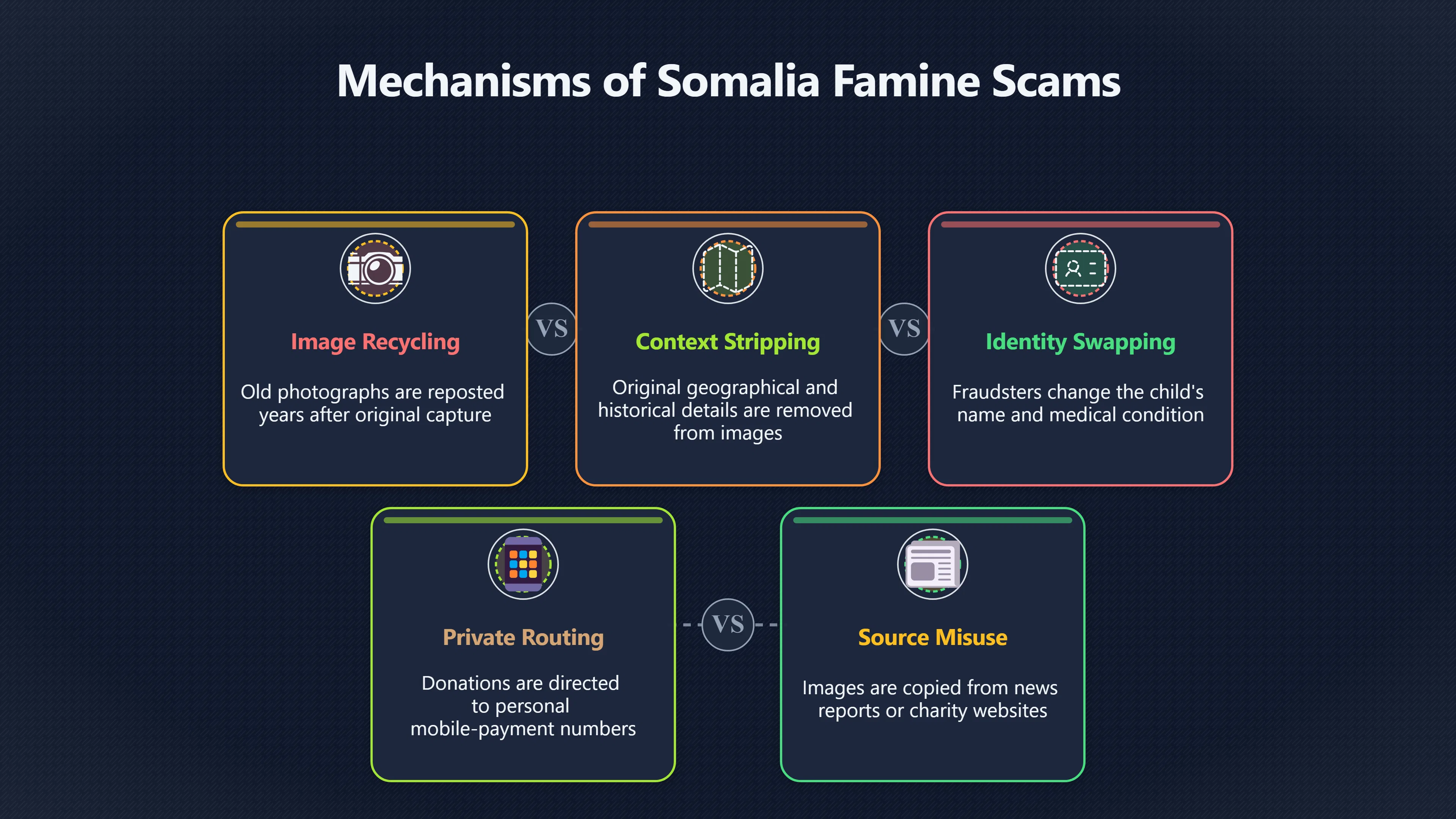
Fact-checking organisations have documented a recurring pattern in online fundraising fraud. A post presents a photograph of a child said to be suffering from starvation, cancer, a rare disease or war injuries. Readers are urged to send money through a personal account, mobile-payment number or crowdfunding page. Investigation later reveals that the photograph belonged to a different child entirely.[Fact Check AFP]factcheck.afp.combeware fake medical appeals misuse sick childrens photosFact Check AFPBeware fake medical appeals that misuse sick children's…19 Nov 2019 — Fact Check has debunked various social media posts…
Several features appear repeatedly:
- Old photographs are reposted years after they were taken.
- Images are copied from news reports or charity websites.
- The child’s name, location and medical condition are changed.
- Payment requests direct money to private accounts rather than established organisations.
- The same photograph appears in multiple contradictory stories.[afp.com]factcheck.afp.combeware fake medical appeals misuse sick childrens photosFact Check AFPBeware fake medical appeals that misuse sick children's…19 Nov 2019 — Fact Check has debunked various social media posts…
AFP Fact Check has documented numerous examples in which photographs of children who had already received treatment, or who lived in entirely different countries, were repurposed for fresh fundraising appeals. The emotional impact of the image encouraged rapid sharing before verification took place.[Fact Check AFP]factcheck.afp.combeware fake medical appeals misuse sick childrens photosFact Check AFPBeware fake medical appeals that misuse sick children's…19 Nov 2019 — Fact Check has debunked various social media posts…
The same tactic can be applied to famine imagery connected with Somalia. A genuine photograph from a humanitarian emergency may be recycled repeatedly across platforms, accumulating new stories with each reuse. The longer an image circulates, the harder it becomes for ordinary users to trace its original source.
Why authentic images are so effective in scams
Fake photographs can often be detected through visual errors, manipulation artefacts or reverse-image searches. Authentic photographs are harder to challenge because the image itself is not false.
Researchers studying misinformation increasingly describe this as “out-of-context” deception: a real image paired with a misleading claim. Instead of manufacturing evidence, the fraudster borrows credibility from genuine documentation and changes only the surrounding narrative.[arXiv]arxiv.orgOpen source on arxiv.org.
This approach offers several advantages to scammers:
- Real photographs appear more convincing than fabricated ones.
- Humanitarian imagery triggers strong emotional reactions.
- Viewers often share appeals before checking dates or locations.
- The original photographer or organisation may be difficult to identify.
- Corrections rarely travel as widely as the original post.[arXiv]arxiv.orgOpen source on arxiv.org.
In Somalia-related appeals, the combination of urgency, compassion and limited public knowledge about specific locations can make verification especially difficult.
What these scams reveal about modern humanitarian misinformation
The most important lesson from famine-image fraud is that authenticity and truth are not the same thing. A photograph can accurately show a hungry child while simultaneously being used to tell a false story about who that child is, where the picture was taken, or where donated money will go.
Somalia’s history of famine has therefore generated a distinctive category of misinformation. The deception usually does not involve inventing suffering. Instead, it involves repackaging real suffering for a different purpose—whether fundraising fraud, engagement farming, political messaging or viral social-media attention.[afp.com]factcheck.afp.combeware fake medical appeals misuse sick childrens photosFact Check AFPBeware fake medical appeals that misuse sick children's…19 Nov 2019 — Fact Check has debunked various social media posts…
For investigators and fact-checkers, the key question is often not whether the image is genuine, but whether the caption, location, date and donation request are genuine as well. The history of famine scams linked to Somalia demonstrates how easily those crucial pieces of context can be stripped away, leaving an authentic photograph in the service of a false appeal.[afp.com]factcheck.afp.combeware fake medical appeals misuse sick childrens photosFact Check AFPBeware fake medical appeals that misuse sick children's…19 Nov 2019 — Fact Check has debunked various social media posts…
Amazon book picks
Further Reading
Books and field guides related to How Real Suffering Became a Fundraising Scam. Use these as the next step if you want deeper reading beyond the article.
Factfulness
Challenges misleading impressions created by dramatic images and anecdotes.
Calling Bullshit
Useful for evaluating emotional claims and deceptive fundraising posts.
eBay marketplace picks
Marketplace Samples
Live-tested eBay searches with available results related to this page.
Endnotes
1.
Source: factcheck.afp.com
Title: beware fake medical appeals misuse sick childrens photos
Link:https://factcheck.afp.com/beware-fake-medical-appeals-misuse-sick-childrens-photos
Source snippet
Fact Check AFPBeware fake medical appeals that misuse sick children's...19 Nov 2019 — Fact Check has debunked various social media posts...
2.
Source: arxiv.org
Link:https://arxiv.org/abs/2112.00061
3.
Source: arxiv.org
Link:https://arxiv.org/abs/2412.15621
4.
Source: arxiv.org
Title: arXiv I call BS: Fraud Detection in Crowdfunding Campaigns
Link:https://arxiv.org/abs/2006.16849
5.
Source: Wikipedia
Title: The Vulture and the Little Girl
Link:https://en.wikipedia.org/wiki/The_Vulture_and_the_Little_Girl
6.
Source: Wikipedia
Title: Kevin Carter
Link:https://en.wikipedia.org/wiki/Kevin_Carter
7.
Source: arxiv.org
Title: arXiv Fact-Checking Meets Fauxtography: Verifying Claims About Images
Link:https://arxiv.org/abs/1908.11722
Additional References
8.
Source: instagram.com
Title: 🚨 Beware of Fake Donation Scams!
Link:https://www.instagram.com/p/DHJCkikhiUW/?hl=en
Source snippet
🚨 Scammers in India...Scammers in India are using sad photos of sick and injured children, many from war zones like Gaza, to steal money...
9.
Source: youtube.com
Title: The Little Black Book of Scams: Charity Scams
Link:https://www.youtube.com/watch?v=zln7kuvHznw
Source snippet
Charity donation scam fake photos Accountant Stole $2.3M From Fake Cancer Charity Using Dying Kids Photos Unbelievable Facts and Stories...
10.
Source: instagram.com
Title: A lie went viral
Link:https://www.instagram.com/reel/DMueNi2M7SO/?hl=en
Source snippet
A child's illness was twisted into propaganda...Fact Check claims that this image has been altered by AI and is fake. In fact, the authe...
11.
Source: youtube.com
Title: Scammers using real people’s stories for fake Go Fund Me campaigns
Link:https://www.youtube.com/watch?v=zbRY0QcDVEI
Source snippet
What to look for regarding fake GoFundMe accounts...
12.
Source: youtube.com
Title: Influencer’s AI-faked orphanage footage revealed by ABC NEWS Verify
Link:https://www.youtube.com/watch?v=fDf6AEM75vs
Source snippet
How Fake Charities Scam Millions EVERY YEAR...
13.
Source: instagram.com
Title: Dan LDG3DYp X
Link:https://www.instagram.com/p/DanLDG3DYpX/
Source snippet
taken during the famine in the early 1990s....Kevin Carter's photograph of a starving child being stalked by a vulture is one of the mos...
14.
Source: youtube.com
Title: How Fake Charities Scam Millions EVERY YEAR
Link:https://www.youtube.com/watch?v=549usXVIfhU
Source snippet
Scammers using real people's stories for fake GoFundMe campaigns...
15.
Source: facebook.com
Link:https://www.facebook.com/IsraelinNY/posts/with-every-photo-of-a-starving-gazan-proving-fake-how-can-famine-claims-be-belie/1212801747555616/
16.
Source: reddit.com
Link:https://www.reddit.com/r/interestingasfuck/comments/1hytkuk/haunting_image_and_a_tragic_end_kevin_carters/
17.
Source: aestheticinvestigations.eu
Link:https://aestheticinvestigations.eu/article/download/12001/13563
Topic Tree