Within Antigua Deceptions
How Stanford Made a Ponzi Scheme Look Safe
Allen Stanford's Antiguan bank sold risky, fabricated investments by making them look safe, regulated and professionally managed.
On this page
- What investors were promised
- How the bank manufactured credibility
- Where the money really went
Page outline Jump by section
Introduction
For many investors, the appeal of Stanford International Bank was not that it promised impossible riches. The attraction was that it appeared to offer something rarer: unusually good returns combined with exceptional safety. Operating from St John’s, Antigua, the bank sold billions of dollars in certificates of deposit (CDs) while presenting itself as a conservatively managed international institution backed by professional oversight, careful investing and strong regulation. In reality, according to US prosecutors and regulators, much of that appearance was manufactured. The Stanford fraud became one of the largest investment schemes of its era because it did not look like a reckless gamble. It looked like a safe place to keep money.[SEC]sec.govPress Release: SEC Charges RAllen Stanford…17 Feb 2009 — The Securities and Exchange Commission today charged Robert Allen Stanford and three of his companies for…

The Antiguan bank sat at the centre of the deception. Investors were persuaded not simply by promises of profit but by a carefully constructed illusion of stability. Understanding how that illusion was built helps explain why the scheme survived for so many years and why so many people failed to recognise the danger until the collapse in 2009.[SEC]sec.govPress Release: SEC Charges RAllen Stanford…17 Feb 2009 — The Securities and Exchange Commission today charged Robert Allen Stanford and three of his companies for…
What Investors Were Promised
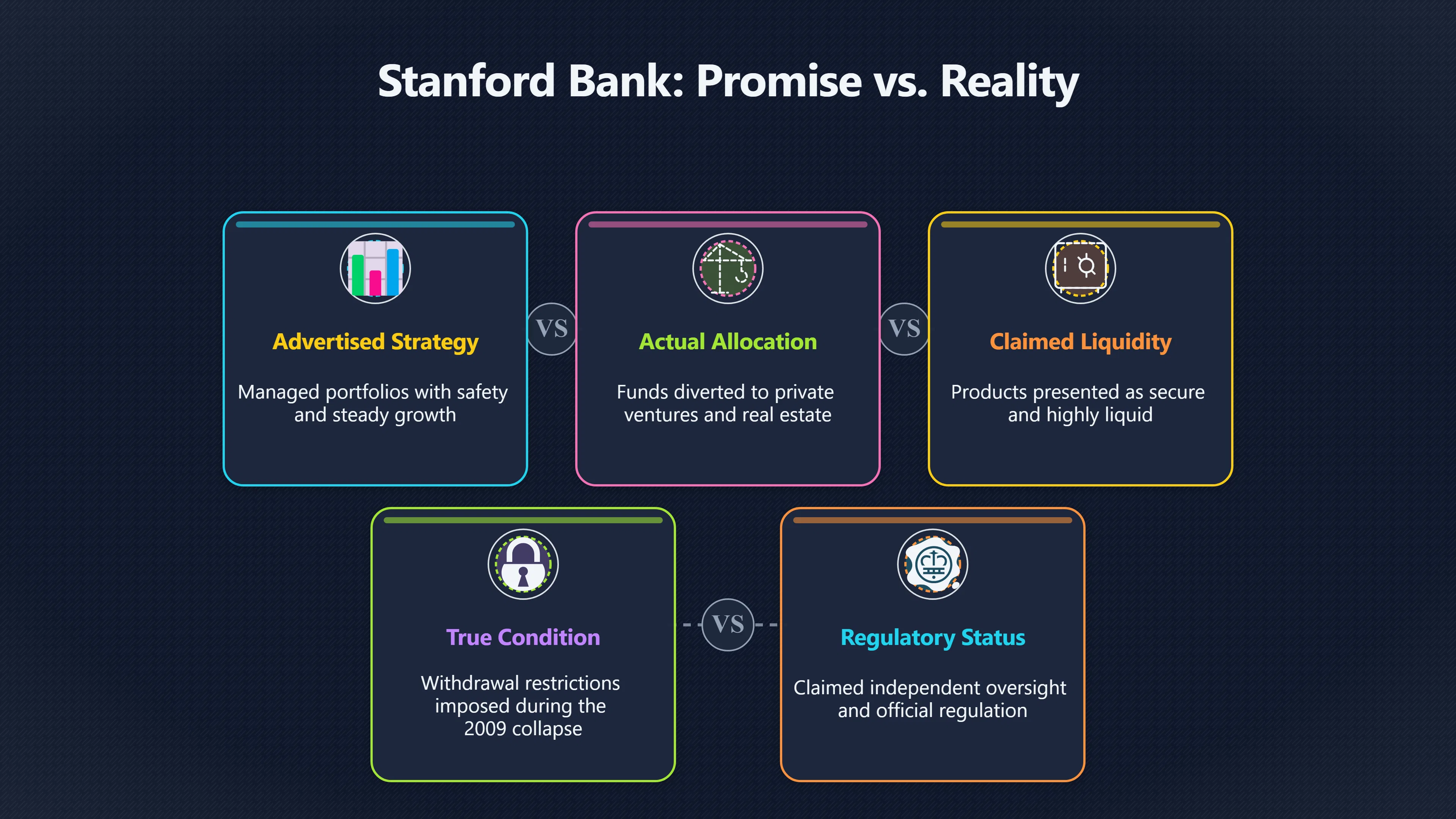
Stanford International Bank marketed certificates of deposit as a superior alternative to ordinary bank products. Customers were told that their money was being managed through a sophisticated investment strategy that combined safety, liquidity and steady growth. Marketing materials described diversified portfolios, conservative risk management and professional asset allocation. The bank repeatedly claimed that its investment approach protected depositors from the volatility affecting other financial institutions.[SEC]sec.govPress Release: SEC Charges RAllen Stanford…17 Feb 2009 — The Securities and Exchange Commission today charged Robert Allen Stanford and three of his companies for…
A crucial part of the sales pitch was that the returns seemed high but not absurdly high. Unlike many obvious scams, Stanford did not generally promise fantastic overnight wealth. Instead, the bank offered rates that were consistently above those available from mainstream banks while presenting detailed explanations for why this performance was achievable. Investors were told that international expertise, unique opportunities and careful management produced better results than conventional competitors.[Wikipedia]WikipediaStanford International BankStanford International Bank
The message was especially persuasive during periods of financial uncertainty. When investors worried about stock-market turbulence, Stanford representatives portrayed the CDs as a secure refuge. Some sales materials even suggested that the products were as safe as, or safer than, accounts available through heavily regulated banking systems.[Wikipedia]WikipediaAllen StanfordAllen Stanford
How the Bank Manufactured Credibility
The Stanford fraud worked because it wrapped misleading claims inside institutions and symbols that people normally associate with trustworthiness.
First, there was the physical reality of the organisation. Stanford International Bank was not a phantom company operating from a post office box. It had offices, employees, executives, annual reports and visible operations in Antigua and elsewhere. Investors could visit offices, meet advisers and receive professional-looking documentation. That tangible presence made the institution seem legitimate.[Wikipedia]WikipediaStanford International BankStanford International Bank
Second, the bank produced financial statements that appeared to show strong performance and healthy reserves. Regulators later alleged that these statements were false and that key figures were fabricated. The SEC described the bank’s reported investment results as fictional and accused accountants connected to the operation of helping create misleading financial information.[sec.gov]sec.govSEC Charges Two Accountants and Antiguan Regulator for…June 19, 2009 — 19 Jun 2009 — The Securities and Exchange Commission today c…
Third, Stanford cultivated an image of personal success and respectability. He sponsored sporting events, funded projects, received honours and maintained a highly visible public profile. For many investors, the existence of a wealthy and celebrated founder appeared to reinforce the impression that the underlying business must be genuine. Fraud investigators later argued that this public prestige functioned as an important part of the sales machinery.[Department of Justice]justice.govDepartment of Justice United States vRobert Allen Stanford et al.Allen Stanford's Ponzi Scheme and will resolve litigation involving approximately $296 million in assets froz…
Most importantly, the bank appeared to operate under regulatory supervision. Customers were repeatedly reassured that Stanford International Bank was regulated in Antigua and subject to oversight. To ordinary investors, regulation signalled independent scrutiny. The presence of a regulator suggested that someone outside the company was checking the claims being made.[SEC]sec.govPress Release: SEC Charges RAllen Stanford…17 Feb 2009 — The Securities and Exchange Commission today charged Robert Allen Stanford and three of his companies for…

Why the Appearance of Regulation Mattered
Many investment frauds collapse quickly because investors fear that nobody is watching. Stanford’s operation largely avoided that problem by presenting itself as part of a recognised financial system.
The illusion became much stronger because regulators themselves appeared to endorse the bank’s credibility. US authorities later alleged that Leroy King, then head of Antigua and Barbuda’s Financial Services Regulatory Commission, secretly assisted Stanford rather than acting as an independent watchdog. According to SEC allegations, King accepted benefits from Stanford, passed confidential regulatory information to him and helped obstruct investigations.[sec.gov]sec.govSEC Charges Two Accountants and Antiguan Regulator for…June 19, 2009 — 19 Jun 2009 — The Securities and Exchange Commission today c…
This distinction is important. Investors were not merely deceived by advertising. They believed that a regulatory framework existed to test the bank’s claims. When that oversight failed, one of the most powerful warning systems available to investors effectively stopped working. The existence of regulation became part of the deception rather than a defence against it.[SEC]sec.govSEC Charges Two Accountants and Antiguan Regulator for…June 19, 2009 — 19 Jun 2009 — The Securities and Exchange Commission today c…
The result was a powerful feedback loop. Investors saw a regulated bank. The bank pointed to favourable financial statements. The financial statements appeared to justify the attractive returns. The continuing payment of interest seemed to confirm that everything was functioning properly. Each element reinforced the others.[SEC]sec.govPress Release: SEC Charges RAllen Stanford…17 Feb 2009 — The Securities and Exchange Commission today charged Robert Allen Stanford and three of his companies for…
Where the Money Really Went
According to prosecutors, the reality behind the CDs differed dramatically from the story told to customers.
Investors were informed that their deposits were being placed into carefully managed portfolios of liquid and conservative investments. Evidence presented by regulators and later court proceedings indicated that only a small fraction of assets were actually managed according to the advertised strategy. Much of the money was diverted into private ventures, real-estate projects, speculative investments and loans connected to Stanford’s broader business empire.[Wikipedia]WikipediaLeroy King (Antigua and BarbudaLeroy King (Antigua and Barbuda
The scheme depended on secrecy. Investors generally had no practical way to verify where their money had gone. They relied on reports prepared by the institution itself and on assurances from advisers and regulators. As long as redemptions and interest payments continued, many customers saw no reason to question the official explanation.[SEC]sec.govPress Release: SEC Charges RAllen Stanford…17 Feb 2009 — The Securities and Exchange Commission today charged Robert Allen Stanford and three of his companies for…
By 2008 the bank owed more than $8 billion to CD investors. Prosecutors later argued that Stanford had misappropriated billions of dollars and used investor funds to support personal spending and business activities unrelated to the conservative investment strategy being advertised.[Department of Justice]justice.govDepartment of Justice United States vRobert Allen Stanford et al.Allen Stanford's Ponzi Scheme and will resolve litigation involving approximately $296 million in assets froz…

The Collapse of the Safety Myth
The illusion began to unravel in early 2009 when regulators intensified their investigations. On 17 February 2009, the US Securities and Exchange Commission charged Stanford and associated entities with operating a massive fraud centred on the CD programme. Assets were frozen, receivers were appointed and confidence evaporated almost immediately.[SEC]sec.govPress Release: SEC Charges RAllen Stanford…17 Feb 2009 — The Securities and Exchange Commission today charged Robert Allen Stanford and three of his companies for…
One revealing moment came when withdrawals became difficult. Institutions that claim to hold large quantities of liquid assets should generally be able to meet redemption requests. Instead, Stanford International Bank imposed restrictions on early withdrawals from its CDs, exposing a gap between the advertised picture of liquidity and the bank’s actual condition.[Wikipedia]WikipediaStanford International BankStanford International Bank
As investigators examined the records, they concluded that the bank’s image of safety had been sustained through fabricated reporting, misleading representations and compromised oversight. What had looked like evidence of stability turned out to be evidence that the deception had been effective.[SEC]sec.govSEC Charges Two Accountants and Antiguan Regulator for…June 19, 2009 — 19 Jun 2009 — The Securities and Exchange Commission today c…
Why the Story Still Matters in Antigua and Barbuda
Within the history of Antigua and Barbuda, the Stanford affair occupies a different category from folklore, tourism myths or exaggerated local legends. It was not a misunderstanding or an embellished story. It was a deliberate financial fraud built around the appearance of legitimacy.
The case remains important because it demonstrates that successful deception often depends less on extravagant lies than on convincing performances of authority. Stanford International Bank did not ask investors to suspend disbelief. It encouraged them to trust familiar signals: regulation, audits, financial statements, prestigious offices and a respected public figure. Those signals are normally useful indicators of safety. In this case, they became tools of manipulation.[SEC]sec.govPress Release: SEC Charges RAllen Stanford…17 Feb 2009 — The Securities and Exchange Commission today charged Robert Allen Stanford and three of his companies for…
For that reason, the Stanford fraud is remembered not only as a major Ponzi scheme but also as a powerful lesson in how credibility itself can be manufactured. The central deception was not simply that investors would earn high returns. It was the far more persuasive claim that those returns were backed by a bank that was safe, regulated and trustworthy.[sec.gov]sec.govPress Release: SEC Charges RAllen Stanford…17 Feb 2009 — The Securities and Exchange Commission today charged Robert Allen Stanford and three of his companies for…
eBay marketplace picks
Marketplace Samples
Live-tested eBay searches with available results related to this page.



Endnotes
1.
Source: sec.gov
Title: Press Release: SEC Charges R
Link:https://www.sec.gov/news/press/2009/2009-26.htm
Source snippet
Allen Stanford...17 Feb 2009 — The Securities and Exchange Commission today charged Robert Allen Stanford and three of his companies for...
2.
Source: justice.gov
Title: Department of Justice United States v
Link:https://www.justice.gov/criminal/criminal-vns/case/united-states-v-robert-allen-stanford-et-al
Source snippet
Robert Allen Stanford et al.Allen Stanford's Ponzi Scheme and will resolve litigation involving approximately $296 million in assets froz...
3.
Source: securities.stanford.edu
Title: (CDs).Read more
Link:https://securities.stanford.edu/academic-articles/20131007-the-7-billion-stanford-ponzi-scheme.pdf
Source snippet
The $7 Billion Stanford Ponzi Schemeby LS Mullenix · Cited by 2 — The Stanford Ponzi scheme involved approximately 25,000 investors who...
4.
Source: Wikipedia
Title: Leroy King (Antigua and Barbuda)
Link:https://en.wikipedia.org/wiki/Leroy_King_%28Antigua_and_Barbuda%29
5.
Source: Wikipedia
Title: Stanford International Bank
Link:https://en.wikipedia.org/wiki/Stanford_International_Bank
6.
Source: Wikipedia
Title: Bank of Antigua
Link:https://en.wikipedia.org/wiki/Bank_of_Antigua
7.
Source: Wikipedia
Title: Allen Stanford
Link:https://en.wikipedia.org/wiki/Allen_Stanford
8.
Source: Wikipedia
Title: Stanford Financial Group
Link:https://en.wikipedia.org/wiki/Stanford_Financial_Group
9.
Source: sec.gov
Link:https://www.sec.gov/news/press/2009/2009-140.htm
Source snippet
SEC Charges Two Accountants and Antiguan Regulator for...June 19, 2009 — 19 Jun 2009 — The Securities and Exchange Commission today c...
Published: June 19, 2009
10.
Source: reuters.com
Title: accused antigua regulator gave stanford clean bill id USTRE55I57E
Link:https://www.reuters.com/article/business/accused-antigua-regulator-gave-stanford-clean-bill-idUSTRE55I57E/
11.
Source: Wikipedia
Title: Antigua and Barbuda Financial Services Regulatory Commission
Link:https://en.wikipedia.org/wiki/Antigua_and_Barbuda_Financial_Services_Regulatory_Commission
12.
Source: reuters.com
Link:https://www.reuters.com/legal/us-sec-case-over-massive-allen-stanford-fraud-ends-judge-orders-fines-2025-01-30/
13.
Source: justice.gov
Link:https://www.justice.gov/archives/opa/pr/stanford-financial-group-executives-and-former-chairman-antiguan-bank-regulator-indicted
Additional References
14.
Source: emerald.com
Title: Sir Allen Stanford inmate 35017 183 a case study
Link:https://www.emerald.com/tcj/article/16/4/433/446802/Sir-Allen-Stanford-inmate-35017-183-a-case-study
Source snippet
Sir Allen Stanford: inmate # 35017-183; a case study of a...8 Jul 2020 — This case involves a real-life Ponzi scheme perpetrated...
15.
Source: youtube.com
Link:https://www.youtube.com/watch?v=xT2fIXbhSYY
Source snippet
Allen Stanford: The Dark Knight | American Greed...
16.
Source: jcpc.uk
Link:https://jcpc.uk/uploads/In_the_matter_of_Stanford_International_Bank_Ltd_In_Liquidation_Antigua_and_Barbuda_PS_a7493168d2.pdf
17.
Source: courthousenews.com
Link:https://courthousenews.com/investors-sue-auditor-for-stanford-ponzi-fraud/
18.
Source: youtube.com
Title: Stanford Ponzi scheme: 15 years later
Link:https://www.youtube.com/watch?v=EW3615o0zIc
Source snippet
Stanford fraud case clouds Antigua poll -12 Mar 09...
19.
Source: constantinecannon.com
Title: catch of the week infamous ponzi scheme stanford international bank fraud
Link:https://constantinecannon.com/whistleblower/whistleblower-insider-blog/catch-of-the-week-infamous-ponzi-scheme-stanford-international-bank-fraud/
20.
Source: fortune.com
Title: r allen stanford ponzi scheme 1 6 billion settlement td bank hsbc
Link:https://fortune.com/2023/02/27/r-allen-stanford-ponzi-scheme-1-6-billion-settlement-td-bank-hsbc/
21.
Source: youtube.com
Title: Allen Stanford: The Dark Knight | American Greed
Link:https://www.youtube.com/watch?v=W7u0LPh72PM
Source snippet
Stanford Ponzi scheme: 15 years later...
22.
Source: state.gov
Title: Stanford ArbReq 290313 USPFTA R 508
Link:https://www.state.gov/wp-content/uploads/2020/09/Stanford_ArbReq_-290313-USPFTA-_R-508.pdf
23.
Source: youtube.com
Title: Stanford fraud case clouds Antigua poll -12 Mar 09
Link:https://www.youtube.com/watch?v=8kt-tjIYFB8
Source snippet
Stanford's Caribbean Scam...
Topic Tree