Within British Hoaxes
When a Camera Made Paper Fairies Look Real
The Cottingley photographs looked persuasive because cameras recorded real paper cut-outs, defeating tests aimed only at darkroom manipulation.
On this page
- How the fairy photographs were staged
- Why spiritualists and experts accepted the images
- What the case teaches about testing photographs
Page outline Jump by section
Introduction
The Cottingley Fairies photographs are often remembered as a charming British fairy hoax, but their deeper significance lies in what they revealed about photography itself. Taken by Yorkshire cousins Elsie Wright and Frances Griffiths between 1917 and 1920, the images appeared to show living fairies dancing beside the girls. Decades later the cousins admitted that most of the fairies were cardboard cut-outs supported by hatpins. Yet the photographs had already convinced many intelligent observers, including Sir Arthur Conan Doyle, that they were genuine evidence of a hidden world.[Wikipedia]WikipediaCottingley FairiesCottingley Fairies
The case remains important because the photographs were not altered in a darkroom. The negatives were real. The camera faithfully recorded objects that actually stood in front of its lens. That distinction exposed a weakness in photographic proof that still matters today: a photograph can be technically authentic while depicting a fabricated scene.[Wikipedia]WikipediaCottingley FairiesCottingley Fairies
How the Fairy Photographs Were Staged
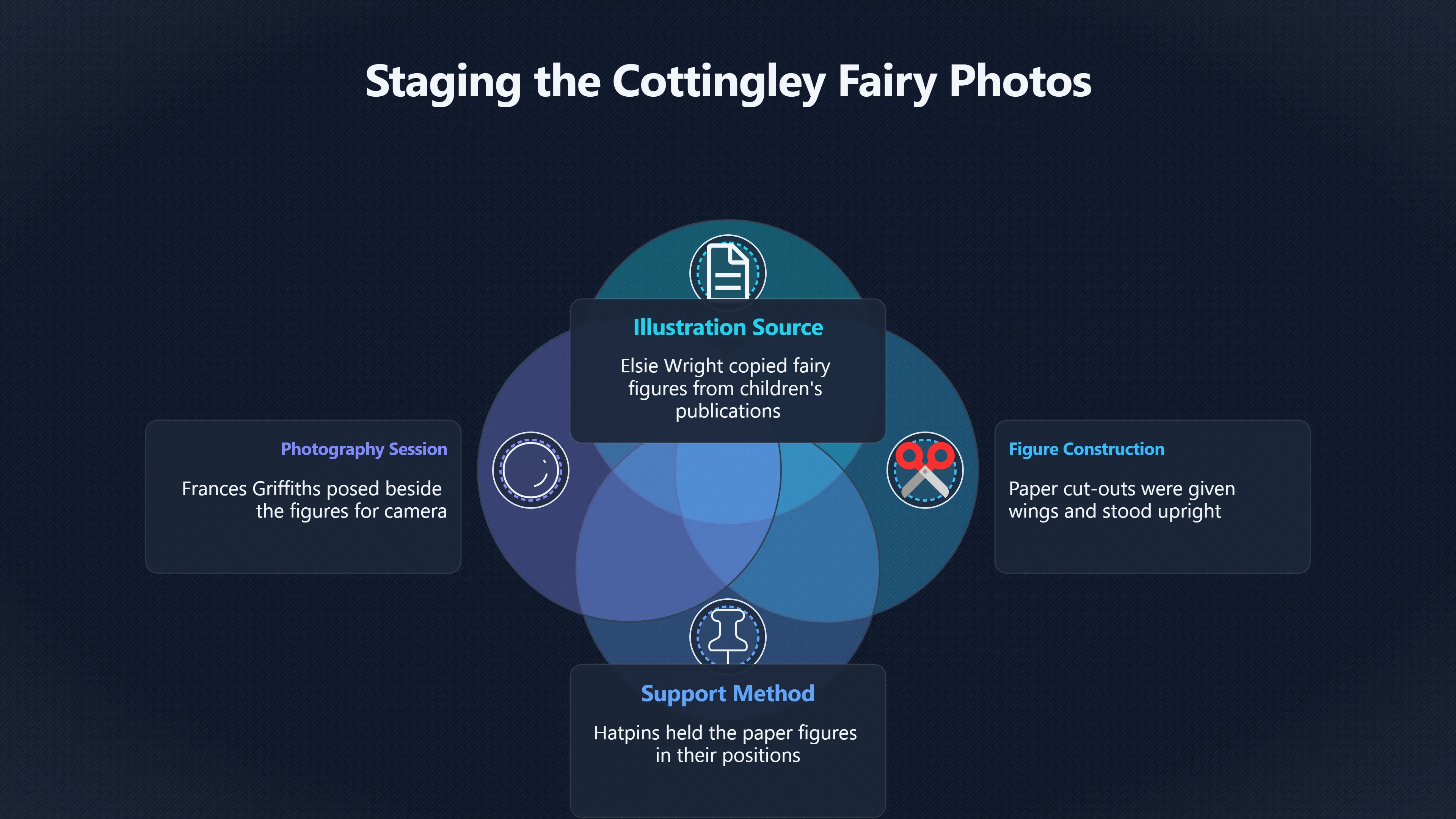
The success of the Cottingley photographs depended on a surprisingly simple method. Elsie Wright was artistically talented and copied fairy figures from illustrations in a popular children’s publication. The figures were cut out, given wings, and placed upright using hatpins. Frances Griffiths then posed beside them while the photographs were taken.[Wikipedia]WikipediaCottingley FairiesCottingley Fairies
What made the trick effective was that nothing unusual happened to the photographic negatives themselves. The camera captured exactly what was physically present in front of it:
- Paper fairy figures really were standing beside the girls.
- Lighting and shadows were genuine because the cut-outs occupied real space.
- The negatives showed no signs of double exposure or obvious darkroom manipulation.
- Anyone examining only the photographic process could conclude that the images had not been tampered with after exposure.[Wikipedia]WikipediaCottingley FairiesCottingley Fairies
This is the key lesson. The camera was not lying. It accurately recorded a staged arrangement. The deception existed in the scene rather than in the photograph.
Modern discussions of image manipulation often focus on editing software, but the Cottingley case demonstrates that visual deception can occur before a shutter is ever pressed. A photograph may honestly document an artificial situation.[Digital Camera World]digitalcameraworld.comIn the early 20th century, teenage cousins Elsie Wright and Frances Griffiths staged photographs with paper fairies, which even convinced…
Why Spiritualists and Experts Accepted the Images
The photographs appeared at a moment when many people were receptive to supernatural claims. The First World War had left millions grieving, and spiritualism enjoyed widespread interest. Conan Doyle, who had suffered personal losses and had become deeply committed to spiritualist beliefs, viewed the photographs as potential evidence that unseen realms existed.[The Public Domain Review]publicdomainreview.orgsir arthur and the fairiesThe Public Domain ReviewSir Arthur and the Fairies12 Jun 2013 — Mary Losure explores how the creator of Sherlock Holmes became convinced…
The images also benefited from expert examination. Harold Snelling, a photographic specialist, reported that the negatives showed no indication of manipulation. Kodak technicians likewise found no evidence of darkroom fakery, although the company stopped short of certifying that the fairies themselves were real. Ilford was more sceptical, suggesting signs of possible fabrication.[Wikipedia]WikipediaCottingley FairiesCottingley Fairies
The crucial problem was that investigators were asking the wrong question.
Instead of asking, “Could the scene itself have been staged?”, many focused on, “Has the negative been altered?” Because the negatives appeared genuine, some observers treated that finding as support for the fairy claim. Yet a photograph can be a completely genuine record of a completely artificial arrangement.[Wikipedia]WikipediaCottingley FairiesCottingley Fairies
Several factors strengthened belief:
- Photography still carried a strong reputation for objectivity.
- The girls appeared unlikely hoaxers.
- The images matched existing spiritualist expectations.
- Respected public figures gave the photographs credibility.[publicdomainreview.org]publicdomainreview.orgsir arthur and the fairiesThe Public Domain ReviewSir Arthur and the Fairies12 Jun 2013 — Mary Losure explores how the creator of Sherlock Holmes became convinced…
The result was a classic example of evidence being interpreted through prior belief rather than tested against alternative explanations.

The Failure of Photographic Authentication
The Cottingley photographs became a textbook demonstration of the limits of photographic verification.
Experts correctly concluded that the negatives were authentic. Their mistake was assuming that authentic negatives implied authentic subject matter. The two questions are not the same. A photograph can satisfy technical tests while still presenting a false story about reality.[Wikipedia]WikipediaCottingley FairiesCottingley Fairies
The distinction can be expressed simply:
QuestionAnswer in the Cottingley caseWas the photograph genuinely taken with a camera?YesWas the negative obviously manipulated?NoDid the photographed scene depict real fairies?NoDid the image therefore provide proof of fairies?No
This gap between photographic authenticity and factual authenticity is what made the case so influential. The photographs passed tests designed to detect one type of fraud while entirely missing another.[Wikipedia]WikipediaCottingley FairiesCottingley Fairies
Later investigators, including photographic experts and sceptical researchers, revisited the images and pointed out features suggesting cut-outs and supports. By the early 1980s the cousins publicly admitted that the photographs had been staged using paper figures, although Frances Griffiths continued to insist that one image might have captured a genuine fairy.[Wikipedia]WikipediaCottingley FairiesCottingley Fairies
What the Case Teaches About Testing Photographs
The enduring importance of the Cottingley Fairies lies less in the fairy story than in the method of deception.
The episode demonstrates three principles that remain relevant in the age of digital media:
A camera records appearances, not explanations
A photograph can show what was present before the lens without revealing why it was there. The camera documented paper cut-outs accurately. What it could not reveal was that they were paper cut-outs.[Wikipedia]WikipediaCottingley FairiesCottingley Fairies
Technical authenticity is not factual authenticity
A genuine photograph does not automatically prove a claimed interpretation. Evidence must include context, corroboration and alternative explanations, not merely the image itself.[Google Arts & Culture]artsandculture.google.comGoogle Arts & CultureThe Cottingley Fairies: A Study In DeceptionIt contained photographs of fairies that Doyle concluded were real. Expe…
People often believe images that fit existing expectations
The fairy photographs gained power because they appeared during a period when many people wanted evidence of spiritual realities. The same psychological pattern can be seen in later photographic hoaxes, from monster photographs to modern digital fakes.[publicdomainreview.org]publicdomainreview.orgsir arthur and the fairiesThe Public Domain ReviewSir Arthur and the Fairies12 Jun 2013 — Mary Losure explores how the creator of Sherlock Holmes became convinced…
From Fairy Cut-Outs to Modern Visual Hoaxes
The Cottingley photographs belong to a long British history of deceptive images, but they remain unusually instructive because the fraud required almost no technical sophistication. Two young cousins created a scene, photographed it, and allowed others to draw extraordinary conclusions.[National Science and Media Museum]scienceandmediamuseum.org.ukfake news exhibition national science and media museumFake News is an exhibition at the National Science and Media Museum…. hoaxes: the Cottingley Fairies photographs. In 1917 two cousins…
That is why the case continues to appear in museum exhibitions and discussions of misinformation. It reminds viewers that the central question is not merely whether a photograph has been altered. The more important question is whether the scene being photographed deserves trust in the first place. A camera may record reality with perfect accuracy while still helping a fiction appear true.[scienceandmediamuseum.org.uk]scienceandmediamuseum.org.ukfake news exhibition national science and media museumFake News is an exhibition at the National Science and Media Museum…. hoaxes: the Cottingley Fairies photographs. In 1917 two cousins…
Amazon book picks
Further Reading
Books and field guides related to When a Camera Made Paper Fairies Look Real. Use these as the next step if you want deeper reading beyond the article.
The Demon-Haunted World
Rating: 4.5/5 from 43 Google Books ratings
Provides tools for evaluating extraordinary claims and images.
Why People Believe Weird Things
Relevant to belief in supernatural photographic evidence.
eBay marketplace picks
Marketplace Samples
Example marketplace items related to this page. Use the search link to explore similar finds on eBay.
Endnotes
1.
Source: Wikipedia
Title: Cottingley Fairies
Link:https://en.wikipedia.org/wiki/Cottingley_Fairies
2.
Source: time.com
Title: cottingley fairies book
Link:https://time.com/4876824/cottingley-fairies-book/
Source snippet
The girls produced photographs of supposed fairies, which were actually illustrations pinned to the ground. This captured public imaginat...
3.
Source: artsandculture.google.com
Link:https://artsandculture.google.com/story/the-cottingley-fairies-a-study-in-deception-leeds-university-library-galleries/lgVB6Ceti9WVAw?hl=en
Source snippet
Google Arts & CultureThe Cottingley Fairies: A Study In DeceptionIt contained photographs of fairies that Doyle concluded were real. Expe...
4.
Source: history.com
Title: cottingley fairies altered photos hoax
Link:https://www.history.com/articles/cottingley-fairies-altered-photos-hoax
5.
Source: digitalcameraworld.com
Link:https://www.digitalcameraworld.com/tech/artificial-intelligence/what-this-109-year-old-deepfake-can-teach-us-about-spotting-ai-photos-today
Source snippet
In the early 20th century, teenage cousins Elsie Wright and Frances Griffiths staged photographs with paper fairies, which even convinced...
6.
Source: scienceandmediamuseum.org.uk
Title: fake news exhibition national science and media museum
Link:https://www.scienceandmediamuseum.org.uk/about-us/press-office/fake-news-exhibition-national-science-and-media-museum
Source snippet
Fake News is an exhibition at the National Science and Media Museum.... hoaxes: the Cottingley Fairies photographs. In 1917 two cousins...
7.
Source: publicdomainreview.org
Title: sir arthur and the fairies
Link:https://publicdomainreview.org/essay/sir-arthur-and-the-fairies/
Source snippet
The Public Domain ReviewSir Arthur and the Fairies12 Jun 2013 — Mary Losure explores how the creator of Sherlock Holmes became convinced...
8.
Source: blog.scienceandmediamuseum.org.uk
Link:https://blog.scienceandmediamuseum.org.uk/cottingleys-scientific-fairies-and-enchanting-technology/
Source snippet
National Science and Media Museum blogCottingley's Scientific Fairies and Enchanting Technology26 Sept 2025 — In 1983, after decades of h...
9.
Source: scienceandmediamuseum.org.uk
Title: fake news
Link:https://www.scienceandmediamuseum.org.uk/what-was-on/fake-news
10.
Source: victorianweb.org
Link:https://victorianweb.org/authors/doyle/fairies.html
Additional References
11.
Source: theguardian.com
Title: The Guardian’It never happened
Link:https://www.theguardian.com/artanddesign/2025/apr/12/28-fake-images-that-fooled-the-world
Source snippet
From early examples such as Abraham Lincoln’s doctored portraits and spirit photography, to politically motivated fakes like doctored ima...
12.
Source: youtube.com
Link:https://www.youtube.com/watch?v=1Z7zSGzdgTU
Source snippet
Sir Arthur Conan Doyle and the Cottingley Fairies...
13.
Source: youtube.com
Title: Fairies Photographed! The Cameo Camera and the Case of the Cottingley Fairies
Link:https://www.youtube.com/watch?v=UWXBfjwIBKs
Source snippet
How the Cottingley Fairies Photographs Were Made...
14.
Source: youtube.com
Title: How the Cottingley Fairies Photographs Were Made
Link:https://www.youtube.com/watch?v=Fki-ELK3G5g
Source snippet
1976: COTTINGLEY FAIRIES: FACT or FANTASY? | Nationwide | Weird and Wonderful | BBC Archive...
15.
Source: youtube.com
Title: The Story of the Cottingley Fairies Hoax
Link:https://www.youtube.com/watch?v=FtSVxd_pXns
Source snippet
Fairies Photographed! The Cameo Camera and the Case of the Cottingley Fairies...
16.
Source: facebook.com
Link:https://www.facebook.com/newspaperscom/posts/fairytale-fraud-learn-about-the-5-fairy-photos-that-fooled-sir-arthur-conan-doyl/805437311597581/
17.
Source: facebook.com
Link:https://www.facebook.com/nationalscienceandmediamuseum/posts/its-international-fairy-day-did-you-know-that-bradford-is-home-to-one-of-the-wor/1124975909660435/
18.
Source: facebook.com
Link:https://www.facebook.com/BBCArchive/posts/1976-nationwide-explored-the-mystery-of-the-cottingley-fairies-with-the-woman-wh/588616683563263/
19.
Source: historic-uk.com
Link:https://www.historic-uk.com/CultureUK/The-Fairies-of-Cottingley/
20.
Source: conwayhall.org.uk
Link:https://www.conwayhall.org.uk/whats-on/event/the-cottingley-fairies-100-years-of-the-fairy-photographs/
Topic Tree