Within Saudi Hoaxes
Why One Staged Photograph Fit Three Wars
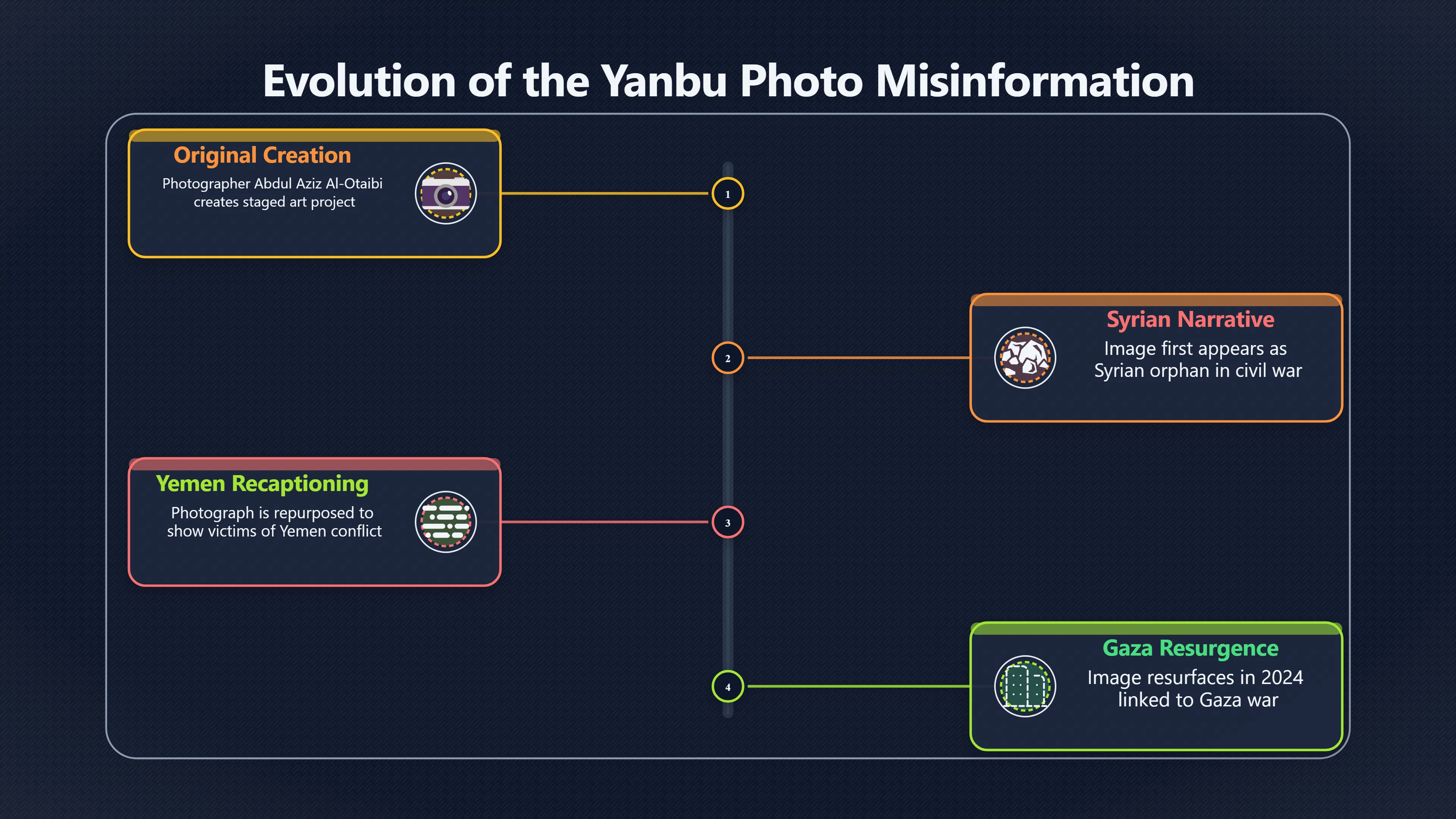
A staged photograph made near Yanbu was repeatedly recaptioned as proof of real suffering in Syria, Yemen and Gaza.
On this page
- The original art project near Yanbu
- How false captions moved the image between conflicts
- What image verification revealed about the scene
Page outline Jump by section
Introduction
Few examples of modern visual misinformation are as revealing as the photograph commonly known as the “Yanbu photo”. The image shows a small child apparently asleep between two graves. Since it first appeared online in 2014, it has been repeatedly presented as documentary evidence of suffering in entirely different conflicts. At various times it has been described as a Syrian orphan sleeping beside his parents’ graves, a victim of the war in Yemen, and later a child in Gaza mourning relatives killed in the Israel–Hamas conflict. In reality, none of those captions were true. The photograph was a staged art project created near Yanbu on Saudi Arabia’s Red Sea coast.[Reuters]reuters.comImage of child sleeping between graves is an old art project, not in GazaThe photograph was taken by Aziz Alotaibi, a Saudi Arabian photographer, as part of an art project to illustrate the irreplaceable love o…

The story matters because it illustrates a common form of propaganda and misinformation: not a fake image, but a real photograph detached from its original context. The picture’s emotional power made it persuasive, while the lack of obvious geographical clues allowed it to be endlessly recaptioned for new political causes and new wars.[Reuters]reuters.comImage of child sleeping between graves is an old art project, not in GazaThe photograph was taken by Aziz Alotaibi, a Saudi Arabian photographer, as part of an art project to illustrate the irreplaceable love o…
The Original Art Project Near Yanbu
The photograph was created by Saudi photographer Abdul Aziz Al-Otaibi (also rendered as Aziz Alotaibi). In January 2014 he published a series of images centred on the theme of orphanhood and the irreplaceable bond between children and their deceased parents. The child in the picture was not a war victim but the photographer’s nephew. The apparent graves were not graves at all: Al-Otaibi constructed piles of rubble to resemble burial sites and arranged the scene as a conceptual artwork near Yanbu.[Reuters]reuters.comImage of child sleeping between graves is an old art project, not in GazaThe photograph was taken by Aziz Alotaibi, a Saudi Arabian photographer, as part of an art project to illustrate the irreplaceable love o…
According to later interviews, the photographer’s intention was symbolic rather than journalistic. He wanted to express the idea that parental love cannot be replaced, even after death. The image was therefore staged from the beginning, but it was not created as a deception. The problem arose when the photograph escaped its original artistic context.[Reuters]reuters.comImage of child sleeping between graves is an old art project, not in GazaThe photograph was taken by Aziz Alotaibi, a Saudi Arabian photographer, as part of an art project to illustrate the irreplaceable love o…
Within days of publication, copies began circulating online with entirely new captions. The image’s creator later complained that people had taken his work and used it for causes and narratives he had never intended to support. He described being shocked and frustrated by the way the photograph had been transformed into propaganda.[Arab News]arabnews.comArab NewsArt project, not Syrian orphan29 Jan 2014 — A photo claimed by some to show a Syrian child sleeping between two graves has turne…
How False Captions Moved the Image Between Conflicts
The first major false claim identified by fact-checkers presented the child as a Syrian orphan sleeping between the graves of his parents during the Syrian civil war. The story spread rapidly through social media and was repeated by users around the world who believed they were sharing authentic evidence of wartime suffering.[Arab News]arabnews.comArab NewsArt project, not Syrian orphan29 Jan 2014 — A photo claimed by some to show a Syrian child sleeping between two graves has turne…
What made the image unusually durable was its lack of specific visual markers. There are no road signs, military uniforms, identifiable buildings or landscape features that immediately tie it to a particular place. Viewers see only a child, rubble and apparent graves. That ambiguity allowed the same image to be recycled whenever a new conflict generated public sympathy.
Over the following years, versions appeared connected to other crises in the Middle East. The photograph was repeatedly presented as evidence from Yemen. Later, during the Gaza war, social-media posts once again claimed it showed a Palestinian child sleeping beside the graves of relatives killed in the conflict. Reuters documented a major resurgence of the image in 2024 under Gaza-related captions, despite the photograph’s well-established origin in Saudi Arabia.[Reuters]reuters.comImage of child sleeping between graves is an old art project, not in GazaThe photograph was taken by Aziz Alotaibi, a Saudi Arabian photographer, as part of an art project to illustrate the irreplaceable love o…
The pattern reveals an important distinction. The image itself was genuine in the sense that it was not digitally fabricated. The deception lay in the caption. Each new caption encouraged viewers to interpret the same visual scene as proof of a different political narrative.[Reuters]reuters.comImage of child sleeping between graves is an old art project, not in GazaThe photograph was taken by Aziz Alotaibi, a Saudi Arabian photographer, as part of an art project to illustrate the irreplaceable love o…
Why the Photograph Was So Persuasive
The Yanbu image succeeded because it activates powerful emotional responses before viewers begin asking questions. A sleeping child evokes vulnerability. The apparent graves suggest loss and tragedy. The scene contains almost no distracting details and therefore communicates a simple story at a glance.[Reuters]reuters.comImage of child sleeping between graves is an old art project, not in GazaThe photograph was taken by Aziz Alotaibi, a Saudi Arabian photographer, as part of an art project to illustrate the irreplaceable love o…
Psychologically, photographs often carry an assumption of authenticity. Many people instinctively treat a striking image as evidence, especially when it appears to confirm what they already know about a war or humanitarian disaster. The photograph therefore benefited from what misinformation researchers call “out-of-context” reuse: a genuine image paired with a false explanation.[arXiv]arxiv.orgOpen source on arxiv.org.
Unlike obvious digital hoaxes, out-of-context images are difficult to spot because nothing in the photograph itself necessarily appears altered. A viewer who already knows that civilians have suffered in Syria, Yemen or Gaza may see the picture as plausible and share it without verification. The emotional message arrives faster than the factual investigation.[arXiv]arxiv.orgOpen source on arxiv.org.
What Image Verification Revealed About the Scene
The photograph was ultimately traced back through reverse-image searches, archived social-media posts and statements from the photographer himself. Investigators found the image on Al-Otaibi’s accounts from January 2014, along with other photographs from the same project showing the same child and location.[Reuters]reuters.comImage of child sleeping between graves is an old art project, not in GazaThe photograph was taken by Aziz Alotaibi, a Saudi Arabian photographer, as part of an art project to illustrate the irreplaceable love o…
Journalists who contacted the photographer received a consistent explanation. He confirmed that the scene had been staged, that the child was his nephew and that the apparent graves had been constructed specifically for the artwork. He also stated that the image had nothing to do with Syria or any other armed conflict.[Reuters]reuters.comImage of child sleeping between graves is an old art project, not in GazaThe photograph was taken by Aziz Alotaibi, a Saudi Arabian photographer, as part of an art project to illustrate the irreplaceable love o…
The case became a textbook example of how visual verification works:
- Locate the earliest known publication of the image.
- Identify the original creator and obtain their explanation.
- Compare later captions with the original context.
- Search for additional photographs from the same shoot that reveal the wider scene.
- Check whether independent reporting supports the claimed location and event.
When these steps were applied, the wartime narratives collapsed. The photograph originated from a Saudi art project, not from a battlefield.[Reuters]reuters.comImage of child sleeping between graves is an old art project, not in GazaThe photograph was taken by Aziz Alotaibi, a Saudi Arabian photographer, as part of an art project to illustrate the irreplaceable love o…
What the Yanbu Photo Reveals About Modern Propaganda
The Yanbu photograph is notable not because it was expertly forged, but because it demonstrates how little manipulation is sometimes required. A powerful image plus a false caption can be enough.
In the history of Saudi Arabia-related misinformation, the case stands apart from famous Photoshop hoaxes such as the giant skeleton supposedly discovered in the desert. The Yanbu image was not digitally fabricated and was not originally created to deceive. Instead, it became propaganda through repeated recontextualisation. Each new conflict gave the image a fresh audience, while many viewers never encountered the corrections.[Reuters]reuters.comImage of child sleeping between graves is an old art project, not in GazaThe photograph was taken by Aziz Alotaibi, a Saudi Arabian photographer, as part of an art project to illustrate the irreplaceable love o…
The photograph continues to circulate because its emotional message is universal. A child mourning parents can symbolise suffering in almost any war. That very universality is what makes the image dangerous when detached from its source. The lesson of the Yanbu photo is that verification requires more than asking whether a picture is real. It also requires asking whether the story attached to the picture is real.[Reuters]reuters.comImage of child sleeping between graves is an old art project, not in GazaThe photograph was taken by Aziz Alotaibi, a Saudi Arabian photographer, as part of an art project to illustrate the irreplaceable love o…
Amazon book picks
Further Reading
Books and field guides related to Why One Staged Photograph Fit Three Wars. Use these as the next step if you want deeper reading beyond the article.
eBay marketplace picks
Marketplace Samples
Live-tested eBay searches with available results related to this page.

Endnotes
1.
Source: reuters.com
Title: Image of child sleeping between graves is an old art project, not in Gaza
Link:https://www.reuters.com/fact-check/image-child-sleeping-between-graves-is-an-old-art-project-not-gaza-2024-06-11/
Source snippet
The photograph was taken by Aziz Alotaibi, a Saudi Arabian photographer, as part of an art project to illustrate the irreplaceable love o...
2.
Source: arxiv.org
Link:https://arxiv.org/abs/2112.00061
3.
Source: arabnews.com
Link:https://www.arabnews.com/news/511261
Source snippet
Arab NewsArt project, not Syrian orphan29 Jan 2014 — A photo claimed by some to show a Syrian child sleeping between two graves has turne...
Additional References
4.
Source: youtube.com
Link:https://www.youtube.com/watch?v=jBF2qCxQG88
Source snippet
AI-generated beached shark: When fake news and artificial intelligence meet business • FRANCE 24...
5.
Source: facebook.com
Link:https://www.facebook.com/timesofoman/posts/the-project-was-selected-among-90-projects-submitted-by-individuals-and-institut/3656854327727529/
Source snippet
t aims to revive art and strengthen the human relationship with...
6.
Source: facebook.com
Link:https://www.facebook.com/IsraelinLA/posts/one-photo-was-staged-the-other-debunked-itwhile-bild-revealed-how-hamas-photogra/1082613154053473/
Source snippet
an photographer as staging “starvation” scenes in Gaza as...
7.
Source: youtube.com
Link:https://www.youtube.com/watch?v=rRIg3qE_RM8
Source snippet
Fact Check: These Viral Photos Are Of Rohingya, Not The Aftermath Of Tripura Clashes...
8.
Source: theguardian.com
Link:https://www.theguardian.com/media/2006/aug/09/pressandpublishing.syria
Source snippet
The GuardianPhotos under fire in the propaganda war | Media9 Aug 2006 — Images have been manipulated ever since Matthew Brady, considered...
9.
Source: youtube.com
Title: 10 Viral Images That Turned Out to Be Fake
Link:https://www.youtube.com/watch?v=cUZV6lemotE
Source snippet
The Falling Soldier by Robert Capa (1936) Story behind perhaps the most well known war photograph...
10.
Source: instagram.com
Link:https://www.instagram.com/p/DAtkEFWOyhy/
11.
Source: researchgate.net
Link:https://www.researchgate.net/profile/Asmaa-Abdelrahman-7/publication/363924654_Evaluating_Cultural_Heritage_Landscape_Design_as_an_Approach_for_Al_Bujairi_Park_Development_Saudi_Arabia/links/63354fa7769781354ea49bf8/Evaluating-Cultural-Heritage-Landscape-Design-as-an-Approach-for-Al-Bujairi-Park-Development-Saudi-Arabia.pdf
12.
Source: fullfact.org
Link:https://fullfact.org/middle-east-conflict/
13.
Source: alamy.com
Link:https://www.alamy.com/stock-photo/yanbu-saudi-arabia.html
Topic Tree