How Fiji Became a Perfect Name for Hoaxes
Fiji’s best-known “hoaxes” do not form a neat collection of home-grown practical jokes. The more revealing pattern is how Fiji has repeatedly been turned into a persuasive label: a supposedly remote source of monsters, cannibals, exotic artefacts, miraculous purity or political intrigue. The most famous example, P. T.
Page outline Jump by section
Introduction
Some of these stories were deliberate deceptions; others grew through exaggeration, loose labelling, commercial promotion or sincere repetition. Their shared lesson is that a false story becomes durable when it fits an image the audience already expects.
Why the Feejee Mermaid was hardly Fijian
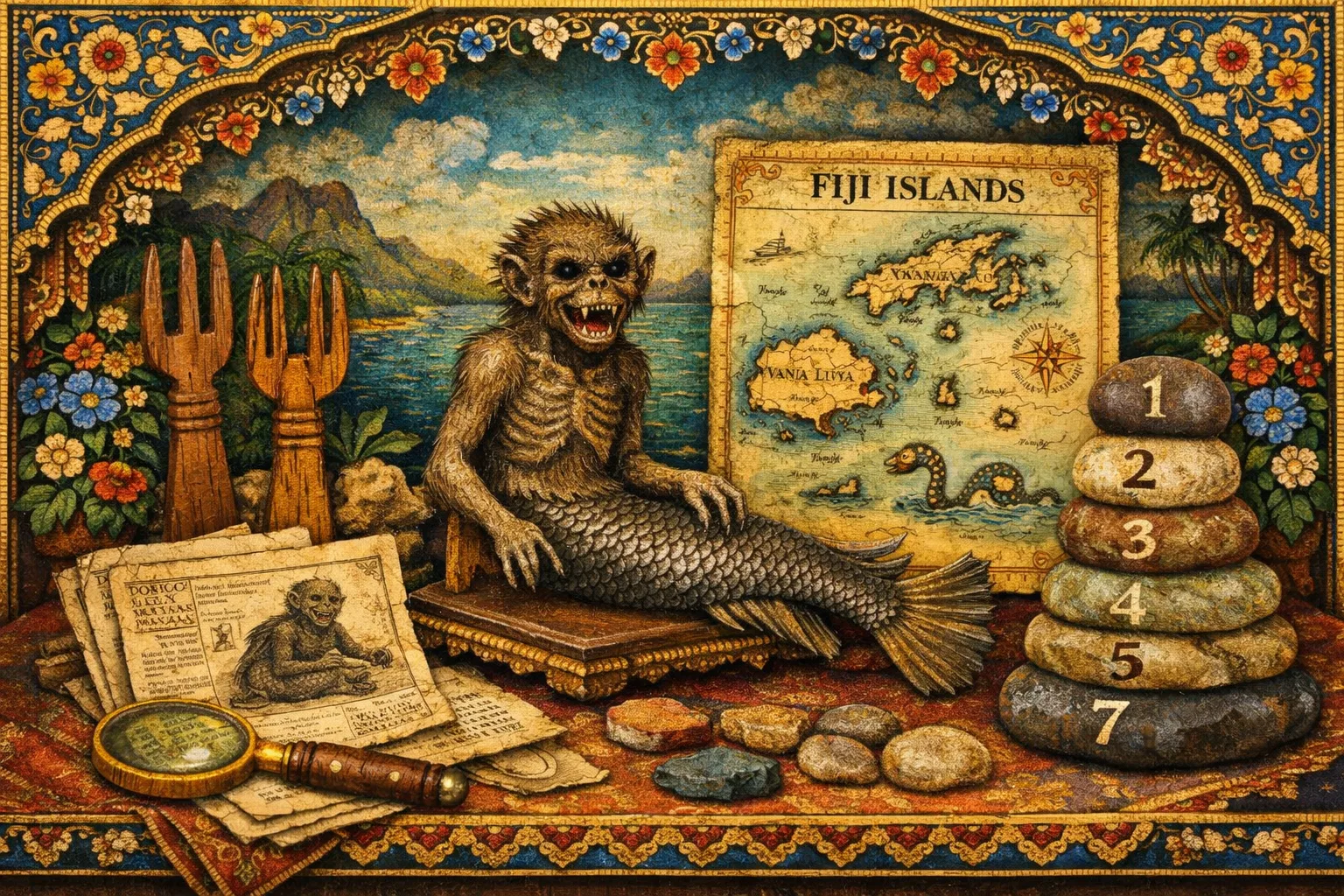
The Feejee Mermaid was one of the nineteenth century’s most successful fake creatures: a grotesque dried body presented as physical proof that mermaids existed. Rather than the beautiful half-woman of European art, the specimen resembled a small, snarling animal with a shrivelled torso joined to a fish. Examples were assembled from animal parts and modelling materials. Harvard’s Peabody Museum describes its own version as incorporating monkey and fish remains, reptile claws, teeth, clay and papier-mâché.[Harvard Gazette]news.harvard.eduHarvard GazetteFeejee Mermaid offers haunting image at Harvard museumOctober 30, 2017 — 30 Oct 2017 — Origins unknown, the skeletal mythi…
The celebrated version reached the American showman P. T. Barnum through Moses Kimball, proprietor of the Boston Museum. Barnum exhibited it in 1842 and built a publicity campaign around the claim that it had been caught near the “Feejee Islands”. Its supposed geographical origin was central to the performance. Fiji was distant enough from most American customers to be difficult to check, while European and American travel writing had already portrayed the islands as an uncanny frontier populated by unfamiliar peoples and creatures.
Barnum’s method was more sophisticated than merely placing a fake in a glass case. Advance publicity included manufactured controversy and an apparently independent expert. A naturalist using the name “Dr Griffin” promoted the specimen before its exhibition, but he was part of the publicity operation. Newspaper editors were supplied with conflicting images of beautiful mermaids, encouraging discussion even though the actual object looked nothing like them. The campaign exploited a basic weakness in sensational journalism: once several newspapers had repeated the story, repetition itself looked like corroboration.
The object’s manufacture probably lay in East Asia, where composite mermaid figures were made from fish, monkeys and other materials for religious, entertainment or collecting purposes. The exact history of Barnum’s original specimen remains uncertain, and several later objects have been called the “original” Feejee Mermaid. That uncertainty is part of the hoax’s afterlife. A false provenance was attached to a composite artefact, and subsequent copying made it increasingly difficult to establish which surviving object belonged to which stage of the story.[Harvard Gazette]news.harvard.eduHarvard GazetteFeejee Mermaid offers haunting image at Harvard museumOctober 30, 2017 — 30 Oct 2017 — Origins unknown, the skeletal mythi…
Fiji therefore supplied the mermaid’s brand rather than its body. The episode belongs in Fijian hoax history because it shows how the country’s name was commercially used to authenticate something supposedly beyond ordinary experience. The deception worked not because audiences knew much about Fiji, but because they knew so little that almost any marvel could be placed there.

How the “Cannibal Isles” image mixed fact with spectacle
The Feejee Mermaid drew credibility from a wider nineteenth-century image of Fiji as the “Cannibal Isles”. Cannibalism was practised in parts of pre-colonial Fiji, particularly in warfare, punishment and ritual humiliation. Historical testimony, oral traditions and archaeological work mean it cannot responsibly be dismissed as a complete European invention. Yet the way it was described abroad was often selective, sensational and politically useful. Missionaries could present conversion as rescue from barbarism, colonial advocates could portray foreign control as a civilising necessity, and publishers could sell violent travel narratives to readers eager for distant horrors.[nationalgeographic.com]nationalgeographic.comcannibalism contagion measles fiji vitu levu graveNational GeographicMass grave found in Fiji sparks a mystery: cannibalism or…15 Apr 2024 — They dubbed the region “the Cannibal Isles”…
The misleading element was not usually the bare claim that cannibalism occurred. It was the conversion of particular practices into a national character: every Fijian became a potential man-eater, every implement became a cannibal weapon, and every uncertain anecdote could be treated as fact. Later scholarship has therefore had to navigate between two errors—accepting lurid colonial accounts literally and denying well-supported practices merely because colonial writers exploited them.
This distinction matters when assessing stories about the Methodist missionary Thomas Baker, who was killed with members of his party in the interior of Viti Levu in 1867. The killing and consumption of Baker are well established, but popular retellings commonly reduce the entire event to a simple tale in which he touched a chief’s head and was immediately eaten for breaking a taboo. Historical reconstructions describe a more complicated political and religious setting involving resistance to missionary expansion, local alliances and a planned attack. The memorable head-touching explanation may preserve one element of the dispute, but it has often displaced the wider circumstances.[Wikipedia]WikipediaThomas Baker (missionaryThomas Baker (missionary
The story acquired another layer in 2003, when Baker’s descendants attended a reconciliation ceremony with villagers who believed their community had suffered misfortune because of the killing. Reporting frequently described this as the lifting of a “cannibal curse”. For participants, however, the ceremony concerned reconciliation, memory and communal healing rather than an experiment proving that a supernatural curse existed. Treating the ceremony only as a bizarre survival of superstition reproduced the same exoticising habits that had shaped earlier coverage.[The Guardian]theguardian.comThe Guardian Fijians apologise for eaten missionary | World newsThe Guardian Fijians apologise for eaten missionary | World news
The trouble with “cannibal forks”
Few objects demonstrate the manufacture of a national stereotype as clearly as the carved wooden utensils widely labelled “Fijian cannibal forks”. Genuine Fijian forks existed and some had specialised ceremonial uses, including feeding high-ranking people who were restricted from touching food. Certain examples may have been used when human flesh was served. The misleading claim is that the entire class of objects was designed exclusively for cannibalism.
The British Museum now warns that these implements acquired notoriety because European commentators falsely assumed that their sole purpose was eating human flesh and misunderstood the nature of the restrictions surrounding them. The National Museum of Ireland likewise records a fork with a collector’s cannibal-feast description, but notes that its provenance depends on an acquisition catalogue rather than direct documentation of how that particular object was used.[National Museum of Ireland]museum.ieOpen source on museum.ie.
Demand from outsiders complicated the picture. Once sailors, officials and tourists wanted tangible relics of the “Cannibal Isles”, objects could be collected, relabelled or manufactured for sale. A fork dated 1939 in Boston Children’s Museum, for example, was almost certainly a souvenir rather than an implement used in an actual cannibal ceremony, because it was produced many decades after the practice had ended.[The Power of Play]bostonchildrensmuseum.blogThe Power of Play Hidden Object Highlight – Fijian ForkThe Power of Play Hidden Object Highlight – Fijian Fork
This does not make every museum fork a forgery. It reveals a spectrum:
- some are older ceremonial objects with credible Fijian provenance;
- some may have been used in meals that included human flesh, though proof for an individual object is often weak;
- some were ordinary or specialised feeding forks later given a more sensational label;
- others were made for the souvenir market after “cannibal Fiji” had become a profitable tourist image.
The deception often occurred in the description rather than the carving. A real object became commercially more valuable when labelled a cannibal artefact, while collectors had little incentive to ask whether the story could be verified.
Did Ratu Udre Udre really eat 872 people?
One of Fiji’s most repeated macabre claims concerns Ratu Udre Udre, a nineteenth-century chief from the Rakiraki area. Guinness World Records has listed him as the “most prolific cannibal”, reporting that he ate between 872 and 999 people. The number is usually linked to stones said to have been placed near his residence or grave, one for each victim consumed.[Guinness World Records]guinnessworldrecords.comGuinness World Records Most prolific cannibalGuinness World Records Most prolific cannibal
The problem is that the stones do not explain themselves. Their number, original arrangement and meaning are not established by contemporary records capable of supporting such a precise total. Retellings disagree sharply: some local accounts give 99, others 872 or 999. Even the story’s basic arithmetic varies according to which source is repeating it.[Fiji Suncoast]suncoastfiji.orgFiji Suncoast Mystery surrounds Udre Udre's victim countFiji Suncoast Mystery surrounds Udre Udre's victim count
It is plausible that Udre Udre participated in cannibal feasts associated with warfare. What cannot be treated as securely demonstrated is that he personally ate 872 separate people, still less that this can be ranked like a modern sporting record. The claim converts oral tradition and an archaeological feature into a precise statistic without a reliable chain of evidence.
Its persistence shows why record-book formats can lend authority to folklore. A number printed beside an institutional logo feels measured, even when it rests on a story whose variants differ by hundreds. The cautious conclusion is not that Udre Udre was invented, but that the famous total belongs to contested legend rather than verified biography.
When Fiji became a marketing claim
The use of Fiji as shorthand for untouched nature did not end with nineteenth-century curiosities. FIJI Water built an international identity around artesian water from Viti Levu, tropical remoteness and environmental purity. In the late 2000s, the company promoted the product as “carbon negative”, meaning that its climate projects and offsets were said to exceed the emissions produced by bottling and transporting the water.
A United States class action filed in 2010 challenged that language as deceptive. The complaint focused on “forward crediting”: counting carbon reductions expected from projects in future decades as though they had already offset present emissions. Critics argued that consumers seeing “carbon negative” on a bottle would naturally understand it as a statement about current performance, not a promise dependent on forests growing or offsets continuing to work.[business-humanrights.org]business-humanrights.orgOpen source on business-humanrights.org.
A lawsuit allegation is not itself proof of fraud, and the dispute should not be described as a concluded finding that the company operated a hoax. Its importance lies in the mechanism being challenged. Environmental claims can be literally derived from an accounting model yet still give buyers a misleading impression if future benefits, uncertain assumptions and the emissions from packaging and global transport are not made clear.
The Fiji branding strengthened that impression. A bottle shipped thousands of miles could still be imagined as an almost direct gift from an unspoilt island. As with the Feejee Mermaid, geographical distance did persuasive work. In the older case Fiji authenticated a manufactured monster; in the newer one it helped authenticate an image of exceptional natural purity.
How false election evidence spreads online
Digital misinformation in Fiji more often relies on recycled material than elaborate physical fabrication. Before the general election of 14 December 2022, photographs circulated online claiming to show Attorney-General Aiyaz Sayed-Khaiyum visiting a ballot-printing facility less than two weeks before polling. The implication was that a senior government figure had gained suspicious access to election preparations.
RMIT FactLab traced the pictures to a documented visit in 2019. The images themselves were genuine; the date attached to them was false. That small change converted an ordinary earlier event into supposed evidence of contemporary electoral interference.[RMIT University]rmit.edu.auOpen source on edu.au.
This kind of deception is especially effective because a photograph feels more direct than an unsupported statement. Viewers can see that the person and location are real, so they may fail to check when the photograph was taken. Social-media sharing then strips away original captions and links, making the false context harder to detect with each repost.
The episode also unfolded in a tense information environment. The 2022 count included a genuine results-app anomaly, which the elections office acknowledged and corrected. Real technical problems can make unrelated false claims seem more credible: audiences reason that if one error occurred, a photograph alleging something worse may also be true. The proper response is not to dismiss every concern as “fake news”, but to separate demonstrable failures from claims supported by misdated or manipulated evidence.
Fiji’s election authorities have continued to warn about false information concerning voter registration and electoral procedures. Such warnings carry their own democratic risk if regulation is applied too broadly, because criticism, mistake, satire and deliberate disinformation are not the same thing. The strongest debunking remains transparent verification: locating the earliest version of an image, checking dates and identifying what independent evidence would be needed for the claim to stand.[Islands Business]islandsbusiness.comIslands Business FEO rejects voter register misinformationIslands Business FEO rejects voter register misinformation
Why the same stories keep returning
Fiji’s hoax history is less about an unusual national appetite for deception than about recurring incentives in global media and commerce.
Distance reduces accountability. Barnum’s customers could not easily investigate a creature allegedly obtained in Fiji. Modern audiences can search more quickly, but a misleading post often reaches thousands of people before anyone finds its original date.
Existing stereotypes fill gaps in the evidence. A strange fork looked like a cannibal implement because collectors already expected Fiji to be defined by cannibalism. A grotesque composite animal sounded more plausible when assigned to islands imagined as wild and unexplored.
Real facts give false claims something to attach to. Cannibalism did occur, but that did not validate every lurid story, souvenir label or numerical record. An election app did malfunction, but that did not make photographs from 2019 evidence of wrongdoing in 2022.
Institutions can preserve uncertainty as authority. Museum labels, record books, newspapers and corporate packaging all compress complicated evidence into confident phrases. Later corrections rarely travel as widely as the original claim.
The most useful way to read these stories is therefore not to divide them simply into “true” and “fake”. The Feejee Mermaid was a deliberate manufactured imposture. The exclusive “cannibal fork” label was often a collector’s exaggeration applied to real objects. Udre Udre’s exact tally is an unverified legend presented as a statistic. The disputed carbon-negative claim depended on contested accounting and consumer interpretation. The election photographs were authentic images placed in a false time frame.
Together they show how deception usually succeeds: not by inventing every detail, but by combining something real with a name, date, label or explanation that the audience is already prepared to believe.
Amazon book picks
Further Reading
Books and field guides related to How Fiji Became a Perfect Name for Hoaxes. Use these as the next step if you want deeper reading beyond the article.
The Feejee Mermaid and Other Essays in Natural and Unnatural...
Explores the history of fabricated curiosities.
Cannibalism and Colonialism: Charting Colonies and Frontiers...
Examines how stories and colonial narratives shaped Fiji's image.
eBay marketplace picks
Marketplace Samples
Live-tested eBay searches with available results related to this page.



Endnotes
1.
Source: news.harvard.edu
Link:https://news.harvard.edu/gazette/story/2017/10/feejee-mermaid-offers-haunting-tale-at-harvard-museum/
Source snippet
Harvard GazetteFeejee Mermaid offers haunting image at Harvard museumOctober 30, 2017 — 30 Oct 2017 — Origins unknown, the skeletal mythi...
Published: October 30, 2017
2.
Source: peabody.harvard.edu
Title: Peabody Museum Harvard’s Fee Jee Mermaid
Link:https://peabody.harvard.edu/resource/harvards-feejee-mermaid
Source snippet
location_on. Harvard University 11 Divinity Avenue Cambridge, MA 02138.Read more...
3.
Source: news.harvard.edu
Title: s peabody museum fetes 150 years with unusual exhibit
Link:https://news.harvard.edu/gazette/story/2017/05/harvards-peabody-museum-fetes-150-years-with-unusual-exhibit/
Source snippet
Harvard GazetteHarvard's Peabody Museum fetes 150 years with unusual...5 May 2017 — There's a hand-carved effigy pipe of a flying man dr...
Published: May 2017
4.
Source: jstor.org
Link:https://www.jstor.org/stable/3695286
Source snippet
to the recuperation of the culture (Williams and Calvert. 1859: 161; see Sahlins 1983). Fijian cannibalism was not.Read more...
5.
Source: jstor.org
Link:https://www.jstor.org/stable/24644566
Source snippet
The Capture and Curation of the Cannibal ʻVendoviʼby A ADLER · 2014 · Cited by 13 — 28 Gananath Obeyesekere has demonstrated that ac...
6.
Source: Wikipedia
Title: Thomas Baker (missionary)
Link:https://en.wikipedia.org/wiki/Thomas_Baker_%28missionary%29
7.
Source: museum.ie
Link:https://www.museum.ie/en-IE/Collections-Research/Collection/Documentation-Discoveries/Artefact/Cannibal%E2%80%99s-Fork-from-Fiji/b7f4d30c-4c64-4924-a7a9-fd84504c2798
8.
Source: Wikipedia
Title: Udre Udre
Link:https://en.wikipedia.org/wiki/Udre_Udre
9.
Source: trellis.net
Title: fiji water sued over claim product carbon negative
Link:https://trellis.net/article/fiji-water-sued-over-claim-product-carbon-negative/
10.
Source: jstor.org
Link:https://www.jstor.org/stable/10.1525/j.ctt1ppn6j
11.
Source: jstor.org
Link:https://www.jstor.org/stable/25064862
12.
Source: jstor.org
Link:https://www.jstor.org/stable/4139606
13.
Source: jstor.org
Link:https://www.jstor.org/stable/25112562
14.
Source: jstor.org
Link:https://www.jstor.org/stable/41236850
15.
Source: jstor.org
Link:https://www.jstor.org/stable/41710655
16.
Source: jstor.org
Link:https://www.jstor.org/stable/23551285
17.
Source: jstor.org
Link:https://www.jstor.org/stable/23041465
18.
Source: jstor.org
Title: Response to Victor Li
Link:https://www.jstor.org/stable/41949299
19.
Source: peabody.harvard.edu
Title: exhibition videos
Link:https://peabody.harvard.edu/exhibition-videos?page=1
20.
Source: news.harvard.edu
Link:https://news.harvard.edu/gazette/page/222/?p=gazette%2F2004%2F04.29%2F13-loeblecture.html
21.
Source: dash.harvard.edu
Link:https://dash.harvard.edu/server/api/core/bitstreams/759c55fb-cc24-4950-a77c-e2b5220d968b/content
22.
Source: news.harvard.edu
Link:https://news.harvard.edu/gazette/page/222/?p=gfscoqlafibje.html
23.
Source: nationalgeographic.com
Title: cannibalism contagion measles fiji vitu levu grave
Link:https://www.nationalgeographic.com/premium/article/cannibalism-contagion-measles-fiji-vitu-levu-grave
Source snippet
National GeographicMass grave found in Fiji sparks a mystery: cannibalism or...15 Apr 2024 — They dubbed the region “the Cannibal Isles”...
24.
Source: theguardian.com
Title: The Guardian Fijians apologise for eaten missionary | World news
Link:https://www.theguardian.com/world/2003/nov/14/1
25.
Source: bostonchildrensmuseum.blog
Title: The Power of Play Hidden Object Highlight – Fijian Fork
Link:https://bostonchildrensmuseum.blog/2018/08/01/hidden-object-highlight-fijian-fork/
26.
Source: guinnessworldrecords.com
Title: Guinness World Records Most prolific cannibal
Link:https://www.guinnessworldrecords.com/world-records/74205-most-prolific-cannibal
27.
Source: suncoastfiji.org
Title: Fiji Suncoast Mystery surrounds Udre Udre’s victim count
Link:https://www.suncoastfiji.org/news/mystery-surrounds-udre-udres-victim-count/
28.
Source: business-humanrights.org
Link:https://www.business-humanrights.org/en/latest-news/fiji-water-sued-over-claim-that-product-is-carbon-negative-usa/
29.
Source: rmit.edu.au
Link:https://www.rmit.edu.au/news/factlab-meta/old-photos-used-to-spread-false-fiji-election-claim
30.
Source: islandsbusiness.com
Title: Islands Business FEO rejects voter register misinformation
Link:https://islandsbusiness.com/news-break/feo-rejects-voter-register-misinformation/
31.
Source: resolve.cambridge.org
Title: feejee islands
Link:https://resolve.cambridge.org/core/services/aop-cambridge-core/content/view/8C75A4C8D3DB7C909AA0E31201250BE4/9781139013130c5_p165-280_CBO.pdf/feejee_islands.pdf
32.
Source: policycommons.net
Title: general election
Link:https://policycommons.net/artifacts/12659091/general-election/13557240/
33.
Source: otagomuseum.nz
Title: cannibal forks
Link:https://otagomuseum.nz/blog/cannibal-forks/
Additional References
34.
Source: youtube.com
Title: Feejee Mermaid & Centaur of Tymfi | Bizarre Secrets of Barnum Museum!
Link:https://www.youtube.com/watch?v=qQL5pJgM-XM
Source snippet
The Boston Museum Owner Behind Barnum's Famous Mermaid...
35.
Source: youtube.com
Title: The Feejee Mermaid: An American Tradition
Link:https://www.youtube.com/watch?v=_d-CbURZh1I
Source snippet
Feejee Mermaid & Centaur of Tymfi | Bizarre Secrets of Barnum Museum...
36.
Source: parliament.gov.fj
Link:https://www.parliament.gov.fj/wp-content/uploads/2023/11/131-2022-General-Election-Joint-Report-by-the-Electoral-Commission-and-Supervisor-of-Elections.pdf
37.
Source: facebook.com
Link:https://www.facebook.com/groups/11467143891/posts/10155633728548892/
38.
Source: facebook.com
Link:https://www.facebook.com/FijianCCC/posts/-alert-the-age-of-digital-deception-in-an-era-where-artificial-intelligence-can-/803921728440773/
39.
Source: facebook.com
Link:https://www.facebook.com/BSPFinancialGroupLimited/posts/bsp-fiji-could-you-spot-a-scam-email-scam-emails-are-designed-to-look-convincing/1440554321440335/
40.
Source: britishmuseum.org
Link:https://www.britishmuseum.org/collection/object/E_Oc-6705?selectedImageId=1211843001
41.
Source: cfjctoday.com
Link:https://cfjctoday.com/2018/07/03/cannibal-fork-from-the-fiji-islands/
42.
Source: tuhura.nz
Link:https://www.tuhura.nz/athome/cannibal-forks
43.
Source: facebook.com
Link:https://www.facebook.com/groups/archeologyandcivilizations/posts/9012900712136706/
Topic Tree
Follow this branch
Related pages 192
- Albanian Hoaxes
- Algerian Hoaxes
- Antigua Deceptions
- Argentina Hoaxes
- Armenian Hoaxes
- +187 more in sidebar