Within Bahamian Mysteries
Are the Monsters of Andros Genuine Hoaxes?
Stories of the lusca and chickcharney reveal how real environmental dangers can become monsters without becoming deliberate frauds.
On this page
- The lusca in the blue holes
- The chickcharney in island folklore
- Where folklore ends and fakery begins
Page outline Jump by section
Introduction
The monsters of Andros are not among the Bahamas’ clearest hoaxes. They occupy a more interesting territory between folklore, misidentification and later sensational retelling. The two best-known examples are the lusca, a giant sea creature said to inhabit the island’s blue holes, and the chickcharney, a strange owl-like being associated with the pine forests of Andros. Both stories emerged from landscapes that were genuinely difficult, dangerous and mysterious to earlier inhabitants. Neither requires a deliberate fraudster to explain its popularity. Instead, they show how people transformed unfamiliar environments into memorable stories and how later writers sometimes blurred the line between local tradition and claims of literal monsters.[Wikipedia]WikipediaMay 10, 2026 — The Lusca is a name given to a mythological sea monster said to exist in the region of the blue holes nearby Andros, an is…
For a history of hoaxes and contested truths in the Bahamas, the Andros monsters are valuable precisely because they are not straightforward deceptions. They reveal how folklore can be mistaken for evidence, how tourism and popular media can amplify legends, and how genuine environmental hazards can acquire supernatural explanations.[science.gmu.edu]science.gmu.eduwhat really lives king kong cavernLusca Monster Of The Blue Holes | River Monsters). Others believe that mermaids live in Andros Blue Holes, and that they take the unwary…
The lusca in the blue holes
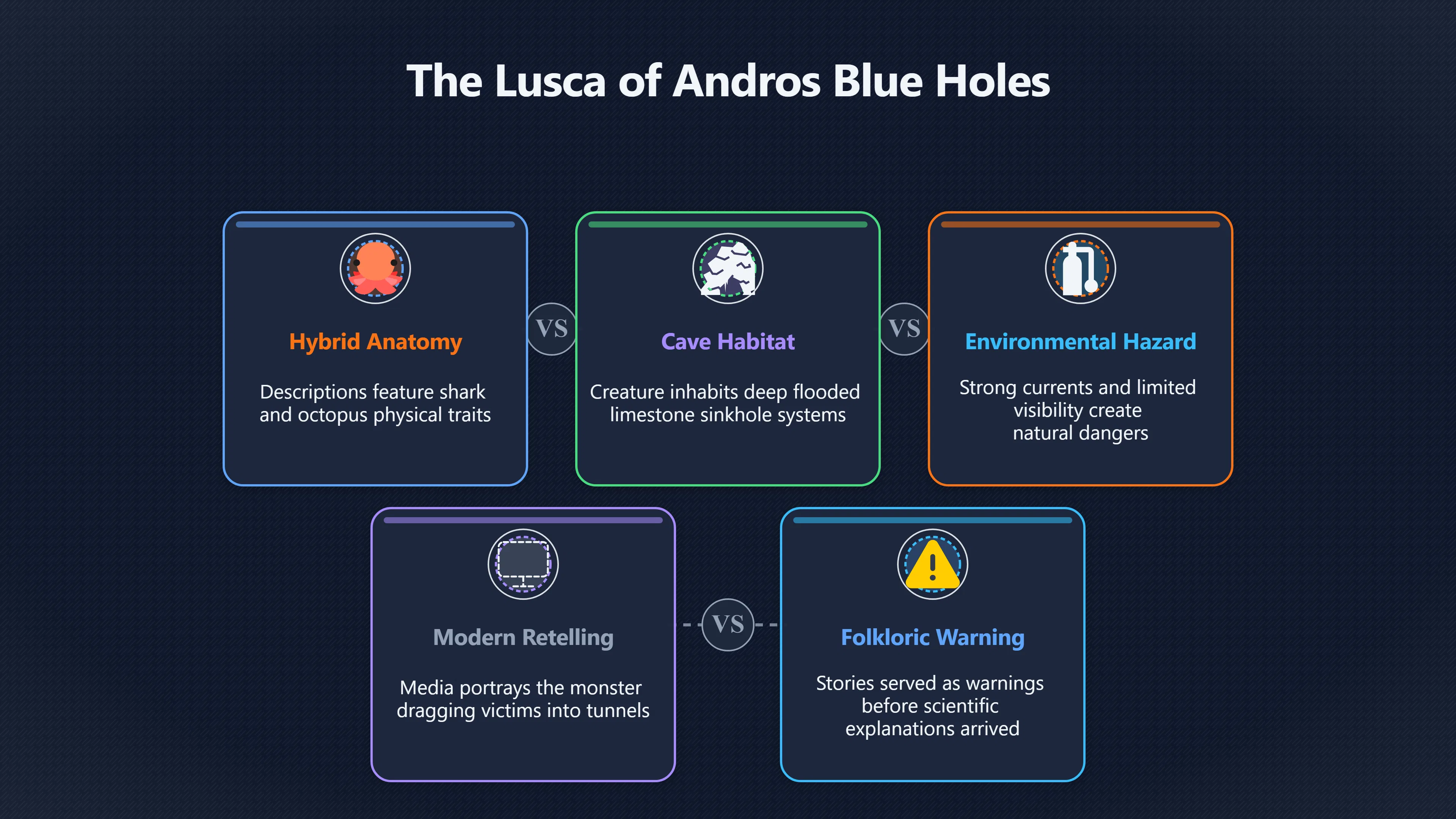
The lusca is one of the most famous creatures in Bahamian folklore. Accounts vary, but it is commonly described as a gigantic octopus-like monster or a hybrid with features of both an octopus and a shark. The creature is especially associated with the blue holes of Andros, deep water-filled cave systems connected to extensive underground passages.[wikipedia.org]WikipediaMay 10, 2026 — The Lusca is a name given to a mythological sea monster said to exist in the region of the blue holes nearby Andros, an is…
The setting matters. Andros contains one of the world’s greatest concentrations of blue holes, both inland and offshore. These flooded sinkholes can be extremely deep, visually striking and potentially hazardous because of currents, underwater cave systems and limited visibility. For generations, fishermen and travellers encountered places that seemed dark, bottomless and unpredictable. In such conditions, stories about something living below the surface served as a way of explaining danger.[myirietime.com]myirietime.comMy Irie Time Blue Holes of Andros, BahamasMy Irie TimeBlue Holes of Andros, Bahamas - My Irie TimeBlue holes are vertical caves, formed by the slow erosion of the limestone bedroc…
The lusca legend often links disappearances, damaged boats or unexplained underwater events to a lurking creature. Modern retellings frequently emphasise attacks on divers or claims that the monster drags victims into underwater tunnels. Yet these dramatic accounts are difficult to verify and generally rely on folklore, anecdote or cryptozoological speculation rather than documented evidence.[folktalesamerica.com]folktalesamerica.comthe lusca of the blue holes bahamian folktaleThe Lusca is a legendary sea monster described as half shark and half octopus living in blue holes.Read more…
What makes the lusca particularly revealing is that a real environmental threat sits beneath the legend. Strong currents, underwater cave networks and the natural risks of diving in blue holes are well documented. A story about a monster may have provided a memorable warning long before scientific explanations became widely available. In that sense, the legend functioned less as a hoax than as a folkloric way of communicating danger.[myirietime.com]myirietime.comMy Irie Time Blue Holes of Andros, BahamasMy Irie TimeBlue Holes of Andros, Bahamas - My Irie TimeBlue holes are vertical caves, formed by the slow erosion of the limestone bedroc…
Why some people treated the lusca as real
The boundary between folklore and alleged evidence became blurred in the twentieth and twenty-first centuries. Television programmes, cryptozoology books and internet discussions often presented the lusca as a possible undiscovered animal rather than as a traditional legend. Some writers suggested that sightings could be explained by unusually large octopuses or squid, while others embraced far more extravagant descriptions.[fandom.com]river-monsters.fandom.comTerror in Paradise | River Monsters WikiTerror in Paradise | River Monsters Wiki
This shift illustrates a common pattern in monster stories. A tale that originally belonged to oral tradition is reinterpreted as a biological mystery. Once that happens, audiences begin looking for proof, sightings and photographs. The result is not necessarily deliberate deception, but it can create the impression that folklore itself is evidence for a hidden creature. No convincing physical evidence has emerged for the existence of a giant monster matching the traditional lusca descriptions.[Wikipedia]WikipediaMay 10, 2026 — The Lusca is a name given to a mythological sea monster said to exist in the region of the blue holes nearby Andros, an is…
The chickcharney in island folklore
If the lusca belongs to the sea, the chickcharney belongs to the forests. The creature is usually described as an owl-like being with bright eyes, unusual feet and a long tail. Stories portray it as mischievous rather than purely dangerous. Travellers who treat a chickcharney respectfully may receive good fortune, while those who insult or harm one risk bad luck or misfortune.[wikipedia.org]WikipediaOpen source on wikipedia.org.
Unlike many monster legends, the chickcharney is woven into everyday local storytelling. It is not simply a predator lurking in the wilderness. Instead, it acts almost like a supernatural resident of the forest, rewarding proper behaviour and punishing arrogance. Such stories often serve social purposes, encouraging respect for nature and caution in unfamiliar environments.[Wikipedia]WikipediaOpen source on wikipedia.org.
The legend became famous enough to inspire festivals, artwork and tourism references associated with Andros. Yet despite occasional claims of sightings, there is no verified evidence that a chickcharney exists as a living species.[Wikipedia]WikipediaAndros, The BahamasAndros, The Bahamas
A possible link to a real animal
One of the most intriguing attempts to explain the chickcharney involves extinct wildlife rather than fraud. Researchers have suggested that memories of a large prehistoric owl, Tyto pollens, may have contributed to the legend. This giant barn owl once lived in the Bahamas and was considerably larger than modern species. Some scholars have argued that stories passed down over generations could preserve echoes of encounters with unusual birds.[Wikipedia]WikipediaOpen source on wikipedia.org.
The theory remains speculative, but it demonstrates that folklore does not have to be entirely invented. Legends can preserve distorted memories of real animals, landscapes or events. Whether or not Tyto pollens directly inspired the chickcharney, the proposal highlights the way natural history and storytelling can become intertwined.[Wikipedia]WikipediaOpen source on wikipedia.org.
Where folklore ends and fakery begins
Neither the lusca nor the chickcharney is best understood as a classic hoax. There is no known mastermind who fabricated the stories to deceive the public, no forged specimen and no documented scheme comparable to famous monster frauds elsewhere in the world. The legends emerged organically within local culture.[Wikipedia]WikipediaMay 10, 2026 — The Lusca is a name given to a mythological sea monster said to exist in the region of the blue holes nearby Andros, an is…
The closer connection to hoax history appears later, when folklore is presented as factual evidence. Problems arise when anecdotes are treated as zoological proof, when dramatic claims are repeated without verification, or when entertainment media encourage audiences to believe that a traditional legend has been scientifically validated. At that point the story shifts from folklore into the realm of contested truth.[fandom.com]river-monsters.fandom.comTerror in Paradise | River Monsters WikiTerror in Paradise | River Monsters Wiki
This distinction is important. A folk tale about a sea monster warning people away from dangerous waters is culturally valuable even if the monster never existed. A claim that a giant undiscovered predator has been proven to inhabit Andros blue holes requires evidence that has never materialised. The first belongs to tradition; the second belongs to extraordinary claims.[A Book of Creatures]abookofcreatures.comOpen source on abookofcreatures.com.
What the Andros monsters reveal
The enduring appeal of the Andros monsters comes from the unusual geography of the island itself. Vast forests, isolated settlements, flooded cave systems and deep blue holes provided ideal conditions for legends to flourish. The stories survived because they expressed real anxieties and experiences connected to the landscape.[myirietime.com]myirietime.comMy Irie Time Blue Holes of Andros, BahamasMy Irie TimeBlue Holes of Andros, Bahamas - My Irie TimeBlue holes are vertical caves, formed by the slow erosion of the limestone bedroc…
For students of hoaxes and disputed claims, the lusca and the chickcharney are reminders that not every extraordinary story begins as a fraud. Sometimes a legend emerges from genuine uncertainty. The more interesting question is how later generations reinterpret that legend—turning a cautionary tale into a cryptid hunt, a cultural tradition into supposed evidence, or a local story into an international mystery. In the Bahamas, the monsters of Andros sit precisely on that boundary between folklore and hoax, where imagination, environment and belief overlap.[Wikipedia]WikipediaMay 10, 2026 — The Lusca is a name given to a mythological sea monster said to exist in the region of the blue holes nearby Andros, an is…
Amazon book picks
Further Reading
Books and field guides related to Are the Monsters of Andros Genuine Hoaxes?. Use these as the next step if you want deeper reading beyond the article.
The Demon-Haunted World
Rating: 4.5/5 from 43 Google Books ratings
Encourages critical evaluation of extraordinary folklore claims.
The Field Guide to North American Monsters
Covers legendary creatures and how such stories evolve.
eBay marketplace picks
Marketplace Samples
Live-tested eBay searches with available results related to this page.
Endnotes
1.
Source: Wikipedia
Link:https://en.wikipedia.org/wiki/Lusca
Source snippet
May 10, 2026 — The Lusca is a name given to a mythological sea monster said to exist in the region of the blue holes nearby Andros, an is...
Published: May 10, 2026
2.
Source: Wikipedia
Link:https://en.wikipedia.org/wiki/Chickcharney
3.
Source: Wikipedia
Title: Andros, The Bahamas
Link:https://en.wikipedia.org/wiki/Andros%2C_The_Bahamas
4.
Source: science.gmu.edu
Title: what really lives king kong cavern
Link:https://science.gmu.edu/news/what-really-lives-king-kong-cavern
Source snippet
Lusca Monster Of The Blue Holes | River Monsters). Others believe that mermaids live in Andros Blue Holes, and that they take the unwary...
5.
Source: bahamas4kids.com
Link:https://www.bahamas4kids.com/stories/stories-myths.html
Source snippet
Half-shark, half-octopus, Lusca lurks around in the underwater caves, tunnels and blue holes found all over...Read more...
6.
Source: explorersweb.com
Title: a guide to the blue holes of the bahamas andros island
Link:https://explorersweb.com/a-guide-to-the-blue-holes-of-the-bahamas-andros-island/
Source snippet
When the last ice age ended and glaciers melted, sea levels rose and flooded the...Read more...
7.
Source: folktalesamerica.com
Title: the lusca of the blue holes bahamian folktale
Link:https://folktalesamerica.com/the-lusca-of-the-blue-holes-bahamian-folktale/
Source snippet
The Lusca is a legendary sea monster described as half shark and half octopus living in blue holes.Read more...
8.
Source: cryptidarchives.fandom.com
Link:https://cryptidarchives.fandom.com/wiki/Lusca
Source snippet
Cryptid ArchivesLusca - Encyclopaedia of Cryptozoology - FandomIt is particularly associated with the blue holes↗, large and deep marine...
9.
Source: river-monsters.fandom.com
Title: Terror in Paradise | River Monsters Wiki
Link:https://river-monsters.fandom.com/wiki/Terror_in_Paradise
10.
Source: cryptidz.fandom.com
Title: Cryptid Wiki Lusca
Link:https://cryptidz.fandom.com/wiki/Lusca
11.
Source: warriorsofmyth.fandom.com
Link:https://warriorsofmyth.fandom.com/wiki/Chickcharney
12.
Source: youtube.com
Title: The Truth About the Chickcharney
Link:https://www.youtube.com/watch?v=4he10fma_ew
Source snippet
The Chickcharney | The Fate Changing Owls of the Bahamas...
13.
Source: youtube.com
Title: The Chickcharney | The Fate Changing Owls of the Bahamas
Link:https://www.youtube.com/watch?v=9cYjqNCmbdM
Source snippet
The Curse of Chickcharney: The Dark Tale of This Bahamian Cryptid...
14.
Source: youtube.com
Title: The Curse of Chickcharney: The Dark Tale of This Bahamian Cryptid
Link:https://www.youtube.com/watch?v=I4icf4Rc4dc
Source snippet
The Lusca | The Caribbean's Giant Sea Monsters...
15.
Source: youtube.com
Title: The Lusca | The Caribbean’s Giant Sea Monsters
Link:https://www.youtube.com/watch?v=MzB36TuRnxU
Source snippet
Jeremy May Have Found The Lusca Monster Of The Blue Holes | River Monsters...
16.
Source: myirietime.com
Title: My Irie Time Blue Holes of Andros, Bahamas
Link:https://myirietime.com/blue-holes-andros-bahamas/
Source snippet
My Irie TimeBlue Holes of Andros, Bahamas - My Irie TimeBlue holes are vertical caves, formed by the slow erosion of the limestone bedroc...
17.
Source: abookofcreatures.com
Link:https://abookofcreatures.com/2020/06/15/lusca/
18.
Source: mythosjourney.com
Link:https://www.mythosjourney.com/encyclopedia/pages/chickcharney/
19.
Source: caribbeanfolkloremonth.wordpress.com
Link:https://caribbeanfolkloremonth.wordpress.com/2025/09/15/lusca/
20.
Source: fischipedia.org
Link:https://fischipedia.org/wiki/Lusca
21.
Source: dailybestiary.blogspot.com
Link:https://dailybestiary.blogspot.com/2017/04/lusca.html
22.
Source: kids.nationalgeographic.com
Link:https://kids.nationalgeographic.com/geography/countries/article/bahamas
Additional References
23.
Source: roadmapwriters.com
Link:https://www.roadmapwriters.com/sites/default/files/2024-09/CHICKCHARNEY.pdf
24.
Source: reddit.com
Link:https://www.reddit.com/r/Cryptozoology/comments/13jsjxu/have_you_heard_of_lusca/
25.
Source: shoplusca.com
Link:https://shoplusca.com/?srsltid=AfmBOoqPhYIf20QshzVGKg4JVo1qJQn6XpDTdY9FxPtm3BQtRyPMiHRJ
26.
Source: d20pfsrd.com
Link:https://www.d20pfsrd.com/bestiary/monster-listings/magical-beasts/lusca/
27.
Source: reddit.com
Link:https://www.reddit.com/r/UnresolvedMysteries/comments/97n4ko/the_lusca_beast_of_the_bahamas_blue_holes/
28.
Source: roadmapwriters.com
Link:https://www.roadmapwriters.com/sites/default/files/2024-09/LUSCA.pdf
29.
Source: thecryptidatlas.com
Title: the curse of chickcharney the dark tale of this bahamian cryptid
Link:https://thecryptidatlas.com/the-curse-of-chickcharney-the-dark-tale-of-this-bahamian-cryptid/
30.
Source: instagram.com
Link:https://www.instagram.com/reel/DMvbhnPxie1/?hl=en
31.
Source: youtube.com
Title: Jeremy May Have Found The Lusca Monster Of The Blue Holes | River Monsters
Link:https://www.youtube.com/watch?v=bnWg7hM07Qg
32.
Source: tastywithkc.com
Title: legends of the bahamas tales of mythical creatures
Link:https://tastywithkc.com/legends-of-the-bahamas-tales-of-mythical-creatures/
Topic Tree