Within Cyprus Hoaxes
When Ancient Statues Were Made Too Complete
Cesnola's collection shows how genuine ancient fragments could be assembled into misleadingly complete museum objects.
On this page
- How Cesnola Built His Cypriot Collection
- Unrelated Heads, Missing Records and Aggressive Restoration
- How Museums Changed Their Standards of Authenticity
Page outline Jump by section
Introduction
The controversy surrounding Luigi Palma di Cesnola’s Cypriot statues was not primarily about forged antiquities. Most of the stone fragments he collected in Cyprus were genuinely ancient. The problem was that many damaged pieces were restored so aggressively that museum visitors could no longer tell where antiquity ended and nineteenth-century reconstruction began. In some cases, heads were attached to the wrong bodies, fragments from different sculptures were combined, and missing sections were rebuilt to create impressive complete figures. The result was a powerful illusion of authenticity: genuine ancient material presented in forms that were partly modern creations. This episode became one of the most important early debates about museum ethics, archaeological evidence and the difference between an authentic artefact and an authentic reconstruction.[metmuseum.org]metmuseum.orgThe Metropolitan Museum of ArtAncient Art from Cyprus: The Cesnola Collection in The…The Cesnola Collection in The Metropolitan Museum…
For the history of Cyprus, the significance is enormous. Cesnola’s collection helped shape how the outside world imagined ancient Cypriot art. Yet it also demonstrated how easily museums could manufacture certainty from incomplete evidence long before modern conservation standards emerged.[The Metropolitan Museum of Art]metmuseum.orgThe Metropolitan Museum of ArtAncient Art from Cyprus: The Cesnola Collection in The…The Cesnola Collection in The Metropolitan Museum…
How Cesnola Built His Cypriot Collection
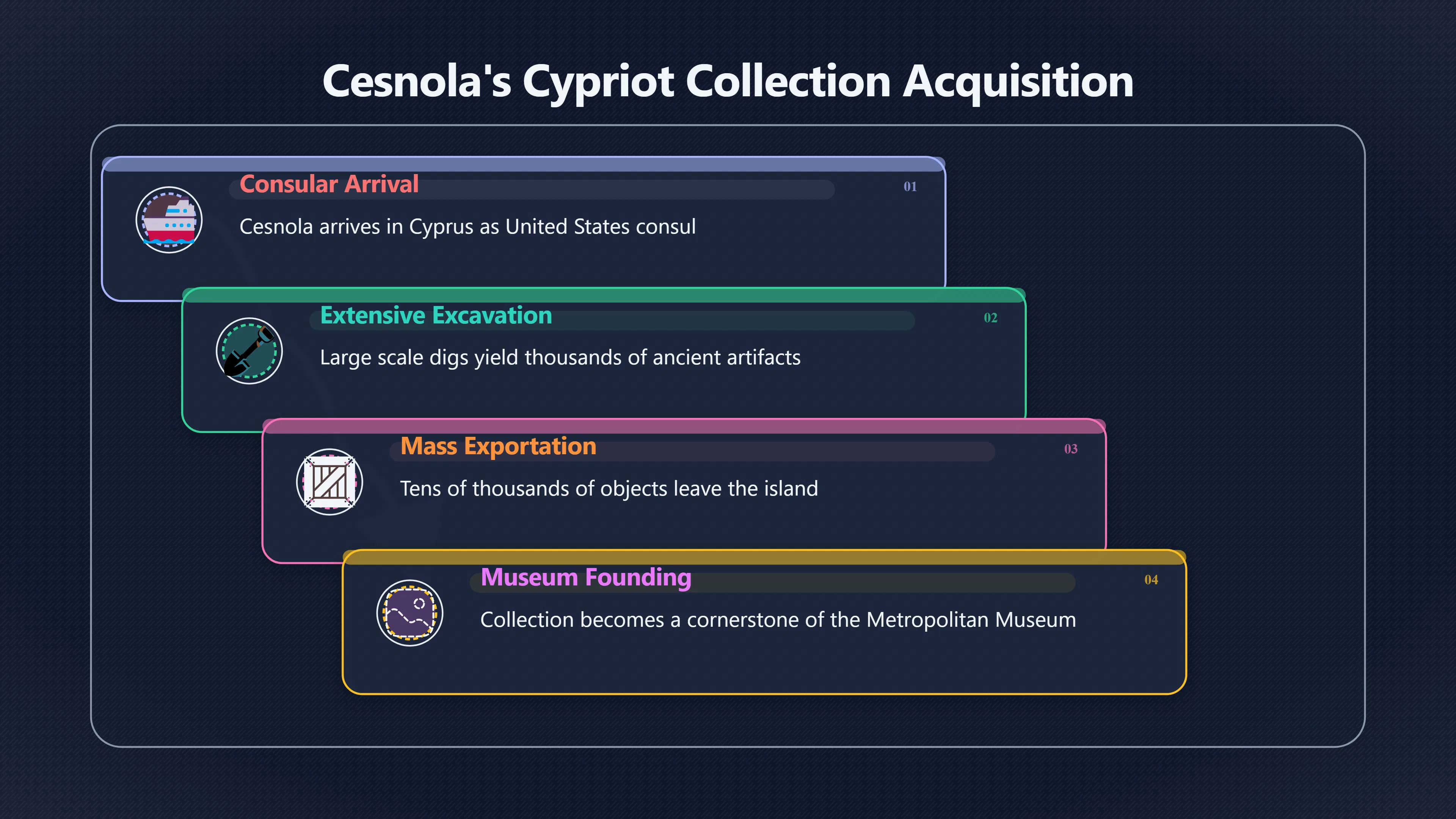
Luigi Palma di Cesnola arrived in Cyprus in 1865 as the United States consul. During the following decade he carried out extensive excavations and acquired thousands of antiquities from across the island. The scale of the operation was unprecedented. Tens of thousands of objects were exported, and the collection eventually became one of the founding treasures of the Metropolitan Museum of Art in New York, where Cesnola later served as the museum’s first director.[metmuseum.org]metmuseum.orgThe Metropolitan Museum of ArtAncient Art from Cyprus: The Cesnola Collection in The…The Cesnola Collection in The Metropolitan Museum…
To nineteenth-century audiences, the collection seemed extraordinary. Cyprus was still relatively unfamiliar to many European and American museum visitors, and Cesnola presented his discoveries as evidence of a sophisticated ancient civilisation linking the Greek, Near Eastern and Egyptian worlds. Large limestone statues were particularly impressive because they appeared to provide direct encounters with the island’s ancient past.[The Metropolitan Museum of Art]metmuseum.orgThe Metropolitan Museum of ArtAncient Art from Cyprus: The Cesnola Collection in The…The Cesnola Collection in The Metropolitan Museum…
The difficulty was that many of these sculptures had been recovered in fragmentary condition. Ancient statues often survive as separate heads, torsos, limbs and architectural pieces. Faced with galleries full of fragments, nineteenth-century curators frequently preferred visually complete displays. In that environment, restoration was often treated as a legitimate way of helping visitors imagine the original appearance of an object.[aiacentralarizonasociety]aiacentralarizonasociety.wordpress.coma scandal (and eventual public trial) about alleged improper restorations to some of the…
Unrelated Heads, Missing Records and Aggressive Restoration
The scandal emerged because critics argued that restoration had crossed the line from repair into invention.
Several scholars and observers accused Cesnola and his restorers of assembling statues from unrelated fragments. A head found separately might be attached to a body because the combination looked convincing rather than because there was reliable archaeological evidence that the pieces originally belonged together. Missing sections could be sculpted anew to create the appearance of a complete monument. Critics also complained that excavation records were often inadequate, making it difficult to verify where individual fragments had been discovered or whether particular combinations were justified.[victorianvoices.net]victorianvoices.netOpen source on victorianvoices.net.
The controversy became public in New York during the 1880s. Opponents challenged claims that the sculptures had not been substantially altered. Newspapers, archaeologists and museum figures argued over whether visitors were seeing authentic ancient objects or modern constructions built around ancient cores. The dispute became sufficiently serious that it generated investigations, expert testimony and legal conflict.[Victorian Voices]victorianvoices.netOpen source on victorianvoices.net.
What makes the episode especially revealing is that later scholarship confirmed at least part of the criticism. Modern catalogues of the collection acknowledge that some statues contain mismatched components and that certain heads do not belong to the bodies on which they were mounted. The issue is therefore not merely a historical quarrel between rival personalities. Subsequent research demonstrated that some of the celebrated sculptures had indeed been assembled in misleading ways.[Scribd]scribd.comThe Cesnola Collection of Cypriot Stone Sculpture | PDFAs noted in the catalogue, there are galleries of the Metropolitan Museum an…
One telling example involves objects whose restorations were later reversed or reconsidered after specialists recognised that attached fragments did not belong together. Even when the replacement pieces were themselves ancient, the resulting statue could present a false historical identity. A viewer believed they were looking at a single surviving sculpture when in reality they were looking at a modern composite assembled from multiple ancient objects.[Wikipedia]WikipediaCesnola sphinx funerary steleCesnola sphinx funerary stele
Why the Reconstructions Looked Convincing
The restored statues succeeded because they combined genuine antiquity with authoritative presentation.
Visitors entered a major museum, saw labels describing ancient Cyprus and encountered apparently complete sculptures displayed as masterpieces. Few people had access to excavation notes, conservation reports or archaeological debates. The authority of the museum itself encouraged trust.[aiacentralarizonasociety]aiacentralarizonasociety.wordpress.coma scandal (and eventual public trial) about alleged improper restorations to some of the…
Nineteenth-century restoration culture also differed from modern expectations. Today conservators usually try to make additions identifiable and reversible. In Cesnola’s era, restoration often aimed for visual completeness. A successful restoration was one that disappeared into the object and made damage seem to vanish. That philosophy naturally blurred the boundary between preservation and reconstruction.[aiacentralarizonasociety]aiacentralarizonasociety.wordpress.coma scandal (and eventual public trial) about alleged improper restorations to some of the…
As a result, audiences were not simply deceived by fake artefacts. They were persuaded by authentic artefacts whose presentation implied a level of certainty that the evidence could not support.
The Real Question: What Counts as Authentic?
The Cesnola controversy exposed a problem that still affects museums today. Authenticity is not only about whether stone, bronze or pottery is ancient. It also concerns the relationships between fragments, the accuracy of restoration, the reliability of excavation records and the honesty of interpretation.[metmuseum.org]metmuseum.orgThe Metropolitan Museum of ArtAncient Art from Cyprus: The Cesnola Collection in The…The Cesnola Collection in The Metropolitan Museum…
A statue assembled from genuine ancient pieces can still communicate a false story if the pieces never belonged together. Conversely, a damaged object may be entirely authentic even when it survives only as fragments. The scandal forced museums and archaeologists to confront the uncomfortable reality that completeness can be misleading.
In that sense, the Cesnola affair sits somewhere between restoration controversy and manufactured authenticity. The ancient material was largely real. The deceptive element lay in the confidence with which uncertain reconstructions were transformed into apparently complete historical facts.[victorianvoices.net]victorianvoices.netOpen source on victorianvoices.net.

How Museums Changed Their Standards of Authenticity
Modern museums approach restoration very differently because of lessons learned from cases such as Cesnola’s.
Today, professional archaeology places heavy emphasis on excavation records, provenance, photographs, conservation documentation and transparency about restoration. Curators routinely distinguish original material from modern additions. Many institutions publish conservation histories and openly discuss earlier mistakes rather than concealing them.[The Metropolitan Museum of Art]metmuseum.orgfeatured publication cesnola collectionfeatured publication cesnola collection
The Metropolitan Museum itself has spent decades re-examining the Cesnola Collection. Modern catalogues identify problematic restorations, reconsider earlier attributions and provide more rigorous documentation than was available in the nineteenth century. Scholars continue to value the collection because it remains one of the most important groups of Cypriot antiquities outside Cyprus, but they approach it with greater caution than earlier generations did.[The Metropolitan Museum of Art]metmuseum.orgThe Metropolitan Museum of ArtAncient Art from Cyprus: The Cesnola Collection in The…The Cesnola Collection in The Metropolitan Museum…
The legacy of the controversy extends far beyond Cyprus. It helped establish a principle now central to museum practice: an object can be ancient yet still be presented in a misleading way. Authentic materials alone are not enough. Authenticity also depends on truthful reconstruction, transparent documentation and a clear distinction between what is known and what has been guessed.[scribd.com]scribd.comThe Cesnola Collection of Cypriot Stone Sculpture | PDFAs noted in the catalogue, there are galleries of the Metropolitan Museum an…
Why claims about Cesnola Statues remained persuasive
The enduring fascination of the Cesnola statues comes from the fact that they challenge a common assumption about historical fraud. People often imagine authenticity as a simple choice between genuine and fake. The Cypriot sculptures show a more complicated reality.
The statues were not usually modern forgeries. Instead, they occupied a grey area where authentic ancient fragments were reorganised into persuasive modern narratives. That makes the episode one of the most important cautionary tales in the history of archaeology and museums. It demonstrates how authority, restoration and visual spectacle can create certainty where the evidence is incomplete, and why modern standards of transparency emerged in response.[victorianvoices.net]victorianvoices.netOpen source on victorianvoices.net.
Within the broader history of Cyprus, the Cesnola affair remains a classic example of how the appearance of authenticity can be manufactured even when the underlying material is real. The lesson is not that ancient Cyprus was invented, but that the stories museums tell about ancient objects require the same scrutiny as the objects themselves.[metmuseum.org]metmuseum.orgThe Metropolitan Museum of ArtAncient Art from Cyprus: The Cesnola Collection in The…The Cesnola Collection in The Metropolitan Museum…
Amazon book picks
Further Reading
Books and field guides related to When Ancient Statues Were Made Too Complete. Use these as the next step if you want deeper reading beyond the article.
Frauds, Myths, and Mysteries: Science and Pseudoscience in Ar...
Relevant to reconstruction, authenticity and evidence.
eBay marketplace picks
Marketplace Samples
Live-tested eBay searches with available results related to this page.
Endnotes
1.
Source: scribd.com
Link:https://www.scribd.com/document/672585427/The-Cesnola-Collection-of-Cypriot-Stone-Sculpture-1
Source snippet
The Cesnola Collection of Cypriot Stone Sculpture | PDFAs noted in the catalogue, there are galleries of the Metropolitan Museum an...
2.
Source: researchgate.net
Link:https://www.researchgate.net/publication/331787992_Art_of_Ancient_Cyprus_The_Cesnola_Collection_in_the_Metropolitan_Museum_of_Art
Source snippet
The Cesnola Collection in the Metropolitan Museum of ArtThe Cesnola Collection in The Metropolitan Museum of Art is the riche...
3.
Source: Wikipedia
Title: Luigi Palma di Cesnola
Link:https://fr.wikipedia.org/wiki/Luigi_Palma_di_Cesnola
4.
Source: Wikipedia
Title: Cesnola sphinx funerary stele
Link:https://en.wikipedia.org/wiki/Cesnola_sphinx_funerary_stele
5.
Source: youtube.com
Title: 6,000 Stolen Artifacts: The Met’s Founding Secret
Link:https://www.youtube.com/watch?v=paOwkeYfWqE
Source snippet
The Metropolitan Museum of Art - The Art of Cypress...
6.
Source: youtube.com
Title: The Metropolitan Museum of Art
Link:https://www.youtube.com/watch?v=H–CmC4dEd8
Source snippet
From Plunder to Partnership: American Adventures in the Archaeology of Cyprus...
7.
Source: metmuseum.org
Link:https://www.metmuseum.org/met-publications/ancient-art-from-cyprus-the-cesnola-collection-in-the-metropolitan-museum-of-art
Source snippet
The Metropolitan Museum of ArtAncient Art from Cyprus: The Cesnola Collection in The...The Cesnola Collection in The Metropolitan Museum...
8.
Source: aiacentralarizonasociety.wordpress.com
Link:https://aiacentralarizonasociety.wordpress.com/2022/09/11/ancient-cypriote-sculpture-in-new-york-cesnola-the-metropolitan-museum-and-19th-century-spectacle/
Source snippet
a scandal (and eventual public trial) about alleged improper restorations to some of the...
9.
Source: metmuseum.org
Title: the cesnola collection of cypriot stone sculpture
Link:https://www.metmuseum.org/met-publications/the-cesnola-collection-of-cypriot-stone-sculpture
Source snippet
The Metropolitan Museum of ArtThe Cesnola Collection of Cypriot Art: Stone SculptureThis collection, with over 6,000 works, documents the...
10.
Source: victorianvoices.net
Link:https://www.victorianvoices.net/ARTICLES/CENTURY/Century1882B/C1882B-Metropolitan.pdf
11.
Source: metmuseum.org
Title: featured publication cesnola collection
Link:https://www.metmuseum.org/perspectives/featured-publication-cesnola-collection
12.
Source: resources.metmuseum.org
Title: The Metropolitan Museum Journal v 47 2012
Link:https://resources.metmuseum.org/resources/metpublications/pdf/The_Metropolitan_Museum_Journal_v_47_2012.pdf
Additional References
13.
Source: youtube.com
Link:https://www.youtube.com/watch?v=lRIpcxXAd_c
Source snippet
Cesnola collection Cyprus Metropolitan Museum of Art The Metropolitan Museum of Art - The Art of Cypress Art and Travel by Dave...
14.
Source: erhantamur.com
Title: Erhan Tamur Luigi Palma di Cesnola vs
Link:https://www.erhantamur.com/project/cesnola/
Source snippet
The Ottoman Government (1865...1 Nov 2025 — Cesnola obtained and exported about 35,000 objects, which almost singlehandedly led to the f...
15.
Source: youtube.com
Title: Ethics in Archaeology | Fakes, Forgeries, and Repatriation | SCHG_FOC20_EIA
Link:https://www.youtube.com/watch?v=VYUnWEYxjss
Source snippet
The Religious Record — Dead Sea Scroll Forgeries: What the Fakes Revealed About the Real Ones...
16.
Source: vtechworks.lib.vt.edu
Link:https://vtechworks.lib.vt.edu/items/7d447312-93dd-46d3-8baa-9714970f03c3
Source snippet
1870s New York Reacts to the Cesnola Collectionsby AM Knoblauch · 2019 · Cited by 3 — The mainstream media and the “shocking ba...
17.
Source: youtube.com
Title: From Plunder to Partnership: American Adventures in the Archaeology of Cyprus
Link:https://www.youtube.com/watch?v=qOvm3OoLOYc
Source snippet
Ethics in Archaeology | Fakes, Forgeries, and Repatriation | SCHG_FOC20_EIA...
18.
Source: academia.edu
Link:https://www.academia.edu/75721492/Envisioning_Egypt_American_orientalism_in_turn_of_the_century_New_York_City
19.
Source: academia.edu
Link:https://www.academia.edu/70649809/Collecting_Antiquities_from_the_Middle_Ages_to_the_End_of_the_Nineteenth_Century_Collecting_Antiquities_from_the_Middle_Ages_to_the_End_of_the_Nineteenth_Century_E_d_i_t_e_d_b
20.
Source: archive.org
Link:https://archive.org/stream/in.ernet.dli.2015.70975/2015.70975.Journal-Of-Egyptian-Archaeology-Vol3_djvu.txt
21.
Source: brill.com
Link:https://brill.com/downloadpdf/edcollbook/title/54749.pdf?srsltid=AfmBOorUjFjFYTFHNv4hSz_9iAAegEyWLVo3Ii6UqYDXTm3yrxTLHGKN
22.
Source: penn.museum
Link:https://www.penn.museum/sites/journal/941/
Topic Tree