Austria's Most Convincing Hoaxes and Contested Frauds
Austria’s most revealing hoax stories are not simply tales of foolish people believing impossible things. They show how deception flourishes when it resembles something that an age already expects to be true.
Page outline Jump by section
Introduction
The strongest Austrian cases therefore range from deliberate theatrical concealment to disputed scientific tampering and pseudoscience promoted with near-religious certainty. Some were exposed by opening cabinets, examining photographs or looking through a microscope. Others remain unresolved because the suspicious object survived but the chain of responsibility did not. Together they illustrate a recurring lesson: an impressive demonstration is not the same as independent evidence, and exposure rarely ends a story once it has become useful, profitable or culturally appealing.
The chess machine with a man inside
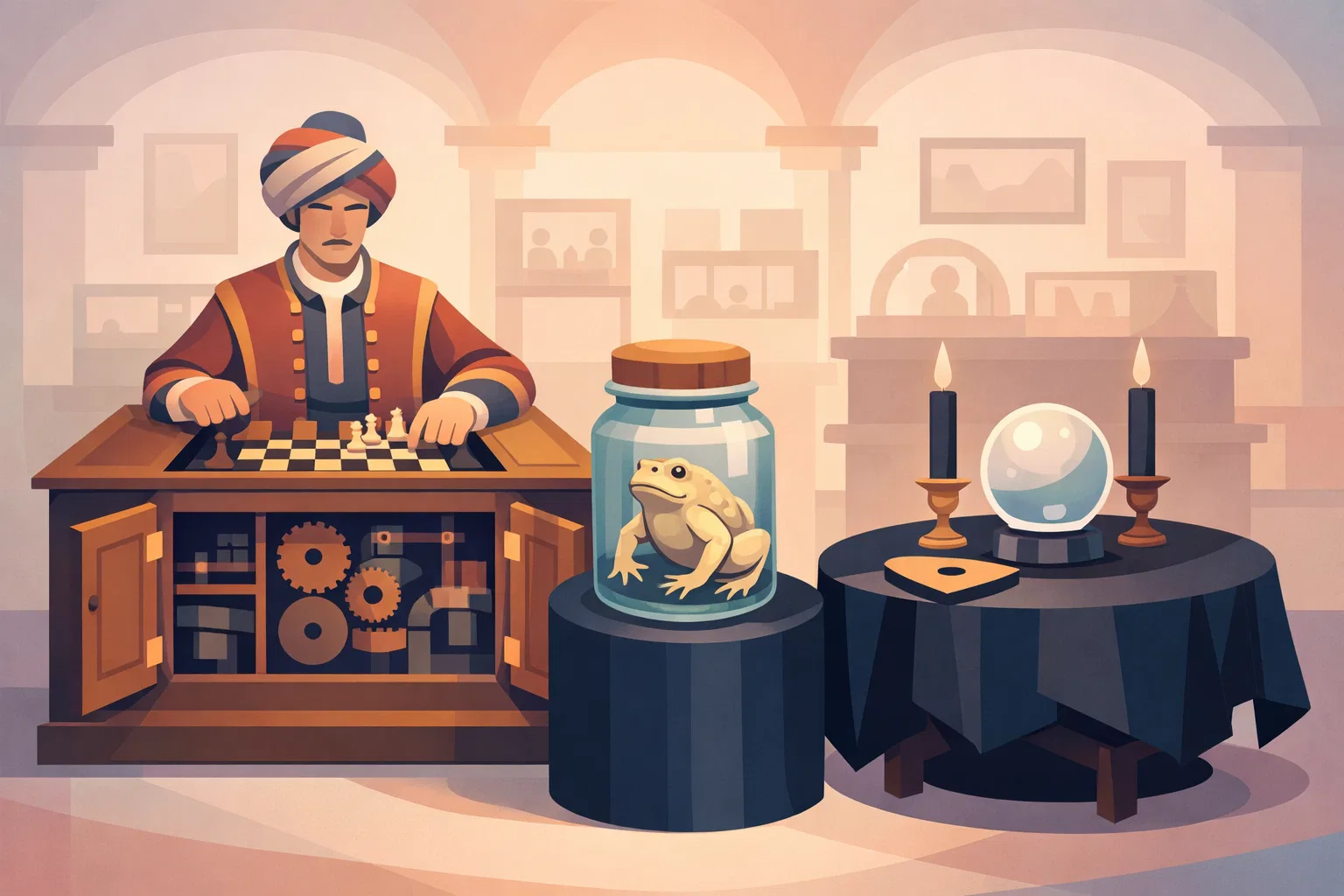
The Mechanical Turk was one of the most successful technological deceptions of the eighteenth and nineteenth centuries. Created by the Hungarian-born inventor and imperial official Wolfgang von Kempelen, it was first demonstrated at Maria Theresa’s court in Vienna in 1770. The apparatus appeared to be an automaton: a life-sized figure in elaborate costume sat behind a wooden cabinet and played competent chess against human opponents. Kempelen opened doors in the cabinet to display wheels, gears and other machinery, apparently proving that no player could be concealed inside.[WIRED]wired.comMonster in a BoxThe Turk, unveiled in 1770, featured a wooden mannequin seated behind a cabinet with clockwork machinery that could mimic playing chess…
That inspection was part of the trick. The internal fittings were arranged so that a hidden operator could shift position as different doors were opened. Once the demonstration began, the concealed chess player followed the game and controlled the figure’s arm through an internal mechanism. The visible clockwork was not entirely meaningless—it helped operate the illusion—but it did not think or play chess.
The Turk was persuasive because it appeared during a period of remarkable mechanical innovation. Automata could already write, play musical instruments and imitate human movements. Balloon flight and industrial machinery were expanding the boundaries of what educated spectators considered possible. A machine capable of strategic thought was extraordinary, but not necessarily absurd to audiences watching technology advance at startling speed.[WIRED]wired.comMonster in a BoxThe Turk, unveiled in 1770, featured a wooden mannequin seated behind a cabinet with clockwork machinery that could mimic playing chess…
Kempelen seems to have regarded the device partly as an elaborate court entertainment rather than as the announcement of a genuine scientific breakthrough. Yet the distinction became less meaningful once the Turk was exhibited to paying audiences and presented as an autonomous chess player. After Kempelen’s death, later owner Johann Nepomuk Mälzel turned it into an international attraction. It played across Europe and the United States, supposedly facing figures including Napoleon Bonaparte and Benjamin Franklin, while employing a succession of skilled human operators.[History of Information]historyofinformation.comHistory of InformationVon Kempelen "Invents" the Chess-Playing TurkVon Kempelen's Turk became a commercial sensation, deceiving a very la…
Sceptics proposed hidden operators almost from the beginning. Various pamphlets attempted to explain the secret, and the engineer Robert Willis published a detailed mechanical analysis in 1821 arguing that a person could be concealed within the cabinet. The original machine was destroyed in a Philadelphia museum fire in 1854, but accounts by people connected with it eventually confirmed the basic method.[History of Information]historyofinformation.comHistory of InformationVon Kempelen "Invents" the Chess-Playing TurkVon Kempelen's Turk became a commercial sensation, deceiving a very la…
The deception endured because audiences were shown exactly the evidence they thought should settle the matter: open cabinet doors, visible machinery and a public performance. The lesson was not that machinery was incapable of playing chess. Genuine computer chess later became routine. It was that spectators had mistaken a carefully managed inspection for unrestricted access. Modern demonstrations of artificial intelligence, robotics and automation can raise the same question: how much invisible human labour or selection lies behind the apparently autonomous result?

The midwife toad and an unresolved scientific scandal
The case of Austrian biologist Paul Kammerer is often described as a scientific fraud, but that label conceals an important uncertainty. A crucial specimen was demonstrably altered. What has never been established is who altered it, when the alteration occurred or whether Kammerer knowingly relied upon it.
Working at Vienna’s experimental biology institute in the early twentieth century, Kammerer investigated whether environmental changes could produce inherited characteristics. His best-known experiments involved midwife toads, which normally mate on land. Male midwife toads carry strings of fertilised eggs around their hind legs until the tadpoles are ready to enter water. Unlike many water-mating amphibians, they generally lack the rough gripping structures known as nuptial pads.[Embryo Project Encyclopedia]embryo.asu.edupaul kammerers experiments midwife toadIn the first series of experiments, Kammerer bred midwife toads and then varied…Read more…
Kammerer reported that, after he forced successive generations to breed in water, the animals changed their reproductive behaviour and male descendants developed dark nuptial pads. He presented this as evidence that characteristics acquired in response to the environment could be transmitted to offspring. The claim entered an already bitter debate over evolution and heredity, making the toads much more than an obscure zoological curiosity.[Embryo Project Encyclopedia]embryo.asu.edupaul kammerers experiments midwife toadIn the first series of experiments, Kammerer bred midwife toads and then varied…Read more…
The decisive challenge came in 1926. Gladwyn Kingsley Noble of the American Museum of Natural History examined the surviving specimen and reported that its darkened structures contained injected black ink. The physical evidence offered as proof of an inherited adaptation had therefore been artificially modified. No investigation established who had performed the injection. Kammerer acknowledged that ink was present but denied responsibility, suggesting that someone else had tampered with the specimen. His reputation collapsed, and he died by suicide a few weeks later.[Embryo Project Encyclopedia]embryo.asu.edupaul kammerers experiments midwife toadIn the first series of experiments, Kammerer bred midwife toads and then varied…Read more…
Several interpretations remain possible. Kammerer may have falsified evidence to support results he believed or wanted to be true. An assistant might have “improved” an unimpressive specimen. A hostile person could have sabotaged it. The specimen may also have been altered at some later point in its troubled history. None of these possibilities has been proved.
Later attempts to rehabilitate Kammerer have drawn attention to epigenetics, the study of changes in gene activity that do not alter the underlying DNA sequence. Some researchers have argued that modern mechanisms make parts of his reported results less biologically inconceivable than critics once assumed. Others reply that the existence of epigenetic inheritance does not validate Kammerer’s exact experiments, restore missing records or explain away the inked specimen.[nih.gov]pubmed.ncbi.nlm.nih.govPub Med Did Paul Kammerer discover epigenetic inheritance?AO Vargas · 2009 · Cited by 73 — The controversy surrounding the alleged Lamarckian fraud of Paul Kammerer's midwife toad experim…
The safest conclusion is narrower than either complete condemnation or complete vindication. The specimen was manipulated, so it could not support the claim made for it. Kammerer’s personal guilt, however, remains unproved. The affair demonstrates why repeatable experiments, preserved records and independent replication matter more than the charisma or tragedy of an individual scientist. A plausible modern mechanism cannot retrospectively turn compromised evidence into reliable evidence.
Spirits, restraints and suspicious photographs
Austria also produced some of the best-known physical mediums of the interwar period. Brothers Willi and Rudi Schneider, from Braunau am Inn, held séances in which objects allegedly moved without contact and invisible entities supposedly produced physical effects. Their careers unfolded when spiritualism was trying to present itself not merely as a faith but as an experimental subject that could be tested with instruments, cameras and controlled sittings.
This setting made the Schneider phenomena unusually persuasive. Participants held the medium’s limbs, electrical devices could be used to monitor movement, and photographs were taken in darkened rooms. Such precautions appeared to transfer authority from personal testimony to laboratory procedure. Yet séance controls were often designed by investigators who underestimated conjuring, bodily flexibility, confederates and the advantages created by darkness.
Investigators accused Willi Schneider of using ordinary methods, including blowing on objects and relying on movement by another person in or near the séance room. Warren Jay Vinton, who attended a series of sittings, published a detailed allegation that the phenomena involved a confederate. Later accounts also described supposed spirit forms that looked like cloth or other prepared materials rather than unknown substances.[Encyclopedia.com]encyclopedia.comschneider brothers willi 1903 1971 and rudischneider brothers willi 1903 1971 and rudi
Rudi Schneider’s case became more contentious because he underwent extensive testing by psychical researchers who disagreed sharply about the results. British investigator Harry Price initially treated him as a serious subject. Price later published photographs from an April 1932 sitting that appeared to show Rudi freeing an arm while supposedly under control and reaching towards a handkerchief associated with the reported phenomenon. Price presented the images as evidence of cheating.[PubMed]pubmed.ncbi.nlm.nih.govOpen source on nih.gov.
The exposure did not produce agreement. Critics of Price alleged that the photographic evidence was misleading or had been manipulated, while defenders maintained that the images genuinely caught Schneider evading control. Historian Anita Gregory’s detailed study of the dispute showed that the case involved not only séance-room conduct but rivalry, unpublished correspondence and deep divisions within psychical research.[ia902807.us.archive.org]ia902807.us.archive.orgHarry price and the medium rudi schneiderHarry price and the medium rudi schneider
The Schneider controversy is therefore best understood in layers. There is substantial evidence that deceptive methods occurred around the brothers’ mediumship. It is harder to reconstruct every individual sitting or to assume that each investigator behaved impartially. An exposure can itself become contested when the exposer has professional rivals, controls the evidence and has previously promoted the person being exposed.
What made physical mediumship resilient was the ability to reinterpret failure. A successful sitting was treated as supernatural evidence; an unsuccessful one could be blamed on hostile observers; and evidence of cheating might be dismissed as an isolated lapse by someone who also possessed genuine powers. This structure protected belief from decisive testing. It also explains why theatrical tricks could survive within settings described as scientific.
When cosmic ice became a worldview
Hanns Hörbiger’s World Ice Theory was not a conventional hoax based on a hidden mechanism. It was pseudoscience: an elaborate claim presented as a superior alternative to mainstream astronomy without the evidential discipline expected of scientific theories.
Hörbiger was a successful Austrian engineer whose genuine technical achievements gave him public credibility. From the 1890s, he developed a cosmology in which ice was a fundamental cosmic substance. The theory described collisions between stars and enormous bodies of ice, successive moons captured by Earth and catastrophic cycles affecting planetary and human history. It attempted to explain astronomy, geology, mythology and ancient disasters within a single sweeping system.[mpiwg-berlin.mpg.de]mpiwg-berlin.mpg.deDept III Christina Wessely WelteislehreDept III Christina Wessely Welteislehre
Its appeal did not rest chiefly on accurate predictions. World Ice Theory offered a dramatic, intuitive universe that supporters claimed ordinary people could grasp without submitting to specialised mathematics. It attacked professional science as narrow, abstract and culturally sterile. According to historical research by the Max Planck Institute for the History of Science, its promoters linked cosmology to broader anxieties that modern, materialist science was contributing to cultural decline.[mpiwg-berlin.mpg.de]mpiwg-berlin.mpg.deDept III Christina Wessely WelteislehreDept III Christina Wessely Welteislehre
The movement developed organisations, publications, lectures and publicity campaigns. Supporters treated opposition from astronomers less as evidence of weakness than as proof that an entrenched establishment was protecting its authority. That rhetorical move allowed the doctrine to appear rebellious and democratic while making it increasingly immune to correction.
World Ice Theory later acquired political significance through parts of the German nationalist and National Socialist milieu. Certain Nazi figures found it attractive as a supposedly Germanic alternative to established scientific thought, although policy towards occult and unconventional doctrines within the Third Reich was inconsistent rather than uniform. Hörbiger died in 1931, before the Nazi seizure of power, but members of his family and other advocates continued promoting the doctrine.[Cambridge University Press & Assessment]resolve.cambridge.orgOpen source on cambridge.org.
Astronomical observation provided no support for its proposed cosmic ice bodies, captured moons or universal cycles. The theory did not become accepted science because it could not compete with models that explained observations quantitatively and survived repeated testing.
Its historical importance lies in how it marketed rejection of expertise. Hörbiger’s technical authority in engineering was extended into fields where his claims lacked comparable support. Followers were offered not merely a proposition about space but a complete identity: to accept World Ice Theory was to reject timid specialists and recover an allegedly more heroic understanding of nature. In this respect it resembles later pseudoscientific movements that treat criticism as persecution and complexity as evidence of corruption.
Mozart’s skull and the difference between a fake and an uncertain relic
Not every doubtful Austrian object is a deliberate forgery. The skull held by the International Mozarteum Foundation in Salzburg and traditionally associated with Wolfgang Amadeus Mozart demonstrates the difference between fraud and uncertain provenance.
Mozart was buried in Vienna in 1791 in a common grave whose precise location was subsequently lost. The skull’s later history depends on a story that a gravedigger recognised Mozart’s remains during a reorganisation of the cemetery and secretly retained the skull. It passed through private hands and eventually reached the Mozarteum in 1902. Gaps and inconsistencies in that chain make firm authentication difficult.[muttermuseum.org]muttermuseum.orgshakespeare mozart and hyrtl skullsshakespeare mozart and hyrtl skulls
Scientific testing has not settled the matter. Researchers attempted to compare DNA from the skull with remains believed to belong to Mozart’s maternal relatives. The samples did not produce the expected family match. This did not conclusively disprove the skull, because the supposed relatives’ remains also failed to match one another, leaving open the possibility that the comparison skeletons had been wrongly identified.[PubMed]pubmed.ncbi.nlm.nih.govOpen source on nih.gov.
The correct verdict is therefore “unverified”, not automatically “forged”. Someone may have deliberately attached Mozart’s name to an unrelated skull, but the evidence also permits gradual misidentification, family legend, mistaken memory or confused transfer between collections. The story became more compelling with each retelling because a physical relic promises an intimate connection to a famous person. That emotional value can encourage institutions and audiences to preserve an attribution even when the documentary chain is weak.
This distinction matters throughout hoax history. A fake is made or presented with an intention to deceive. A misattributed relic may result from sincere belief supported by poor records. Both require sceptical examination, but they raise different historical questions. In the Mozart case, forensic science has exposed the weakness of the available provenance without identifying a culprit or producing a definitive replacement narrative.

What Austria’s famous deceptions have in common
These episodes worked in different ways, yet several recurring mechanisms connect them.
Authority travelled beyond its proper limits. Kempelen’s engineering skill made a chess automaton seem plausible. Kammerer’s scientific position gave weight to difficult-to-replicate experiments. Hörbiger’s success as an inventor helped him claim authority over cosmology. Expertise in one field was treated as a guarantee in another.
The demonstration controlled what observers could see. The Turk’s cabinet could be inspected, but only in a choreographed sequence. Séance sitters could restrain a medium, but darkness and imperfect control preserved opportunities for movement. A test is only as strong as the freedom given to independent examiners.
Objects carried more emotional force than records. An ink-darkened toad specimen, a séance photograph and a skull said to be Mozart’s all seemed capable of settling large questions. Yet each object required a trustworthy history: who handled it, whether it had been altered and whether the comparison material was genuine.
Exposure was rarely final. Once a claim had followers, reputations or institutions attached to it, contrary evidence could be reinterpreted. Critics became conspirators, suspicious behaviour became an isolated mistake, and uncertainty became permission to continue believing.
The most durable stories occupied a boundary. The Turk was machinery and theatre as well as deception. Kammerer’s affair involved genuine biological questions alongside a tampered specimen. The Schneider sittings mixed attempted experimentation with conditions ideal for conjuring. Mozart’s skull may be a fraud, a mistake or an irretrievably confused relic.
Austria’s hoax history is therefore less a parade of obvious frauds than a study in contested truth. Its most memorable cases survived because they attached themselves to real transformations: mechanisation, evolutionary theory, spiritualist experimentation, mass politics and forensic science. The deception or error entered through the gap between what people could imagine and what they could independently verify.
Amazon book picks
Further Reading
Books and field guides related to Austria's Most Convincing Hoaxes and Contested Frauds. Use these as the next step if you want deeper reading beyond the article.
Extraordinary Popular Delusions and the Madness of Crowds
Rating: 4.0/5 from 5 Google Books ratings
Historical survey of mass belief and dubious claims.
The Demon-Haunted World
Rating: 4.5/5 from 43 Google Books ratings
Provides a framework for understanding frauds and pseudoscience.
eBay marketplace picks
Marketplace Samples
Live-tested eBay searches with available results related to this page.



Endnotes
1.
Source: wired.com
Title: Monster in a Box
Link:https://www.wired.com/2002/03/turk
Source snippet
The Turk, unveiled in 1770, featured a wooden mannequin seated behind a cabinet with clockwork machinery that could mimic playing chess...
2.
Source: mpiwg-berlin.mpg.de
Title: The Toad Kisser and the Bear’s Lair
Link:https://www.mpiwg-berlin.mpg.de/research/projects/NWGLipphardt_KTaschwer_Toad_Kisser
Source snippet
The Case of Paul...The best account of “the case of the midwife toad” is still Arthur Koestler's homonymous book, which defends “toad-ki...
3.
Source: encyclopedia.com
Title: schneider brothers willi 1903 1971 and rudi 1908 1957
Link:https://www.encyclopedia.com/science/encyclopedias-almanacs-transcripts-and-maps/schneider-brothers-willi-1903-1971-and-rudi
4.
Source: ia902807.us.archive.org
Title: Harry price and the medium rudi schneider
Link:https://ia902807.us.archive.org/3/items/NotesonSpiritualismandPsychicalResearch/AnatomyOfAFraud.pdf
5.
Source: mpiwg-berlin.mpg.de
Title: Dept III Christina Wessely Welteislehre
Link:https://www.mpiwg-berlin.mpg.de/research/projects/DeptIII-ChristinaWessely-Welteislehre
6.
Source: resolve.cambridge.org
Link:https://resolve.cambridge.org/core/services/aop-cambridge-core/content/view/D6B752E5444D6C7AADE46C7297B9FF35/9781782046080c6_p132-156_CBO.pdf/hitlers_supernatural_sciences_astrology_anthroposophy_and_world_ice_theory_in_the_third_reich.pdf
7.
Source: muttermuseum.org
Title: shakespeare mozart and hyrtl skulls
Link:https://muttermuseum.org/stories/posts/shakespeare-mozart-and-hyrtl-skulls/
8.
Source: history.com
Title: 7 historical hoaxes
Link:https://www.history.com/articles/7-historical-hoaxes
9.
Source: encyclopedia.com
Title: horbiger hans 1860 1931
Link:https://www.encyclopedia.com/science/encyclopedias-almanacs-transcripts-and-maps/horbiger-hans
10.
Source: historyofinformation.com
Link:https://www.historyofinformation.com/detail.php?entryid=487
Source snippet
History of InformationVon Kempelen "Invents" the Chess-Playing TurkVon Kempelen's Turk became a commercial sensation, deceiving a very la...
11.
Source: Wikipedia
Title: Mechanical Turk
Link:https://en.wikipedia.org/wiki/Mechanical_Turk
12.
Source: embryo.asu.edu
Title: paul kammerers experiments midwife toad 1905 1910
Link:https://embryo.asu.edu/pages/paul-kammerers-experiments-midwife-toad
Source snippet
In the first series of experiments, Kammerer bred midwife toads and then varied...Read more...
13.
Source: vargaslab.wordpress.com
Title: He has also.Read more
Link:https://vargaslab.wordpress.com/wp-content/uploads/2009/03/kammerer-science.pdf
Source snippet
Laboratorio de Ontogenia y FilogeniaThe Case of the Midwife Toad: Fraud or Epigenetics?3 Sept 2009 — Paul Kammerer has been called the pe...
14.
Source: pubmed.ncbi.nlm.nih.gov
Title: Pub Med Did Paul Kammerer discover epigenetic inheritance?
Link:https://pubmed.ncbi.nlm.nih.gov/19731234/
Source snippet
AO Vargas · 2009 · Cited by 73 — The controversy surrounding the alleged Lamarckian fraud of Paul Kammerer's midwife toad experim...
15.
Source: Wikipedia
Title: Willi Schneider
Link:https://en.wikipedia.org/wiki/Willi_Schneider
16.
Source: pubmed.ncbi.nlm.nih.gov
Link:https://pubmed.ncbi.nlm.nih.gov/11615618/
17.
Source: pubmed.ncbi.nlm.nih.gov
Link:https://pubmed.ncbi.nlm.nih.gov/17429616/
18.
Source: Wikipedia
Title: Paul Kammerer
Link:https://en.wikipedia.org/wiki/Paul_Kammerer
19.
Source: Wikipedia
Link:https://en.wikipedia.org/wiki/Welteislehre
20.
Source: Wikipedia
Title: Rudi Schneider
Link:https://en.wikipedia.org/wiki/Rudi_Schneider
21.
Source: gallery.fm
Title: willi schneider
Link:https://www.gallery.fm/artist/1728663/willi-schneider
22.
Source: books.google.com
Title: The Chess Machine
Link:https://books.google.com/books/about/The_Chess_Machine.html?id=_ochAQAAIAAJ
23.
Source: pmc.ncbi.nlm.nih.gov
Link:https://pmc.ncbi.nlm.nih.gov/articles/PMC3381523/
Additional References
24.
Source: youtube.com
Title: Problems Inherent in Mediumship Research with Stephen E. Braude
Link:https://www.youtube.com/watch?v=SBcRgEL9v-o
Source snippet
These videos are relevant because they document the history of the Mechanical Turk chess hoax unveiled in Vienna, the controversial evolu...
25.
Source: youtube.com
Link:https://www.youtube.com/watch?v=PiN481EdZHo
Source snippet
Arthur Koeslter - The Law of Seriality by Paul Kammerer...
26.
Source: youtube.com
Title: The Story of The Mechanical Turk: the 18th Century Chess Automaton
Link:https://www.youtube.com/watch?v=_E3L1tTM3WQ
Source snippet
The Mechanical Turk: How an 18th century Chess bot Fooled Napoleon and Benjamin Franklin...
27.
Source: youtube.com
Title: Kammerer’s Law of Seriality: Jason Bulkeley, EP 378
Link:https://www.youtube.com/watch?v=B3KdZU02VdQ
Source snippet
Problems Inherent in Mediumship Research with Stephen E. Braude...
28.
Source: youtube.com
Title: Arthur Koeslter
Link:https://www.youtube.com/watch?v=pmrjz83J81k
Source snippet
Kammerer's Law of Seriality: Jason Bulkeley, EP 378...
29.
Source: researchgate.net
Link:https://www.researchgate.net/publication/350939886_The_Braunau_Trance_Mediums_and_their_Spiritualist_Circle_Between_the_Two_World_Wars_A_Local_Study
30.
Source: academia.edu
Link:https://www.academia.edu/49643262/The_case_of_the_midwife_toad_revisited
31.
Source: spr.ac.uk
Link:https://www.spr.ac.uk/7-physical-mediumship
32.
Source: semanticscholar.org
Link:https://www.semanticscholar.org/paper/Anatomy-of-a-fraud%3A-Harry-Price-and-the-medium-Rudi-Gregory/d7f4932fc1875d9e8252645b130dad70b892c107
33.
Source: facebook.com
Link:https://www.facebook.com/KasparovChessFoundation/posts/the-turk-before-modern-engines-the-most-famous-chess-machine-was-the-mechanical-/1301817958652434/
Topic Tree
Follow this branch
Related pages 192
- Albanian Hoaxes
- Algerian Hoaxes
- Antigua Deceptions
- Argentina Hoaxes
- Armenian Hoaxes
- +187 more in sidebar