Within India Hoaxes
When Sacred Relics and Museum Histories Were Faked
Official authority helped fake inscriptions, sham relics and invented ownership histories enter scholarship and museum collections.
On this page
- Alois Anton Fuhrer and the authority of colonial archaeology
- How genuine discoveries became entangled with forged evidence
- Why false provenance still enables the antiquities trade
Page outline Jump by section
Introduction
India’s history of archaeological deception is not mainly a story of crude fake artefacts. More often, it is a story about authority. Objects acquired credibility because respected officials, scholars, collectors or institutions attached convincing stories to them. In some cases the artefacts themselves were forged. In others, genuine objects were given invented histories, misleading inscriptions or fabricated ownership records. The result was the same: false evidence entered scholarship, museum collections and public memory.
Few episodes illustrate this better than the scandal surrounding the colonial archaeologist Alois Anton Führer in the late nineteenth century. His career showed how official status could help forged inscriptions and sham relics circulate as historical truth. The broader lesson extends far beyond one individual. Across India’s antiquities market, false provenance—the invented history of where an object came from and how it changed hands—has often been as important as the object itself. Understanding that process helps explain both historic archaeological frauds and modern disputes over looted artefacts.[Wikipedia]WikipediaAlois Anton FührerAlois Anton Führer
Alois Anton Führer and the authority of colonial archaeology
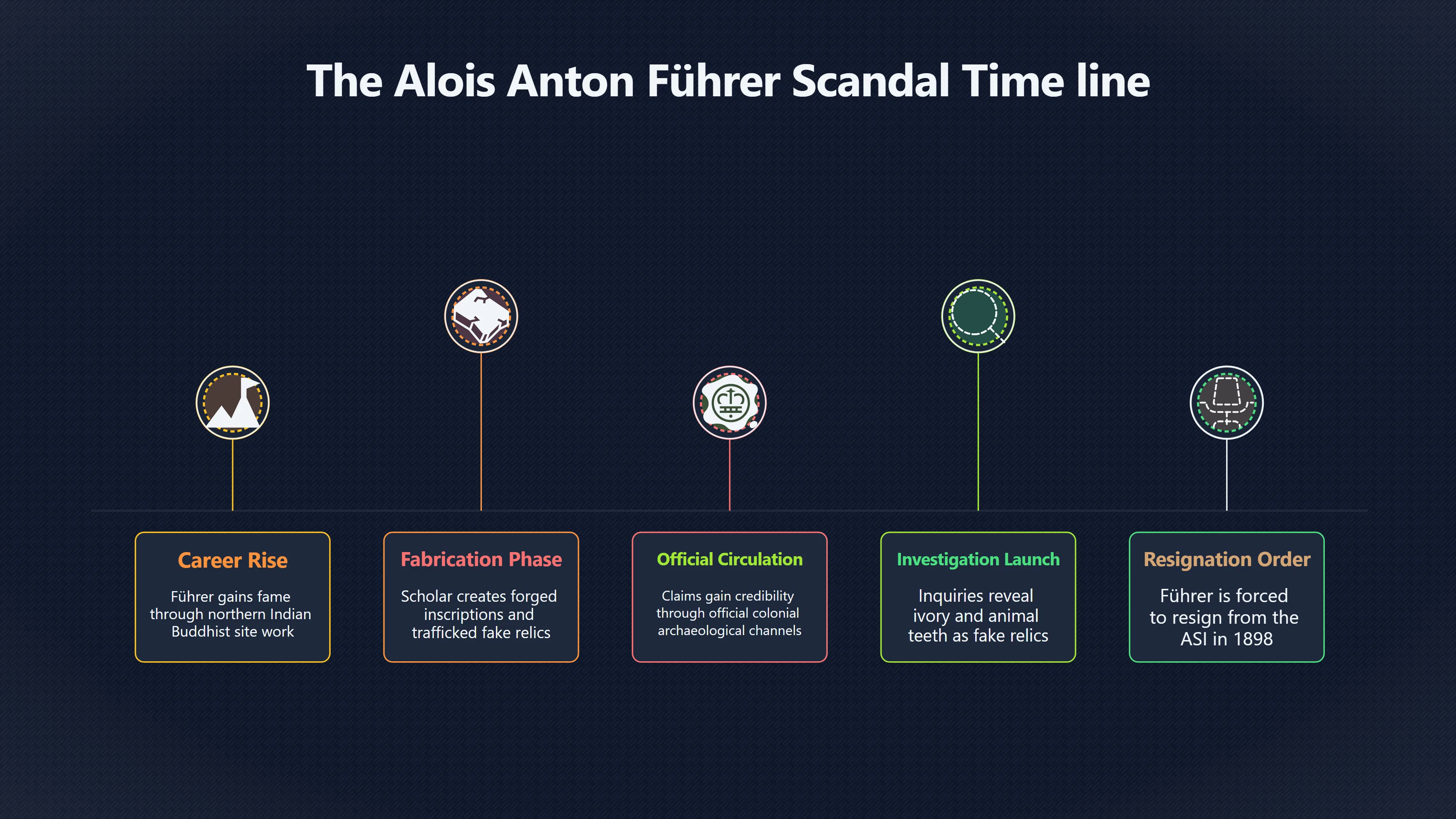
The most notorious case of archaeological forgery connected with British India centres on Alois Anton Führer, a German scholar employed by the Archaeological Survey of India (ASI). During the 1890s he gained fame through work associated with Buddhist sites in northern India and the Nepal border region. Archaeology was becoming an increasingly influential tool for identifying places linked to the life of the Buddha, and discoveries attracted worldwide attention.[Wikipedia]WikipediaAlois Anton FührerAlois Anton Führer
Führer’s reputation collapsed when investigators concluded that he had fabricated inscriptions, invented discoveries and trafficked in fake Buddhist relics. Later reviews of his work described some inscriptions linked to his excavations as “impudent forgeries”. Evidence emerged that he supplied supposed relics of the Buddha to a Burmese monk while supporting their authenticity with forged documentation. One alleged Buddha tooth was reportedly carved from ivory, while another was identified as an animal tooth. Official inquiries eventually forced his resignation in 1898.[Wikipedia]WikipediaAlois Anton FührerAlois Anton Führer
What made the scandal especially significant was not merely the forgery itself. Führer was operating from within the colonial archaeological establishment. His position gave claims immediate credibility. Reports were circulated through official channels, repeated in scholarly publications and accepted by other researchers before thorough verification occurred. In Burma, for example, inscriptions that Führer claimed to have discovered were widely cited for years before later scholars demonstrated that the inscriptions had never existed at all.[Wikipedia]WikipediaAlois Anton FührerAlois Anton Führer
The episode demonstrates a recurring pattern in archaeological fraud. People often trust evidence because they trust the institution presenting it. Once an official report enters the scholarly record, correcting it can take decades.
A complicated legacy
The Führer scandal also illustrates an important distinction between forged evidence and genuine discoveries associated with compromised individuals.
Modern scholars generally continue to accept important finds such as the Ashokan pillar inscription at Lumbini, which helped identify the Buddha’s birthplace. Contemporary and later investigators criticised Führer’s conduct but did not reject every discovery connected with him. The challenge was separating authentic evidence from fabricated additions.[Wikipedia]WikipediaAlois Anton FührerAlois Anton Führer
This distinction matters because archaeological fraud rarely consists of inventing an entire past from nothing. More commonly, a real site, real artefact or genuine excavation becomes entangled with fabricated details that exaggerate its significance or support a preferred interpretation.
How genuine discoveries became entangled with forged evidence
One reason archaeological fraud can be difficult to detect is that forgers often work around genuine objects rather than creating obvious fakes.
In the Buddhist archaeology controversies of the 1890s, authentic sites, relic deposits and inscriptions became mixed with forged claims, making it difficult for later researchers to determine where evidence ended and invention began. The Piprahwa relic discoveries, for example, became surrounded by suspicion because they emerged during the same period as the Führer scandal. Subsequent historians have spent decades disentangling legitimate finds from allegations of fraud and determining which claims were actually supported by excavation records.[Dakini Translations]dakinitranslations.comAnton Alois Führer, William Claxton Peppé, Vincent Smith, and Dr. William Hoey have all been put forward as potential archaeological frau…
Several mechanisms repeatedly appear in such cases:
- Forged inscriptions attached to real objects. A genuine artefact can be given a fabricated inscription that changes its historical significance.
- Invented excavation contexts. An object may be authentic but falsely claimed to have come from a particular site.
- Fabricated ownership histories. Collectors and dealers may create paperwork linking an artefact to old collections in order to hide recent looting.
- Selective publication. Scholars sometimes emphasise evidence supporting a preferred conclusion while neglecting contradictory information.
These practices can distort historical understanding without requiring the manufacture of entirely fake artefacts.
Why provenance matters as much as authenticity
For archaeologists, an artefact’s value lies not only in what it is but also in where it was found and how it was recovered.
A coin, sculpture or relic removed from its original context loses much of its historical meaning. Because of this, provenance—the documented chain of ownership and discovery—is often as important as the object itself. Specialists in cultural heritage have long noted that authentic artefacts can become misleading historical evidence when accompanied by false provenance records.[ResearchGate]researchgate.netResearch Gate(PDF) Provenances: Real, Fake, and QuestionableResearchGate(PDF) Provenances: Real, Fake, and QuestionableAugust 1, 2019 — The realm of archaeological artifacts is different in that fa…
This creates a paradox. An object can be genuine in material terms while its historical story is largely fictional.
Why false provenance still enables the antiquities trade
The nineteenth-century world of forged relics has modern parallels in the international antiquities market.
Many disputes over Indian artefacts today do not centre on whether an object is ancient. Instead, the question is whether documentation claiming lawful ownership is genuine. Investigations into trafficking networks have repeatedly uncovered cases in which photographs, ownership histories and export records were manipulated to make recently looted objects appear legally tradable.[Sahapedia]sahapedia.organtiquities theft and illicit antiquities trade indiaAntiquities Theft and Illicit Antiquities Trade in IndiaIndia between 1977 and 1979, nearly 3,000 thefts of antiquities were rep…
The market rewards convincing paperwork. Museums and collectors often require documented histories showing that an artefact left its country of origin legally or was part of an older collection. Forged provenance records can therefore increase an object’s financial value and reduce scrutiny. Heritage specialists describe fake ownership histories as one of the most persistent tools used to move illicit antiquities into respectable collections.[ResearchGate]researchgate.netResearch Gate(PDF) Provenances: Real, Fake, and QuestionableResearchGate(PDF) Provenances: Real, Fake, and QuestionableAugust 1, 2019 — The realm of archaeological artifacts is different in that fa…
A number of international restitution disputes involving Indian artefacts have turned on provenance questions. Investigators have challenged ownership histories supplied by dealers after discovering photographs or records showing that objects remained in India long after their supposed export dates. Such contradictions have helped trigger returns of artefacts from overseas collections.[The Guardian]theguardian.comThe artefacts included a 900-year-old statue of the Goddess Pratyangira and a third-century carving of Worshippers of the Buddha, both pu…
The continuing governance problem
The deeper issue is governance rather than forgery alone.
Archaeological knowledge depends on documentation, archives, excavation records and institutional trust. When those systems fail, false claims can survive for years. The Führer scandal revealed weaknesses in colonial-era oversight. Modern antiquities investigations reveal similar vulnerabilities in museums, auction houses and private collecting networks.[wikipedia.org]WikipediaAlois Anton FührerAlois Anton Führer
The challenge is not simply identifying fake objects. It is verifying the stories attached to them. An artefact with an invented provenance can mislead historians, inflate market prices, obscure theft and distort public understanding even when the object itself is ancient and genuine.
What these cases reveal about truth and authority
The history of forged relics and false archaeological provenance in India shows that deception often succeeds through institutions rather than outside them. Official reports, respected scholars, museum catalogues and apparently complete ownership records can all lend credibility to weak or fabricated evidence.
The Führer affair remains the clearest historical example. His influence came not from extraordinary skill as a forger but from his position within a trusted archaeological system. Modern provenance fraud works in much the same way. The most persuasive deception is rarely the fake object alone; it is the convincing story built around it.[wikipedia.org]WikipediaAlois Anton FührerAlois Anton Führer
Amazon book picks
Further Reading
Books and field guides related to When Sacred Relics and Museum Histories Were Faked. Use these as the next step if you want deeper reading beyond the article.
Frauds, Myths, and Mysteries: Science and Pseudoscience in Ar...
Directly relevant to forged relics and deceptive provenance.
The Rise of the Indian Rope Trick
Covers the creation and spread of a celebrated false story.
The Looting Machine
Explains how provenance narratives affect museum collections and markets.
eBay marketplace picks
Marketplace Samples
Live-tested eBay searches with available results related to this page.

Endnotes
1.
Source: Wikipedia
Title: Alois Anton Führer
Link:https://en.wikipedia.org/wiki/Alois_Anton_F%C3%BChrer
2.
Source: researchgate.net
Title: Research Gate(PDF) Provenances: Real, Fake, and Questionable
Link:https://www.researchgate.net/publication/335550326_Provenances_Real_Fake_and_Questionable
Source snippet
ResearchGate(PDF) Provenances: Real, Fake, and QuestionableAugust 1, 2019 — The realm of archaeological artifacts is different in that fa...
Published: August 1, 2019
3.
Source: sahapedia.org
Title: antiquities theft and illicit antiquities trade india
Link:https://www.sahapedia.org/antiquities-theft-and-illicit-antiquities-trade-india
Source snippet
Antiquities Theft and Illicit Antiquities Trade in IndiaIndia between 1977 and 1979, nearly 3,000 thefts of antiquities were rep...
4.
Source: dakinitranslations.com
Link:https://dakinitranslations.com/wp-content/uploads/2021/09/bfb85-whathappenedatpiprahwabycharlesallen.pdf
Source snippet
Anton Alois Führer, William Claxton Peppé, Vincent Smith, and Dr. William Hoey have all been put forward as potential archaeological frau...
5.
Source: theguardian.com
Link:https://www.theguardian.com/culture/2016/sep/19/national-gallery-of-australia-returns-indian-antiquities-worth-more-than-2m
Source snippet
The artefacts included a 900-year-old statue of the Goddess Pratyangira and a third-century carving of Worshippers of the Buddha, both pu...
Additional References
6.
Source: orgs.law.harvard.edu
Link:https://orgs.law.harvard.edu/halo/2025/04/01/illicit-trafficking-of-cultural-goods-an-indian-perspective-on-the-loss-of-a-heritage/
Source snippet
HLS OrgsIllicit Trafficking of Cultural Goods: An Indian Perspective...1 Apr 2025 — Sophisticated techniques, such as digitally forged p...
7.
Source: quod.lib.umich.edu
Title: relics in transition material mediations in changing worlds
Link:https://quod.lib.umich.edu/a/ars/13441566.0048.002/–relics-in-transition-material-mediations-in-changing-worlds?rgn=main%3Bview%3Dfulltext
Source snippet
Quod LibetRelics in Transition: Material Mediations in Changing Worldsby S Mukherjee · 2018 · Cited by 6 — Führer—have sought to clear th...
8.
Source: youtube.com
Link:https://www.youtube.com/watch?v=UxS4Rq8W-bw
Source snippet
The Idol Thief: How We Recovered Stolen Indian Temple Treasures Worth Millions | S. Vijay Kumar...
9.
Source: ignca.gov.in
Link:https://ignca.gov.in/Asi_data/21606.pdf
Source snippet
avoured to support the imposition by a forged.Read more...
10.
Source: youtube.com
Link:https://www.youtube.com/watch?v=A2FT-N8UhCA
Source snippet
Centuries old stolen antiquities returned to India...
11.
Source: youtube.com
Title: Real Birth Place of Buddha is India
Link:https://www.youtube.com/watch?v=rD7R6XVbaOs
Source snippet
Inside the US Black Market Stealing India's Sacred Temple Art | Tess Davis Antiquities Expert...
12.
Source: youtube.com
Title: Centuries old stolen antiquities returned to India
Link:https://www.youtube.com/watch?v=aTRSiziEsxk
Source snippet
US Returns 657 Stolen Indian Artefacts Worth $14 Million | WION Podcast...
13.
Source: hamletram.blogspot.com
Link:https://hamletram.blogspot.com/search/label/Alois%20Anton%20F%C3%BChrer
14.
Source: reddit.com
Link:https://www.reddit.com/r/forgeryreplicafiction/comments/ptr0tq/alois_f%C3%BChrer_and_his_legacy/
15.
Source: instagram.com
Link:https://www.instagram.com/p/DX1M_uWDOza/
Topic Tree