Why Britain's Most Famous Hoaxes Seemed Believable
The United Kingdom’s most famous hoaxes are not simply stories about unusually gullible people. They are stories about trust: trust in doctors, scientists, photographs, newspapers, government officials, ancient manuscripts and authoritative voices.
Page outline Jump by section
Introduction
The cases range from Mary Toft’s supposed rabbit births in eighteenth-century Surrey to Piltdown Man, the Cottingley Fairies, the forged Zinoviev letter and the disastrous “Wearside Jack” messages. Some were calculated frauds; others began as jokes, artistic inventions or disputed reconstructions before promoters transformed them into public “evidence”. Wartime operations such as Operation Mincemeat belong to a different category again: deliberate falsehoods designed against an enemy rather than scams aimed at the public. Together, these episodes reveal how deception spreads when spectacle, institutional prestige and media competition outrun careful checking.
Why a hoax becomes believable
A successful hoax rarely needs to persuade everybody. It needs only a sufficiently influential chain of believers: an expert who certifies an object, a newspaper that supplies publicity, a public figure who gives the story respectability, or an institution reluctant to admit that it has made a mistake.
British hoax history repeatedly demonstrates four conditions that help doubtful claims travel:
- The claim fits an existing belief. Piltdown Man appeared to support contemporary expectations about human evolution; the Cottingley photographs appealed to spiritualists already convinced that invisible beings could be recorded.
- Authority substitutes for verification. Doctors, museum specialists, writers and government departments could make weak evidence seem stronger merely by discussing it seriously.
- The media reward novelty. Extraordinary births, prehistoric survivors, political conspiracies and supernatural photographs were highly saleable stories.
- Doubt becomes socially costly. Once reputations have been committed, investigators may defend an error rather than reassess it.
The dividing line between fraud and error is nevertheless important. A person who fabricates evidence is behaving differently from a witness who mistakes a floating log for an animal. A newspaper April Fool is not equivalent to a forged political document released during an election. Folklore may grow without any single inventor, while propaganda is normally intended to shape behaviour rather than to produce a permanent historical falsehood.
When doctors and scientists certified the impossible
Mary Toft and the rabbit births
In 1726, Mary Toft, a poor labouring woman from Godalming, Surrey, appeared to give birth to pieces of rabbits and other animals. Local surgeon John Howard reported the supposed phenomenon, and the case attracted royal interest, newspaper attention and examinations by prominent medical men. Some physicians interpreted it through “maternal impression”, a then-respectable theory that a pregnant woman’s experiences or imagination could physically mark her unborn child.[PMC]pmc.ncbi.nlm.nih.govWhat Mary Toft Felt: Women's Voices, Pain, Power and the Bodyby K Harvey · 2015 · Cited by 26 — Toft was attended by at least six diff…
The deception depended on animal parts being placed inside Toft’s body and then apparently delivered in front of observers. It was not accepted without question: the surgeon Cyriacus Ahlers found signs that specimens had been cut with instruments, while investigators discovered that rabbits were being obtained for the household. After Toft was moved to London and watched more closely, the supposed births stopped. She eventually confessed under severe pressure from investigators.[PMC]pmc.ncbi.nlm.nih.govWhat Mary Toft Felt: Women's Voices, Pain, Power and the Bodyby K Harvey · 2015 · Cited by 26 — Toft was attended by at least six diff…
The episode is often retold as a simple triumph of a cunning woman over foolish doctors. The reality is more troubling. Toft underwent painful and intimate examinations, and the surviving evidence does not establish a single, certain motive for her participation. Poverty, family pressure, the prospect of money and the unequal treatment of working-class women may all have mattered. The medical establishment’s embarrassment, however, was unmistakable: satirists such as William Hogarth depicted learned men solemnly inspecting an impossibility of their own making.[PMC]pmc.ncbi.nlm.nih.govWhat Mary Toft Felt: Women's Voices, Pain, Power and the Bodyby K Harvey · 2015 · Cited by 26 — Toft was attended by at least six diff…

Piltdown Man and the “earliest Englishman”
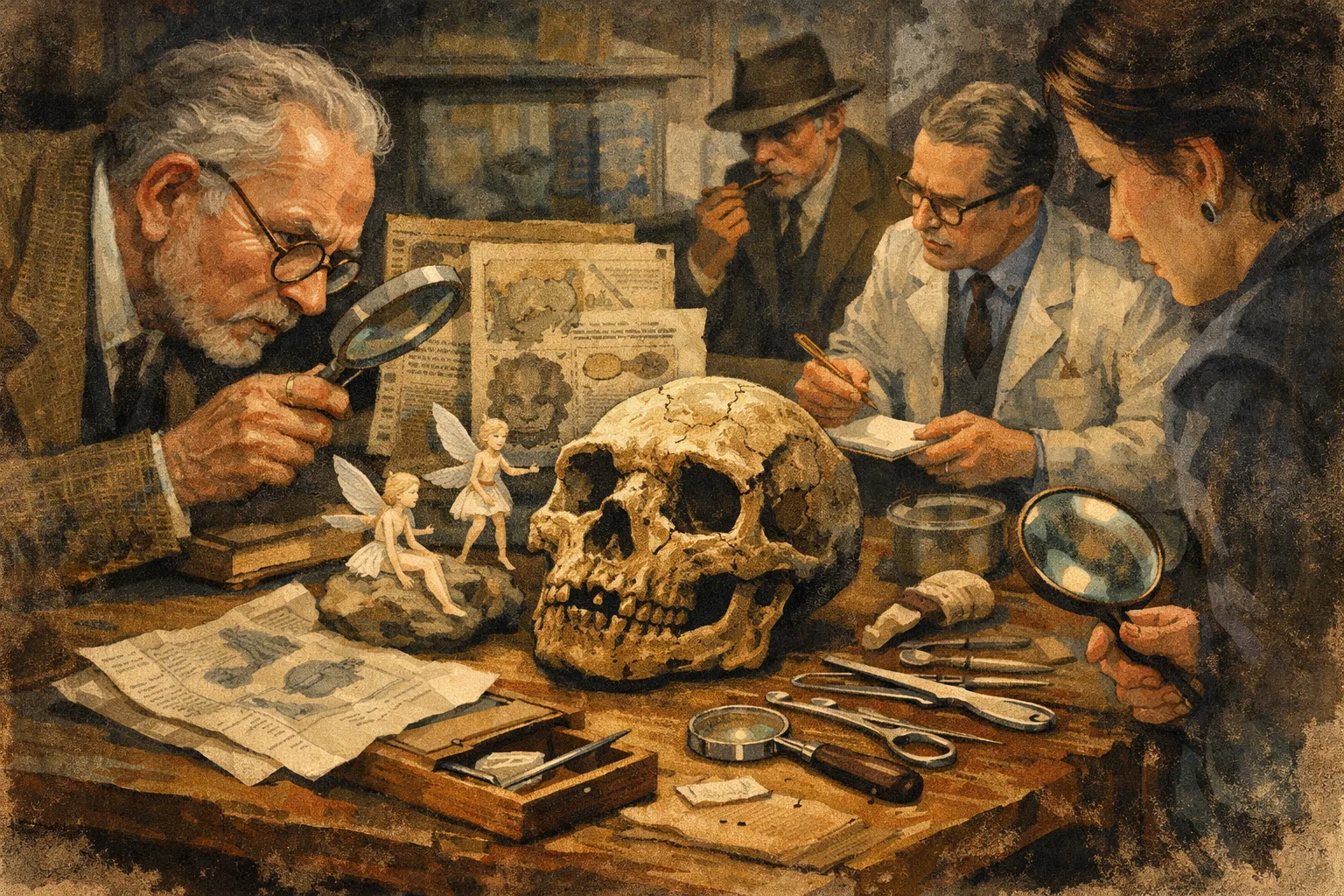
Piltdown Man was announced in 1912 after solicitor and amateur antiquarian Charles Dawson claimed to have found human-like skull fragments in gravel at Piltdown, East Sussex. Arthur Smith Woodward of the British Museum’s natural history department helped reconstruct and present the specimen as a previously unknown early human. It seemed to possess a large, human-style braincase combined with an ape-like jaw — precisely the kind of “missing link” many expected to find.[Natural History Museum]nhm.ac.ukOpen source on nhm.ac.uk.
National pride helped make the discovery attractive. Important early human fossils had been found elsewhere in Europe, and Piltdown offered Britain its own ancient ancestor. The specimen also reflected a mistaken evolutionary expectation: that the human brain had enlarged before the face and jaw became recognisably human. Fossils discovered in Africa and Asia increasingly contradicted that sequence, but Piltdown’s status and the limited access granted to the remains helped delay a decisive reassessment.[Science History Institute]sciencehistory.orgthe problem of piltdown manScience History InstituteThe Problem of Piltdown Man4 May 2023 — Others were convinced one of Woodward's colleagues at the British Museum…
New testing changed the case. Fluorine analysis showed that the skull and jaw were not of the same antiquity. Investigators found that the jaw came from an orangutan, that the teeth had been filed to imitate human wear, and that the components had been artificially stained. In 1953, Kenneth Oakley, Joseph Weiner and Wilfrid Le Gros Clark publicly demonstrated that the celebrated fossil was a deliberate composite.[nhm.ac.uk]nhm.ac.ukOpen source on nhm.ac.uk.
Numerous suspects were proposed, including Woodward and Arthur Conan Doyle, but later genetic, morphological and manufacturing evidence pointed strongly towards Dawson as the principal and probably sole forger. Researchers found consistent methods across the material, while Dawson had associations with other doubtful antiquarian discoveries and a clear appetite for scientific recognition. Absolute certainty about every step is impossible because the central participants are dead and some records are incomplete, but modern research has greatly weakened the more elaborate conspiracy theories.[Science History Institute]sciencehistory.orgthe problem of piltdown manScience History InstituteThe Problem of Piltdown Man4 May 2023 — Others were convinced one of Woodward's colleagues at the British Museum…
Piltdown mattered because it did more than embarrass a museum. For decades it complicated the study of human origins and demonstrated how an object can be protected by reputation, restricted access and theoretical convenience. The eventual exposure also illustrates the corrective power of improved techniques: the fraud became vulnerable when claims about age and anatomy could be tested rather than judged mainly by appearance and authority.
How photographs made fantasy look factual
The Cottingley Fairies
In 1917, cousins Elsie Wright and Frances Griffiths produced photographs showing Frances with small winged fairies near a stream in Cottingley, West Yorkshire. The fairies were drawings, copied or adapted from published illustrations, cut out and supported with hatpins. What began partly as a response to adults who doubted the girls’ stories became a much larger controversy when the photographs entered spiritualist networks.[National Science and Media Museum blog]blog.scienceandmediamuseum.org.ukcottingleys scientific fairies and enchanting technologycottingleys scientific fairies and enchanting technology
The photographs were promoted by the theosophist Edward Gardner and by Sir Arthur Conan Doyle, who believed they provided evidence for supernatural beings. Photographic specialists found no obvious darkroom manipulation, but that conclusion answered the wrong question. The images had not been created through sophisticated alteration of the negative; they recorded physical cut-outs placed in front of the camera. Technical examination could show that a photograph had not been composited without proving that the scene itself was genuine.[National Science and Media Museum blog]blog.scienceandmediamuseum.org.ukcottingleys scientific fairies and enchanting technologycottingleys scientific fairies and enchanting technology
Doyle’s involvement gave the pictures international prominence. His confidence is especially memorable because Sherlock Holmes, his most famous creation, represented disciplined observation. Yet Doyle approached the pictures as a committed spiritualist who believed modern science was unfairly dismissing psychic and supernatural evidence. The photographs therefore supported a worldview he already held rather than forcing him to adopt a new one.[National Science and Media Museum blog]blog.scienceandmediamuseum.org.ukthe story of the cottingley fairies shows that image manipulation is nothing newthe story of the cottingley fairies shows that image manipulation is nothing new
Elsie and Frances admitted the staging in the early 1980s, although Frances continued to maintain that the fifth photograph was genuine. That lingering disagreement is one reason the case should not be compressed into the claim that two children coldly planned a 60-year global fraud. The girls’ intentions, their later discomfort and the roles played by adult promoters were more complicated. Recent scholarship has also argued that the familiar “girls fooled the world” version can obscure their creative experimentation and the restrictions placed on working-class girls of the period.[scienceandmediamuseum.org.uk]blog.scienceandmediamuseum.org.ukcottingleys scientific fairies and enchanting technologycottingleys scientific fairies and enchanting technology
The Loch Ness “surgeon’s photograph”
The modern Loch Ness Monster sensation developed rapidly after press reports in 1933. The best-known image followed in 1934, when the Daily Mail published a photograph attributed to London doctor Robert Kenneth Wilson. It appeared to show a small head and long neck rising from the loch and became the defining visual image of “Nessie”. The doctor’s professional status encouraged the popular label “surgeon’s photograph”, even though medical expertise had no bearing on whether the object was a monster.[Wikipedia]WikipediaLoch Ness MonsterLoch Ness Monster
The familiar published version was often tightly cropped. Wider versions made the object look much smaller and revealed that the supposed monster occupied only a tiny part of the scene. The scale of the ripples was consistent with a modest object rather than an enormous animal. In accounts that emerged decades later, Christian Spurling said he had constructed the model using a toy submarine and a fabricated neck as part of a plot involving Marmaduke Wetherell, who had previously been humiliated after supposed monster tracks proved false.[Wikipedia]WikipediaLoch Ness MonsterLoch Ness Monster
Exposing one photograph did not disprove every report from Loch Ness, because sightings may arise from many causes: jokes, wakes, birds, boats, floating debris, unusual wave patterns or honest errors of distance and scale. Nor does it prove that every person reporting something strange is dishonest. It does remove the most iconic photograph from the serious evidence. The broader legend persists because it is attached to a dramatic landscape, an enjoyable mystery and a tourist economy that does not require literal belief from every visitor.
The Cottingley and Loch Ness pictures expose a recurring weakness in visual evidence. A camera can faithfully record a staged model. Cropping can alter perceived scale. A respectable person can be mistaken or complicit. Most importantly, a memorable image can continue to define a story long after the circumstances of its production have been challenged.
Forging a usable national past
Hoaxes about the past are often harder to untangle than a fabricated photograph. A forged manuscript may contain genuine traditional material, creative adaptation and deliberate invention at the same time. Once its stories enter literature, ceremonies and national culture, exposing the forgery does not make every later tradition simply disappear.
James Macpherson’s eighteenth-century poems attributed to the ancient bard Ossian are a central Scottish example. Macpherson presented the works as translations from old Gaelic sources, and they became enormously influential across Europe. Critics, most famously Samuel Johnson, challenged his failure to produce adequate manuscripts and accused him of composing rather than translating the poetry. Modern assessments are more qualified than the stark choice between authentic ancient epic and total fabrication: Macpherson drew upon real Gaelic oral and literary traditions, but reshaped, combined and expanded them while claiming an antiquity and textual basis he could not substantiate.[omeka.library.uvic.ca]omeka.library.uvic.caossian second edition 1762ossian second edition 1762
The controversy was sharpened by cultural rivalry. Scottish and Irish scholars disputed the ownership and origins of shared Gaelic heroic traditions, while supporters valued Ossian as evidence that northern and Celtic cultures possessed an epic literature comparable to classical Greece. The poems’ doubtful provenance did not prevent them influencing Romantic writers, artists and ideas of Highland identity. Their importance rests partly on that paradox: a misleading claim of ancient authenticity helped generate genuine modern culture.[Wikipedia]WikipediaOpen source on wikipedia.org.
In Wales, Edward Williams, better known as Iolo Morganwg, copied and preserved valuable material but also invented documents, poems, histories and supposed ancient practices. He incorporated forgeries into influential collections and devised the Coelbren y Beirdd, presenting his invented bardic alphabet as a survival from the Celtic druids. He also created the modern Gorsedd tradition, elements of which became connected with the National Eisteddfod.[Welsh Biography]biography.waless WILL EDW 1747s WILL EDW 1747
Iolo’s case cannot be reduced to commercial fraud. His inventions served a cultural programme: he wanted to supply Wales with a continuous, humane and radical bardic inheritance. Scholarship has had to separate his genuine collecting from his fabrication without overlooking the lasting cultural institutions his imagination helped shape. The result is an “invented tradition” in the strongest sense — not an ancient custom faithfully preserved, but a modern creation that acquired real communal meaning.[University of Wales]wales.ac.ukOpen source on wales.ac.uk.
These literary cases show why exposure does not always end a hoax’s influence. A false fossil can be removed from a scientific family tree. A fabricated cultural tradition may instead become part of history precisely because people have performed, published and believed in it for generations.

When false documents entered politics and war
The Zinoviev letter
Four days before the 1924 general election, the Daily Mail published a letter supposedly sent by Grigory Zinoviev, head of the Communist International, to the Communist Party of Great Britain. It appeared to encourage revolutionary organisation and the political use of closer Anglo-Soviet relations. The document damaged an already vulnerable Labour government by reinforcing claims that the party was dangerously soft on Soviet communism.
Its origin was suspect from the beginning. The British government possessed only a copy, not an original, and officials knew that forged material circulated frequently in intelligence reporting concerning Soviet affairs. Cabinet investigations in November 1924 concluded that the evidence then available did not permit a positive finding on authenticity. The timing of press publication, before official checks were complete, gave the document its greatest political force.[The National Archives]nationalarchives.gov.ukOpen source on nationalarchives.gov.uk.
Later investigation has treated the letter as a forgery, although debates continue over exactly who produced it, who knowingly circulated it and how much it changed the election result. Labour was already facing substantial political difficulties, so it is too simple to claim that a single fake document alone determined the outcome. Its importance lies in the mechanism: intelligence of uncertain provenance moved through official channels, gained authority from government handling and reached voters when there was too little time for correction.
Operation Mincemeat
Operation Mincemeat demonstrates why not every deception should be judged as a public fraud. In 1943, British intelligence placed false documents on a corpse dressed as a Royal Marines officer and arranged for the body to reach the coast of neutral Spain. The papers suggested that Allied forces intended to attack Greece and Sardinia rather than Sicily. The aim was to let German intelligence secretly obtain the information while believing it had intercepted an authentic military accident.[The National Archives Shop]shop.nationalarchives.gov.ukOpen source on nationalarchives.gov.uk.
The deception worked because it supplied not merely a document but a plausible human identity, complete with personal effects and traces of an ordinary life. It also reinforced German expectations about Allied strategy. Mincemeat was propaganda in a tightly targeted operational form: the intended audience was the enemy command structure, and the purpose was to save Allied lives and protect an invasion.
Its later fame can obscure an ethical distinction. Hoaxes such as Piltdown sought prestige through counterfeit evidence; Mincemeat used counterfeit evidence during a war against a hostile state. The techniques overlap — forged papers, planted clues, carefully managed discovery — but motive, audience and accountability differ markedly.
A hoax that distorted a murder investigation
During the Yorkshire Ripper investigation, police received letters and an audio recording from a man claiming to be the murderer. The speaker’s north-east English accent led investigators to concentrate heavily on suspects with connections to Wearside. The messages were in fact sent by John Humble, who had no involvement in the killings.[Wikipedia]WikipediaWearside JackWearside Jack
The consequences were far more serious than those of a media prank. Investigators gave the recording extraordinary weight, even though the killer’s responsibility for it had not been established. Peter Sutcliffe, who did not match the voice, was interviewed repeatedly but remained free. He murdered three more women after the tape was sent. Humble was finally identified decades later through DNA recovered from an envelope and pleaded guilty in 2006.[Wikipedia]WikipediaWearside JackWearside Jack
The central failure was not simply that the police encountered a liar. Major investigations routinely attract false confessions, attention-seekers and malicious communications. The deeper problem was allowing an unverified item to dominate the suspect profile and override contradictory evidence. The tape seemed intimate and direct — apparently the killer’s own voice — which gave it psychological force far beyond its evidential reliability.
Wearside Jack therefore belongs in a different moral category from harmless April Fools. The hoax exploited public fear, diverted investigative resources and contributed to the exclusion of viable suspects. It demonstrates that false evidence can become most dangerous when institutions turn it into a rigid theory.
When the media made deception part of the entertainment
On 1 April 1957, the BBC current-affairs programme Panorama broadcast a report showing a family in Switzerland harvesting strands of spaghetti from trees. The film borrowed the visual and verbal style of factual television, presenting the absurd event with a calm commentary and convincing location footage. Some viewers contacted the BBC to ask how they might grow spaghetti themselves.[Bon Appétit]bonappetit.comwatch the swiss spaghetti harvest of 1957watch the swiss spaghetti harvest of 1957
The joke worked partly because pasta was not yet an everyday food in every British household. More importantly, television news carried considerable authority. Viewers had not developed the same expectation of elaborate screen manipulation, and the segment appeared within a recognised current-affairs format rather than a comedy programme.
The Guardian used a similar technique in 1977 with a long travel supplement on San Serriffe, a fictional island republic whose geography and place names were built from printing terminology. Advertisements and detailed descriptions created the texture of a real destination. Both jokes were deliberately time-limited April Fools, but they demonstrated that layout, tone and institutional branding can make invented information feel factual.[The Guardian]theguardian.comThe Guardian Foolish thingsHighlighting historic and contemporary pranks, the author details notable hoaxes such as the BBC’s 1957 “spaghetti tree” broadcast and th…
Such stunts are normally exposed quickly and invite the audience to enjoy having been fooled. Their legacy is more benign than that of political forgery or criminal interference. Even so, they reveal a basic media truth: people often assess credibility from presentation before examining content. A familiar broadcaster, polished graphic or solemn narrator can lower the level of scrutiny applied to an extraordinary statement.
How famous hoaxes are finally exposed
The strongest debunkings generally combine several kinds of evidence rather than relying on a clever sceptic’s intuition.
Physical examination revealed filing, staining and incompatible anatomy in Piltdown Man. Provenance checks exposed the absence of reliable originals behind documents such as the Zinoviev letter. Reconstruction of method explained how cardboard fairies and model monsters could produce apparently impressive photographs. Surveillance and controlled conditions stopped Mary Toft’s supposed phenomenon when access to animal material was restricted. Forensic advances eventually identified Wearside Jack from biological traces that investigators could not use effectively when the letters were first sent.
Confession is useful but not always essential. It may be delayed, partial or shaped by self-interest. Frances Griffiths continued to defend one Cottingley photograph; accounts of the Loch Ness picture appeared many decades after the event; Mary Toft’s statements were extracted under conditions that would be unacceptable in a modern inquiry. The best historical assessment asks whether the confession matches independent material evidence.
Exposure also requires institutions to revisit their own conduct. A forged object may survive because a museum restricts access. A mistaken criminal profile may persist because senior investigators have publicly endorsed it. A political falsehood may achieve its purpose before a cautious official inquiry reports. Corrections therefore need more than a declaration that something was “fake”; they must explain the chain of decisions that allowed it to gain authority.
The wider consequences of United Kingdom’s hoax history
British hoaxes survive because the false version is often simpler and more vivid than the correction. A prehistoric Englishman, a fairy caught by a camera or a monster lifting its neck from a Highland loch can be understood in seconds. The debunking requires discussion of chemical tests, photographic scale, provenance, institutional rivalries or the gradual development of folklore.
They also survive because exposure does not erase cultural value. Nessie remains a symbol of the Highlands even when a famous photograph is rejected. The Cottingley images remain important objects in photographic history. Iolo Morganwg’s inventions helped shape ceremonies that later generations made meaningful. Piltdown Man has become a useful scientific cautionary tale rather than merely a discarded fossil.
The most durable lesson is not “never trust experts” or “people in the past believed anything”. Experts were central both to promoting and exposing these claims. The better conclusion is that authority should remain answerable to evidence, access and replication. Photographs need provenance; extraordinary specimens need independent testing; intelligence needs authentication; and investigative theories must remain open to contradiction.
Hoaxes flourish where stories meet incentives. Their promoters may seek money, fame, revenge, amusement, political advantage or cultural prestige. Audiences may supply the rest because they want a mystery, a national ancestor, a supernatural world or confirmation that their opponents are dangerous. Understanding that partnership between maker, messenger and believer is more useful than laughing at those who were deceived.
Amazon book picks
Further Reading
Books and field guides related to Why Britain's Most Famous Hoaxes Seemed Believable. Use these as the next step if you want deeper reading beyond the article.
Mistakes Were Made (but Not by Me)
Shows why individuals and institutions resist admitting error.
The Demon-Haunted World
Rating: 4.5/5 from 43 Google Books ratings
Classic guide to evaluating extraordinary claims.
Hoax
First published 2018. Subjects: Errors, inventions, Common fallacies, Deception, Anecdotes, Folklore.
eBay marketplace picks
Marketplace Samples
Live-tested eBay searches with available results related to this page.
Endnotes
1.
Source: pmc.ncbi.nlm.nih.gov
Link:https://pmc.ncbi.nlm.nih.gov/articles/PMC4804233/
Source snippet
What Mary Toft Felt: Women's Voices, Pain, Power and the Bodyby K Harvey · 2015 · Cited by 26 — Toft was attended by at least six diff...
2.
Source: Wikipedia
Title: Mary Toft
Link:https://en.wikipedia.org/wiki/Mary_Toft
3.
Source: pmc.ncbi.nlm.nih.gov
Link:https://pmc.ncbi.nlm.nih.gov/articles/PMC5108962/
Source snippet
New genetic and morphological evidence suggests a single...by I De Groote · 2016 · Cited by 72 — If Dawson was the perpetrator of the...
4.
Source: australian.museum
Title: piltdown man skull
Link:https://australian.museum/learn/science/human-evolution/piltdown-man-skull/
5.
Source: Wikipedia
Title: Loch Ness Monster
Link:https://en.wikipedia.org/wiki/Loch_Ness_Monster
6.
Source: time.com
Link:https://time.com/3829211/loch-ness-monster-google-doodle/
7.
Source: omeka.library.uvic.ca
Title: ossian second edition 1762
Link:https://omeka.library.uvic.ca/exhibits/show/movable-type/authorship/ossian-second-edition-1762.html
8.
Source: Wikipedia
Link:https://en.wikipedia.org/wiki/Ossian
9.
Source: biography.wales
Title: s WILL EDW 1747
Link:https://biography.wales/article/s-WILL-EDW-1747.html
10.
Source: museum.wales
Title: Our own pageantry and peacockry the Gorsedd of the Bards
Link:https://museum.wales/articles/1139/Our-own-pageantry-and-peacockry-the-Gorsedd-of-the-Bards/
11.
Source: archives.library.wales
Link:https://archives.library.wales/index.php/eighteenth-century-literary-forgeries-with-special-reference-to-work-of-iolo-morganwg
12.
Source: Wikipedia
Title: Wearside Jack
Link:https://en.wikipedia.org/wiki/Wearside_Jack
13.
Source: archives.library.wales
Link:https://archives.library.wales/index.php/iolo-morganwg-manuscripts
14.
Source: library.wales
Link:https://www.library.wales/discover-learn/digital-exhibitions/manuscripts
15.
Source: archives.library.wales
Title: wales Llanover Manuscripts
Link:https://archives.library.wales/index.php/llanover-manuscripts
16.
Source: library.wales
Title: our archives your archives
Link:https://www.library.wales/news/article/our-archives-your-archives
17.
Source: archives.library.wales
Title: wales Glamorgan (Wales) – History
Link:https://archives.library.wales/index.php/glamorgan-wales-history
18.
Source: archives.library.wales
Title: wales Plague – History
Link:https://archives.library.wales/index.php/plague-history
19.
Source: archives.library.wales
Link:https://archives.library.wales/index.php/glamorgan-wales-politics-and-government-18th-century
20.
Source: archives.library.wales
Link:https://archives.library.wales/index.php/welsh-language-wales-glamorgan
21.
Source: archives.library.wales
Title: wales Breconshire (Wales)
Link:https://archives.library.wales/index.php/breconshire-wales
22.
Source: archives.library.wales
Title: wales Tir Iarll (Glamorgan, Wales)
Link:https://archives.library.wales/index.php/tir-iarll-glamorgan-wales
23.
Source: archives.library.wales
Title: wales Welsh poetry – 19th century
Link:https://archives.library.wales/index.php/welsh-poetry-19th-century-3?listLimit=20&listPage=2&sf_culture=en&sort=referenceCode&sortDir=asc&subjects=1181345
24.
Source: archives.library.wales
Title: wales Bards and bardism – Wales
Link:https://archives.library.wales/index.php/bards-and-bardism-wales-2
25.
Source: archives.library.wales
Title: wales John Bedford Papers
Link:https://archives.library.wales/index.php/john-bedford-papers
26.
Source: archives.library.wales
Link:https://archives.library.wales/index.php/glamorgan-wales-2?listLimit=20&listPage=3&sf_culture=en&sort=alphabetic&sortDir=desc
27.
Source: museum.wales
Title: Visitation learning resource final
Link:https://museum.wales/media/30883/Visitation-learning-resource-final.pdf
28.
Source: biography.wales
Title: s WILL TAL 1787
Link:https://biography.wales/article/s-WILL-TAL-1787.html
29.
Source: biography.wales
Title: s2 WILL JOH 1892
Link:https://biography.wales/article/s2-WILL-JOH-1892?author_multi_facet%5B%5D=al%25%25en%3DAneirin+Lewis%25%25cy%3DAneirin+Lewis&lang%5B%5D=en&order=asc&page=1&query=%2A&rows=12&searchType=nameSearch&sort=sort_name
30.
Source: biography.wales
Title: s GUTU OWA 1450
Link:https://biography.wales/article/s-GUTU-OWA-1450?author_multi_facet%5B%5D=tro%25%25en%3DThomas+Roberts%25%25cy%3DThomas+Roberts&lang%5B%5D=en&order=asc&page=1&query=%2A&rows=12&searchType=nameSearch&sort=sort_name
31.
Source: biography.wales
Title: s POWE ANT 1560
Link:https://biography.wales/article/s-POWE-ANT-1560.html
32.
Source: biography.wales
Link:https://biography.wales/article/s-EDER-AUR-1280
33.
Source: biography.wales
Title: s BRAD JOH 1706
Link:https://biography.wales/article/s-BRAD-JOH-1706
34.
Source: biography.wales
Link:https://biography.wales/assets/pdf/ybc106.pdf
35.
Source: biography.wales
Title: s MEUR RHY 1586
Link:https://biography.wales/article/s-MEUR-RHY-1586.html
36.
Source: biography.wales
Title: s PRIC WIL 1749
Link:https://biography.wales/article/s-PRIC-WIL-1749
37.
Source: Wikipedia
Title: Piltdown Man
Link:https://en.wikipedia.org/wiki/Piltdown_Man
38.
Source: Wikipedia
Title: Cottingley Fairies
Link:https://en.wikipedia.org/wiki/Cottingley_Fairies
39.
Source: Wikipedia
Title: Iolo Morganwg
Link:https://en.wikipedia.org/wiki/Iolo_Morganwg
40.
Source: Wikipedia
Title: Spaghetti tree hoax
Link:https://en.wikipedia.org/wiki/Spaghetti-tree_hoax
41.
Source: theguardian.com
Title: The Guardian Mary and the Rabbit Dream by Noémi Kiss-Deáki review
Link:https://www.theguardian.com/books/article/2024/jul/11/mary-and-the-rabbit-dream-by-noemi-kiss-deaki-review-an-18th-century-hoax
Source snippet
In 1726, Toft's fake rabbit births captured public imagination and led to extensive examinations by the medical establishment, driven by...
42.
Source: nhm.ac.uk
Link:https://www.nhm.ac.uk/our-science/services/library/collections/piltdown-man.html
43.
Source: sciencehistory.org
Title: the problem of piltdown man
Link:https://www.sciencehistory.org/stories/magazine/the-problem-of-piltdown-man/
Source snippet
Science History InstituteThe Problem of Piltdown Man4 May 2023 — Others were convinced one of Woodward's colleagues at the British Museum...
Published: May 2023
44.
Source: theguardian.com
Title: piltdown man remains exposed as fake 1953
Link:https://www.theguardian.com/science/2023/nov/23/piltdown-man-remains-exposed-as-fake-1953
45.
Source: blog.scienceandmediamuseum.org.uk
Title: cottingleys scientific fairies and enchanting technology
Link:https://blog.scienceandmediamuseum.org.uk/cottingleys-scientific-fairies-and-enchanting-technology/
46.
Source: blog.scienceandmediamuseum.org.uk
Title: the story of the cottingley fairies shows that image manipulation is nothing new
Link:https://blog.scienceandmediamuseum.org.uk/the-story-of-the-cottingley-fairies-shows-that-image-manipulation-is-nothing-new/
47.
Source: scienceandmediamuseum.org.uk
Title: museum acquires final camera cottingley fairies story
Link:https://www.scienceandmediamuseum.org.uk/about-us/press-office/museum-acquires-final-camera-cottingley-fairies-story
48.
Source: wales.ac.uk
Link:https://www.wales.ac.uk/cawcs/research/iolo-morganwg
49.
Source: nationalarchives.gov.uk
Link:https://www.nationalarchives.gov.uk/education/resources/twenties-britain-part-one/zinoviev-letter/
50.
Source: shop.nationalarchives.gov.uk
Link:https://shop.nationalarchives.gov.uk/products/operation-mincemeat-the-true-spy-story-that-changed-the-course-of-world-war-ii
51.
Source: theguardian.com
Link:https://www.theguardian.com/uk/2006/mar/21/ukcrime.uknews21
52.
Source: bonappetit.com
Title: watch the swiss spaghetti harvest of 1957
Link:https://www.bonappetit.com/entertaining-style/pop-culture/article/watch-the-swiss-spaghetti-harvest-of-1957
53.
Source: theguardian.com
Title: The Guardian Foolish things
Link:https://www.theguardian.com/commentisfree/2006/apr/01/uk.comment
Source snippet
Highlighting historic and contemporary pranks, the author details notable hoaxes such as the BBC’s 1957 “spaghetti tree” broadcast and th...
54.
Source: nationalarchives.gov.uk
Link:https://www.nationalarchives.gov.uk/
55.
Source: shop.nationalarchives.gov.uk
Link:https://shop.nationalarchives.gov.uk/collections/mi5-official-secrets/world-war-ii
56.
Source: shop.nationalarchives.gov.uk
Link:https://shop.nationalarchives.gov.uk/collections/world-war-ii-books/intelligence
57.
Source: shop.nationalarchives.gov.uk
Link:https://shop.nationalarchives.gov.uk/collections/mi5-official-secrets/bay08
58.
Source: shop.nationalarchives.gov.uk
Link:https://shop.nationalarchives.gov.uk/collections/mi5-official-secrets/espionage
59.
Source: shop.nationalarchives.gov.uk
Link:https://shop.nationalarchives.gov.uk/collections/world-war-ii-books/bay08
60.
Source: shop.nationalarchives.gov.uk
Link:https://shop.nationalarchives.gov.uk/collections/world-war-ii-books/espionage
61.
Source: shop.nationalarchives.gov.uk
Link:https://shop.nationalarchives.gov.uk/collections/books/bay08
62.
Source: shop.nationalarchives.gov.uk
Link:https://shop.nationalarchives.gov.uk/collections/all/espionage
63.
Source: scienceandmediamuseum.org.uk
Title: Large-print Sound and Vision highlights guide
Link:https://www.scienceandmediamuseum.org.uk/sites/default/files/2025-07/LargePrint_L5_highlights_compressed.pdf
64.
Source: scienceandmediamuseum.org.uk
Title: Sound and Vision large print guide, Part 3
Link:https://www.scienceandmediamuseum.org.uk/sites/default/files/2025-07/LargePrint_Online_Pt3_L5_Storytelling_FINAL.pdf
65.
Source: scienceandmediamuseum.org.uk
Title: fake news
Link:https://www.scienceandmediamuseum.org.uk/what-was-on/fake-news
66.
Source: therockyroadtowelsh.weebly.com
Title: iolo morganwg
Link:https://therockyroadtowelsh.weebly.com/blog/iolo-morganwg
Additional References
67.
Source: youtube.com
Title: Mary Toft: the woman who gave birth to rabbits
Link:https://www.youtube.com/watch?v=MaHIxLCYZR4
Source snippet
Cottingley Fairies: How Sherlock Holmes's creator was fooled by hoax...
68.
Source: youtube.com
Title: 40 Year Hoax: The Piltdown Man | Plainly Difficult Short Documentary
Link:https://www.youtube.com/watch?v=fs7T7ICPj1c
Source snippet
Mary Toft: the woman who gave birth to rabbits - undergraduate lecture by Professor Karen Harvey...
69.
Source: rcseng.ac.uk
Title: a hare raising tale
Link:https://www.rcseng.ac.uk/library-and-publications/library/blog/a-hare-raising-tale/
Source snippet
Royal College of SurgeonsA hare-raising tale29 Mar 2018 — The story of Mary Toft of Guildford who, in 1726, claimed she had given birth t...
70.
Source: youtube.com
Title: The Sinister Man Who Helped The Yorkshire Ripper | Our Life
Link:https://www.youtube.com/watch?v=RWic7YiOULE
Source snippet
Operation Mincemeat: The True Story Behind the Greatest Spy Deception of WW2 | Full Documentary...
71.
Source: arxiv.org
Title: arXiv A Networks-Science Investigation into the Epic Poems of Ossian
Link:https://arxiv.org/abs/1610.00142
72.
Source: facebook.com
Link:https://www.facebook.com/groups/413517082015337/posts/5852812281419096/
73.
Source: facebook.com
Link:https://www.facebook.com/groups/blackpoolhistory/posts/2364406847077975/
74.
Source: pbs.org
Link:https://www.pbs.org/wgbh/nova/lochness/legend3.html
75.
Source: bournemouth.ac.uk
Link:https://www.bournemouth.ac.uk/research/projects/piltdown-man
76.
Source: piltdownman.co.uk
Link:https://piltdownman.co.uk/about-us/the-piltdown-man-hoax/
Topic Tree
Follow this branch
Related pages 192
- Albanian Hoaxes
- Algerian Hoaxes
- Antigua Deceptions
- Argentina Hoaxes
- Armenian Hoaxes
- +187 more in sidebar