Within Japan Hoaxes
Why the STAP Stem Cell Breakthrough Collapsed
The celebrated STAP breakthrough unravelled when laboratories failed to reproduce it and genetic evidence pointed to contamination.
On this page
- Why the simple stem cell claim seemed revolutionary
- The image problems and failed replication attempts
- What contamination evidence did and did not prove
Page outline Jump by section
Introduction
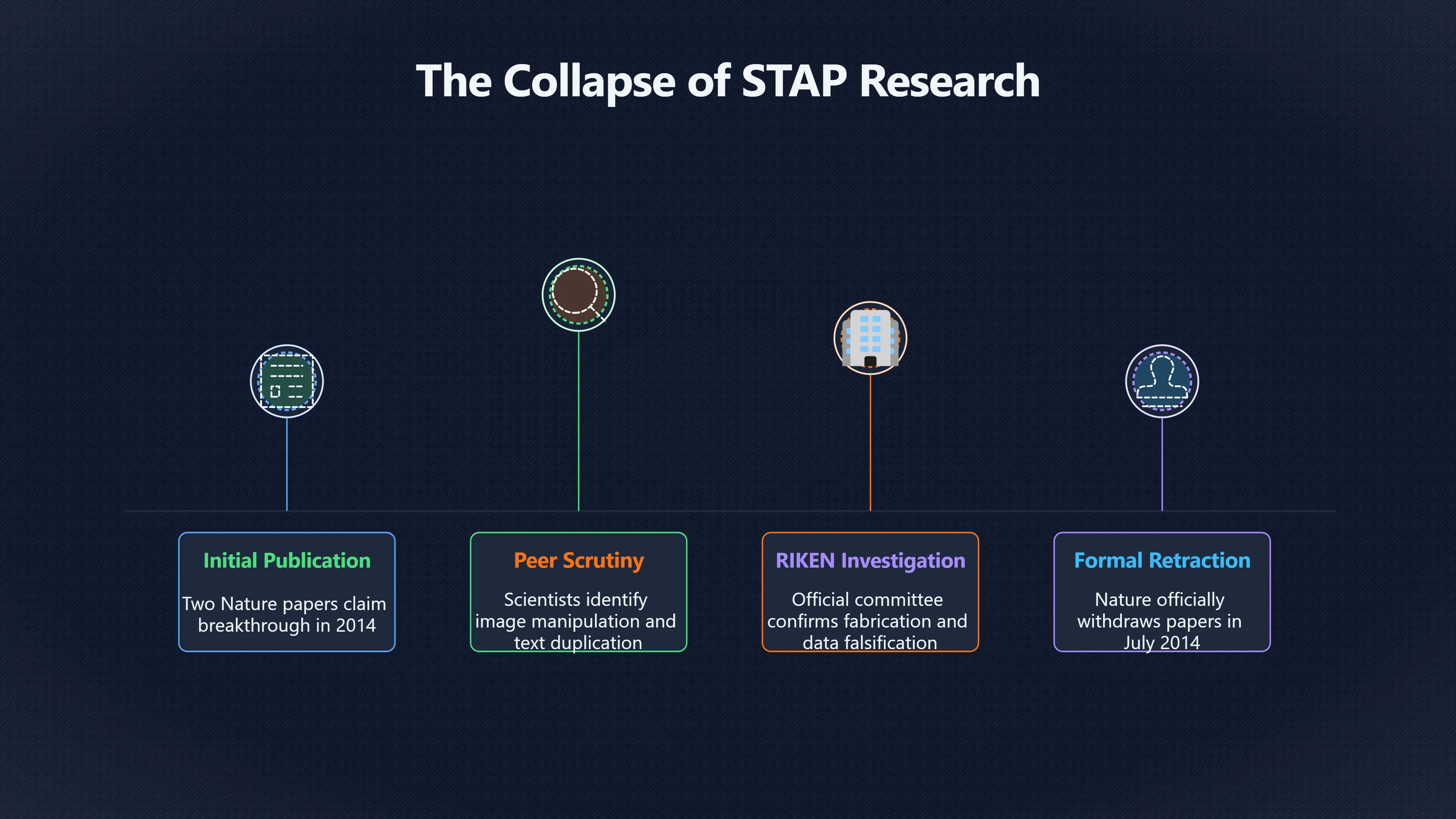
In early 2014, a team of researchers in Japan announced what sounded like one of the most important breakthroughs in modern biology. They claimed that ordinary cells from mice could be transformed into versatile stem cells simply by exposing them to stress, such as a brief bath in a mildly acidic solution. The method, called Stimulus-Triggered Acquisition of Pluripotency (STAP), appeared dramatically simpler than existing techniques for creating pluripotent stem cells. Within months, however, the claim unravelled. Image irregularities were discovered, laboratories around the world failed to reproduce the results, formal investigations found research misconduct, and genetic analyses eventually indicated that the supposed STAP cells were most likely the result of contamination by existing embryonic stem cells rather than a new biological phenomenon. The affair became one of the most famous scientific collapses in modern Japan and a cautionary tale about publicity, prestige and the central role of replication in science.[nature.com]nature.comSTAP retractedJul 2, 2014 — This week, Nature publishes retractions of two high-profile papers that claimed a major advance in the…
Why the simple stem-cell claim seemed revolutionary
The attraction of the STAP claim lay in its apparent simplicity. Before 2014, researchers could create pluripotent stem cells—cells capable of developing into many different tissue types—through complex laboratory procedures, most famously the induced pluripotent stem-cell (iPSC) method developed by Japanese scientist Shinya Yamanaka. The STAP papers suggested that exposing mature cells to stress could achieve a similar result quickly and cheaply.[Nature]nature.comSTAP retractedJul 2, 2014 — This week, Nature publishes retractions of two high-profile papers that claimed a major advance in the…
The two papers, published in Nature in January 2014, attracted worldwide attention. If correct, the discovery promised to make regenerative medicine dramatically easier and potentially transform biological research. The work was led by Haruko Obokata at the Japanese research institute RIKEN and involved several prominent collaborators. The findings appeared in one of the world’s most prestigious scientific journals, lending them considerable authority.[Nature]nature.comStimulus-triggered fate conversion of somatic cells into…by H Obokata · 2014 · Cited by 396 — This file contains a report by the…
The claim also arrived at a moment when stem-cell research was advancing rapidly and attracting intense public interest. A method that seemed to bypass many existing technical barriers was exactly the kind of discovery scientists hoped for. The story spread far beyond specialist journals into mainstream media, where it was often presented as a breakthrough rather than a tentative result awaiting independent confirmation.[Ovid]ovid.com511140a~research integrity cell induced stressCell-induced stressby D Cyranoski · 2014 · Cited by 22 — But within weeks, anonymous observers began noting mistakes in the papers, i…
How doubts appeared almost immediately
The collapse began with scrutiny from other scientists. Within weeks of publication, researchers examining the papers noticed apparent problems. Images appeared duplicated or manipulated, some figures seemed inconsistent with the experiments described, and sections of text resembled material from earlier publications. Online forums and post-publication peer-review sites played a significant role in identifying these issues.[Ovid]ovid.com511140a~research integrity cell induced stressCell-induced stressby D Cyranoski · 2014 · Cited by 22 — But within weeks, anonymous observers began noting mistakes in the papers, i…
RIKEN launched an investigation, and by April 2014 its committee concluded that there had been research misconduct involving the handling and presentation of data. The institute identified specific instances of fabrication and falsification related to figures in the papers, although the investigation did not initially settle the broader question of whether the STAP phenomenon itself existed.[RIKEN]riken.jpTime will be allowed for an appeal to be made, as stipulated by RIKEN's regulations.Read more…
One reason the controversy became so intense was that the alleged misconduct and the scientific claim were not identical issues. A paper can contain errors yet still describe a genuine phenomenon. For a time, supporters argued that although the publications were flawed, the underlying discovery might still prove real. The decisive test would be whether other laboratories could reproduce the results.[RIKEN]riken.jpTime will be allowed for an appeal to be made, as stipulated by RIKEN's regulations.Read more…
The image problems and failed replication attempts
Replication is one of science’s most important safeguards. A result becomes convincing when independent researchers can obtain the same outcome using the published methods. In the STAP case, this process quickly turned against the original claim.
Laboratories in Japan and abroad attempted to reproduce the reported procedure. Despite the supposed simplicity of the method, researchers repeatedly failed to generate the claimed cells. The inability of multiple groups to repeat the experiments became increasingly difficult to reconcile with the extraordinary claims made in the papers.[Wikipedia]WikipediaStimulus-triggered acquisition of pluripotencyStimulus-triggered acquisition of pluripotency
RIKEN eventually organised a closely monitored effort in which Obokata herself was given the opportunity to reproduce the phenomenon under supervised conditions. The resulting report found no convincing evidence that STAP cells could be created using the published methods. The experiments failed to demonstrate the claimed conversion of ordinary cells into pluripotent stem cells.[PMC]pmc.ncbi.nlm.nih.govOpen source on nih.gov.
As replication attempts continued to fail, confidence in the discovery collapsed. In July 2014 the two Nature papers were formally retracted. The journal acknowledged that the studies contained flaws that fatally undermined their conclusions. What had been presented only months earlier as a landmark breakthrough was rapidly becoming a textbook example of a result that could not survive independent testing.[nature.com]nature.comOpen source on nature.com.
What contamination evidence did and did not prove
The strongest blow to the STAP hypothesis came from later genetic investigations. Researchers examined cell lines that had supposedly been produced through the STAP process and compared their genetic signatures with those expected from the source animals.
The analyses revealed that several purported STAP cell lines were genetically consistent with previously existing embryonic stem-cell lines rather than with the mice from which the cells were supposedly derived. Investigators concluded that contamination by embryonic stem cells provided a far more plausible explanation for the remarkable results than the existence of a new biological process.[science.org]science.orgdiscredited stap cells were likely embryonic stem cellsdiscredited stap cells were likely embryonic stem cells
Importantly, the contamination evidence did not prove exactly who introduced the contaminating cells or at what point contamination occurred. That distinction matters. Scientific investigations are often better at determining what happened to the data than at establishing individual intent. The evidence strongly undermined the claim that stress had created a new kind of stem cell, but it could not answer every question about responsibility inside the laboratory.[www3.riken.jp]www3.riken.jpOpen source on riken.jp.
What the evidence did show was that the spectacular results could be explained without invoking a revolutionary new phenomenon. Once contamination became the most convincing explanation, and replication repeatedly failed, the central claim of STAP cells effectively lost scientific credibility.[Science]science.orgdiscredited stap cells were likely embryonic stem cellsdiscredited stap cells were likely embryonic stem cells
Why the affair became a landmark Japanese science scandal
The STAP controversy resonated far beyond stem-cell biology because it exposed weaknesses in the way scientific claims can be promoted and evaluated. The research had benefited from prestigious institutions, high-profile publication and intense media enthusiasm before independent verification had occurred. When problems emerged, the correction process unfolded in public view.[The Scientist]the-scientist.comThe Scientist STAP Papers RetractedThe Scientist STAP Papers Retracted
The human consequences were severe. Careers were damaged, public trust in research suffered, and the scandal placed enormous pressure on the scientists involved. The episode also prompted debate within Japan about research oversight, laboratory culture and the incentives that reward spectacular findings over careful verification.[Nippon]nippon.comOpen source on nippon.com.
Unlike a classic hoax involving forged artefacts or deliberate publicity stunts, the STAP affair sits at the intersection of misconduct, error and institutional failure. The published papers contained documented problems, yet the broader lesson extends beyond individual actions. The episode demonstrated how easily an exciting claim can gain momentum when it aligns with scientific hopes and media expectations, and how difficult it can be to slow that momentum until replication provides an independent check.[riken.jp]riken.jpTime will be allowed for an appeal to be made, as stipulated by RIKEN's regulations.Read more…
What remains of the STAP story today
Today, STAP cells are remembered not as a breakthrough but as a warning. The original claim that simple stress could reliably convert ordinary cells into pluripotent stem cells has not been validated, and the evidence accumulated after publication overwhelmingly supports the conclusion that the reported results were artefacts of flawed research and contamination rather than a genuine biological discovery.[nature.com]nature.comFailed replications put STAP stem-cell claims to restSep 23, 2015 — Multiple labs conclude that the seemingly miraculous results or…
The story continues to be cited in discussions of scientific integrity because it illustrates a fundamental principle: extraordinary discoveries do not become accepted because they are exciting, prestigious or widely reported. They become accepted when independent researchers can reproduce them. In the case of STAP cells, that process ultimately revealed that one of the most celebrated scientific announcements in modern Japan rested on foundations that could not withstand scrutiny.[nih.gov]pmc.ncbi.nlm.nih.govOpen source on nih.gov.
Amazon book picks
Further Reading
Books and field guides related to Why the STAP Stem-Cell Breakthrough Collapsed. Use these as the next step if you want deeper reading beyond the article.
The Demon-Haunted World
Rating: 4.5/5 from 43 Google Books ratings
Relevant to evaluating extraordinary scientific announcements.
eBay marketplace picks
Marketplace Samples
Live-tested eBay searches with available results related to this page.

Endnotes
1.
Source: nature.com
Link:https://www.nature.com/articles/511005b
Source snippet
STAP retractedJul 2, 2014 — This week, Nature publishes retractions of two high-profile papers that claimed a major advance in the...
2.
Source: riken.jp
Link:https://www.riken.jp/en/news_pubs/research_news/pr/2014/20140401_2/
Source snippet
Time will be allowed for an appeal to be made, as stipulated by RIKEN's regulations.Read more...
3.
Source: nature.com
Link:https://www.nature.com/articles/nature.2015.18412
Source snippet
Failed replications put STAP stem-cell claims to restSep 23, 2015 — Multiple labs conclude that the seemingly miraculous results or...
4.
Source: Wikipedia
Title: Stimulus-triggered acquisition of pluripotency
Link:https://en.wikipedia.org/wiki/Stimulus-triggered_acquisition_of_pluripotency
5.
Source: nature.com
Link:https://www.nature.com/articles/nature13598
Source snippet
Stimulus-triggered fate conversion of somatic cells into...by H Obokata · 2014 · Cited by 396 — This file contains a report by the...
6.
Source: ovid.com
Title: 511140a~research integrity cell induced stress
Link:https://www.ovid.com/journals/natr/pdf/10.1038/511140a~research-integrity-cell-induced-stress
Source snippet
Cell-induced stressby D Cyranoski · 2014 · Cited by 22 — But within weeks, anonymous observers began noting mistakes in the papers, i...
7.
Source: researchgate.net
Title: 271856588 The Acid Test for Biological Science STAP Cells Trust and Replication
Link:https://www.researchgate.net/publication/271856588_The_Acid_Test_for_Biological_Science_STAP_Cells_Trust_and_Replication
Source snippet
ResearchGate(PDF) The Acid Test for Biological Science: STAP Cells...The STAP cell saga of 2014 is used as an example to highlight the i...
8.
Source: pmc.ncbi.nlm.nih.gov
Link:https://pmc.ncbi.nlm.nih.gov/articles/PMC4995676/
9.
Source: nature.com
Link:https://www.nature.com/articles/nature.2014.15501
10.
Source: riken.jp
Link:https://www.riken.jp/en/news_pubs/news/2014/20140702_1/index.html
11.
Source: www3.riken.jp
Link:https://www3.riken.jp/stap/e/c13document52.pdf
12.
Source: www3.riken.jp
Link:https://www3.riken.jp/stap/e/c13document5.pdf
13.
Source: the-scientist.com
Title: The Scientist STAP Papers Retracted
Link:https://www.the-scientist.com/stap-papers-retracted-37221
14.
Source: nippon.com
Link:https://www.nippon.com/en/behind/l00059/
15.
Source: Wikipedia
Link:https://en.wikipedia.org/wiki/Riken
16.
Source: Wikipedia
Title: Haruko Obokata
Link:https://en.wikipedia.org/wiki/Haruko_Obokata
17.
Source: retractionwatch.com
Title: riken finds two instances of research misconduct in stap stem cell work
Link:https://retractionwatch.com/2014/04/01/riken-finds-two-instances-of-research-misconduct-in-stap-stem-cell-work/
Source snippet
Retraction WatchRIKEN finds two “instances of research misconduct” in...Apr 1, 2014 — Japan's RIKEN research center has found misconduct...
18.
Source: science.org
Title: discredited stap cells were likely embryonic stem cells
Link:https://www.science.org/content/article/discredited-stap-cells-were-likely-embryonic-stem-cells
19.
Source: mdedge.com
Title: nature retracts stap cell papers
Link:https://www.mdedge.com/hematology-oncology/article/186612/related-issues/nature-retracts-stap-cell-papers
20.
Source: community.embassy.science
Link:https://community.embassy.science/uploads/short-url/981TJWyG8aoTAGyjbFA1sxL1jUs.pdf
Additional References
21.
Source: youtube.com
Link:https://www.youtube.com/watch?v=YN7NLN3BqsM
Source snippet
Japanese scientists discover new speedy way to create stem cells...
22.
Source: youtube.com
Title: The Most Fraudulent Medical ‘Breakthrough’ in History?
Link:https://www.youtube.com/watch?v=e6ivl_NkNAQ
Source snippet
Pretty Woman: Japanese Media Blinded by the Gender of Stem Cell Scientist (LinkAsia: 2/7/14)...
23.
Source: youtube.com
Title: The Acid Test for Biological Science | Cheryl Lancaster | TEDx Durham University
Link:https://www.youtube.com/watch?v=lMtOvxRsILw
Source snippet
The Most Fraudulent Medical 'Breakthrough' in History?...
24.
Source: youtube.com
Title: The Biggest Fraud in Stem Cell History
Link:https://www.youtube.com/watch?v=aYvnpezbpKE
Source snippet
The Acid Test for Biological Science | Cheryl Lancaster | TEDxDurhamUniversity...
25.
Source: thoraxchirurgie.meduniwien.ac.at
Link:https://thoraxchirurgie.meduniwien.ac.at/fileadmin/content/OE/thoraxchirurgie/bilder/applied-immunology/praesentationen/ss2016/5_Berger_Fraud_in_stem_cell_research.pdf
26.
Source: retractionwatch.com
Link:https://retractionwatch.com/2014/07/02/stap-stem-cell-papers-officially-retracted-as-nature-argues-peer-review-couldnt-have-detected-fatal-problems/
27.
Source: retractionwatch.com
Title: obokata agrees to retract one of two stap stem cell papers in nature reports
Link:https://retractionwatch.com/2014/05/28/obokata-agrees-to-retract-one-of-two-stap-stem-cell-papers-in-nature-reports/
28.
Source: theguardian.com
Title: haruko obokata stap cells controversy scientists lie
Link:https://www.theguardian.com/science/2015/feb/18/haruko-obokata-stap-cells-controversy-scientists-lie
29.
Source: ipscell.com
Title: Perspectives on STAP cell Nature paper retractions
Link:https://ipscell.com/2014/07/perspectives-on-stap-cell-nature-paper-retractions/
30.
Source: abc.net.au
Title: stemcell paper retracted due to critical errors
Link:https://www.abc.net.au/news/2014-07-03/stemcell-paper-retracted-due-to-critical-errors/5568724
Topic Tree