What Made Chad's Most Persistent False Stories Believable?
Chad does not have a well-documented catalogue of spectacular, nationally famous hoaxes comparable with Piltdown Man or the Cottingley Fairies.
Page outline Jump by section
Introduction
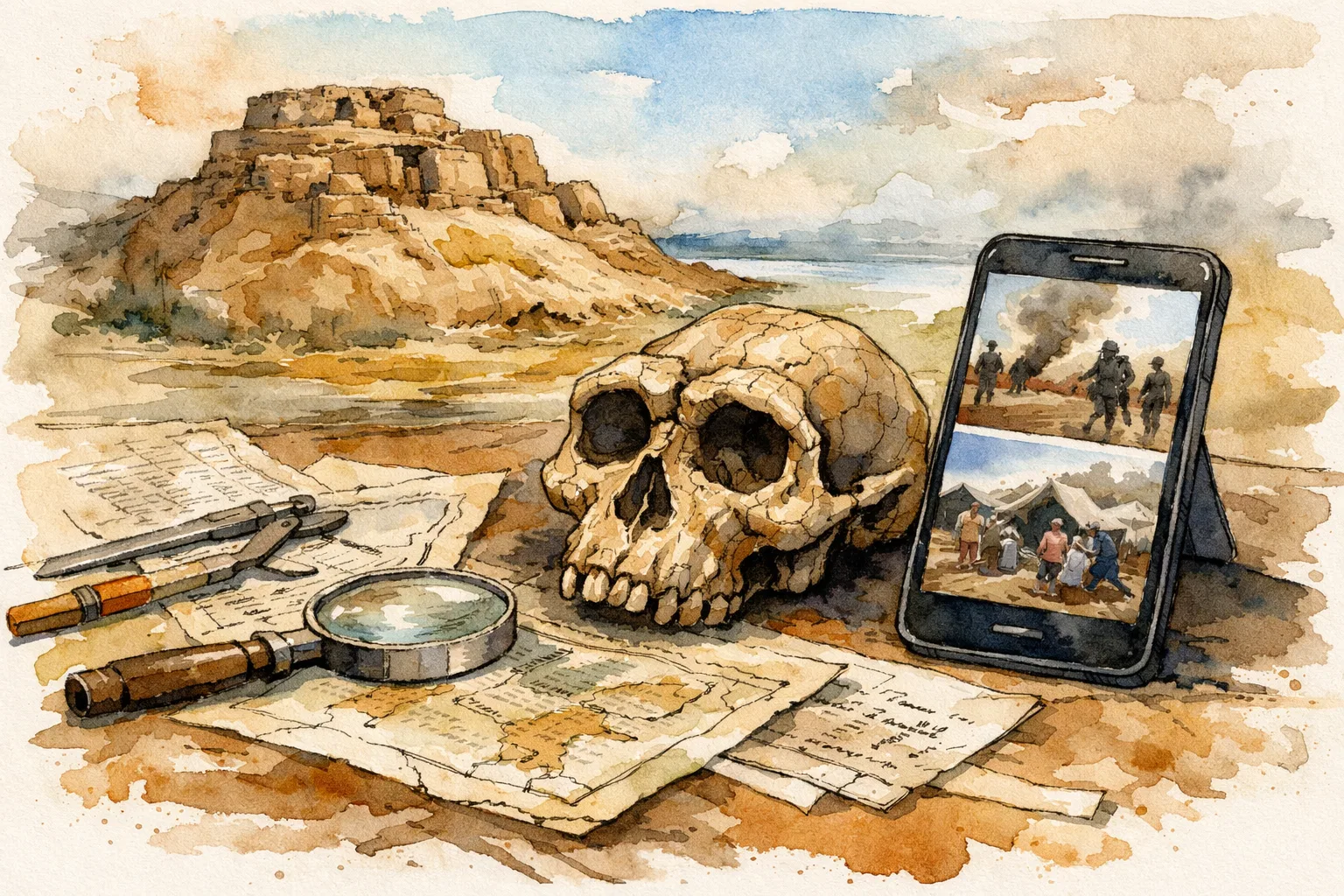
These cases matter because they show how deception often works without inventing everything from nothing. A genuine funeral photograph can be given a false caption. Real ancient ruins can acquire stories about giants. An authentic fossil can be promoted with more certainty than the surviving bones allow. Political messages can come from apparently local accounts secretly managed abroad. Chad’s most significant “hoax history” is therefore less a parade of ingenious practical jokes than a study of how uncertainty, authority and weak access to reliable information create opportunities for manipulation.
The giants of the Sao
One of the oldest contested stories associated with Chad concerns the Sao, the peoples linked with archaeological settlements south of Lake Chad. Oral traditions describe them as exceptionally large, powerful warriors who built fortified communities and possessed remarkable strength. Such accounts helped turn the Sao into something between a historical population and a lost race of giants.[Wikipedia]WikipediaSao civilisationSao civilisation
There is no doubt that substantial societies existed in the Lake Chad basin. Excavations have uncovered fortified settlements, decorated pottery, metalwork, terracotta figures and evidence of long-term political development. The misleading step is to treat every mound, unusually large pot or monumental feature as proof that its makers were physically gigantic, or to assume that the name “Sao” identifies one uniform civilisation stretching unchanged across many centuries. Archaeologists have warned that the conventional Sao chronology mixes excavated evidence with later legendary traditions, while the label itself may have been applied to several different populations.[africanistarchaeology.net]africanistarchaeology.netlegendary spurious SaoSociety of Africanist ArchaeologistsIntroduction AD 1850-1 960 (Colonial Period)January 30, 2004 — by A Garba — Introduction 'his paper a…
The giant story is better understood as folklore than as a deliberate fraud. Communities commonly describe earlier inhabitants as larger, stronger or more accomplished than people living in the present. Ancient walls and objects whose original functions have been forgotten provide persuasive physical anchors for such stories. Colonial researchers then tended to collect, classify and sometimes flatten varied traditions into a single account of a mysterious vanished people.
This distinction matters. Declaring the entire Sao tradition “false” would dismiss both genuine archaeology and meaningful oral history. Accepting it literally, however, turns a complex regional past into pseudohistory. The evidence supports skilled Iron Age communities and changing societies around Lake Chad, not an extinct biological race of giants.
Toumaï: disputed science, not an exposed fossil hoax
The discovery of the Toumaï skull in Chad’s Djurab Desert produced one of the most important and contentious claims in modern palaeoanthropology. Announced in 2002 as Sahelanthropus tchadensis, the fossil was dated to roughly six or seven million years ago and presented as a possible early member of the human evolutionary line. Its location was striking: it challenged the tendency to concentrate the search for humanity’s earliest ancestors in eastern Africa.
The skull was real, professionally recovered and studied. The controversy concerns interpretation and scientific conduct, not evidence that somebody manufactured the fossil. Researchers disagreed over whether the position of the opening beneath the skull indicated upright posture and whether the creature should be placed close to the human lineage rather than among fossil apes. Those questions became more serious when a thigh bone from the same fossil locality emerged from storage years after its discovery. Critics alleged that it had received insufficient attention because it might weaken the claim that Sahelanthropus walked on two legs.[The Guardian]theguardian.comThis assertion challenged prevailing theories that humanity originated in East Africa. Brunet named the species Sahelanthropus tchadensis…
A later study by members of the original research collaboration argued that the surviving limb bones were consistent with habitual bipedalism, although perhaps combined with climbing. Other specialists remained unconvinced, pointing to the small sample and the uncertainty over whether the bones belonged to the same individual as the famous skull. The result is an unresolved scientific argument, not a demonstrated fraud.[The Guardian]theguardian.comThis assertion challenged prevailing theories that humanity originated in East Africa. Brunet named the species Sahelanthropus tchadensis…
That has not prevented websites and videos from describing Toumaï as an “ape-man fraud”. Such wording exploits a familiar misunderstanding: when scientists revise, challenge or dispute a conclusion, audiences may assume that the original object was fake. In reality, palaeoanthropology often works from damaged and incomplete remains. Researchers can study the same authentic bone and reach different conclusions about locomotion or ancestry.
The episode still belongs in a history of contested truth because publicity shaped its reception. The exciting claim — perhaps the oldest known human ancestor — travelled much further than the qualifications. Institutional prestige, competition between research teams and the symbolic importance of a major discovery in Chad raised the stakes. The lesson is not that Toumaï was a hoax, but that dramatic scientific narratives can harden before the underlying evidence is secure.
The false images surrounding Idriss Déby’s death
President Idriss Déby’s death in April 2021 created ideal conditions for fast-moving misinformation. He had ruled Chad for three decades, had just been declared the winner of another election and reportedly died after visiting forces fighting rebels. The military suspended the constitution and installed a transitional council headed by his son, Mahamat Idriss Déby. With fighting continuing and the exact circumstances of the president’s death still unclear, social-media users were hungry for immediate visual proof.[brookings.edu]brookings.eduAfrica in the news: President Déby of Chad dies; KenyaAfrica in the news: President Déby of Chad dies; Kenya…April 24, 2021 — This week, Chad's army released a statement confirmin…
One widely circulated video appeared to show a gun battle at Chad’s presidential palace on the evening Déby’s death was announced. It was genuine footage of violence, but not in Chad. Fact-checkers traced it to armed clashes in Iraq in 2020. The false caption worked because the pictures matched what viewers feared might be happening in N’Djamena: gunfire, darkness and apparent chaos at the centre of power.[AFP Fact Check]factcheck.afp.comvideo shows clashes iraq 2020 not chads presidential palacevideo shows clashes iraq 2020 not chads presidential palace
A second post claimed to show Déby’s funeral. The photograph actually depicted the 2019 memorial service for Lol Mahamat Choua, another former president of Chad. Again, the image itself had not been digitally forged. Its meaning was changed by removing it from its original date and attaching it to a breaking event.[AFP Fact Check]factcheck.afp.comOpen source on afp.com.
These examples illustrate why false captions are so effective. Producing an elaborate fake requires skill; finding an old picture with the right emotional appearance takes only minutes. A coffin, soldiers or gunfire can seem self-authenticating when viewers already expect death or conflict. Reverse-image searching, comparison with earlier uploads and consultation of local journalists exposed the errors, but usually after the material had begun circulating.
The episode also demonstrates the difference between misinformation and a planned hoax. Some people may have deliberately relabelled the images for attention or political effect. Others probably shared them sincerely. Once detached from the original uploader, a fabricated caption can spread through networks of people who have no knowledge of its source.
Chad’s images reused in other countries’ false stories
Visual misinformation also travels out of Chad. In October 2022, posts in South Africa claimed that a disturbing photograph showed people killed after burning mosquito-repellent tablets in a closed room. The photograph actually came from Chad, where the pictured people had been exposed to tear gas. Nothing in the image supported the supposed warning about mosquito products.[AFP Fact Check]factcheck.afp.comOpen source on afp.com.
In another case, footage of Sudanese refugees crossing into Chad was falsely presented as Nigerian troops entering Niger after the 2023 coup. The clip showed a real column of people moving through a Sahelian landscape, but those people were civilians fleeing the war in Darfur, not soldiers beginning a regional intervention.[AFP Fact Check]factcheck.afp.comOpen source on afp.com.
These examples reveal a kind of international stock library of crisis imagery. Photographs from Chad and its borders can be repeatedly recaptioned because many distant viewers cannot identify the landscape, uniforms or local context. Dusty roads, crowds and armed men become interchangeable symbols of “Africa in crisis”.
The people shown suffer a second erasure in the process. Tear-gas victims become evidence for a fictitious household poisoning; refugees become an invading army. The hoax does more than misstate a location. It replaces the subjects’ real experience with a story designed for somebody else’s fear, politics or online engagement.
Foreign influence behind apparently local accounts
A more deliberate form of deception emerged in December 2020, when Facebook removed coordinated networks originating in France and Russia that had targeted audiences in several African countries, including Chad. The operations used false accounts and pages to conceal who was speaking and to make strategic messaging look like organic local discussion.[About Facebook]about.fb.comOpen source on fb.com.
Independent researchers described an extraordinary contest in which rival French- and Russian-linked networks posted in the same online spaces, denounced one another as sources of fake news and attempted to expose or undermine opposing accounts. The campaigns were most intensely focused on the Central African Republic, but their reach extended into neighbouring and strategically connected states.[Graphika]graphika.commore troll kombatmore troll kombat
The deception lay primarily in identity and coordination. Individual posts could include true statements, selective facts, patriotic slogans or ordinary political commentary. What users could not see was that supposedly independent voices were being operated together for a geopolitical purpose. Facebook defines this activity as coordinated inauthentic behaviour: manipulation of public debate in which fake accounts are central to the operation.[About Facebook]about.fb.comdecember 2020 coordinated inauthentic behavior reportdecember 2020 coordinated inauthentic behavior report
Who benefited was clearer than in a spontaneous rumour. Russian-linked operators sought favourable attitudes towards Russian involvement and hostility towards France. French-linked actors promoted narratives supportive of French policy and military engagement. The exposure was significant because it showed two foreign powers adopting some of the same covert techniques while publicly presenting themselves as defenders against disinformation.
It would be wrong to imagine that these campaigns simply controlled Chadian opinion. Influence operations often attract limited genuine engagement, and platform takedown reports measure accounts and activity more easily than changes in public belief. Their importance lies in the attempt: foreign actors judged that political arguments in and around Chad could be shaped more effectively when the sponsor remained hidden.
Why political rumours spread so easily
Chad’s recent history has combined armed rebellions, disputed elections, abrupt political transitions and restrictions on independent communication. Social media became increasingly important for political debate, particularly among younger urban Chadians, but it also carried rumours, inflammatory messages and competing accounts of violent events. The International Crisis Group found that online platforms expanded political participation during the post-Déby transition while simultaneously facilitating misinformation and disinformation.[Crisis Group]crisisgroup.orgb183 chads transition easing tensions onlineb183 chads transition easing tensions online
Long periods of restricted internet access made the information environment still harder to navigate. Social networks and messaging services were blocked in 2018, with access remaining severely restricted for more than a year. Reporters Without Borders and digital-rights organisations argued that such shutdowns obstruct journalism and verification as well as political mobilisation.[rsf.org]rsf.orgsocial networks disconnected again chadsocial networks disconnected again chad
This creates a recurring paradox. Authorities may justify restrictions as a defence against rumours, hatred or disorder, yet blocking reliable communication can increase uncertainty and force people towards hearsay, screenshots and private messaging. Human-rights investigators studying shutdowns elsewhere have likewise found that information vacuums generate speculation and make misinformation harder to correct.[OHCHR]ohchr.orgactivists internet shutdowns violate human rightsactivists internet shutdowns violate human rights
Official warnings about “fake news” must therefore be assessed carefully. Some concern genuine fabrications, forged announcements or manipulated media. The same language can also be used broadly against criticism, opposition speech or reporting that authorities dislike. A claim should not be treated as false merely because a government labels it dangerous, just as an anti-government claim does not become credible merely because official media are distrusted.
How to judge a claimed Chadian hoax
The surviving cases suggest several practical tests.
- Separate the object from its interpretation. The Toumaï fossils are authentic even though their place in human evolution is contested. Sao sites are real even though giant traditions should not be read as literal biological evidence.
- Search for the earliest appearance of an image. The presidential-palace firefight and the supposed funeral photograph were exposed by locating older, correctly identified versions.
- Check geography rather than relying on atmosphere. Refugees, soldiers and protesters in different countries may look superficially similar, especially in short, low-resolution clips.
- Ask who is pretending to speak. In a covert influence campaign, the central falsehood may be the account’s identity rather than every sentence it publishes.
- Treat breaking claims as provisional. Rumours flourish during deaths, coups, battles and communications outages because reliable details arrive slowly while demand for certainty is immediate.
- Do not confuse disagreement with exposure. Scientific controversy, oral tradition and incomplete historical evidence are not automatically hoaxes. Deliberate manufacture requires evidence of intent, manipulation or concealed authorship.
What Chad’s cases reveal
Chad’s record does not support a colourful national mythology of master forgers and theatrical pranksters. Its best-documented cases are more modern and politically consequential. They concern the reuse of real media, the exaggeration of uncertain knowledge and the disguising of organised propaganda as ordinary public speech.
The Sao giant tradition shows how archaeology and folklore can become fused without anyone necessarily setting out to deceive. Toumaï shows how prestige and dramatic presentation can turn a cautious scientific proposition into a public certainty, and how later disagreement can itself be misrepresented as proof of fraud. The misinformation surrounding Idriss Déby’s death demonstrates the speed with which old photographs and foreign footage can colonise an information vacuum. The French- and Russian-linked account networks reveal deception as infrastructure: fabricated identities, coordinated amplification and hidden sponsorship.
Together, the cases make a broader point. The most persuasive falsehood is often built around something genuine — an authentic ruin, bone, photograph, grievance or political rivalry. Exposure therefore depends not only on asking whether a thing is “real”, but also when it was made, where it came from, who is presenting it, what has been omitted and how confidently the available evidence can bear the story attached to it.
Amazon book picks
Further Reading
Books and field guides related to What Made Chad's Most Persistent False Stories Believable?. Use these as the next step if you want deeper reading beyond the article.
The Fate of Africa
Provides broad context for Chad's contested stories and political history.
The Archaeology of Africa
Useful for understanding stories surrounding ancient societies such as the Sao.
Africa Since Independence
Helps explain the background behind misinformation and disputed claims.
eBay marketplace picks
Marketplace Samples
Live-tested eBay searches with available results related to this page.

Endnotes
1.
Source: Wikipedia
Title: Sao civilisation
Link:https://en.wikipedia.org/wiki/Sao_civilisation
2.
Source: Wikipedia
Title: Bornu (historical region)
Link:https://en.wikipedia.org/wiki/Bornu_%28historical_region%29
3.
Source: brookings.edu
Title: Africa in the news: President Déby of Chad dies; Kenya
Link:https://www.brookings.edu/articles/africa-in-the-news-president-deby-of-chad-dies-kenya-drc-sign-trade-and-security-deals-and-cape-town-survives-massive-fire/
Source snippet
Africa in the news: President Déby of Chad dies; Kenya...April 24, 2021 — This week, Chad's army released a statement confirmin...
Published: April 24, 2021
4.
Source: factcheck.afp.com
Title: video shows clashes iraq 2020 not chads presidential palace
Link:https://factcheck.afp.com/video-shows-clashes-iraq-2020-not-chads-presidential-palace
5.
Source: factcheck.afp.com
Link:https://factcheck.afp.com/image-shows-memorial-service-lol-mahamat-choua-chads-fourth-president-who-died-2019
6.
Source: factcheck.afp.com
Link:https://factcheck.afp.com/doc.afp.com.32M99EW
7.
Source: factcheck.afp.com
Link:https://factcheck.afp.com/doc.afp.com.33TT9UV
8.
Source: graphika.com
Title: more troll kombat
Link:https://www.graphika.com/reports/more-troll-kombat
9.
Source: time.com
Link:https://time.com/5559491/chad-social-media-internet-ban-censorship/
10.
Source: ohchr.org
Title: activists internet shutdowns violate human rights
Link:https://www.ohchr.org/en/stories/2022/08/activists-internet-shutdowns-violate-human-rights
11.
Source: facebook.com
Link:https://www.facebook.com/groups/573281328185475/posts/1024271963086407/
12.
Source: facebook.com
Title: after russia invaded ukraine in 2022 social media was littered with crude fakes
Link:https://www.facebook.com/cnn/posts/after-russia-invaded-ukraine-in-2022-social-media-was-littered-with-crude-fakes-/1305746311418017/
13.
Source: facebook.com
Link:https://www.facebook.com/groups/philippineatheists/posts/10159065302262136/
14.
Source: facebook.com
Title: the piltdown man fossil presented in 1912 perfectly matched the prevailingand bi
Link:https://www.facebook.com/historixpage/posts/the-piltdown-man-fossil-presented-in-1912-perfectly-matched-the-prevailingand-bi/882564924754203/
15.
Source: facebook.com
Link:https://www.facebook.com/Politicalplatfom101/posts/newspaper-headlines-for-wednesday-29th-october-2025the-nationosun-apc-supporters/1418953066635107/
16.
Source: facebook.com
Link:https://www.facebook.com/foxsanantonio/posts/newly-released-records-show-the-top-republicans-in-arizonas-largest-county-dodge/10159629448511738/
17.
Source: facebook.com
Link:https://www.facebook.com/groups/396321610432143/posts/9556450834419129/
18.
Source: facebook.com
Link:https://www.facebook.com/groups/119396741908738/posts/557521811429560/
19.
Source: facebook.com
Link:https://www.facebook.com/scottishbloodline/posts/the-loch-ness-monster-is-a-lie-what-was-actually-in-that-water-is-far-darker-the/122105172146893153/
20.
Source: facebook.com
Link:https://www.facebook.com/BBCnewsafrica/posts/is-everything-you-see-online-real-or-true-after-the-coup-in-niger-in-july-false-/866764028141335/
21.
Source: facebook.com
Link:https://www.facebook.com/dw.africa/posts/rumors-of-a-possible-coup-against-president-bola-tinubus-administration-are-fake/784052890425272/
22.
Source: facebook.com
Link:https://www.facebook.com/africandiasporainternational/posts/the-lost-civilization-beneath-lake-chad-the-ancient-sao-master-mound-builders-py/1177055011237903/
23.
Source: facebook.com
Link:https://www.facebook.com/abidjan.net/posts/factcheck-pr%C3%A9tendu-d%C3%A9c%C3%A8s-de-l%C3%A9pouse-du-vice-premier-ministre-le-service-de-commu/1471251771702099/
24.
Source: facebook.com
Link:https://www.facebook.com/WenakLabs/posts/factcheckingces-derniers-jours-des-fausses-informations-circulent-les-r%C3%A9seaux-so/2691163934453498/?locale=sw_KE
25.
Source: facebook.com
Link:https://www.facebook.com/www.defimedia.info/posts/attention-fake-news-en-circulation-une-publication-circule-actuellement-sur-les-/1361913902627567/
26.
Source: facebook.com
Link:https://www.facebook.com/groups/tchadgouv/posts/25302478866110510/
27.
Source: facebook.com
Link:https://www.facebook.com/TchadOne/posts/tchad-coronavirus-le-fake-news-qui-circule-depuis-hier-sur-les-r%C3%A9seaux-sociaux-c/1433064310235338/
28.
Source: facebook.com
Link:https://www.facebook.com/groups/tchadgouv/posts/24385501844474888/
29.
Source: facebook.com
Link:https://www.facebook.com/minaderpv/posts/communiqu%C3%A9-officiel-de-d%C3%A9menti-du-minadrpv-relatif-%C3%A0-la-publication-sur-les-r%C3%A9se/1321294113527636/
30.
Source: facebook.com
Link:https://www.facebook.com/dailymaverick/posts/the-institute-for-security-studies-reported-earlier-this-year-that-russia-consid/832012542292829/
31.
Source: facebook.com
Title: 🇲🇬 Russia’s influence tactics are showing up
Link:https://www.facebook.com/CodeForAfrica/posts/-russias-influence-tactics-are-showing-up-in-madagascaran-investigation-traces-h/1301775458747387/
32.
Source: Wikipedia
Title: Palmer Report
Link:https://en.wikipedia.org/wiki/Palmer_Report
33.
Source: Wikipedia
Title: History of Chad
Link:https://en.wikipedia.org/wiki/History_of_Chad
34.
Source: factcheck.afp.com
Link:https://factcheck.afp.com/doc.afp.com.34J86HB
35.
Source: factcheck.afp.com
Link:https://factcheck.afp.com/doc.afp.com.36T83FR
36.
Source: factcheck.afp.com
Title: no these pictures do not show weapons france going boko haram insurgents nigeria
Link:https://factcheck.afp.com/no-these-pictures-do-not-show-weapons-france-going-boko-haram-insurgents-nigeria
37.
Source: factcheck.afp.com
Link:https://factcheck.afp.com/doc.afp.com.36YA87B
38.
Source: factcheck.afp.com
Link:https://factcheck.afp.com/doc.afp.com.327T2F6
39.
Source: factcheck.afp.com
Title: old video senegal presented attack nigerias embassy benin over border closure
Link:https://factcheck.afp.com/old-video-senegal-presented-attack-nigerias-embassy-benin-over-border-closure
40.
Source: africanistarchaeology.net
Title: legendary spurious Sao
Link:https://www.africanistarchaeology.net/s/Nyame-Akuma-Issue-047-Article-08.pdf
Source snippet
Society of Africanist ArchaeologistsIntroduction AD 1850-1 960 (Colonial Period)January 30, 2004 — by A Garba — Introduction 'his paper a...
Published: January 30, 2004
41.
Source: theguardian.com
Link:https://www.theguardian.com/science/2025/may/27/the-curse-of-toumai-ancient-skull-disputed-femur-feud-humanity-origins
Source snippet
This assertion challenged prevailing theories that humanity originated in East Africa. Brunet named the species Sahelanthropus tchadensis...
42.
Source: crisisgroup.org
Link:https://www.crisisgroup.org/qna/africa/chad/chad-what-are-risks-after-idriss-debys-death
Source snippet
Crisis GroupChad: What are the risks after Idriss Déby's death?22 Apr 2021 — Although FACT has suffered significant human and material lo...
43.
Source: about.fb.com
Link:https://about.fb.com/news/2020/12/removing-coordinated-inauthentic-behavior-france-russia/
44.
Source: about.fb.com
Title: december 2020 coordinated inauthentic behavior report
Link:https://about.fb.com/news/2021/01/december-2020-coordinated-inauthentic-behavior-report/
Published: december 2020
45.
Source: crisisgroup.org
Title: b183 chads transition easing tensions online
Link:https://www.crisisgroup.org/brf/africa/central-africa/chad/b183-chads-transition-easing-tensions-online
46.
Source: crisisgroup.org
Title: b183 chads transition easing tensions online
Link:https://www.crisisgroup.org/fr/brf/africa/central-africa/chad/b183-chads-transition-easing-tensions-online
47.
Source: rsf.org
Title: social networks disconnected again chad
Link:https://rsf.org/en/social-networks-disconnected-again-chad
48.
Source: about.fb.com
Title: December 2020 CIB Report
Link:https://about.fb.com/wp-content/uploads/2021/01/December-2020-CIB-Report-.pdf
Published: December 2020
49.
Source: about.fb.com
Title: March 2020 Detailed CIB Report
Link:https://about.fb.com/wp-content/uploads/2020/04/March-2020-Detailed-CIB-Report.pdf
Published: March 2020
50.
Source: about.fb.com
Title: 2017 2021 IO Threat Report Takedown List.xlsx
Link:https://about.fb.com/wp-content/uploads/2021/05/2017-2021-IO-Threat-Report-Takedown-List.xlsx
51.
Source: about.fb.com
Title: FINAL FB Response to DSA Consultations
Link:https://about.fb.com/de/wp-content/uploads/sites/10/2020/09/FINAL-FB-Response-to-DSA-Consultations.pdf
52.
Source: about.fb.com
Title: IO Threat Report May 20 2021
Link:https://about.fb.com/wp-content/uploads/2021/05/IO-Threat-Report-May-20-2021.pdf
53.
Source: about.fb.com
Title: october 2020 cib report
Link:https://about.fb.com/news/2020/11/october-2020-cib-report/
Published: october 2020
54.
Source: omc.obta.al.uw.edu.pl
Link:https://www.omc.obta.al.uw.edu.pl/myth-survey/country/43
55.
Source: abcnews.com
Link:https://abcnews.com/Technology/russia-focused-us-ukraine-africa-coordinated-tactics-websites/story?id=95308058
Additional References
56.
Source: youtube.com
Title: A Researcher Hid This Fossil For Decades. Here’s Why
Link:https://www.youtube.com/watch?v=YS60Tv3EXPs
Source snippet
This SciShow investigation breaks down the academic secrecy and controversy surrounding the Toumaï hominid fossil discovered in Chad, dir...
57.
Source: issafrica.org
Title: chad navigates the deby void
Link:https://issafrica.org/pscreport/psc-insights/chad-navigates-the-deby-void
Source snippet
ISS AfricaChad navigates the Déby void | PSC Report31 Aug 2021 — The death of Idriss Déby on 19 April 2021 plunged Chad into political un...
Published: April 2021
58.
Source: arxiv.org
Link:https://arxiv.org/abs/1511.05185
59.
Source: youtube.com
Title: Unveiling The Mysteries of the African Sao Civilization
Link:https://www.youtube.com/watch?v=e3Xjr5ZlDxw
Source snippet
Sleep Story: Sao Civilization & Ancient Lake Chad Mysteries ASMR...
60.
Source: youtube.com
Title: Human Evolution History Rewritten By Ancient Bones
Link:https://www.youtube.com/watch?v=WSX_sbUXa7Q
Source snippet
A Researcher Hid This Fossil For Decades. Here's Why...
61.
Source: historyguild.org
Link:https://historyguild.org/ancient-africa/?srsltid=AfmBOopsATdEZn2UVImwmQVPbxtuV17dK0vY-MFC0wkeI9vbe2gAVi2O
62.
Source: sahistory.org.za
Link:https://sahistory.org.za/place/chad
63.
Source: ancient-origins.net
Link:https://www.ancient-origins.net/chad
64.
Source: reddit.com
Link:https://www.reddit.com/r/Cryptozoology/comments/1m5u1dm/the_legend_of_the_lake_van_monster/?tl=nl
65.
Source: instagram.com
Link:https://www.instagram.com/reel/DL9cPTtigB2/?hl=en
Topic Tree
Follow this branch
Related pages 192
- Albanian Hoaxes
- Algerian Hoaxes
- Antigua Deceptions
- Argentina Hoaxes
- Armenian Hoaxes
- +187 more in sidebar