When Tanzania's Strangest Stories Met the Evidence
Tanzania’s best-known stories of deception and contested truth are not a tidy catalogue of deliberate hoaxes.
Page outline Jump by section
Introduction
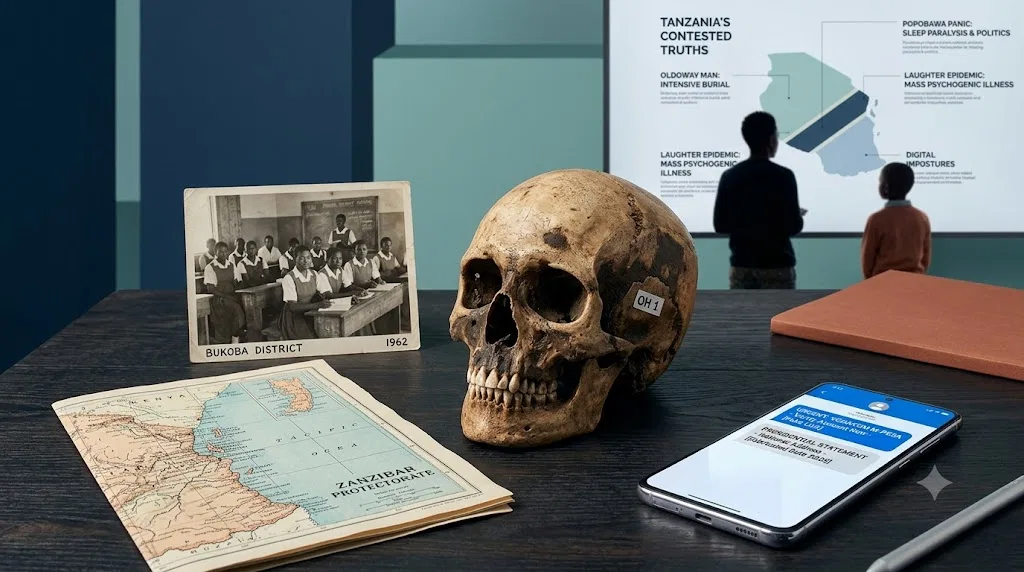
Four episodes are especially revealing. “Oldoway Man” shows how geological context can make an ordinary burial look scientifically revolutionary. The Popobawa panics demonstrate how folklore, frightening bodily experiences and political tension can reinforce one another. The Tanganyika laughter epidemic shows how a documented health event became exaggerated in popular retelling. Recent impersonation scams and fabricated political posts reveal the same mechanisms operating at digital speed.
The ancient man who was not ancient enough
In 1913, German geologist Hans Reck’s expedition uncovered a nearly complete human skeleton at Olduvai Gorge, then in German East Africa. The remains appeared to lie within Bed II, a geological formation associated with extinct animals and immensely older deposits. Because the skeleton looked anatomically modern, its apparent position seemed capable of rewriting human prehistory. Reck argued that it belonged to the ancient layer rather than to a later grave dug down into it.[Wikipedia]WikipediaHans ReckHans Reck
The claim was not an obvious fraud. Reck inspected the deposits for evidence of a grave cut and believed that the hardened material surrounding the bones had not been disturbed. Dating methods were far less developed than they are today, and the location itself carried enormous authority: Olduvai would eventually become one of the world’s most important sites for the study of human evolution.
The case became more confusing when Louis Leakey investigated it. Leakey initially suspected that the skeleton was much younger, but after visiting Olduvai with Reck in 1931 he publicly endorsed a very great age. Contemporary reporting presented the find as possibly the oldest authentic skeleton of a modern human. That endorsement helped transform a disputed field observation into an international scientific sensation.[Wikipedia]WikipediaHans ReckHans Reck
Later work changed the interpretation. The skeleton, now catalogued as Olduvai Hominid 1, is regarded as an intrusive burial: a comparatively recent body placed in a grave that penetrated much older sediments. Modern radiocarbon analysis dates it to roughly the eleventh or twelfth century AD, not the deep Pleistocene. The surrounding rock was ancient; the person buried within it was not.[ResearchGate]researchgate.net1021–1155, consists primarily of broken long bones that indicate a robust individual with a height…
This distinction matters because “Oldoway Man” is sometimes recycled in fringe literature as evidence that conventional archaeology suppresses inconvenient human remains. In reality, the episode illustrates ordinary scientific correction. An early interpretation was plausible enough to attract serious support, but it failed when researchers gained better evidence and better dating techniques. Calling it a hoax wrongly implies that Reck planted the skeleton. The more instructive story is how easily the age of a geological layer can be mistaken for the age of an object inserted into it.

Popobawa: when a spirit story became a public panic
The most famous supernatural scare associated with Tanzania concerns Popobawa, an alleged nocturnal attacker reported principally in Zanzibar. Accounts varied, but witnesses commonly described being awakened, immobilised, pressed down or assaulted by an unseen or shape-changing presence. A major wave began on Pemba in early 1995 and spread to Unguja, Zanzibar’s main island, with related reports reaching parts of the mainland.[Academia]academia.eduThe politicisation of Popobawa: changing explanations of a…January 1, 2009 — The 1995 Popobawa panic in Zanzibar revealed sign…
Some features resemble sleep paralysis, a condition in which a person becomes conscious while the body remains temporarily unable to move. Episodes can include chest pressure, intense fear and vivid hallucinations interpreted through the sufferer’s cultural expectations. Medical literature on sleep paralysis notes that similar experiences have been described elsewhere as attacks by ghosts, witches, demons or alien intruders. That offers a credible explanation for at least some individual encounters, but it does not by itself explain the spread of an island-wide panic.[Cambridge University Press & Assessment]cambridge.orgOpen source on cambridge.org.
The story contained its own transmission mechanism. Victims were reportedly expected to tell others what had happened; silence or denial was sometimes said to invite further attacks. A terrifying private experience therefore became a public narrative, repeatedly discussed in homes, streets and gathering places. Each new account supplied imagery and expectations that could shape later experiences. Research on the tradition emphasises this interaction between reported attacks and talk about the attacks, rather than reducing the episode to a single prankster or invented newspaper story.[ResearchGate]researchgate.net263678458 SWAHILI TALK ABOUT SUPERNATURAL SODOMY263678458 SWAHILI TALK ABOUT SUPERNATURAL SODOMY
The timing also encouraged political interpretations. The 1995 outbreak occurred during the approach to Zanzibar’s first multiparty elections, and later smaller scares appeared around periods of political strain. Different explanations circulated: some blamed political actors, some connected the spirit to the turbulent history of Zanzibar, and others treated the phenomenon as wholly supernatural. The association with elections was real enough to attract scholarly attention, but it does not prove that a party created the panic as a planned deception.[Academia]academia.eduThe politicisation of Popobawa: changing explanations of a…January 1, 2009 — The 1995 Popobawa panic in Zanzibar revealed sign…
The consequences were not merely folkloric. On 3 April 1995, a visitor from mainland Tanzania was killed by a mob in Zanzibar Town after being identified as a manifestation of Popobawa. Rumour transformed an ambiguous stranger into a physical threat, showing how belief in a shape-changing attacker could place vulnerable or unfamiliar people in immediate danger.[ResearchGate]researchgate.netResearch Gate Killing Popobawa: collective panic and violence in ZanzibarResearch Gate Killing Popobawa: collective panic and violence in Zanzibar
Popobawa is therefore better understood as a collective panic and evolving legend than as a proven hoax. Individual claims may have included joking, imitation or deliberate fabrication, but the evidence does not support one mastermind or a single falsehood imposed on passive believers. The episode drew its strength from genuine fear, frightening sleep experiences, repeated storytelling, local spiritual ideas and political uncertainty.
Later foreign retellings often flatten that complexity into a tale about a “bat demon” terrorising an exotic island. Scholars have criticised such readings for treating Tanzanian speech merely as evidence of credulity while overlooking humour, political commentary, coded discussion of sexuality and disagreement among Zanzibaris themselves.[Cambridge University Press & Assessment]cambridge.orgOpen source on cambridge.org.
The laughter epidemic was real, but the legend is misleading
In January 1962, soon after Tanganyika gained independence, pupils at a girls’ boarding school in the Bukoba district developed episodes of uncontrollable laughter and crying. The disturbance disrupted lessons and eventually forced the school to close. Related cases later appeared in other schools and communities. The original medical report described 95 affected pupils at the first school and 217 people in one later community outbreak.[Journals]journals.co.zaAJA00089176 6171AJA00089176 6171
Popular versions frequently turn the event into an absurd story in which one joke made hundreds or even a thousand people laugh continuously for months. That is not what the evidence says. Individuals experienced intermittent attacks lasting from hours to days; the overall series of outbreaks continued as cases appeared in different places. Symptoms included crying, agitation, pain, fainting and breathing difficulties as well as laughter. It was neither a single unbroken fit nor an outbreak of irresistible amusement.[ResearchGate]researchgate.net249929567 The laughter of the 1962 Tanganyika 'laughter epidemic249929567 The laughter of the 1962 Tanganyika 'laughter epidemic
Investigators did not identify an infectious agent or poison. The episode is usually classified as mass psychogenic illness: real, involuntary symptoms spreading through social groups without a conventional infectious cause. “Psychogenic” does not mean that victims were pretending. Stress, expectation, observation of others and social relationships can produce genuine physical and behavioural effects.
The historical setting may have contributed. Tanganyika had become independent in December 1961, and pupils were living within a strict educational environment amid rapid social change and rising expectations. Later interpretations have connected the outbreak to pressure on young people and tensions between school discipline, family authority and a changing society. These explanations remain interpretive rather than conclusively proven, but they fit the broader pattern of psychogenic outbreaks occurring in tightly organised institutions.[ResearchGate]researchgate.net249929567 The laughter of the 1962 Tanganyika 'laughter epidemic249929567 The laughter of the 1962 Tanganyika 'laughter epidemic
The misleading part of the story is therefore not the existence of the epidemic. Contemporary doctors documented it. The distortion lies in turning a distressing cluster of symptoms into a whimsical “contagious laughter” anecdote. Repetition favours the simplest and strangest version: laughing spread like a virus. The medical reality—mixed symptoms, recurrent episodes, institutional stress and uncertainty—is less comic but more revealing.

Digital hoaxes borrow trusted names
Modern Tanzanian hoaxes often dispense with monsters and ancient bones. Their main technique is impersonation. Fraudulent pages, applications and messages copy the names or visual identities of trusted organisations, then ask users to share a link, submit personal details or pay money.
Fact-checkers have documented fake Tanzanian offers attributed to lenders, telecommunications companies and major businesses. Examples include a page falsely claiming that the mobile lender Tala had resumed Tanzanian operations, a supposed loan offer using the name of the Bakhresa Group and messages promising cash relief to Vodacom M-Pesa users. The organisations denied the promotions.[Pesacheck]pesacheck.orghoax this page claiming that tala has resumed operations in tanzania is fakehoax this page claiming that tala has resumed operations in tanzania is fake
Other schemes exploit public services or travel. A bogus application claimed to provide Tanzanian national identity services and required users to circulate its link, while an imitation Air Tanzania website advertised a giveaway in the airline’s name. These scams gain credibility from familiar logos and bureaucratic language, then use urgency or the promise of scarce benefits to push people past normal caution.[Pesacheck]pesacheck.orghoax this app offering tanzanian national identity services is fakehoax this app offering tanzanian national identity services is fake
Celebrity impersonation uses the same structure. A fake account using the identity of Tanzanian model and entertainer Hamisa Mobetto advertised jobs, despite her warning that she did not operate the purported Facebook page. A fake recruitment letter attributed to Oxfam Tanzania similarly borrowed the authority of a recognised organisation.[Pesacheck]pesacheck.orghoax this facebook account claiming hamisa mobetto is offering jobs is fakehoax this facebook account claiming hamisa mobetto is offering jobs is fake
Political falsehoods add another layer because they can exploit genuine uncertainty. In May 2025, hackers took control of official or corporate accounts, including the Tanzanian police account on X. Among the material posted was a false announcement that President Samia Suluhu Hassan had died. The message was especially deceptive because it appeared through an authentic institutional account rather than an obvious imitation.[AP News]apnews.comOpen source on apnews.com.
This case demonstrates a weakness in the familiar advice to “check the source”. A genuine account can be compromised. Verification may therefore require checking whether the same announcement appears through several independent official channels, established news organisations or a later institutional correction.
Fabricated documents and altered media have also become important. False press releases, doctored newspaper covers, recycled photographs and synthetic audio can imitate the appearance of journalism without its reporting process. A 2025 manipulated video, for example, falsely presented an artificial voice as commentary by CNN presenter Fareed Zakaria on events involving Tanzania; CNN confirmed that it had not published the clip.[AFP Fact Check]factcheck.afp.comOpen source on afp.com.
What these cases have in common
Tanzania’s hoax history is most useful when its cases are kept distinct. Oldoway Man was a scientific misinterpretation, not a planted fossil. The laughter epidemic was a genuine health event converted into a misleading legend. Popobawa was a collective supernatural panic with no demonstrated central inventor. Digital giveaways and impersonation pages, by contrast, are deliberate frauds designed to obtain attention, information or money.
Despite those differences, the episodes share several mechanisms.
Authority can substitute for proof. A respected geologist, a famous archaeological site, an official social-media account or a recognised company name gives a claim an initial advantage. People are more likely to repeat information when its apparent source already seems trustworthy.
Ambiguous experiences invite familiar explanations. A skeleton inside ancient sediments looked ancient. Sleep paralysis could be experienced as spiritual attack. Stress-related symptoms appeared to spread like an infection. The explanation was not random; it was shaped by the evidence and concepts available to observers at the time.
Retelling removes inconvenient detail. The laughter epidemic becomes “a joke that lasted eighteen months”. Popobawa becomes a literal winged monster. Oldoway Man becomes a forbidden fossil suppressed by scientists. Simple versions travel further because they are easier to remember and more emotionally satisfying.
Fear and reward both accelerate transmission. Popobawa stories warned of nocturnal danger; political fabrications exploit uncertainty; commercial scams promise loans, jobs or prize money. A message that appears to demand immediate action leaves less time for verification.
Correction rarely erases the original story. Radiocarbon dating can settle the age of a skeleton, and a company can deny a fake promotion, yet the earlier claim may continue circulating in books, copied posts and sensational videos. Debunking changes the evidence, but it does not automatically remove the narrative from popular culture.
How to read Tanzanian hoax stories critically
The first question should be whether the case was actually a hoax. Deliberate deception requires evidence of intent. A mistaken scientist, an ill patient or a frightened witness should not be labelled a fraud merely because the final explanation differs from the original belief.
The next step is to separate the event from its most famous retelling. In the laughter epidemic, the original clinical description is more reliable than later summaries built around the comic word “laughter”. For Oldoway Man, the specimen’s modern database record and dating research outweigh claims that rely only on its position in ancient rock. For digital promotions, confirmation from the named organisation matters more than copied branding.
It is also worth asking who gains from circulation. A scammer may seek money or personal data. A political fabricator may seek confusion or anger. A publisher may package a complicated episode as a monster story because sensational versions attract attention. In other cases, however, the benefit is social rather than financial: a frightening story can provide a shared language for discussing stress, danger, authority or taboo subjects.
Tanzania’s most memorable disputed stories survive because each contains something more durable than a simple lie. They dramatise the uncertainty of scientific discovery, the bodily force of fear, the social transmission of illness and the ease with which borrowed authority can make false information look legitimate. Their value lies not in proving that people were foolish, but in showing how belief becomes reasonable within a particular set of circumstances—and how later evidence can alter the story without making it disappear.
Amazon book picks
Further Reading
Books and field guides related to When Tanzania's Strangest Stories Met the Evidence. Use these as the next step if you want deeper reading beyond the article.
Mistakes Were Made (but Not by Me)
Helps explain why people defend mistaken beliefs and interpretations.
The Demon-Haunted World
Rating: 4.5/5 from 43 Google Books ratings
Explains how extraordinary claims gain credibility and how evidence is evaluated.
Why People Believe Weird Things
Directly addresses pseudoscience, myths, hoaxes and contested claims.
The Invisible Gorilla
Shows how perception and attention can mislead even careful observers.
eBay marketplace picks
Marketplace Samples
Live-tested eBay searches with available results related to this page.




Endnotes
1.
Source: Wikipedia
Title: Hans Reck
Link:https://en.wikipedia.org/wiki/Hans_Reck
2.
Source: time.com
Title: science oldest man
Link:https://time.com/archive/6749015/science-oldest-man/
Source snippet
Science: Oldest Man?It is almost beyond question that the skeleton of a human being found by Professor Hans Reck in 1913 is the oldes...
3.
Source: researchgate.net
Link:https://www.researchgate.net/publication/316665020_Taphonomy_and_Paleoichnology_of_Olduvai_Hominid_1_OH1_Tanzania
Source snippet
1021–1155, consists primarily of broken long bones that indicate a robust individual with a height...
4.
Source: academia.edu
Link:https://www.academia.edu/694054/The_politicisation_of_Popobawa_changing_explanations_of_a_collective_panic_in_Zanzibar
Source snippet
The politicisation of Popobawa: changing explanations of a...January 1, 2009 — The 1995 Popobawa panic in Zanzibar revealed sign...
Published: January 1, 2009
5.
Source: researchgate.net
Link:https://www.researchgate.net/publication/272202097_The_politicisation_of_Popobawa_changing_explanations_of_a_collective_panic_in_Zanzibar
Source snippet
changing explanations of a collective panic in Zanzibar14 Feb 2015 — This paper examines the development of the 1995 panic, a...
6.
Source: cambridge.org
Link:https://www.cambridge.org/core/books/parasomnias-and-other-sleeprelated-movement-disorders/recurrent-isolated-sleep-paralysis/C20152008D535C91B85249A321DBEDDF
7.
Source: cambridge.org
Link:https://www.cambridge.org/core/books/parasomnias-and-other-sleeprelated-movement-disorders/parasomnias-usually-associated-with-rem-sleep/2B98A513C00F24BB8912D487FD3B6779
8.
Source: researchgate.net
Title: 263678458 SWAHILI TALK ABOUT SUPERNATURAL SODOMY
Link:https://www.researchgate.net/publication/263678458_SWAHILI_TALK_ABOUT_SUPERNATURAL_SODOMY
9.
Source: researchgate.net
Title: Research Gate Killing Popobawa: collective panic and violence in Zanzibar
Link:https://www.researchgate.net/publication/270393629_Killing_Popobawa_collective_panic_and_violence_in_Zanzibar
10.
Source: cambridge.org
Link:https://www.cambridge.org/core/journals/african-studies-review/article/katrina-thompson-popobawa-tanzanian-talk-global-misreadings-bloomington-indiana-university-2017-xii-226-pp-notes-bibliography-index-3000-paper-isbn-9780253024565/C7754D0D3368FCB6F458FE0FC28F1C3D
11.
Source: researchgate.net
Link:https://www.researchgate.net/publication/287306634_Where_humans_and_spirits_meet_The_politics_of_rituals_and_identified_spirits_in_Zanzibar
12.
Source: researchgate.net
Title: 249929567 The laughter of the 1962 Tanganyika ‘laughter epidemic’
Link:https://www.researchgate.net/publication/249929567The_laughter_of_the_1962_Tanganyika%27laughter_epidemic%27
13.
Source: Wikipedia
Title: Tanganyika laughter epidemic
Link:https://en.wikipedia.org/wiki/Tanganyika_laughter_epidemic
14.
Source: pesacheck.org
Title: hoax this page claiming that tala has resumed operations in tanzania is fake
Link:https://pesacheck.org/hoax-this-page-claiming-that-tala-has-resumed-operations-in-tanzania-is-fake/
15.
Source: pesacheck.org
Title: hoax this post claiming tanzanias bakhresa group is offering loans is fake
Link:https://pesacheck.org/hoax-this-post-claiming-tanzanias-bakhresa-group-is-offering-loans-is-fake/
16.
Source: pesacheck.org
Title: hoax vodacom is not offering tsh80 000 to m pesa users as covid 19 relief
Link:https://pesacheck.org/hoax-vodacom-is-not-offering-tsh80-000-to-m-pesa-users-as-covid-19-relief/
17.
Source: pesacheck.org
Title: hoax this app offering tanzanian national identity services is fake
Link:https://pesacheck.org/hoax-this-app-offering-tanzanian-national-identity-services-is-fake/
18.
Source: pesacheck.org
Link:https://pesacheck.org/hoax-mobile-application-offering-national-identity-verification-services-is-not-legitimate/
19.
Source: pesacheck.org
Link:https://pesacheck.org/hoax-this-website-impersonating-air-tanzania-and-offering-giveaways-in-its-name-is-a-scam/
20.
Source: pesacheck.org
Title: hoax this facebook account claiming hamisa mobetto is offering jobs is fake
Link:https://pesacheck.org/hoax-this-facebook-account-claiming-hamisa-mobetto-is-offering-jobs-is-fake/
21.
Source: pesacheck.org
Title: hoax this letter advertising recruitment at oxfam tanzania is fake
Link:https://pesacheck.org/hoax-this-letter-advertising-recruitment-at-oxfam-tanzania-is-fake/
22.
Source: factcheck.afp.com
Link:https://factcheck.afp.com/doc.afp.com.49786KD
23.
Source: facebook.com
Link:https://www.facebook.com/medandmarket/videos/monkey-man-causes-panic-across-delhithe-monkey-man-panic-20-years-latertwenty-ye/587018859665405/
24.
Source: facebook.com
Link:https://www.facebook.com/groups/3137177053251945/posts/3605174543118858/
25.
Source: facebook.com
Link:https://www.facebook.com/trtafrika/posts/tanzanias-police-x-account-has-been-hacked-to-publish-a-hoax-post-on-the-death-o/677719891713483/
26.
Source: facebook.com
Link:https://www.facebook.com/groups/551696956384813/posts/1298592375028597/
27.
Source: facebook.com
Link:https://www.facebook.com/PinasPulse/posts/nbi-arrests-tanzanian-american-over-270m-investment-scamon-february-26-2026-the-/122169821954872450/
28.
Source: facebook.com
Link:https://www.facebook.com/groups/119396741908738/posts/557521811429560/
29.
Source: researchgate.net
Link:https://www.researchgate.net/publication/349766037_Chapter_Four_In_the_Nature_of_the_Human_Landscape_Provenances_in_the_Making_of_Zanzibar_Politics
30.
Source: researchgate.net
Link:https://www.researchgate.net/profile/Martin-Walsh-16/publication/272202097_The_politicisation_of_Popobawa_changing_explanations_of_a_collective_panic_in_Zanzibar/links/54df76810cf2510fcee802f4/The-politicisation-of-Popobawa-changing-explanations-of-a-collective-panic-in-Zanzibar.pdf
31.
Source: researchgate.net
Link:https://www.researchgate.net/publication/281622765Mass_media_constructions_of%27socio-psychological_epidemics%27_in_sub-Saharan_Africa_The_case_of_genital_shrinking_in_11_countries
32.
Source: researchgate.net
Link:https://www.researchgate.net/publication/283247038_Discreet_Talk_about_Supernatural_Sodomy_Transgressive_Gender_Performance_and_Male_Same-Sex_Desire_in_Zanzibar_Town
33.
Source: researchgate.net
Link:https://www.researchgate.net/profile/Martin-Walsh-16
34.
Source: researchgate.net
Title: 312004272 Speed and Academic Blindness
Link:https://www.researchgate.net/publication/312004272_Speed_and_Academic_Blindness
35.
Source: factcheck.afp.com
Link:https://factcheck.afp.com/doc.afp.com.83W43NR
36.
Source: factcheck.afp.com
Link:https://factcheck.afp.com/doc.afp.com.82UB9ZQ
37.
Source: factcheck.afp.com
Title: image 2018 shows girls tanzania who were expelled school falling pregnant
Link:https://factcheck.afp.com/image-2018-shows-girls-tanzania-who-were-expelled-school-falling-pregnant
38.
Source: factcheck.afp.com
Title: photo shows tanzanias leader memorial service not gathering co wives
Link:https://factcheck.afp.com/photo-shows-tanzanias-leader-memorial-service-not-gathering-co-wives
39.
Source: factcheck.afp.com
Link:https://factcheck.afp.com/doc.afp.com.9MU3XZ
40.
Source: factcheck.afp.com
Link:https://factcheck.afp.com/doc.afp.com.9VT62A
41.
Source: factcheck.afp.com
Link:https://factcheck.afp.com/list/regions/Africa
42.
Source: factcheck.afp.com
Title: Tendai DUBE
Link:https://factcheck.afp.com/Tendai-DUBE
43.
Source: factcheck.afp.com
Title: no photo does not show victims xenophobic violence south africa
Link:https://factcheck.afp.com/no-photo-does-not-show-victims-xenophobic-violence-south-africa
44.
Source: Wikipedia
Title: Unusual articles
Link:https://en.wikipedia.org/wiki/Wikipedia%3AUnusual_articles
45.
Source: Wikipedia
Title: Oldoway Man
Link:https://en.wikipedia.org/wiki/Oldoway_Man
46.
Source: Wikipedia
Title: Archaeological forgery
Link:https://en.wikipedia.org/wiki/Archaeological_forgery
47.
Source: Wikipedia
Link:https://en.wikipedia.org/wiki/Popobawa
48.
Source: pesacheck.org
Title: hoax this promotion using halotel tanzanias tagline is fraudulent
Link:https://pesacheck.org/hoax-this-promotion-using-halotel-tanzanias-tagline-is-fraudulent/
49.
Source: pesacheck.org
Link:https://pesacheck.org/partly-false-this-post-about-the-late-john-magufulis-foreign-travels-and-loan-uptake-is-not/
50.
Source: archaeology.org
Title: 220406 olduvai gorge tools
Link:https://archaeology.org/news/2022/04/05/220406-olduvai-gorge-tools/
51.
Source: youtube.com
Title: The Tanganyika Laughter Epidemic
Link:https://www.youtube.com/watch?v=wu6_NUWlQ_c
Source snippet
244 - The Tanganyika Laughter Epidemic: When Stress Went Viral in 1962...
52.
Source: youtube.com
Link:https://www.youtube.com/watch?v=AWprpDloucc
Source snippet
Popobawa - The Bat Demon of Zanzibar - African Creatures...
53.
Source: youtube.com
Link:https://www.youtube.com/watch?v=7Eerrmdhx40
Source snippet
Mary Leakey | The History and Meaning of the Discoveries in Olduvai Gorge...
54.
Source: journals.co.za
Title: AJA00089176 6171
Link:https://journals.co.za/doi/pdf/10.10520/AJA00089176_6171
55.
Source: apnews.com
Link:https://apnews.com/article/d8a4a16349541ccb6f20181fbd4a655e
56.
Source: journals.pagepress.net
Title: harvard cite them right
Link:https://journals.pagepress.net/arc/citationstylelanguage/get/harvard-cite-them-right?issueId=297&publicationId=3480&submissionId=5255
57.
Source: altezzatravel.com
Title: olduvai gorge
Link:https://altezzatravel.com/articles/olduvai-gorge
58.
Source: journals.openedition.org
Link:https://journals.openedition.org/etudesafricaines/29507?lang=en
Additional References
59.
Source: youtube.com
Title: Dr. Leakey and the Dawn of Man
Link:https://www.youtube.com/watch?v=GaGYSN8YDZ4
Source snippet
History of the Tanganyika Laughter Epidemic This video delves into the historical context and timeline of the 1962 mass psychogenic illne...
60.
Source: youtube.com
Title: Mary Leakey | The History and Meaning of the Discoveries in Olduvai Gorge
Link:https://www.youtube.com/watch?v=EQNI0428-ns
Source snippet
Dr. Leakey and the Dawn of Man - 1966, National Geographic Society...
61.
Source: science.org
Link:https://www.science.org/content/article/hoax-detecting-software-spots-fake-papers
62.
Source: olduvai-paleo.org
Title: CODIOH 1
Link:https://olduvai-paleo.org/specimen/oh-1/
Source snippet
Intrusive burial post-dating primary Olduvai sequence. - 9 Elements Preserved: SKEL Sediment/Matrix. Level: Intrusive burial In Situ: Unk...
63.
Source: semanticscholar.org
Link:https://www.semanticscholar.org/paper/AN-EPIDEMIC-OF-LAUGHING-IN-THE-BUKOBA-DISTRICT-OF-9-Am-Pj/52f6add12054e7cd317f7c72b8182467761f32c2
64.
Source: scribd.com
Link:https://www.scribd.com/document/13997211/Diabolical-Delusions-and-Hysterical-Narratives-in-a-Postmodern-State
65.
Source: instagram.com
Link:https://www.instagram.com/reel/DMrrQ_HsaDN/?hl=en
66.
Source: africacheck.org
Link:https://africacheck.org/fact-checks?page=628&sort_bef_combine=created_DESC
67.
Source: africacheck.org
Link:https://africacheck.org/fact-checks?page=97&sort_bef_combine=created_ASC
68.
Source: africacheck.org
Link:https://www.africacheck.org/fact-checks?field_article_type_value=All&field_country_value=KE&field_rated_value=All&page=19&sort_bef_combine=created_DESC
Topic Tree
Follow this branch
Related pages 192
- Albanian Hoaxes
- Algerian Hoaxes
- Antigua Deceptions
- Argentina Hoaxes
- Armenian Hoaxes
- +187 more in sidebar