Why Italy's Most Famous Hoaxes Seemed Convincing
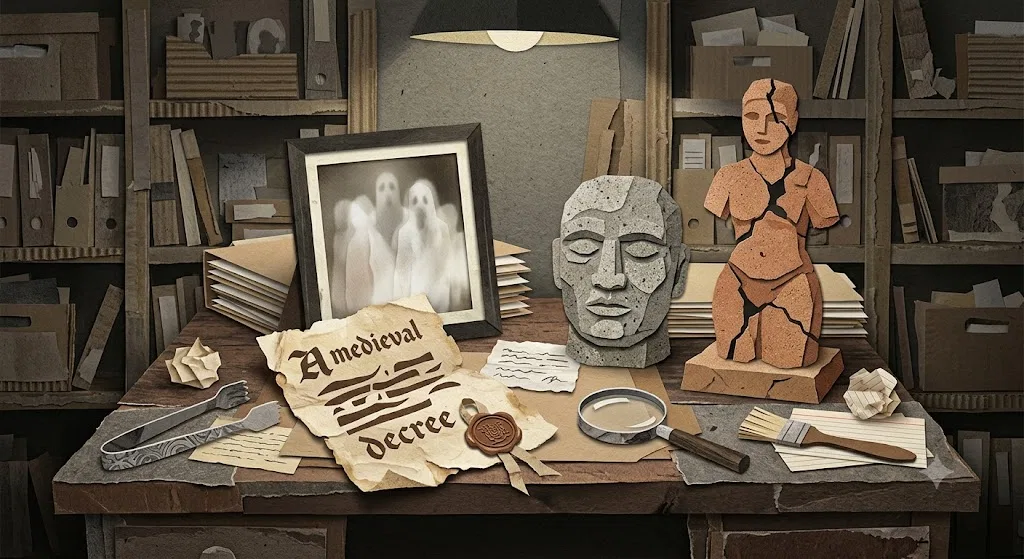
Italy’s best-known hoaxes range from a forged imperial decree that influenced medieval politics to counterfeit antiquities, fake Modigliani sculptures, spirit photographs, invented artists and dubious medical claims. They succeeded for different reasons, but usually exploited the same weakness: people judge evidence partly through its setting.
Page outline Jump by section
Introduction
These stories are not evidence that Italians are unusually credulous. They show how deception flourishes wherever money, prestige, political usefulness or emotional need rewards belief. Some cases were deliberate frauds; others were pranks, artistic provocations or sincerely promoted errors. Their exposure likewise took different forms, including linguistic analysis, laboratory testing, confession, controlled clinical trials and old-fashioned checking of names, dates and provenance. The most revealing question is therefore not merely why people believed, but who or what made belief seem reasonable.
The forgery that strengthened papal power
The Donation of Constantine purported to be a decree issued by the fourth-century emperor Constantine. According to the text, Constantine transferred extensive political authority in Rome and the western empire to Pope Sylvester I after being healed of leprosy and converted to Christianity. It was actually composed centuries later, probably in the eighth century, and became especially useful during medieval disputes over the papacy’s temporal power.[Wikipedia]WikipediaDonation of ConstantineDonation of Constantine
This was a forgery rather than a simple factual error. Its creator placed a desired political arrangement in the mouth of a revered emperor, giving later claims the appearance of ancient legal authority. Once copied into respected collections of ecclesiastical law, the Donation acquired credibility from the institutions preserving and citing it. Not every medieval user need have understood that it was false; an invented document can continue working long after its original author has disappeared.
The Italian humanist Lorenzo Valla exposed the document through philology, the close historical study of language. In the 1430s and 1440s he argued that its Latin contained vocabulary, expressions and political concepts that belonged to a later age, not to Constantine’s court. The supposed emperor appeared to speak in the language of medieval institutions. Valla also attacked implausibilities in the story and the document’s assumptions about Roman government.[hanover.edu]history.hanover.eduIn Latin and English. English translation by Christopher B. ColemanHanover College History DepartmentLorenzo Valla, Discourse on the Forgery of the Alleged…Lorenzo Valla, Discourse on the Forgery of th…
Valla’s achievement did not instantly erase the Donation’s political influence, but it established a powerful method for testing historical documents. A text could no longer be defended simply because it was old, useful or widely accepted. Its words had to fit the period in which it claimed to have been written. The case remains an early and memorable example of exposing forgery by identifying anachronisms rather than finding the forger.
Fake antiquities built for museum belief
The Etruscan terracotta warriors acquired by New York’s Metropolitan Museum of Art were among the most spectacular archaeological fakes connected with Italy. Between 1915 and 1921 the museum bought three monumental terracotta figures presented as ancient Etruscan sculpture. Exhibited together from 1933, they seemed to fill an enticing gap in knowledge: very little comparable large-scale Etruscan statuary had survived.[metmuseum.org]resources.metmuseum.orgEtruscan Art in The Metropolitan MuseumMetropolitan Museum ResourcesEtr uscan a r t24 Mar 2023 — View of the Striding Warrior (later determined a forgery; see 8.5) looking sout…
The objects had been produced in Italy by the Riccardi family and the sculptor Alfredo Fioravanti. Their physical construction helped the deception. The statues reached the market as fragments, which made them resemble excavated and reconstructed antiquities. Fragmentation also solved a practical problem for the makers, whose kiln could not accommodate entire monumental figures. Damage that appeared to prove great age was therefore partly a consequence of modern manufacturing.[Thomas J. Watson Library]libmma.contentdm.oclc.orgThomas JWatson LibraryAn inquiry into the forgery of the Etruscan terracotta…An inquiry into the forgery of the Etruscan terracotta warriors i…
Italian scholars raised stylistic doubts, but suspicion alone struggled against the authority of ownership, exhibition and publication. Once a leading museum had paid for the sculptures and presented them as masterpieces, rejecting them meant challenging a network of curators, dealers and previous expert judgements. The works’ unusually dramatic appearance, rather than weakening the claim, made them appear like important discoveries.
Museum investigators eventually combined stylistic concerns with technical evidence. Examination of the clay, firing and construction revealed features inconsistent with ancient manufacture. In 1961 the Metropolitan Museum published a detailed inquiry identifying the warriors as forgeries. Fioravanti also confessed and produced a missing terracotta thumb that matched one of the statues, creating a direct physical link between the modern workshop and the supposedly ancient object.[Thomas J. Watson Library]libmma.contentdm.oclc.orgThomas JWatson LibraryAn inquiry into the forgery of the Etruscan terracotta…An inquiry into the forgery of the Etruscan terracotta warriors i…
The affair shows that a convincing antiquities fraud needs more than an object that looks old. It needs a credible route into the market, a plausible state of preservation and a scholarly story explaining why the find matters. Modern controversies over apparently looted objects have added another complication: forged antiquities may travel through the same dealers and collections as genuine but illegally excavated material. In 2023, an Italian archaeologist argued that a substantial proportion of a group of antiquities repatriated from the United States appeared to be modern fakes.[Art Newspaper]theartnewspaper.comOpen source on theartnewspaper.com.
The Modigliani heads found exactly where legend expected
In 1984 Livorno marked the centenary of the birth of Amedeo Modigliani, who had grown up in the city before becoming famous in Paris. Organisers hoped to illuminate his relatively poorly documented work as a sculptor. A local story claimed that, as a young man, Modigliani had thrown unsuccessful stone heads into a canal after friends ridiculed them. The canal was dredged, and three carved heads duly appeared.[modigliani1909.com]modigliani1909.comAmedeo Modigliani The 1984 HoaxAmedeo Modigliani The 1984 Hoax
The location supplied an irresistible provenance. The sculptures had been found where the legend said they would be found, during an official commemoration devoted to the artist’s early work. Several critics and commentators accepted them as authentic or treated them seriously, interpreting their rough features through what they already knew of Modigliani’s style.
The story collapsed when three university students revealed that they had carved one of the heads as a prank. They demonstrated their method publicly, explaining that ordinary tools, including a power drill, had been used. The other two heads were made independently by the local artist Angelo Froglia, who described his intervention less as a joke than as an experiment directed at the art establishment and its production of authenticity.[modigliani1909.com]modigliani1909.comAmedeo Modigliani The 1984 HoaxAmedeo Modigliani The 1984 Hoax
The episode is often remembered as proof that experts cannot recognise art. That interpretation is too simple. Attribution rarely depends on appearance alone. The canal, the anniversary, the established story of discarded sculptures and the hope of a major discovery all acted as supporting evidence. Once those circumstances seemed to authenticate the heads, stylistic similarities became easier to see and warning signs easier to explain away.
Modigliani’s wider market remains vulnerable because demand is enormous while his documentary record and accepted catalogue are incomplete. Disputes over authentication have affected collections and exhibitions for decades. A 2017 exhibition in Genoa closed early after questions were raised about the displayed works, and later investigations concluded that most were not authentic.[Vanity Fair]vanityfair.comVanity Fair The Art Market's Modigliani Forgery EpidemicVanity Fair The Art Market's Modigliani Forgery Epidemic
In 2024, Italian investigators announced the discovery of a much larger European network suspected of forging works attributed to artists including Modigliani, Picasso, Warhol, Banksy, Monet and Dalí. More than 2,100 suspected counterfeits were seized. The alleged operation included workshops, auction activity and exhibitions, showing that the modern forgery business manufactures public credibility as well as pictures.[The Guardian]theguardian.comOpen source on theguardian.com.
When spirit photographs looked like experiments
The Turin medium Linda Gazzera became celebrated in spiritualist circles after séances conducted in 1908 and 1909. Enrico Imoda, an Italian doctor and psychical investigator, endorsed her supposed ability to produce materialised spirits. Photographs showed pale faces, hands, flowers and draped figures emerging in the séance room. Imoda’s posthumously published work presented these images as evidence worthy of scientific attention.[labiennale.org]labiennale.orgLa Biennale di Venezia Linda GazzeraLa Biennale di Venezia Linda Gazzera
Photography gave the performances unusual persuasive force. A witness might hallucinate, misremember or be carried away by emotion, but the camera was imagined as an impartial recording machine. The séances also borrowed the outward form of controlled investigation. Gazzera sometimes changed clothes before observers, while guests helped prepare the curtained area in which the manifestations appeared. These precautions created confidence without necessarily preventing concealed props or the temporary release of limbs that were supposedly being held.[La Biennale di Venezia]labiennale.orgLa Biennale di Venezia Linda GazzeraLa Biennale di Venezia Linda Gazzera
Sceptics pointed out that many figures looked flat and oddly arranged. Some resembled photographs, illustrations or masks rather than three-dimensional visitors. Later accounts described simple materials such as muslin, artificial flowers and pictures concealed in clothing or hair. The fraud did not require sophisticated photographic manipulation if the “spirit” was already a physical prop positioned in front of the camera.[Wikipedia]WikipediaLinda GazzeraLinda Gazzera
This makes Gazzera’s case different from a purely photographic fake assembled in a darkroom. The photograph may accurately have recorded what stood before the lens; the deception lay in misrepresenting theatrical material as a supernatural manifestation. It is a reminder that an unaltered photograph can still support a false claim when the scene itself has been staged.
The images later entered museum and exhibition history. The Metropolitan Museum of Art holds one of Imoda’s 1909 photographs, while the Venice Biennale included Gazzera’s material in its 2022 exhibition. In that setting, the pictures were no longer treated as proof of spirits but as documents of spiritualism, performance and the visual construction of belief.[La Biennale di Venezia]labiennale.orgLa Biennale di Venezia Linda GazzeraLa Biennale di Venezia Linda Gazzera
Invented people who entered television and the art world
In the 1990s, activists using the shared identity Luther Blissett carried out media hoaxes intended to expose weak verification, sensationalism and the authority of cultural institutions. “Luther Blissett” was not one stable individual but a name available for collective use, allowing actions by different participants to appear connected.
One prominent invention was Harry Kipper, supposedly a British conceptual artist cycling across Europe so that his route would spell the word “ART” on a map. He was said to have disappeared near Italy’s border with Slovenia. The Italian missing-persons television programme Chi l’ha visto? investigated the case and sent reporters to follow leads, including contacts in Britain. The deception was discovered before the planned broadcast, but only after substantial journalistic effort had been spent searching for someone who had never existed.[wikipedia.org]WikipediaLuther Blissett (pseudonymLuther Blissett (pseudonym
Kipper worked as a media trap because he was strange in an intelligible way. His behaviour sounded eccentric enough for a conceptual artist, while disappearance supplied urgency. The hoaxers also provided apparently independent witnesses and contextual details. Each source seemed to support another, although all ultimately belonged to the same invented narrative.
More disturbing actions attributed to the project involved fabricated reports of satanic activity around Viterbo. False testimony and staged material fed news coverage of black masses and ritual danger before responsibility was claimed. Such interventions demonstrated how moral panics can be manufactured, but they also exposed the ethical limit of media criticism: a hoax may reveal irresponsible reporting while simultaneously spreading fear and suspicion among real communities.[InEnArt]inenart.euIn En Art The Way of the GuerrillaIn En Art The Way of the Guerrilla
The fictional Serbian artist Darko Maver extended this method into contemporary art. Italian and international cultural outlets received accounts of an elusive artist who supposedly placed gruesomely realistic sculptures of mutilated bodies in public places across the former Yugoslavia. Reports later claimed that he had been imprisoned and found dead. Exhibitions and tributes followed, including activity connected with the Venice Biennale.[Wikipedia]WikipediaLuther Blissett (pseudonymLuther Blissett (pseudonym
In 2000 the artist was revealed as an invention associated with the Luther Blissett Project and Eva and Franco Mattes. The purported sculptures had not existed: photographs of actual corpses and crime scenes had been recast as documentation of imaginary artworks. The stunt exposed the willingness of parts of the art world to construct a celebrated figure from press releases, fashionable theory and shocking images. It also remains ethically troubling because real dead bodies became raw material for a deception supposedly criticising the aesthetic consumption of violence.[Wikipedia]WikipediaLuther Blissett (pseudonymLuther Blissett (pseudonym
These interventions were not conventional commercial frauds because eventual disclosure formed part of their purpose. Yet calling them art or media criticism does not remove their consequences. People can lose time, trust and reputation even when the deceiver’s stated aim is educational.
False diaries and the desire to rewrite Fascism
Documents attributed to Benito Mussolini have repeatedly attracted forgers because a genuine private diary could alter interpretations of Fascism, the Second World War and Mussolini’s relationship with Adolf Hitler. The most famous Italian case emerged in 1957, when Amalia and Rosa Panvini produced dozens of notebooks presented as Mussolini’s diaries.
The sheer quantity initially helped them. Producing so many volumes appeared too laborious for a fraud, and Rosa had carefully practised Mussolini’s handwriting. Before a sale was completed, however, Italian police searched the Panvini home and seized most of the notebooks. Rosa admitted the fabrication, and the women were convicted of forgery and fraud.[Time]content.time.comHitler's Forged DiariesHitler's Forged Diaries
Further supposed Mussolini diaries appeared later. In 2007 the politician Marcello Dell’Utri announced that he had examined notebooks covering the years 1935 to 1939 and believed them genuine. Their contents were politically attractive because they appeared to portray Mussolini as reluctant about war and less closely aligned with Hitler than the historical record suggested. Historians quickly identified problems, including historical errors and passages apparently derived from later newspaper material. The notebooks had also reportedly circulated unsuccessfully among publishers and auction houses that rejected them.[Wikipedia]WikipediaMussolini diariesMussolini diaries
The diary forger enjoys a special advantage: private writing is expected to contain revelations unavailable in public records. A surprising claim can therefore look like evidence of authenticity rather than a warning. Documents that soften a dictator’s responsibility also find willing promoters among readers seeking a revisionist or more sympathetic portrait.
The best defence is not handwriting comparison alone. Investigators must test paper and ink, trace ownership, compare entries with independently dated events and identify language borrowed from sources published after the alleged entry. The Mussolini diaries demonstrate why a sensational manuscript with no secure chain of custody should be treated as a claim awaiting proof, not as history recovered.
A cancer controversy driven by hope rather than proven deceit
Luigi Di Bella’s multitherapy became one of Italy’s most heated modern disputes over medical evidence. Di Bella promoted a combination of drugs, hormones and vitamins as a treatment for several cancers. During the late 1990s, patient campaigns, court decisions and intense press coverage generated pressure for the Italian health service to provide or reimburse it.[PMC]pmc.ncbi.nlm.nih.govOpen source on nih.gov.
This case requires careful language. The treatment’s major claims were not supported by reliable evidence, but that does not establish that Di Bella or every supporter knowingly perpetrated a hoax. Many participants appear to have believed that the therapy worked. It belongs in a history of contested truth because sincere conviction, testimonials and accusations of institutional suppression helped an unproven treatment gain national authority.
Italy organised multicentre phase II trials involving patients with advanced cancers. These studies were designed to look for enough signs of tumour response to justify more extensive testing. The published evaluation found that the treatment did not show sufficient efficacy to warrant further clinical trials in the diseases examined. A contemporary review of 386 patients likewise found no clinically important response.[PMC]pmc.ncbi.nlm.nih.govOpen source on nih.gov.
Supporters objected to aspects of the trials and continued to cite personal recoveries. Such testimony is emotionally compelling but cannot show whether a treatment caused improvement, whether a diagnosis was comparable or whether patients also received conventional care. Cancer outcomes vary, and isolated survivors can be remembered while unsuccessful cases disappear from the public story.
The controversy illustrates why medical misinformation does not need an obvious villain. Desperation creates demand for immediate access, while the image of a humane outsider battling an uncaring establishment converts scientific caution into apparent persecution. Later clinical summaries continue to classify the Di Bella approach as ineffective rather than an established cancer treatment.[Memorial Sloan Kettering Cancer Center]mskcc.orgdi bella multitherapydi bella multitherapy
Why the stories remain persuasive
Italy’s major hoaxes do not share one motive. The Donation of Constantine served institutional power; the Etruscan warriors were sold for profit; the Modigliani heads mixed prank and artistic provocation; spirit manifestations offered wonder and prestige; fake diaries promised political revelation; and Di Bella’s treatment spread largely through hope and conviction. Collapsing them all into “fraud” would hide important differences.
What they share is a method of borrowing trust.
- The setting authenticates the claim. A canal associated with Modigliani, a museum gallery or a curtained séance room tells the audience how to interpret what it sees.
- Authorities reinforce one another. Dealers cite scholars, journalists cite witnesses, and later commentators cite the resulting publicity.
- The claim fulfils a desire. It supplies a lost masterpiece, a softer version of a dictator, contact with the dead or a treatment when ordinary medicine offers limited hope.
- Doubt arrives at a disadvantage. Early sceptics must challenge not only the evidence but institutions and audiences already invested in it.
- Exposure usually needs several methods. Confession can identify a maker, but physical testing, archival research, linguistic analysis and controlled trials explain why the original claim fails.
Digital communication has increased the speed of this process rather than replacing it. The HoaxItaly research dataset collected more than one million Italian-language Twitter posts from 2019 linking either to low-credibility publishers or to fact-checking organisations. The study did not classify every shared story as an intentional hoax, but it mapped an ecosystem in which fabricated stories, partisan distortion and corrective reporting competed for attention.[arXiv]arxiv.orgOpen source on arxiv.org.
The lasting lesson is not that experts are useless or that nothing can be trusted. It is that expertise works best when prestige does not substitute for verification. Provenance must be documented, experiments must exclude ordinary manipulation, medical claims must survive fair trials, and historical texts must fit their alleged time. A successful hoax imitates the outward signs of trustworthy knowledge; its exposure begins when those signs are separated from the evidence underneath.

Amazon book picks
Further Reading
Books and field guides related to Why Italy's Most Famous Hoaxes Seemed Convincing. Use these as the next step if you want deeper reading beyond the article.
Frauds, Myths, and Mysteries: Science and Pseudoscience in Ar...
Relevant to counterfeit antiquities and historical claims.
eBay marketplace picks
Marketplace Samples
Live-tested eBay searches with available results related to this page.
Endnotes
1.
Source: Wikipedia
Title: Donation of Constantine
Link:https://en.wikipedia.org/wiki/Donation_of_Constantine
2.
Source: history.hanover.edu
Title: In Latin and English. English translation by Christopher B. Coleman
Link:https://history.hanover.edu/texts/vallaintro.html
Source snippet
Hanover College History DepartmentLorenzo Valla, Discourse on the Forgery of the Alleged...Lorenzo Valla, Discourse on the Forgery of th...
3.
Source: libmma.contentdm.oclc.org
Title: Thomas J
Link:https://libmma.contentdm.oclc.org/digital/collection/p15324coll10/id/195973/
Source snippet
Watson LibraryAn inquiry into the forgery of the Etruscan terracotta...An inquiry into the forgery of the Etruscan terracotta warriors i...
4.
Source: modigliani1909.com
Title: Amedeo Modigliani The 1984 Hoax
Link:https://www.modigliani1909.com/Amedeo-Modigliani-The-1984-Hoax.html
5.
Source: Wikipedia
Title: Linda Gazzera
Link:https://en.wikipedia.org/wiki/Linda_Gazzera
6.
Source: Wikipedia
Title: Luther Blissett (pseudonym)
Link:https://en.wikipedia.org/wiki/Luther_Blissett_%28pseudonym%29
7.
Source: lutherblissett.net
Link:https://www.lutherblissett.net/
8.
Source: Wikipedia
Title: Luther Blissett (pseudonimo)
Link:https://it.wikipedia.org/wiki/Luther_Blissett_%28pseudonimo%29
9.
Source: inenart.eu
Title: In En Art The Way of the Guerrilla
Link:https://www.inenart.eu/?p=12004
10.
Source: content.time.com
Title: Hitler’s Forged Diaries
Link:https://content.time.com/time/subscriber/article/0%2C33009%2C925946-7%2C00.html
11.
Source: Wikipedia
Title: Mussolini diaries
Link:https://en.wikipedia.org/wiki/Mussolini_diaries
12.
Source: pmc.ncbi.nlm.nih.gov
Link:https://pmc.ncbi.nlm.nih.gov/articles/PMC27702/
13.
Source: pmc.ncbi.nlm.nih.gov
Title: PMCDi Bella’s therapy: the last word?
Link:https://pmc.ncbi.nlm.nih.gov/articles/PMC1114705/
14.
Source: arxiv.org
Link:https://arxiv.org/abs/2001.10926
15.
Source: Wikipedia
Title: Etruscan civilization
Link:https://en.wikipedia.org/wiki/Etruscan_civilization
16.
Source: Wikipedia
Title: Etruscan language
Link:https://en.wikipedia.org/wiki/Etruscan_language
17.
Source: Wikipedia
Title: Etruscan terracotta warriors
Link:https://en.wikipedia.org/wiki/Etruscan_terracotta_warriors
18.
Source: Wikipedia
Title: Paolo Macchiarini
Link:https://en.wikipedia.org/wiki/Paolo_Macchiarini
19.
Source: Wikipedia
Title: List of scientific misconduct incidents
Link:https://en.wikipedia.org/wiki/List_of_scientific_misconduct_incidents
20.
Source: Wikipedia
Title: Phaistos Disc
Link:https://en.wikipedia.org/wiki/Phaistos_Disc
21.
Source: Wikipedia
Title: List of impostors
Link:https://en.wikipedia.org/wiki/List_of_impostors
22.
Source: history.com
Title: 6 infamous impostors
Link:https://www.history.com/articles/6-infamous-impostors
23.
Source: time.com
Link:https://time.com/archive/6624981/art-fallen-warriors/
24.
Source: content.time.com
Link:https://content.time.com/time/specials/packages/article/0%2C28804%2C1900621_1900618_1900605%2C00.html
25.
Source: hoaxes.org
Title: three modiglianis
Link:https://hoaxes.org/archive/permalink/three_modiglianis
26.
Source: hoaxes.org
Title: diary hoaxes
Link:https://hoaxes.org/archive/display/category/diary_hoaxes
27.
Source: youtube.com
Title: The Church’s Most Famous Forgery: The Donation of Constantine
Link:http://www.youtube.com/watch?v=QV7rtg9ACpQ
Source snippet
The Donation of Constantine | STUFF YOU MISSED IN HISTORY CLASS...
28.
Source: youtube.com
Title: The Donation of Constantine | STUFF YOU MISSED IN HISTORY CLASS
Link:http://www.youtube.com/watch?v=2Ij–umLnHs
Source snippet
Modigliani heads hoax Livorno Modigliani and the Heads of Livorno Lift Lingua - Open your mind with us...
29.
Source: historyofinformation.com
Link:https://www.historyofinformation.com/detail.php?id=1817
Source snippet
History of InformationLorenzo Valla Proves that the Donation of Constantine is a...Valla argued his case so convincingly that it still s...
30.
Source: resources.metmuseum.org
Title: Etruscan Art in The Metropolitan Museum
Link:https://resources.metmuseum.org/resources/metpublications/pdf/Etruscan_Art_in_The_Metropolitan_Museum.pdf
Source snippet
Metropolitan Museum ResourcesEtr uscan a r t24 Mar 2023 — View of the Striding Warrior (later determined a forgery; see 8.5) looking sout...
31.
Source: theartnewspaper.com
Link:https://www.theartnewspaper.com/2023/06/05/easily-recognisable-fakes-among-artefacts-repatriated-to-italy-from-the-us
32.
Source: finestresullarte.info
Title: the hoax of modigliani s fake heads will be a film with a friends of mine cut
Link:https://www.finestresullarte.info/en/news/the-hoax-of-modigliani-s-fake-heads-will-be-a-film-with-a-friends-of-mine-cut
33.
Source: vanityfair.com
Title: Vanity Fair The Art Market’s Modigliani Forgery Epidemic
Link:https://www.vanityfair.com/style/2017/05/worlds-most-faked-artists-amedeo-modigliani-picasso
34.
Source: theguardian.com
Link:https://www.theguardian.com/world/2024/nov/11/huge-network-forging-banksy-warhol-and-picasso-uncovered-in-italy
35.
Source: labiennale.org
Title: La Biennale di Venezia Linda Gazzera
Link:https://www.labiennale.org/en/art/2022/corps-orbite/linda-gazzera
36.
Source: metmuseum.org
Title: The Metropolitan Museum of Art Enrico Imoda
Link:https://www.metmuseum.org/art/collection/search/286789
37.
Source: thedailyomnivore.net
Title: luther blissett
Link:https://thedailyomnivore.net/2019/11/22/luther-blissett/
38.
Source: mskcc.org
Title: di bella multitherapy
Link:https://www.mskcc.org/cancer-care/integrative-medicine/herbs/di-bella-multitherapy
39.
Source: pubmed.ncbi.nlm.nih.gov
Link:https://pubmed.ncbi.nlm.nih.gov/9915729/
40.
Source: pdsh.fandom.com
Title: Luther Blissett
Link:https://pdsh.fandom.com/wiki/Luther_Blissett
41.
Source: theguardian.com
Title: salvador dali carabinieri italy parma authenticity doubts
Link:https://www.theguardian.com/artanddesign/2025/oct/01/salvador-dali-carabinieri-italy-parma-authenticity-doubts
42.
Source: study.com
Link:https://study.com/academy/lesson/donation-constantine-forgery-history-facts.html
43.
Source: tuscanypeople.com
Link:https://www.tuscanypeople.com/en/mostra-livorno-false-teste-di-modigliani/
44.
Source: salute.gov.it
Link:https://www.salute.gov.it/imgs/C_17_pubblicazioni_253_allegato.pdf
Additional References
45.
Source: youtube.com
Title: The Donation of Constantine History’s Biggest Forgery
Link:http://www.youtube.com/watch?v=KcNcGGC6cTg
Source snippet
The Fake Document That Gave the Pope Power Over Kings for 700 Years...
46.
Source: newyorker.com
Title: gods librarians
Link:https://www.newyorker.com/magazine/2011/01/03/gods-librarians
Source snippet
This discovery highlighted the Vatican library's vast, often incomprehensible collection. Recently, the library underwent extensive moder...
47.
Source: books.google.com
Title: Books On the Donation of Constantine
Link:https://books.google.com/books/about/On_the_Donation_of_Constantine.html?id=Xb2DaJg6YnMC
Source snippet
Google BooksOn the Donation of Constantine - Lorenzo VallaValla's most renowned scholarly accomplishment was his exposure of the famous "...
48.
Source: academia.edu
Link:https://www.academia.edu/17340527/The_unconventional_Di_Bella_cancer_treatment
49.
Source: researchgate.net
Link:https://www.researchgate.net/publication/288705951_Who_uses_alternative_medicine_Unconventional_cancer_treatment_in_Italy_after_the_Di_Bella_scandal
50.
Source: facebook.com
Link:https://www.facebook.com/memezarrr/posts/a-truly-shocking-case-in-italy-that-became-known-as-the-mrs-doubtfire-scam-went-/1069150009017784/
51.
Source: shopee.sg
Link:https://shopee.sg/An-Inquiry-Into-the-Forgery-of-the-Etruscan-Terracotta-Warriors-in-the-Metropolitan-by-Dietrich-Von-Bothmer-%28paperback%29-i.474029466.21890614624
52.
Source: facebook.com
Link:https://www.facebook.com/DanAssisi/posts/before-she-turned-twenty-a-young-italian-medium-was-drawing-some-of-europes-most/1948792426299224/
53.
Source: robscholtemuseum.nl
Link:https://robscholtemuseum.nl/ben-davis-is-the-qanon-conspiracy-the-work-of-artist-activist-pranksters-the-evidence-for-and-against-a-dangerous-hypothesis/
54.
Source: soymenos.net
Link:https://www.soymenos.net/CASE%20STUDIES.pdf
Topic Tree
Follow this branch
Related pages 192
- Albanian Hoaxes
- Algerian Hoaxes
- Antigua Deceptions
- Argentina Hoaxes
- Armenian Hoaxes
- +187 more in sidebar