Why Australia's Greatest Hoaxes Seemed Believable
Australia’s best-known hoaxes are not a single tradition of national gullibility. They are episodes in which unusual wildlife, distant landscapes, cultural authority, commercial incentives and fast-moving media made a doubtful story seem plausible. Some were deliberate traps, such as the invented poet Ern Malley or the manufactured fish Ompax spatuloides.
Page outline Jump by section
Introduction
The most revealing cases show that a successful hoax rarely depends on one perfect lie. It usually combines a persuasive setting, a trusted intermediary and evidence that is difficult to check quickly. Australia’s physical scale helped: a monster, hermit or unknown animal could always be placed somewhere remote. Its institutions also mattered. Museums, newspapers, publishers and government offices could turn weak claims into public facts simply by displaying, printing or repeating them.
When strange animals looked scientifically possible
Nineteenth-century Australia offered unusually fertile ground for natural-history deception. European science was still documenting animals that seemed improbable by Old World standards. The platypus itself had initially appeared so extraordinary that early specimens raised suspicions of fabrication. Against that background, an alleged new fish or mysterious swamp animal did not automatically sound absurd.
The fish that entered scientific literature
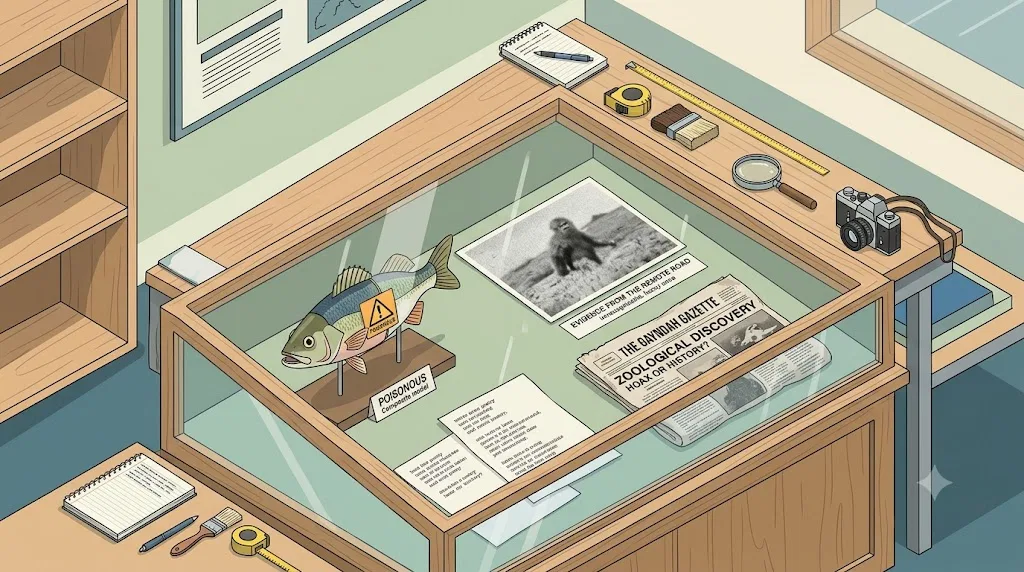
The most elegant Australian zoological hoax was Ompax spatuloides, a supposedly poisonous Queensland fish. According to later accounts, people at Gayndah assembled a grotesque composite from parts of several animals and served it to Karl Theodor Staiger, the director of the Brisbane Museum. Staiger supplied a drawing and description to the naturalist Francis de Castelnau, who formally named the creature in 1879 despite never examining a preserved specimen.[Wikipedia]WikipediaOmpax spatuloidesOmpax spatuloides
The hoax worked because it exploited normal weaknesses in colonial science. Specimens were difficult to transport, local observations often reached metropolitan experts through letters or sketches, and Australia had recently produced genuine animals almost as strange as the fabricated one. Once Castelnau’s description appeared in the Proceedings of the Linnean Society of New South Wales, the invented fish gained the authority of print and taxonomy.
Some zoologists expressed doubts early, particularly because the description relied on a drawing rather than a specimen. Yet Ompax continued to appear in Australian fish lists into the twentieth century. A public account of the prank emerged in 1930, and the species was subsequently treated as a textbook example of how an unsupported claim can persist after entering a scientific catalogue.[Taxonomy Australia]taxonomyaustralia.org.aua fishy taleTaxonomy AustraliaA fishy tale31 Mar 2019 — Sadly, Ompax spatuloides was outed as a hoax in the Bulletin in 1930. These are not the most…
The lasting lesson is not that taxonomy was foolish. It is that classification can preserve an error when later writers copy an authoritative name without returning to the original evidence. The hoaxers supplied the joke, but institutional repetition gave it longevity.
The bunyip skull and the power of display
The bunyip cannot simply be labelled a hoax. Bunyip traditions have Indigenous cultural histories that are far older and more complex than colonial newspaper stories about unknown beasts. The deception-and-error story begins when settler society tried to turn varied traditions into a single undiscovered animal that Western science might capture and classify.
In the 1840s, a strange skull found near the Murrumbidgee River was presented as possible evidence of such a creature. Experts concluded that it was probably the deformed foetal skull of a calf or foal, yet its brief exhibition in Sydney attracted crowds and encouraged further reports of sightings.[Wikipedia]WikipediaOpen source on wikipedia.org.
This was less a carefully planned fraud than a mixture of misidentification, publicity and wishful interpretation. The museum setting mattered enormously. An ambiguous bone in a private collection was merely curious; behind glass, associated with expert discussion, it looked like evidence. Later museum constructions and representations of the bunyip added another layer, blurring genuine specimens, fabricated display objects and folklore.[australianhumanitiesreview.org]australianhumanitiesreview.orgThe Bunyip as Uncanny Rupture: Fabulous Animals…by P Edmonds · Cited by 9 — Yes, the bunyip's head was a fraud, a clever admixture of…
The case also shows why cultural caution is necessary. Colonial retellings often stripped Indigenous traditions of local meaning and repackaged them as monster-hunting stories. The false claim was not that bunyip traditions existed, but that a single zoological specimen had settled what those traditions described.
Photographs, remoteness and invented creatures
By the twentieth century, photographs replaced bones and drawings as the most persuasive form of monster evidence. Yet a photograph could conceal scale, distance, staging and context more effectively than it revealed them.
The Nullarbor Nymph
In late 1971, reports emerged from Eucla of a young woman supposedly living wild among kangaroos on the Nullarbor Plain. Grainy images appeared to show a scantily dressed, fair-haired figure in the scrub. The story spread internationally, and reporters travelled to a settlement whose tiny population and remote location only made the tale more attractive.[Australian Geographic]australiangeographic.com.auAustralian Geographic The tale of the Nullarbor NymphAustralian GeographicThe tale of the Nullarbor NymphFebruary 7, 2021 — 8 Feb 2021 — The photo of the so-called Nullarbor Nymph spread lik…
The setting did much of the persuasive work. The Nullarbor was already imagined by urban readers as an immense and barely knowable space. A feral woman living beyond ordinary society fitted both the landscape and a long tradition of stories about lost children, wild people and frontier survival.
The episode was exposed as a publicity stunt involving local participants, staged photographs and media contacts. Different women were associated with different images, including Geneice Brooker and the teenage model Janice Beeby. The stunt benefited Eucla by generating attention and visitors, while newspapers gained a highly visual story requiring little explanation.[Wikipedia]WikipediaNullarbor NymphNullarbor Nymph
The Nullarbor Nymph remains memorable because exposure did not destroy the image. Once detached from its original claim, the figure became local folklore, art and tourism mythology. This is a recurring pattern: a hoax can fail as news but succeed as legend.
The Ozenkadnook tiger photograph
A darker, striped animal photographed in western Victoria in 1964 became known as the Ozenkadnook tiger. The image was repeatedly discussed as possible evidence for an unknown predator, an unusual large cat or even a surviving thylacine outside Tasmania.
The photograph’s evidential value was always limited. There was no specimen, no sequence of images and no reliable way to judge the object’s size or three-dimensional form. In 2017, an account attributed the picture to a prank involving a painted cardboard cut-out, strengthening the view that the famous “animal” had been staged.[Scientific American]scientificamerican.comScientific American The Ozenkadnook Tiger Photo Revealed as a HoaxScientific American The Ozenkadnook Tiger Photo Revealed as a Hoax
Even so, it is useful to distinguish this photograph from every report of strange animals in rural Australia. Museums Victoria describes Australian cryptozoology as a mixture of folklore, imagination and pseudoscientific speculation, with regional stories arising from many different sources. Some witnesses may misidentify dogs, deer, feral cats or other animals; others may repeat local tales; a smaller number manufacture evidence.[Museums Victoria]museumsvictoria.com.auOpen source on com.au.
The photograph survived because a dramatic image is easy to reproduce while the later explanation is comparatively dull. A cardboard animal can travel through popular culture more effectively than the testimony that revealed it.
Drop bears: a joke that announces itself slowly
The drop bear is a different kind of fake animal. It is not usually a serious attempt to establish a new species, but a participatory joke told to visitors: a dangerous carnivorous relative of the koala supposedly waits in trees and attacks from above.
The Australian Museum maintains a mock zoological entry describing its habitat, hunting behaviour and supposed dangers before acknowledging that the creature is mythical.[The Australian Museum]australian.museumdrop beardrop bear The institutional tone is part of the joke. Scientific formatting, distribution maps and behavioural detail imitate the way real species are presented.
Unlike Ompax, the drop bear usually depends on eventual recognition that the teller is teasing. It belongs closer to folklore and social initiation than fraud. Yet it demonstrates the same principle as more serious hoaxes: precise detail and authoritative presentation make an impossible claim briefly enjoyable to believe.
The poet invented to embarrass modernism
The Ern Malley affair remains Australia’s most famous literary hoax because the intended humiliation did not produce a simple victor.
In 1943, poets James McAuley and Harold Stewart created a fictional young writer named Ern Malley. They composed a group of deliberately disjointed modernist poems, supplied a biography in which Malley had died young, and submitted the work to Max Harris, the editor of the avant-garde journal Angry Penguins, through a supposed surviving sister.
Harris believed he had discovered an important poet and devoted a 1944 issue of the magazine to Malley. McAuley and Stewart then revealed that the poet had never existed and that the verses had been assembled rapidly from borrowed phrases, quotations and deliberately incongruous images. Contemporary reporting treated the episode as a spectacular exposure of modernist pretension.[ABC News]abc.net.auABC News Ern Malley was praised as one of Australia's greatestABC News Ern Malley was praised as one of Australia's greatest
The hoax was persuasive because it offered more than poems. It supplied a complete discovery narrative: an obscure, self-educated writer; an early death; a modest relative unaware of his genius; and manuscripts rescued from neglect. Harris was not responding only to language on a page but to a romantic story about overlooked talent.
The consequences went beyond embarrassment. Harris was prosecuted and fined for publishing material judged indecent, while Angry Penguins became inseparable from the scandal. Yet the hoaxers did not control the later meaning of their work. Readers and writers continued to admire the poems, and the Malley issue became part of the history of Australian modernism rather than proof that modernism itself was empty. Heide Museum of Modern Art still treats the affair as a central episode in the Angry Penguins movement.[Heide Museum of Modern Art]heide.com.auOpen source on com.au.
Ern Malley therefore complicates the normal logic of exposure. The author was fake, the submission was deceptive and the aim was ridicule. But a false authorship does not automatically make every line aesthetically worthless. The affair asks whether art should be judged by intention, identity, context or the experience of the reader.

False identities and fabricated memoirs
Later Australian literary scandals shifted from invented authors used as traps to identities and life stories used as marketing assets. Publishers increasingly sold books not only as texts but as authentic access to trauma, ethnicity and hidden worlds.
Helen Demidenko and borrowed ancestry
In 1994, The Hand That Signed the Paper appeared under the name Helen Demidenko. Its author presented herself as having Ukrainian family connections relevant to a novel about collaboration, antisemitism and the Holocaust. The book won major Australian literary awards, including the Miles Franklin Award.
Journalist David Bentley later established that the author was Helen Darville, the daughter of English migrants, and that the claimed Ukrainian identity was fabricated. Her family publicly confirmed the deception.[ABC News]abc.net.auABC News Fake identity and Helen Demidenko's The HandABC News Fake identity and Helen Demidenko's The Hand
The false identity mattered because it had influenced how the work was received. A novel that might otherwise have been assessed as imaginative historical fiction was promoted and defended partly through an implied family inheritance. Critics therefore argued that the deception had provided unearned authority in a debate involving historical atrocity and cultural memory.
The affair was not merely a pseudonym controversy. Many writers use other names without deception. The central problem was the construction of ancestry as supporting evidence for the book’s historical and moral perspective. Debate also continued over alleged plagiarism, the novel’s representation of the Holocaust and whether literary institutions had allowed a compelling authorial persona to shape their judgement.[SSRN]papers.ssrn.comOpen source on ssrn.com.
Norma Khouri’s Forbidden Love
Norma Khouri’s Forbidden Love, published in Australia as a true account, told of a friend in Jordan murdered in an honour killing after a relationship with a Christian man. The book became a bestseller and gained moral force from its claim to eyewitness truth.
A lengthy investigation by Sydney Morning Herald literary editor Malcolm Knox found that key parts of Khouri’s biography and narrative could not be reconciled with documentary evidence. Khouri had lived in Chicago during much of the period in which she implied she was in Jordan, and Jordanian details in the book were repeatedly challenged. The publisher withdrew the work.[The Guardian]theguardian.comOpen source on theguardian.com.
This deception travelled easily because it confirmed assumptions already familiar to Western readers. It offered a clear victim, a villainous social system and an author positioned as both insider and rescuer. The emotional urgency of the subject discouraged ordinary scepticism: to question the storyteller could appear to minimise real violence against women.
The case illustrates the harm of fabricated advocacy. Honour-based violence is real, but an invented case can misinform readers about law, geography and culture while consuming attention that might otherwise go to verified testimony. Australian filmmaker Anna Broinowski’s documentary Forbidden Lie$ examined not only whether Khouri lied but how charisma, publishing and the desire for morally uncomplicated stories helped sustain her.[Vanity Fair]vanityfair.comin new norma khouri doc f is for forbidden lieAustralian filmmaker Anna Broinowski created a documentary, "Forbidden Lie$", exploring Khouri's fabrications and featuring interviews wi…
Séances, forged objects and the performance of belief
Spiritualist fraud flourished internationally in the late nineteenth and early twentieth centuries, and Australia had its own celebrated practitioners. The Melbourne medium Charles Bailey claimed to produce “apports”: objects, animals and antiquities supposedly transported into the séance room by spirits.
Bailey’s performances benefited from darkness, controlled surroundings and the expectation that extraordinary events might occur beyond ordinary physical laws. He attracted influential supporters, including wealthy spiritualists, and produced items that appeared more impressive when described as ancient or exotic.
Investigators found repeated signs of ordinary procurement and concealment. In Grenoble in 1910, Bailey produced live birds during a séance but was reportedly recognised by a dealer from whom the birds had been purchased. Antiquities associated with his performances were also examined and judged to be forgeries. He continued to retain believers despite repeated exposure.[Wikipedia]WikipediaCharles Bailey (mediumCharles Bailey (medium
Such cases are sometimes presented as simple contests between credulous sitters and clever magicians. In practice, belief could survive exposure because a séance was also a social and emotional event. Participants might have been seeking contact with the dead, communal reassurance or evidence that materialist science was incomplete. Supporters could dismiss one fraudulent performance as a test, an investigator’s mistake or an unfortunate lapse that did not invalidate every previous sitting.
Bailey’s career therefore reveals a central feature of durable imposture: exposure is most effective when it replaces the false mechanism with a clear, observable one. General accusations of trickery often fail where a discovered purchase, concealed object or forged artefact can show exactly how the marvel was produced.

When a false claim became a political fact
Not every nationally significant falsehood begins as a planned hoax. The 2001 “children overboard” affair is better understood as a false official claim, amplified during an election campaign and left uncorrected after contrary evidence emerged.
After an encounter involving the vessel later designated Suspected Illegal Entry Vessel 4, Australian ministers stated that asylum seekers had thrown children into the sea. Subsequent witness statements and video evidence did not support that account. A Senate inquiry found that people entered the water after the vessel sank and that witness reports did not establish that children had been deliberately thrown overboard.[Parliament of Australia]aph.gov.auParliament of Australia Chapter 4Parliament of Australia Chapter 4
The most important issue became the failure to correct the public record. Defence personnel developed serious doubts soon after the original claim, yet the story continued to circulate in a highly charged political environment. Parliamentary investigations examined how information moved between the military, public servants, ministerial offices and the media.[Parliament of Australia]aph.gov.auParliament of Australia ExecutiveParliament of Australia Executive
Calling the episode a conventional hoax would obscure the chain of responsibility. It was not a staged photograph of a monster or a fictional poet sent to a magazine. Its significance lies in how an unverified operational report became a morally potent public narrative, then remained useful after the evidence had weakened.
The affair shows why political misinformation is especially resistant to correction. The original claim was vivid, emotionally charged and easy to summarise. The correction required chronology, witness comparison and explanation of bureaucratic communication. By the time the fuller account emerged, the simpler image had already shaped public debate.
Why Australian hoaxes travelled so well
The strongest Australian hoaxes succeeded for different reasons, but several recurring conditions connect them.
Distance protected weak evidence. The Nullarbor Nymph, remote animal sightings and colonial specimens all came from places most readers could not inspect. Remoteness turned an absence of verification into part of the romance.
Authority converted claims into facts. A scientific name, museum display, literary prize or ministerial statement gave a story a second life. Institutions did not always originate the deception, but they often increased its credibility.
The stories matched existing expectations. Readers were prepared to believe in unknown Australian animals, undiscovered bush inhabitants, tragic young geniuses, secret spiritual forces or morally shocking behaviour by outsiders because those narratives were already culturally available.
Images and biographies outperformed corrections. A blurred creature, a woman among kangaroos or a dead poet’s life story could be absorbed instantly. Explanations involving cardboard, staged photographs, textual borrowing or contradictory witness statements demanded more attention.
Exposure did not erase cultural value. Ern Malley became part of literary history; the Nullarbor Nymph became regional folklore; the drop bear remains a communal joke. A claim can be false as fact yet survive as art, legend or ritual teasing.
What counts as a hoax
Australia’s history of deception becomes clearer when several categories are kept separate.
A deliberate hoax is constructed to make others accept something false, as with Ern Malley, Ompax spatuloides or the Nullarbor Nymph. A fraud adds material gain or sustained personal advantage, as in fabricated memoirs and forged séance objects. An imposture centres on a false identity or authority, such as the Demidenko persona. A misidentification begins with sincere error, although publicity may later exaggerate it. Folklore need not claim literal truth at all; drop-bear stories often function through shared performance rather than permanent deception. Political misinformation can arise through hurried reporting, selective repetition and failure to correct, without following the neat design of a prank.
These distinctions matter because exposure should answer more than “Was it true?” It should identify who created the claim, what they knew, how the evidence travelled, who gained from it and when responsible institutions had enough information to act differently.
Australia’s famous hoaxes endure because they are compact stories about larger systems. A stitched fish exposes weaknesses in scientific transmission. A nonexistent poet reveals the power of biography and cultural rivalry. A staged wilderness photograph shows how remoteness can substitute for evidence. A false memoir demonstrates the commercial value of authenticity. An uncorrected political claim shows that authority can preserve a story even after its factual basis has collapsed. Their value now lies not in laughing at those who believed, but in understanding the conditions that made belief reasonable at the time.
Amazon book picks
Further Reading
Books and field guides related to Why Australia's Greatest Hoaxes Seemed Believable. Use these as the next step if you want deeper reading beyond the article.
Mistakes Were Made (but Not by Me)
Explains why people and institutions continue believing doubtful claims.
The Demon-Haunted World
Rating: 4.5/5 from 43 Google Books ratings
Directly addresses how extraordinary claims gain credibility.
eBay marketplace picks
Marketplace Samples
Live-tested eBay searches with available results related to this page.



Endnotes
1.
Source: Wikipedia
Title: Ompax spatuloides
Link:https://en.wikipedia.org/wiki/Ompax_spatuloides
2.
Source: Wikipedia
Link:https://en.wikipedia.org/wiki/Bunyip
3.
Source: australianhumanitiesreview.org
Link:https://australianhumanitiesreview.org/2018/12/02/the-bunyip-as-uncanny-rupture-fabulous-animals-innocuous-quadrupeds-and-the-australian-anthropocene/
Source snippet
The Bunyip as Uncanny Rupture: Fabulous Animals...by P Edmonds · Cited by 9 — Yes, the bunyip's head was a fraud, a clever admixture of...
4.
Source: Wikipedia
Title: Nullarbor Nymph
Link:https://en.wikipedia.org/wiki/Nullarbor_Nymph
5.
Source: australian.museum
Title: drop bear
Link:https://australian.museum/learn/animals/mammals/drop-bear/
6.
Source: Wikipedia
Title: The Hand That Signed the Paper
Link:https://en.wikipedia.org/wiki/The_Hand_That_Signed_the_Paper
7.
Source: papers.ssrn.com
Link:https://papers.ssrn.com/sol3/papers.cfm?abstract_id=600822
8.
Source: Wikipedia
Title: Charles Bailey (medium)
Link:https://en.wikipedia.org/wiki/Charles_Bailey_%28medium%29
9.
Source: Wikipedia
Link:https://en.wikipedia.org/wiki/Australia
10.
Source: Wikipedia
Title: Ern Malley hoax
Link:https://en.wikipedia.org/wiki/Ern_Malley_hoax
11.
Source: Wikipedia
Title: Forbidden Love (novel)
Link:https://en.wikipedia.org/wiki/Forbidden_Love_%28novel%29
12.
Source: australian.museum
Link:https://australian.museum/learn/science/
13.
Source: museum-publications.australian.museum
Link:https://museum-publications.australian.museum/media/dd/Uploads/Documents/38620/ams370_vXXI_12_LowRes.ed35aaa.pdf
14.
Source: medium.com
Link:https://medium.com/%40johnwelford15/ompax-spatuloides-the-platyfish-that-never-was-c7c3b8b83284
15.
Source: australianhumanitiesreview.org
Title: the demidenko scandal
Link:https://australianhumanitiesreview.org/1996/04/01/the-demidenko-scandal/
16.
Source: taxonomyaustralia.org.au
Title: a fishy tale
Link:https://www.taxonomyaustralia.org.au/post/a-fishy-tale
Source snippet
Taxonomy AustraliaA fishy tale31 Mar 2019 — Sadly, Ompax spatuloides was outed as a hoax in the Bulletin in 1930. These are not the most...
17.
Source: abookofcreatures.com
Link:https://abookofcreatures.com/2017/06/23/ompax/
Source snippet
A Book of CreaturesOmpax23 Jun 2017 — Ompax spatuloides was listed in several catalogues of Queensland fishes, despite immediate and scat...
18.
Source: australiangeographic.com.au
Title: Australian Geographic The tale of the Nullarbor Nymph
Link:https://www.australiangeographic.com.au/blogs/tim-the-yowie-man/2021/02/the-tale-of-the-nullarbor-nymph/
Source snippet
Australian GeographicThe tale of the Nullarbor NymphFebruary 7, 2021 — 8 Feb 2021 — The photo of the so-called Nullarbor Nymph spread lik...
Published: February 7, 2021
19.
Source: naa.gov.au
Link:https://www.naa.gov.au/visit-us/events-and-exhibitions/ghost-town-stories-ruins/eucla
Source snippet
National Archives of AustraliaNullarbor Nymph | naa.gov.au1971 Newspaper report on the 'Nullarbor Nymph', a young woman living with wild...
20.
Source: scientificamerican.com
Title: Scientific American The Ozenkadnook Tiger Photo Revealed as a Hoax
Link:https://www.scientificamerican.com/blog/tetrapod-zoology/the-ozenkadnook-tiger-photo-revealed-as-a-hoax/
21.
Source: museumsvictoria.com.au
Link:https://museumsvictoria.com.au/article/cryptozoology-imagination-science-or-folklore/
22.
Source: abc.net.au
Title: ABC News Ern Malley was praised as one of Australia’s greatest
Link:https://www.abc.net.au/news/2021-08-29/ern-malley-literary-hoax-angry-penguins-1944/100412208
23.
Source: trove.nla.gov.au
Link:https://trove.nla.gov.au/newspaper/article/22730328
24.
Source: heide.com.au
Link:https://www.heide.com.au/exhibitions/making-history-angry-penguins/
25.
Source: abc.net.au
Title: ABC News Fake identity and Helen Demidenko’s The Hand
Link:https://www.abc.net.au/listen/programs/the-book-show/helen-demidenko-darville-dale-the-hand-that-signed-the-paper/102382350
26.
Source: theguardian.com
Link:https://www.theguardian.com/film/2015/jul/05/forbidden-lie-rewatched-disturbing-character-study-of-a-con-artist
27.
Source: vanityfair.com
Title: in new norma khouri doc f is for forbidden lie
Link:https://www.vanityfair.com/news/2009/04/in-new-norma-khouri-doc-f-is-for-forbidden-lie
Source snippet
Australian filmmaker Anna Broinowski created a documentary, "Forbidden Lie$", exploring Khouri's fabrications and featuring interviews wi...
28.
Source: aph.gov.au
Title: Parliament of Australia Chapter 4
Link:https://www.aph.gov.au/Parliamentary_Business/Committees/Senate/Former_Committees/maritimeincident/report/c04
29.
Source: aph.gov.au
Link:https://www.aph.gov.au/Parliamentary_Business/Committees/Senate/Former_Committees/scrafton/report/c04
30.
Source: aph.gov.au
Title: Parliament of Australia Executive
Link:https://www.aph.gov.au/Parliamentary_Business/Committees/Senate/Former_Committees/maritimeincident/report/a06
31.
Source: aph.gov.au
Title: Parliament of Australia Chapter 6
Link:https://www.aph.gov.au/Parliamentary_Business/Committees/Senate/Former_Committees/maritimeincident/report/c06
32.
Source: theguardian.com
Link:https://www.theguardian.com/australia-news/2026/jul/06/mysterious-space-balls-queensland-beaches-origin-source-australia
33.
Source: search.sl.nsw.gov.au
Link:https://search.sl.nsw.gov.au/primo-explore/fulldisplay/SLNSW_ALMA21135451500002626/SLNSW
34.
Source: search.sl.nsw.gov.au
Link:https://search.sl.nsw.gov.au/primo-explore/fulldisplay?adaptor=Local+Search+Engine&context=L&docid=SLNSW_ALMA21214935760002626&lang=en_US&query=any%2Ccontains%2C991012117349702626&search_scope=E&tab=default_tab&vid=SLNSW
35.
Source: nla.gov.au
Link:https://nla.gov.au/nla.obj-52864599
36.
Source: trove.nla.gov.au
Link:https://trove.nla.gov.au/newspaper/article/275385221
37.
Source: trove.nla.gov.au
Link:https://trove.nla.gov.au/newspaper/article/270126006
38.
Source: nla.gov.au
Title: nla.news article195395482
Link:https://nla.gov.au/nla.news-article195395482
39.
Source: trove.nla.gov.au
Link:https://trove.nla.gov.au/newspaper/article/213414585?browse=ndp%3Abrowse%2Ftitle%2FD%2Ftitle%2F1069%2F1875%2F06%2F21%2Fpage%2F23291421%2Farticle%2F213414585
40.
Source: nla.gov.au
Title: nla.news article289638706
Link:https://nla.gov.au/nla.news-article289638706
41.
Source: trove.nla.gov.au
Link:https://trove.nla.gov.au/newspaper/article/177465043
42.
Source: trove.nla.gov.au
Link:https://trove.nla.gov.au/newspaper/article/237603623
43.
Source: nla.gov.au
Title: nla.obj 705697576
Link:https://nla.gov.au/nla.obj-705697576
44.
Source: trove.nla.gov.au
Link:https://trove.nla.gov.au/newspaper/article/32146792
45.
Source: aph.gov.au
Title: Chapter 2
Link:https://www.aph.gov.au/Parliamentary_Business/Committees/Senate/Former_Committees/scrafton/report/c02
46.
Source: aph.gov.au
Link:https://www.aph.gov.au/binaries/senate/committee/maritime_incident_ctte/report/report.pdf
47.
Source: aph.gov.au
Title: c04 pdf.ashx
Link:https://www.aph.gov.au/~/media/wopapub/senate/committee/maritime_incident_ctte/report/c04_pdf.ashx
48.
Source: aph.gov.au
Title: Chapter 3
Link:https://www.aph.gov.au/Parliamentary_Business/Committees/Senate/Former_Committees/scrafton/report/c03
49.
Source: aph.gov.au
Link:https://www.aph.gov.au/~/media/wopapub/senate/committee/scrafton_ctte/report/c03_pdf.ashx
50.
Source: aph.gov.au
Title: c03 pdf.ashx
Link:https://www.aph.gov.au/~/media/wopapub/senate/committee/maritime_incident_ctte/report/c03_pdf.ashx
51.
Source: non-aliencreatures.fandom.com
Link:https://non-aliencreatures.fandom.com/wiki/Bunyip
52.
Source: mythus.fandom.com
Link:https://mythus.fandom.com/wiki/Bunyip
53.
Source: australiangeographic.com.au
Title: the case of the roaring bunyip
Link:https://www.australiangeographic.com.au/blogs/tim-the-yowie-man/2020/03/the-case-of-the-roaring-bunyip/
54.
Source: dfat.gov.au
Link:https://www.dfat.gov.au/about-australia
55.
Source: darktales.blog
Title: The Bunyip
Link:https://darktales.blog/2021/05/18/the-bunyip/
56.
Source: abc.net.au
Title: norma khouri forbidden love fakes and frauds
Link:https://www.abc.net.au/listen/programs/the-book-show/norma-khouri-forbidden-love-fakes-and-frauds/102382068
57.
Source: caseytours.com.au
Title: Nullarbor Plain
Link:https://www.caseytours.com.au/news/nullarbo-nymph/
58.
Source: nfsa.gov.au
Link:https://www.nfsa.gov.au/tags/nullabor
59.
Source: player.nfsa.gov.au
Title: nfsa.gov.au Stream Nullarbor Hideout
Link:https://player.nfsa.gov.au/film/nullarbor-hideout/
Additional References
60.
Source: learnearnandreturn.wordpress.com
Link:https://learnearnandreturn.wordpress.com/2011/04/25/bunyips/
Source snippet
Historians are Past CaringBunyips | Historians are Past Caring - WordPress.com25 Apr 2011 — A year later, in 1846, the Australian Museum...
61.
Source: youtube.com
Title: Ern Malley: The influential Australian poet who never existed
Link:https://www.youtube.com/watch?v=WzqG0Z_fPOw
Source snippet
A Shark Vomits Up An Arm Which Leads To A Murder Mystery...
62.
Source: youtube.com
Title: A Shark Vomits Up An Arm Which Leads To A Murder Mystery!
Link:https://www.youtube.com/watch?v=b8IiuCiBalQ
Source snippet
The Tichborne Claimant: A Butcher's Lie That Fooled Thousands...
63.
Source: youtube.com
Title: The Tichborne Claimant: A Butcher’s Lie That Fooled Thousands
Link:https://www.youtube.com/watch?v=xhwR9zk_EiY
Source snippet
Australia's Greatest Conman? | Official Trailer...
64.
Source: youtube.com
Title: Australia’s Greatest Conman? | Official Trailer
Link:https://www.youtube.com/watch?v=sWuT0shgQVk
Source snippet
Josh Gates Discovers The Truth Behind Australia's Field of Lost Gold...
65.
Source: facebook.com
Link:https://www.facebook.com/61574400590093/posts/a-140-year-old-newspaper-inside-a-fishconservators-at-londons-natural-history-mu/122157927908813353/
66.
Source: thestandard.com.hk
Link:https://www.thestandard.com.hk/world/article/336547/Graffiti-artist-accused-of-scaling-Australian-bridge-tower-and-painting-giant-cartoon-bird
67.
Source: marxists.org
Link:https://www.marxists.org/history/international/comintern/sections/australia/1945/art-hoax.htm
68.
Source: ebsco.com
Link:https://www.ebsco.com/research-starters/literature-and-writing/prize-winning-aborigine-novelist-revealed-fraud
69.
Source: facebook.com
Title: this photo of the ozenkadnook tiger was captured in 1964 by rilla martin in sout
Link:https://www.facebook.com/CryptozoologyFacts/posts/this-photo-of-the-ozenkadnook-tiger-was-captured-in-1964-by-rilla-martin-in-sout/1443150551154449/
Topic Tree
Follow this branch
Related pages 192
- Albanian Hoaxes
- Algerian Hoaxes
- Antigua Deceptions
- Argentina Hoaxes
- Armenian Hoaxes
- +187 more in sidebar