Within Azerbaijan
Did the Vikings Really Come From Azerbaijan?
Thor Heyerdahl turned boat carvings and word similarities into a vivid but academically rejected migration story.
On this page
- How Heyerdahl Built the Migration Claim
- Why the Theory Seemed Plausible
- How Scholars Challenged the Evidence
Page outline Jump by section
Introduction
Did the Vikings really come from Azerbaijan? The short answer is no, at least according to the overwhelming consensus of historians, archaeologists and linguists. Yet for a brief period around the turn of the twenty-first century, the idea attracted international attention because it was championed by one of the world’s most famous explorers, Thor Heyerdahl. Best known for the Kon-Tiki expedition, Heyerdahl argued that the roots of Norse mythology and even the ancestors of the Vikings could be traced to the Caucasus region, particularly Azerbaijan.[azer.com]azer.comThor Heyerdahl - 8.2 Scandinavian AncestryEach time, he garners more evidence to prove his tantalizing theory - that Scandinavian ancestr…
The theory occupies an unusual place in Azerbaijan’s history of contested truth. It was not a classic fraud, forged artefact or deliberate hoax. Rather, it was a highly publicised example of pseudo-historical reasoning: a sincere but speculative attempt to connect distant cultures through archaeology, mythology and language. The story became influential because it offered a dramatic historical narrative linking Azerbaijan to one of Europe’s most famous cultural traditions, while relying on evidence that many specialists considered deeply flawed.[Wikipedia]WikipediaJakten på OdinJakten på Odin
How Heyerdahl Built the Migration Claim
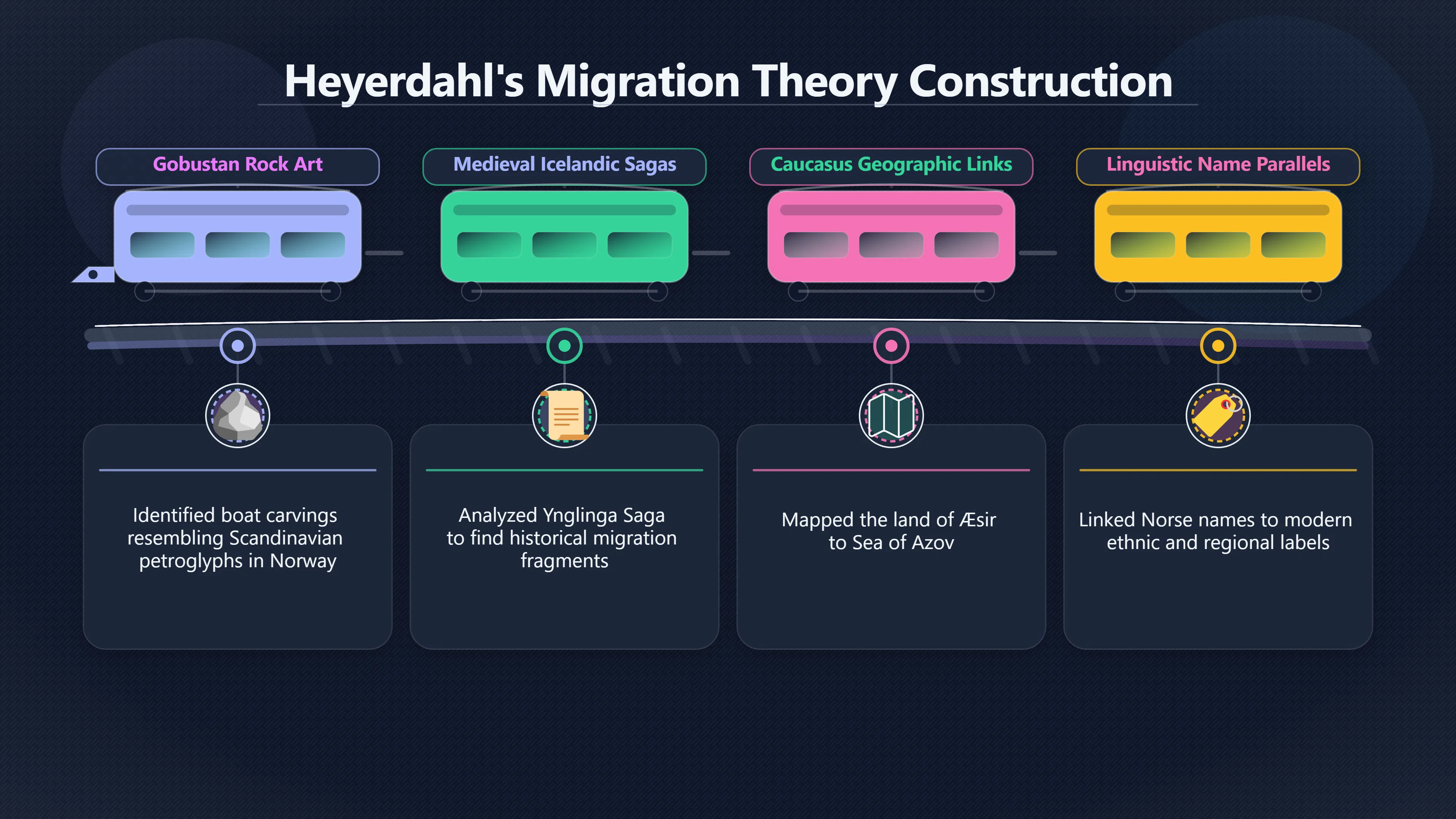
Heyerdahl’s interest in Azerbaijan centred on the prehistoric rock art of Gobustan, near Baku. During repeated visits beginning in the 1980s, he became fascinated by carvings of long boats cut into the rocks. He believed some of these vessels resembled boat images found in Scandinavian rock art, particularly those in northern Norway. From this visual similarity, he began to suspect that ancient cultural connections might have existed between the Caspian region and Scandinavia.[azer.com]azer.comThor Heyerdahl's Final ProjectsBjørnar Storfjell, Ph.D.Thor Heyerdahl had stored in his memory the similarities he found between the petroglyphs in Gobustan near Baku a…
The theory expanded dramatically from there. Heyerdahl turned to medieval Icelandic literature, especially the writings of Snorri Sturluson. In the Ynglinga Saga, Snorri presented a medieval euhemeristic account in which Odin was portrayed not simply as a god but as an ancient leader who migrated northward. Most scholars treat such passages as literary constructions written centuries after the events they supposedly describe. Heyerdahl instead treated them as containing fragments of genuine migration history.[visions.az]visions.azTHOR HEYERDAHL'S SEARCH FOR ODIN: ANCIENT…Heyerdahl speculated that Odin, commonly thought of today as a mythical Norse god, wa…
He argued that the land of the Æsir mentioned in Norse tradition could correspond to a region around the Caucasus and the Sea of Azov. He proposed that Odin had been a real historical chieftain who migrated from this area into northern Europe, where later generations transformed him into a god. Azerbaijan became central to the hypothesis because Heyerdahl believed references to “Aser” or “Æsir” pointed towards the Caucasus and because he saw Gobustan as evidence of an ancient maritime culture capable of long-distance movement.[visions.az]visions.azTHOR HEYERDAHL'S SEARCH FOR ODIN: ANCIENT…Heyerdahl speculated that Odin, commonly thought of today as a mythical Norse god, wa…
A large part of the argument depended on similarities between names. Heyerdahl linked the Norse Æsir to modern ethnic and geographical names in the Caucasus. He suggested connections between Odin and the Udi people, between Tyr and Turkey, and between the Æsir and groups living around Azerbaijan and the Sea of Azov. These linguistic parallels became one of the most publicised features of the theory.[Wikipedia]WikipediaJakten på OdinJakten på Odin
Why the Theory Seemed Plausible
For many non-specialists, the theory sounded less outrageous than it appears to professional historians.
One reason was Heyerdahl’s personal reputation. He had spent decades challenging accepted assumptions about ancient travel. His famous voyages demonstrated that prehistoric peoples could cross enormous distances using relatively simple vessels. Because he had previously shown that seemingly impossible journeys were physically achievable, audiences were often willing to entertain unconventional migration theories.[Wikipedia]WikipediaThor HeyerdahlThor Heyerdahl
The visual appeal of the Gobustan carvings also mattered. Boat images are among the most striking features of the site, and comparisons with Scandinavian rock art are easy for visitors to understand. The suggestion of a forgotten link between the Caspian and the Nordic world offered a memorable story that was far more exciting than careful archaeological discussions about chronology and cultural context.[azer.com]azer.comThor Heyerdahl's Final ProjectsBjørnar Storfjell, Ph.D.Thor Heyerdahl had stored in his memory the similarities he found between the petroglyphs in Gobustan near Baku a…
The theory also arrived at a moment when Azerbaijan was actively redefining its international cultural profile after independence. A claim that connected the country to the origins of Norse civilisation naturally attracted attention. It offered a prestigious historical narrative that linked Azerbaijan not merely to regional history but to one of Europe’s most famous mythological traditions.[ResearchGate]researchgate.netOpen source on researchgate.net.
Perhaps most importantly, Heyerdahl’s argument combined several different kinds of evidence—rock art, mythology, place names and migration stories. To general audiences, multiple strands pointing in the same direction can appear persuasive even when each strand is individually weak.
How Scholars Challenged the Evidence
Academic criticism was swift and unusually forceful. Norwegian specialists in archaeology, linguistics, history and the study of religion argued that Heyerdahl had abandoned the normal standards used to evaluate historical claims. Several leading scholars publicly described the project as an example of pseudoarchaeology.[Wikipedia]WikipediaJakten på OdinJakten på Odin

The Problem with the Boat Carvings
The resemblance between Gobustan’s boats and Scandinavian rock art was never regarded as proof of migration by mainstream archaeologists. Similar boat shapes can appear independently in different cultures because they reflect practical solutions to travel on water.
More importantly, the carvings belong to very different archaeological contexts. Similar-looking images do not automatically demonstrate direct contact, shared ancestry or population movement. Scholars noted that visual resemblance alone cannot establish the complex historical chain required by Heyerdahl’s migration narrative.[ResearchGate]researchgate.netResearch Gate Thor Heyerdahl'sResearch Gate Thor Heyerdahl's
The Problem with Medieval Sources
Historians objected to Heyerdahl’s treatment of Snorri Sturluson’s writings. The sagas were composed in medieval Iceland long after the Viking Age and centuries after the events they describe. Modern scholarship generally uses them cautiously, comparing them against archaeology and other evidence.
Heyerdahl instead treated parts of these texts as preserving literal memories of ancient migrations. Critics argued that this approach ignored how myths evolve and how medieval authors reshaped traditions for literary and political purposes.[Visions]visions.azTHOR HEYERDAHL'S SEARCH FOR ODIN: ANCIENT…Heyerdahl speculated that Odin, commonly thought of today as a mythical Norse god, wa…
The Problem with Name Similarities
The linguistic evidence received perhaps the strongest criticism. Historical linguistics relies on documented sound changes, chronology and established rules of language development. Similar-sounding words are not considered evidence of a relationship unless they fit broader linguistic patterns.
Critics pointed out that many of Heyerdahl’s proposed links depended on superficial resemblances. The comparison between Æsir and Azeri, Odin and Udi, or Tyr and Turkey ignored accepted linguistic methodology. Some examples were also chronologically impossible. One frequently cited case involved Azov: Heyerdahl associated the name with the Æsir, but historians note that the city acquired its current name many centuries after the period in which the supposed migration would have occurred.[Wikipedia]WikipediaJakten på OdinJakten på Odin
Why the Theory Is Not Usually Called a Hoax
Despite its rejection by specialists, Heyerdahl’s theory is generally not classified as a deliberate hoax.
A hoax normally involves intentional deception. There is little evidence that Heyerdahl privately regarded his claims as false. On the contrary, accounts from colleagues and observers suggest that he genuinely believed he had identified overlooked historical connections.[Vestfold Museums]vestfoldmuseene.noVestfold Museums Odin's Seminarmore…
The controversy is therefore better understood as a case of sincere error amplified by celebrity. Heyerdahl’s fame allowed an academically marginal idea to receive enormous public attention. His status as a celebrated explorer gave the theory a credibility that it struggled to earn through conventional scholarly evidence.[Wikipedia]WikipediaJakten på OdinJakten på Odin
This distinction matters because it highlights a common pattern in the history of contested historical claims. A narrative can spread widely without anyone consciously fabricating evidence. Charismatic advocates, attractive stories and selective interpretation can sometimes be enough.

The wider consequences of Viking Theory
The appeal of the Azerbaijan-Viking connection has outlived the theory’s academic credibility. It survives because it compresses a complicated debate into a single memorable sentence: “The Vikings came from Azerbaijan.”
That phrase is far easier to remember than the scholarly objections involving chronology, archaeological context, historical linguistics and medieval literary traditions. It also offers a dramatic reversal of expectations. Instead of Vikings emerging from northern Europe, the story imagines them beginning thousands of kilometres away in the Caucasus.[Caravanistan]caravanistan.comthe unlikely link between azerbaijan and norwaythe unlikely link between azerbaijan and norway
For Azerbaijan, the theory remains an intriguing cultural curiosity connected to Gobustan and to Heyerdahl’s repeated visits to the country. For historians, it serves as a useful case study in how persuasive narratives can emerge from fragments of genuine evidence. Boat carvings are real. Medieval texts are real. Place names are real. The disputed step was the leap from those fragments to a sweeping migration story that the available evidence could not support.[azer.com]azer.comThor Heyerdahl's Final ProjectsBjørnar Storfjell, Ph.D.Thor Heyerdahl had stored in his memory the similarities he found between the petroglyphs in Gobustan near Baku a…
In that sense, Thor Heyerdahl’s Azerbaijan-Viking origin theory reveals less about the actual origins of the Vikings than about the enduring power of adventurous storytelling. A celebrated explorer combined archaeology, myth and coincidence into a grand historical narrative. Scholars dismantled the argument, yet the story continues to circulate because it satisfies a timeless human desire to discover unexpected connections between distant peoples and places.[Wikipedia]WikipediaJakten på OdinJakten på Odin
Amazon book picks
Further Reading
Books and field guides related to Did the Vikings Really Come From Azerbaijan?. Use these as the next step if you want deeper reading beyond the article.
The Viking World
Provides mainstream scholarship against speculative migration theories.
American Gods
Rating: 4.5/5 from 7 Google Books ratings
Engages readers interested in Norse gods and mythic reinterpretations.
eBay marketplace picks
Marketplace Samples
Live-tested eBay searches with available results related to this page.




Endnotes
1.
Source: azer.com
Link:https://www.azer.com/aiweb/categories/magazine/82_folder/82_articles/82_heyerdahl.html
Source snippet
Thor Heyerdahl - 8.2 Scandinavian AncestryEach time, he garners more evidence to prove his tantalizing theory - that Scandinavian ancestr...
2.
Source: Wikipedia
Title: Jakten på Odin
Link:https://en.wikipedia.org/wiki/Jakten_p%C3%A5_Odin
3.
Source: azer.com
Title: Thor Heyerdahl’s Final Projects
Link:https://www.azer.com/aiweb/categories/magazine/ai102_folder/102_articles/102_heyerdahl_storfjell.html
Source snippet
Bjørnar Storfjell, Ph.D.Thor Heyerdahl had stored in his memory the similarities he found between the petroglyphs in Gobustan near Baku a...
4.
Source: azer.com
Link:https://www.azer.com/aiweb/categories/magazine/62_folder/62_articles/62_gobustan.html
5.
Source: Wikipedia
Title: Gobustan State Historical and Cultural Reserve
Link:https://en.wikipedia.org/wiki/Gobustan_State_Historical_and_Cultural_Reserve
6.
Source: visions.az
Link:https://www.visions.az/en/news/635/338ee4e7/
Source snippet
THOR HEYERDAHL'S SEARCH FOR ODIN: ANCIENT...Heyerdahl speculated that Odin, commonly thought of today as a mythical Norse god, wa...
7.
Source: azer.com
Link:https://www.azer.com/aiweb/categories/magazine/73_folder/73_articles/73_thorheyerdahl.html
8.
Source: facebook.com
Title: what say the folkthe search for odinthor heyerdahl made four visits to azerbaija
Link:https://www.facebook.com/100063523181985/posts/what-say-the-folkthe-search-for-odinthor-heyerdahl-made-four-visits-to-azerbaija/1233528568774571/
9.
Source: Wikipedia
Title: Thor Heyerdahl
Link:https://en.wikipedia.org/wiki/Thor_Heyerdahl
10.
Source: researchgate.net
Link:https://www.researchgate.net/publication/398792148_Mapping_Nordic_Exceptionalism_with_GIS_The_Odin_Migration_Theory_and_the_Search_for_a_Northern_Heritage
11.
Source: azer.com
Link:https://www.azer.com/aiweb/categories/magazine/31_folder/31_articles/31_thorazerconn.html
12.
Source: researchgate.net
Title: Research Gate Thor Heyerdahl’s
Link:https://www.researchgate.net/profile/Knut_Helskog/publication/264288729_Petroglyphs_of_boats_as_evidence_of_contact_between_the_Caspian_Sea_and_Scandinavia/links/53d797770cf29f55cfb4e2ea.pdf
13.
Source: caravanistan.com
Title: the unlikely link between azerbaijan and norway
Link:https://caravanistan.com/letter-from-the-silk-road/the-unlikely-link-between-azerbaijan-and-norway/
14.
Source: researchgate.net
Title: 390344891 THOR HEYERDAHL AND AZERBAIJAN
Link:https://www.researchgate.net/publication/390344891_THOR_HEYERDAHL_AND_AZERBAIJAN
15.
Source: facebook.com
Title: the search for óðinnthor heyerdahl made four visits to azerbaijan in 1981 1994 1
Link:https://www.facebook.com/100063523181985/posts/the-search-for-%C3%B3%C3%B0innthor-heyerdahl-made-four-visits-to-azerbaijan-in-1981-1994-1/1560871572706934/
16.
Source: youtube.com
Title: Thor Heyerdahl
Link:https://www.youtube.com/watch?v=DW-LLguaIMA
Source snippet
"History Bites: A Conversation with Thor Heyerdahl Jr.[https://www.youtube.com/watch?v=6lLvrMv_kO0..."](https://www.youtube.com/watch?v=6lLvrMv_kO0...")...
17.
Source: vestfoldmuseene.no
Title: Vestfold Museums Odin’s Seminar
Link:https://vestfoldmuseene.no/thor-heyerdahl-instituttet/odins-seminar
Source snippet
more...
18.
Source: skandinavisksenter.files.wordpress.com
Title: program heyerdahl eng1
Link:https://skandinavisksenter.files.wordpress.com/2011/08/program-heyerdahl-eng1.pdf
Source snippet
Skandinavisk SenterThor Heyerdahl and AzerbaijanOct 26, 2011 — UNIVERSITY OF OSLO. SNORRI AND THE ORIGIN OF THE ODIN THEORY. The so calle...
19.
Source: skandinavisksenter.wordpress.com
Title: thor heyerdahl
Link:https://skandinavisksenter.wordpress.com/category/thor-heyerdahl/
Additional References
20.
Source: youtube.com
Link:https://www.youtube.com/watch?v=Vbyl6QFu5SQ
Source snippet
"National Geographic: The Tigris Expedition (1978)[https://www.youtube.com/watch?v=J7wABa6_BlQ..."](https://www.youtube.com/watch?v=J7wABa6_BlQ...")...
21.
Source: youtube.com
Link:https://www.youtube.com/watch?v=J7wABa6_BlQ
Source snippet
The Tangaroa Expedition (The Kon-Tiki Expedition) 2012 Documentary...
22.
Source: originofnations.org
Title: Tracing Roots to Azerbaijan
Link:https://www.originofnations.org/books%2C%20papers/heyrdahl/8_2%20Scandinavian%20Ancestry%20Tracing%20Roots%20to%20Azerbaijan%20-%20Thor%20Heyerdahl.htm
Source snippet
Thor HeyerdahlHeyerdahl is convinced that people living in the area now known as Azerbaijan settled in Scandinavia around 100 AD...
23.
Source: oldcity.tours
Link:https://www.oldcity.tours/thing-to-do/attractions/gobustan
24.
Source: travelthruhistory.com
Link:https://travelthruhistory.com/in-gobustan-azerbaijan-the-outdoor-museum-really-rocks/
25.
Source: reddit.com
Link:https://www.reddit.com/r/Norse/comments/1jf72sv/the_hunt_for_odin_jakten_p%C3%A5_odin_thor_heyerdahl/
26.
Source: ati.az
Link:https://ati.az/en/blog/thor-heyerdahl-a-wanderer-amongst-the-gobustan-cliffs-which-sparkle-blinds
27.
Source: azertag.az
Title: thor heyerdahl azerbaijanis should be proud of their ancient culture 1519929
Link:https://azertag.az/en/xeber/thor_heyerdahl_azerbaijanis_should_be_proud_of_their_ancient_culture-1519929
28.
Source: academia.edu
Link:https://www.academia.edu/13310693/Book_Review_THOR_HEYERDAHL_S_SEARCH_FOR_ODIN_ANCIENT_LINKS_BETWEEN_AZERBAIJAN_AND_SCANDINAVIA
29.
Source: goodreads.com
Link:https://www.goodreads.com/book/show/30343740-jakten-p-odin
Topic Tree