When Rumour, Fear and Legend Became Fact
Sri Lanka’s best-known stories of deception are not a neat collection of practical jokes. They range from fabricated archaeological discoveries and pseudoscientific claims to communal rumours that caused real violence.
Page outline Jump by section
Introduction
The most revealing cases share a pattern. A claim succeeds because it connects with something already emotionally powerful: pride in an ancient civilisation, fear of hidden attackers, distrust of state institutions, anxiety about demographic change, or fascination with extraterrestrial life. Newspapers, television and social media then supply repetition, striking images and apparent authority. The eventual correction is usually slower and less memorable than the original story. Sri Lanka’s hoax history therefore says less about national gullibility than about the universal difficulty of checking dramatic claims when identity, fear and spectacle are involved.
The grease-devil panic: when rumour became a public emergency
In 2011, reports spread across rural Sri Lanka of mysterious men entering homes at night, attacking women and escaping because their bodies were covered with grease. The supposed intruders became known as “grease devils”. Although grease-covered burglars existed in older South Asian folklore, the modern figure rapidly acquired more sinister qualities: supernatural strength, military training, immunity from capture and, in some versions, a mission to collect women’s blood.
The panic did not emerge from nowhere. It followed extensive press coverage of the murders of several older women around Kahawatte. Reports of suspicious men and assaults then travelled into plantation districts and predominantly Tamil and Muslim areas. Residents formed night patrols, strangers were treated as potential attackers, and mobs assaulted or killed people who had been mistaken for grease devils. Reuters reported that two men identified by villagers as grease devils were hacked to death in Kotagala in August 2011.[lse.ac.uk]personal.lse.ac.ukvenugopal grease devilDemonic Violence and Moral Panic in Post-‐War Sri Lankaby R Venugopal · 2013 — The grease devil crisis arose in mid-‐2011, in the context…
The authorities insisted that no organised supernatural or military-backed menace existed. Police nevertheless arrested people accused of impersonating grease devils, committing ordinary crimes or spreading rumours. This apparent contradiction—announcing that the creature was a myth while arresting supposed examples—did little to restore confidence. In the north and east, many residents suspected that attackers were connected to the security forces, especially when alleged intruders were reported to have fled towards military or police premises. Those suspicions grew out of post-war militarisation and longstanding distrust, not merely belief in a monster.[jstor.org]jstor.orgMoral Panic in Postwar Sri LankaExplaining the Grease Devil Crisis - Sri Lankaby R VENUGOPAL · 2015 · Cited by 17 — grease devil crisis in August 2011, the grease d…
The episode is therefore misleadingly described as a simple hoax. Some assaults and prowling incidents appear to have been real, while other sightings were rumours, misidentifications, opportunistic crimes or inventions. The imaginary all-powerful predator emerged from that mixture. What was decisively false was the idea of one coordinated, ubiquitous being responsible for every event.
The panic matters because belief itself produced consequences. Communities were paralysed, innocent people were attacked, women’s movement was restricted and confrontations with the security forces intensified. The grease devil became a vessel into which different groups poured existing fears: sexual violence, criminal insecurity, ethnic vulnerability and state surveillance. It is a classic example of a moral panic in which the absence of a single proven conspiracy does not mean that the fear surrounding it was irrational or harmless.
Infertility scares and the manufacture of communal fear
One of Sri Lanka’s most damaging modern falsehoods was the claim that Muslims were secretly making members of the Sinhalese Buddhist majority infertile. Versions of the rumour alleged that “sterilisation pills” were being mixed into food, placed in clothing or administered during medical treatment. No known medicine can permanently sterilise someone simply by being slipped into a meal, yet the allegation converted an ordinary object—a lump in restaurant food—into supposed evidence of an organised demographic plot.
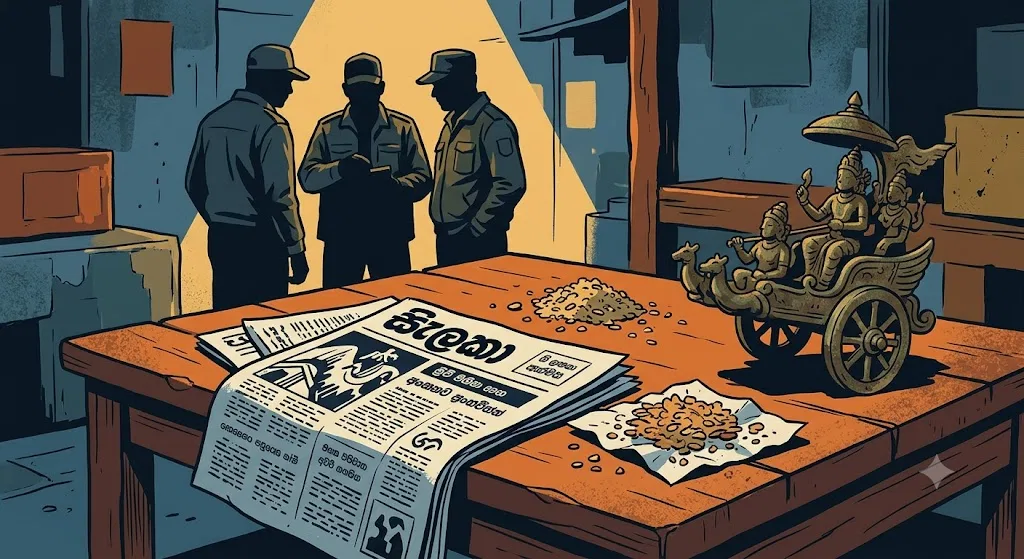
In February 2018, violence erupted at a Muslim-owned restaurant in Ampara after a customer claimed that particles in his food were infertility tablets. Medical specialists publicly explained that no such pill existed. Analysis by Sri Lanka’s Government Analyst reportedly identified the material as carbohydrate-based clumps of flour, not a sterilising chemical. By then, the allegation had already helped provoke attacks on Muslim property and had joined a broader stream of anti-Muslim misinformation circulating before and during communal unrest.[thuppahis.com]thuppahis.comThuppahi's BlogTales of an Infertility Pill are effectively dismissed by Sri…March 18, 2018 — 18 Mar 2018 — There is no contraceptive…
The rumour returned in a more personalised and politically explosive form after the Easter Sunday bombings of April 2019. On 23 May, the newspaper Divaina published a front-page claim that an unnamed Muslim doctor had secretly sterilised 4,000 Sinhalese Buddhist women during caesarean deliveries. The doctor was soon identified as Mohamed Shafi and was arrested amid allegations that also connected him with an extremist organisation and unexplained wealth.[Reuters]reuters.comUnsubstantiated claims Muslim doctor sterilized womenUnsubstantiated claims Muslim doctor sterilized women
Investigators found no evidence that he had performed the alleged sterilisations or had links to terrorism. Court proceedings also revealed how weak the original story was: the dramatic number had circulated before any medical examination capable of establishing that thousands of patients had been sterilised. Prosecutors acknowledged that specialist tests would be required even to assess individual complaints. He was granted bail in July 2019.[reuters.com]reuters.comProsecutors say tests needed before Sri Lanka sterilisationProsecutors say tests needed before Sri Lanka sterilisation
This was more than inaccurate reporting. The allegation worked by attaching a medical impossibility to an established political fear—that a minority community was secretly changing the country’s population. It offered several groups an advantage. Sensational media gained attention; nationalist campaigners received a powerful grievance; and political actors could present themselves as defenders of the majority after a national security catastrophe.
The case also demonstrates why corrections struggle. “No evidence of thousands of covert sterilisations” is less vivid than the original image of a surgeon betraying unconscious patients. Later social-media posts even misidentified other men in photographs as the accused doctor, extending the story after investigators had rejected its central premise.[AFP Fact Check]factcheck.afp.comOpen source on afp.com.
Ravana’s aircraft: legend recast as lost technology
The ancient epic figure Ravana has long belonged to religious literature, folklore and regional storytelling. In modern Sri Lanka, however, a stronger claim has developed: that Ravana was a historical monarch who possessed functioning aircraft, airports and advanced aviation technology thousands of years ago.
The distinction is important. A traditional story about a flying vehicle is not itself a hoax. The questionable step occurs when poetic or mythological material is treated as archaeological proof of mechanical flight. Place names, rock formations, caves and local traditions are then assembled into what appears to be a technical history, even though no verified aircraft components, engineering remains, contemporary inscriptions or securely dated descriptions of such machinery have been produced.
The claim gained unusual authority when Sri Lanka’s Civil Aviation Authority became associated with proposals to collect material and investigate Ravana’s supposed aviation routes. In 2019 and 2020, reports quoted aviation officials describing Ravana as an early or even the world’s first aviator. Supporters spoke of recovering a lost national heritage rather than testing whether the underlying story was historically demonstrable.[tamilguardian.com]tamilguardian.comsri lankan authorities investigate ravanas aviation routessri lankan authorities investigate ravanas aviation routes
That institutional involvement changed how the tale circulated. A claim that might otherwise have remained in tourism, television or fringe publishing could now be repeated as something “the government” or “aviation authorities” believed. Yet aviation expertise is not the same as archaeological expertise, and collecting folklore does not establish that the technology described in folklore existed.
The appeal is easy to understand. A story of prehistoric aviation gives Sri Lanka a spectacular technological priority and reverses the familiar colonial narrative in which modern science arrives from Europe. It also fits a wider South Asian tendency to reinterpret epic descriptions as literal accounts of advanced ancient machines. The cultural value of Ravana traditions does not depend on proving that a metal or wooden aircraft once flew over the island. Presenting myth as engineering history can actually obscure the more interesting questions of how Ravana’s image has changed across literature, politics, tourism and national identity.
The “stargate” at Anuradhapura
At Ranmasu Uyana, near the ancient city of Anuradhapura, a circular design carved into rock has become internationally famous as Sri Lanka’s supposed “stargate”. The carving contains concentric shapes, compartments and small figures. Its original date and precise purpose remain debated, making it ideal material for speculative interpretation.
Online accounts have described it as a portal diagram, an extraterrestrial communication device or a map showing how to travel through space. The mystery is sometimes expanded by comparing the carving with ancient sites in Egypt or South America, although visual resemblance alone cannot establish historical contact or shared technology.
Archaeological interpretations are less theatrical. The design has been discussed as a cosmological diagram, a representation of the world or a symbolic plan associated with the nearby monastic and royal landscape. None of these explanations is universally proven, but they are based on the cultural setting and comparable South Asian imagery rather than on imagined machinery. Archaeologists quoted in coverage of the site have rejected the literal stargate interpretation as unsupported.[amazinglanka.com]amazinglanka.comAmazing Lanka Sakwala Chakraya or the STARGATE of Ranmasu UyanaAmazing Lanka Sakwala Chakraya or the STARGATE of Ranmasu Uyana
This case shows how uncertainty is often marketed as positive evidence. “The purpose is not known with certainty” becomes “experts cannot explain it”, which then becomes “therefore it may be alien technology”. The final step does not follow from the first. An unresolved archaeological question allows several historically plausible interpretations; it does not make every extraordinary explanation equally credible.
Tourism also rewards the more dramatic label. “Ancient cosmological carving” sounds specialised, while “Sri Lanka’s stargate” promises a mystery recognisable to audiences already familiar with ancient-alien entertainment. The nickname now shapes how many visitors first encounter the artefact, even though the extraterrestrial interpretation is a modern addition rather than an established local tradition.
The Polonnaruwa stones and claims of alien fossils
On 29 December 2012, a fireball was reported over Sri Lanka’s North Central Province. Stones collected near Polonnaruwa were subsequently presented by a group led by astronomer Chandra Wickramasinghe as fragments of an unusual meteorite containing fossilised microscopic organisms. If correct, the discovery would have supported panspermia—the hypothesis that life, or its ingredients, can travel between worlds.
The researchers published microscopy, mineral and isotope analyses and argued that biological structures found inside the material were not recent contamination. They compared some features of the stones with carbon-rich meteorites and maintained that the specimens represented an extremely low-density class of cosmic material. Supporters later published additional papers defending the stones’ extraterrestrial origin.[arxiv.org]arxiv.orgOpen source on arxiv.org.
The response from other specialists was sceptical. Critics argued that the samples had not been convincingly established as meteorites and that the supposed fossils resembled familiar terrestrial diatoms—microscopic algae that are common in water and soil. A rock collected after a fireball is not necessarily part of that fireball, particularly without a documented recovery trail, recognised meteorite features and independent confirmation. The journal in which several early claims appeared, the Journal of Cosmology, had also attracted criticism over editorial standards and its enthusiasm for fringe astrobiological conclusions.[phys.org]phys.orgAstrobiologists claim meteorite carried space algaeAstrobiologists claim meteorite carried space algae
The Polonnaruwa affair is better classified as a contested scientific claim than as a proven deliberate fraud. The researchers continued to defend their interpretation and offered analyses intended to answer objections. The central difficulty was evidential: extraordinary biological conclusions rested on specimens whose extraterrestrial status was itself disputed.
Media coverage frequently compressed that uncertainty into “alien life found in Sri Lankan meteorite”. The phrase removed the chain of unresolved questions: Were the stones actually recovered from the fall? Were they meteorites? Were the structures genuinely fossilised organisms? Could they be terrestrial contamination? Only after answering each question could the discovery support life from space.
The case remains instructive because scientific imagery can create an impression of certainty. Electron-microscope pictures look technical and persuasive, but a striking shape is not self-interpreting. Its significance depends on sample handling, comparison material, chemistry, geology and independent replication.

Giant skeletons created for the age of artificial intelligence
In March 2024, images circulated on Sri Lankan social media claiming that enormous human skeletons had been discovered in a local village. The pictures showed excavations surrounded by workers and spectators, apparently documenting the remains of a race of giants.
The discovery was invented. Fact-checkers traced the images to an online group that shared edited and artificial-intelligence-generated pictures. Visual inconsistencies were visible in the skeletons and surrounding figures, while the village named in some posts did not exist. There was no announcement from an archaeological institution and no traceable excavation record.[afp.com]factcheck.afp.comOpen source on afp.com.
Giant-skeleton hoaxes pre-date generative artificial intelligence. Earlier versions were made with image-editing software, sometimes by enlarging genuine excavation photographs or submitting fabricated scenes to digital-art competitions. They later escaped from their original context and were presented as evidence that museums or governments were concealing discoveries.[CEDMO]cedmohub.euOpen source on cedmohub.eu.
The Sri Lankan version gained extra plausibility because it could be attached to stories of ancient superhuman rulers, lost civilisations and Ravana. Generative AI made production easier: a person no longer needed advanced editing skills or a genuine archaeological photograph. The resulting image could imitate the visual vocabulary of a news report—dusty trenches, measuring tools, crowds and documentary-style framing—without representing any real event.
The simplest test is not merely whether an image “looks fake”. A genuine discovery of that scale would produce named archaeologists, an identifiable site, official permits, multiple independent photographs, measurements, scientific papers and institutional statements. A spectacular image accompanied only by recycled captions and an untraceable place name has the appearance of evidence without its supporting structure.
Why these stories endure after being exposed
Sri Lanka’s famous false claims survive for different reasons, but several mechanisms recur.
They offer emotional explanations. A grease devil explains unexplained assaults; an infertility plot explains demographic anxiety; an ancient aircraft restores technological glory; and a giant skeleton promises physical proof that legend was history.
They borrow authority. Newspaper front pages, government agencies, medical language, microscope photographs and documentary-style images make weak claims appear institutionally verified. Readers often encounter the authority signal before they encounter the evidence.
They turn uncertainty into proof. An unidentified carving becomes a stargate because its precise meaning is unknown. A disputed stone becomes a life-bearing meteorite because specialists have not produced one universally accepted alternative. In both cases, absence of a settled explanation is treated as support for the most dramatic possibility.
They spread through repetition rather than demonstration. A numerical claim such as “4,000 women” can circulate through headlines, speeches and social posts even when nobody has shown how the number was calculated. Once familiar, the allegation may feel established merely because readers have heard it repeatedly.
They attach themselves to genuine grievances. The grease-devil panic drew power from real violence and mistrust. Anti-Muslim rumours circulated in a country with recent communal conflict and terrorism. Debunking the literal claim does not automatically remove the social conditions that made it persuasive.
How to judge a Sri Lankan hoax claim
A useful sceptical approach begins by identifying what kind of story is being told. Folklore should not be judged as though it were a laboratory report, and a scientific controversy should not automatically be called fraud. The key question is where the story crosses from interpretation into a claim of verifiable fact.
For an archaeological or technological claim, look for a securely identified site, professional excavation records, dating, material analysis and publication by relevant specialists. Place-name speculation and similarities visible in photographs are not substitutes.
For a medical claim, ask whether the proposed mechanism is biologically possible and whether professional bodies have confirmed it. Large numbers should have a traceable source rather than appearing first in a headline or political speech.
For a viral photograph, search for earlier versions, check whether the location exists and look for independent images from recognised institutions. Artificially generated material often has inconsistencies, but missing provenance is an even stronger warning sign.
For a panic involving alleged attackers, avoid assuming that every report is either wholly true or wholly invented. Real crimes, copycat behaviour, misidentification and rumour can coexist. The grease-devil crisis became dangerous precisely because this mixed reality was compressed into one irresistible explanation.
What Sri Lanka’s hoaxes reveal
The country’s most significant hoax stories are ultimately about authority. They show what can happen when institutional language validates folklore, when a newspaper converts a rumour into an accusation, when fear fills gaps left by distrusted officials, or when technical-looking images circulate without provenance.
They also show that exposure is not a single dramatic moment. The giant-skeleton fabrication could be traced to an image group and dismissed quickly. The infertility allegations required medical explanation, forensic analysis and criminal investigation. The Polonnaruwa stones remain part of a scientific dispute because their promoters continue to publish arguments. The grease devil was never one object that could be unmasked; it was a shifting combination of crime, folklore, rumour and post-war fear.
The most responsible conclusion is therefore not that every strange Sri Lankan story is fraudulent. It is that extraordinary claims must be separated carefully into myth, mistake, speculation, propaganda and deliberate deception. That distinction preserves the cultural interest of legends while preventing them from being used as counterfeit evidence—and recognises that the most harmful falsehoods are often those built around a small fragment of truth.
Amazon book picks
Further Reading
Books and field guides related to When Rumour, Fear and Legend Became Fact. Use these as the next step if you want deeper reading beyond the article.
Mistakes Were Made (but Not by Me)
Explains belief persistence and motivated reasoning.
Extraordinary Popular Delusions and the Madness of Crowds
Rating: 4.0/5 from 5 Google Books ratings
Examines collective belief and social contagion.
eBay marketplace picks
Marketplace Samples
Live-tested eBay searches with available results related to this page.
Endnotes
1.
Source: personal.lse.ac.uk
Title: venugopal grease devil
Link:https://personal.lse.ac.uk/venugopr/venugopal%20-%20grease%20devil.pdf
Source snippet
Demonic Violence and Moral Panic in Post-‐War Sri Lankaby R Venugopal · 2013 — The grease devil crisis arose in mid-‐2011, in the context...
2.
Source: cambridge.org
Link:https://www.cambridge.org/core/journals/journal-of-asian-studies/article/demonic-violence-and-moral-panic-in-postwar-sri-lanka-explaining-the-grease-devil-crisis/1B9A7A938B1A9175CF70FB66D4F6C99A
Source snippet
Cambridge University Press & AssessmentDemonic Violence and Moral Panic in Postwar Sri Lankaby R Venugopal · 2015 · Cited by 17 — Rumors...
3.
Source: reuters.com
Title: grease devil panic grips rural sri lanka at least three id USTRE77B0ZR
Link:https://www.reuters.com/article/world/grease-devil-panic-grips-rural-sri-lanka-at-least-three-idUSTRE77B0ZR/
Source snippet
Reuters"Grease Devil" panic grips rural Sri Lanka, at least three12 Aug 2011 — Two men whom wary villagers identified as "grease devils"...
4.
Source: jstor.org
Title: Moral Panic in Postwar Sri Lanka
Link:https://www.jstor.org/stable/43552756
Source snippet
Explaining the Grease Devil Crisis - Sri Lankaby R VENUGOPAL · 2015 · Cited by 17 — grease devil crisis in August 2011, the grease d...
Published: August 2011
5.
Source: upr-info.org
Link:https://upr-info.org/sites/default/files/country-document/2023-03/JS13_UPR42_LKA_E_Main.pdf
Source snippet
news/tension-ampara-after-fake- · %E2%80%98sterilization-pills%E2%80%99...Read more...
6.
Source: Wikipedia
Title: 2018 anti Muslim riots in Sri Lanka
Link:https://en.wikipedia.org/wiki/2018_anti-Muslim_riots_in_Sri_Lanka
7.
Source: reuters.com
Title: Unsubstantiated claims Muslim doctor sterilized women
Link:https://www.reuters.com/article/world/unsubstantiated-claims-muslim-doctor-sterilized-women-raise-tensions-in-sri-lank-idUSKCN1T71GK/
8.
Source: reuters.com
Link:https://www.reuters.com/article/world/us/insight-unsubstantiated-claims-muslim-doctor-sterilised-women-raise-tensions-in-idUSL4N23D2VF/
9.
Source: reuters.com
Title: Prosecutors say tests needed before Sri Lanka sterilisation
Link:https://www.reuters.com/article/world/prosecutors-say-tests-needed-before-sri-lanka-sterilisation-case-can-proceed-idUSKCN1U62OG/
10.
Source: reuters.com
Link:https://www.reuters.com/article/world/sri-lanka-court-grants-bail-for-doctor-accused-of-sterilising-buddhist-women-idUSKCN1UK2SV/
11.
Source: factcheck.afp.com
Title: sri lankan authorities found muslim surgeon had not performed any sterilisations
Link:https://factcheck.afp.com/sri-lankan-authorities-found-muslim-surgeon-had-not-performed-any-sterilisations
12.
Source: ndtv.com
Title: doctor arrested for sterilising women in sri lanka was framed probe 2064837
Link:https://www.ndtv.com/world-news/doctor-arrested-for-sterilising-women-in-sri-lanka-was-framed-probe-2064837
13.
Source: factcheck.afp.com
Link:https://factcheck.afp.com/man-circled-photo-parliamentarian-sri-lankas-ruling-party-not-doctor-who-was-falsely-accused
14.
Source: tamilguardian.com
Title: sri lankan authorities investigate ravanas aviation routes
Link:https://www.tamilguardian.com/content/sri-lankan-authorities-investigate-ravanas-aviation-routes
15.
Source: lankaweb.com
Link:https://www.lankaweb.com/news/items/2019/08/01/ravana-worlds-first-aviator-says-sri-lanka-launches-initiative-to-study-his-voyage-5000-years-ago/
16.
Source: go.gale.com
Title: The unsolved mystery of Sri Lanka’s ‘Stargate’
Link:https://go.gale.com/ps/i.do?id=GALE%7CA666443004&it=r&p=AONE&sid=sitemap&sw=w&v=2.1
17.
Source: Wikipedia
Title: Ranmasu Uyana
Link:https://en.wikipedia.org/wiki/Ranmasu_Uyana
18.
Source: arxiv.org
Link:https://arxiv.org/abs/1303.1845
19.
Source: meetingorganizer.copernicus.org
Link:https://meetingorganizer.copernicus.org/EPSC2014/EPSC2014-698.pdf
20.
Source: arxiv.org
Link:https://arxiv.org/pdf/1303.1845
21.
Source: panspermia.org
Link:https://www.panspermia.org/AdAp_100158%20MiltPaper.pdf
22.
Source: phys.org
Title: Astrobiologists claim meteorite carried space algae
Link:https://phys.org/news/2013-03-astrobiologists-meteorite-space-algae.html
23.
Source: Wikipedia
Title: Chandra Wickramasinghe
Link:https://en.wikipedia.org/wiki/Chandra_Wickramasinghe
24.
Source: Wikipedia
Title: Journal of Cosmology
Link:https://en.wikipedia.org/wiki/Journal_of_Cosmology
25.
Source: factcheck.afp.com
Link:https://factcheck.afp.com/doc.afp.com.34MC8D2
26.
Source: thequint.com
Link:https://www.thequint.com/news/webqoof/ai-generated-images-of-skeletons-shared-as-real-found-in-sri-lankan-village-fact-check
27.
Source: cedmohub.eu
Link:https://cedmohub.eu/doctored-photo-falsely-shared-as-giants-skeleton-found-in-romania/
28.
Source: reuters.com
Title: giant skeleton is not real but part of an art exhibition id USL2N2OD161
Link:https://www.reuters.com/article/fact-check/giant-skeleton-is-not-real-but-part-of-an-art-exhibition-idUSL2N2OD161/
29.
Source: Wikipedia
Title: Grease devil crisis in Sri Lanka
Link:https://en.wikipedia.org/wiki/Grease_devil_crisis_in_Sri_Lanka
30.
Source: Wikipedia
Title: 2019 anti Muslim riots in Sri Lanka
Link:https://en.wikipedia.org/wiki/2019_anti-Muslim_riots_in_Sri_Lanka
31.
Source: factcheck.afp.com
Link:https://factcheck.afp.com/these-photos-are-unrelated-restaurant-cited-misleading-social-media-posts-police-india-refuted-claim
32.
Source: jstor.org
Link:https://www.jstor.org/stable/44809402
33.
Source: thuppahis.com
Link:https://thuppahis.com/2018/03/18/tales-of-an-infertility-pill-are-effectively-dismissed-by-sri-lankan-medical-specialists/
Source snippet
Thuppahi's BlogTales of an Infertility Pill are effectively dismissed by Sri...March 18, 2018 — 18 Mar 2018 — There is no contraceptive...
Published: March 18, 2018
34.
Source: amazinglanka.com
Title: Amazing Lanka Sakwala Chakraya or the STARGATE of Ranmasu Uyana
Link:https://amazinglanka.com/wp/sawala-chakraya/
Additional References
35.
Source: guernicamag.com
Title: Guernica The Grease Devil Is Not Real
Link:https://www.guernicamag.com/the-grease-devil-is-not-real/
Source snippet
GuernicaThe Grease Devil Is Not Real - Guernica15 Jun 2012 — Forensic experts, funded partly by the state, had pronounced the Grease Devi...
36.
Source: youtube.com
Title: Al-Shabaab exploits Kenya’s divisions to wage war
Link:https://www.youtube.com/watch?v=j13wvZND5zk
Source snippet
Election info changes quickly. Verify responses with official sources...
37.
Source: youtube.com
Title: Inside Al Shabaab: The extremist group trying to seize Somalia
Link:https://www.youtube.com/watch?v=KVSw0E9Y1RI
Source snippet
How Al-Shabab is recruiting young men from Kenya...
38.
Source: youtube.com
Title: Somalia: Govt bans Al Shabaab ‘propaganda’ contents
Link:https://www.youtube.com/watch?v=Vean7jaorHc
Source snippet
Inside Al Shabaab: The extremist group trying to seize Somalia...
39.
Source: youtube.com
Link:https://www.youtube.com/watch?v=5hKAyQIc5rk
Source snippet
Al-Shabaab exploits Kenya's divisions to wage war...
40.
Source: youtube.com
Title: How Al-Shabab is recruiting young men from Kenya
Link:https://www.youtube.com/watch?v=xc6wfF9sV90
Source snippet
Inside Al Shabaab (2017): Terror group tackles drought...
41.
Source: facebook.com
Link:https://www.facebook.com/pulse.lk/posts/ravana-and-the-lost-heritage-of-aviation-dominance-is-an-initiative-that-has-bee/3130737763661989/
42.
Source: researchgate.net
Link:https://www.researchgate.net/publication/280947556_Demonic_Violence_and_Moral_Panic_in_Postwar_Sri_Lanka_Explaining_the_Grease_Devil_Crisis
43.
Source: facebook.com
Link:https://www.facebook.com/Dailymirroronline/videos/a-43-year-old-man-has-been-arrested-for-allegedly-operating-an-illegal-document-/1029226636430128/
44.
Source: ravanaaviation.com
Link:https://ravanaaviation.com/aviation-archaeology/
Topic Tree
Follow this branch
Related pages 192
- Albanian Hoaxes
- Algerian Hoaxes
- Antigua Deceptions
- Argentina Hoaxes
- Armenian Hoaxes
- +187 more in sidebar