Within Montenegro Hoaxes
Why Impressive Symbols Can Outrun Verification
False identities gain power when symbols, institutions and respected people appear to confirm claims that few participants independently verify.
On this page
- How social proof turns claims into credentials
- Why useful myths survive official exposure
- From sealed letters to social media photographs
Page outline Jump by section
Introduction
The most successful impostures connected with Montenegro did not rely primarily on forged documents or elaborate secret plots. They relied on something simpler: borrowed authority. When a claim appears to be endorsed by respected institutions, powerful people, official symbols or widely admired traditions, many observers stop checking independently. The appearance of legitimacy becomes a substitute for proof.
Montenegro’s best-known deception stories illustrate this mechanism particularly clearly. In the eighteenth century, Šćepan Mali gained power by becoming associated with the identity of the Russian emperor Peter III. More recently, Stefano Černetić built a public image as a Montenegrin prince through ceremonial titles, photographs with prominent figures and aristocratic symbolism. In both cases, visible signs of authority persuaded people more effectively than direct evidence. The result was not simply individual gullibility but a social process in which credibility appeared to confirm itself.[Wikipedia]WikipediaŠćepan MaliŠćepan Mali
How Social Proof Turns Claims into Credentials
Borrowed authority works because people rarely evaluate every claim from scratch. Instead, they look for signals that others have already done the checking.
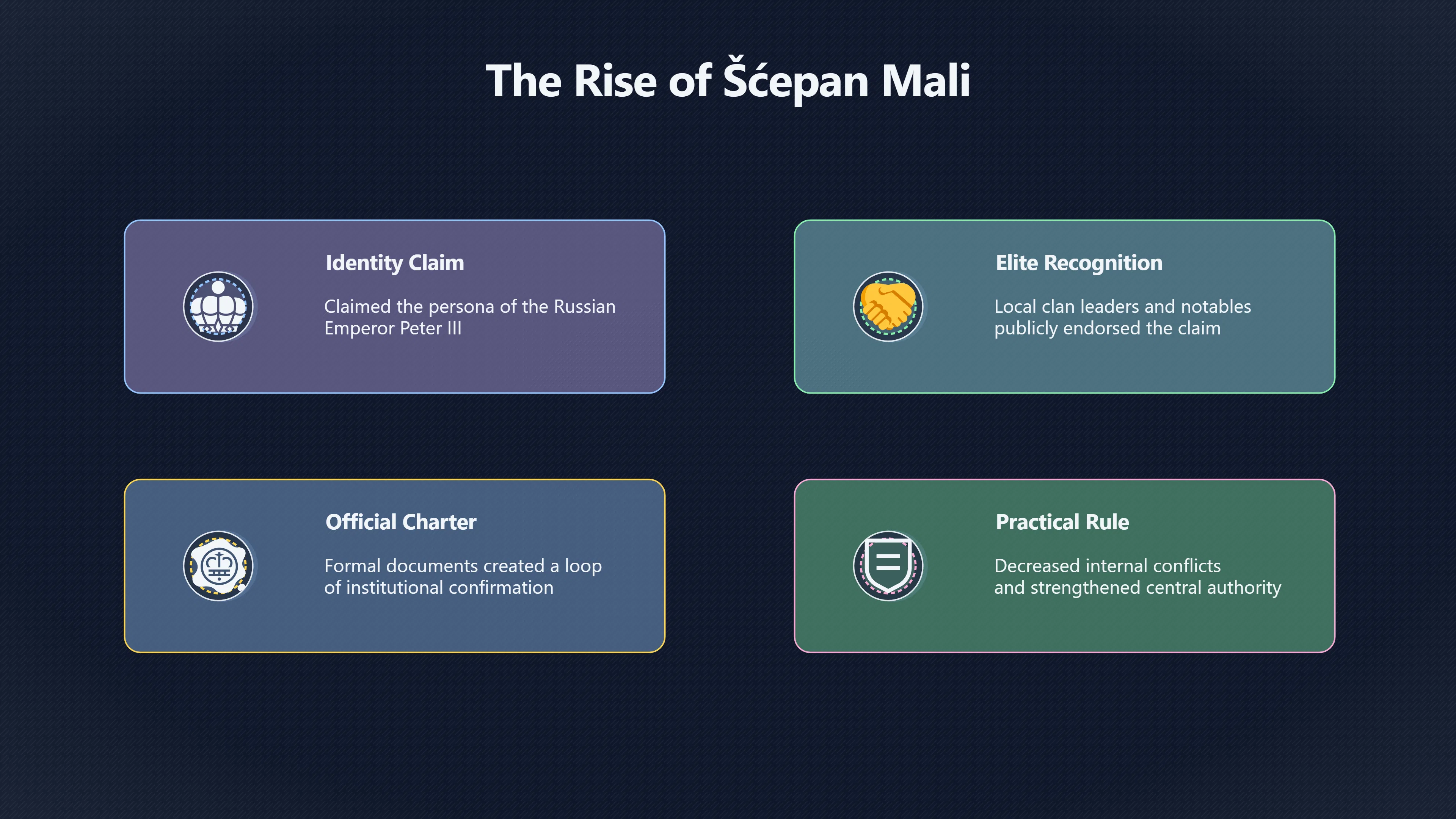
In Montenegro’s most famous imposture, the crucial asset was not a convincing biography but a prestigious identity. Peter III of Russia occupied a powerful place in the political imagination of the eighteenth-century Balkans. Russia was viewed by many Orthodox Christians as a potential protector against Ottoman power. If the supposedly dead emperor had really appeared in Montenegro, that would have transformed the country’s international position overnight.[wikipedia.org]WikipediaŠćepan MaliŠćepan Mali
Šćepan Mali appears to have understood that he did not need to provide detailed proof. Contemporary accounts suggest that he often encouraged belief through ambiguity rather than explicit declarations. Once influential clan leaders, local notables and religious figures began treating him as Peter III, their recognition itself became evidence in the eyes of others. A charter formally recognising him as Peter followed, creating an official-looking confirmation loop. The more people acted as though he were genuine, the more genuine he appeared.[Wikipedia]WikipediaŠćepan MaliŠćepan Mali
Several reinforcing signals helped the claim survive:
- Prestigious association: Peter III was already a famous ruler whose survival rumours circulated beyond Montenegro.
- Elite endorsement: Local leaders publicly recognised the claimant.
- Official-style procedures: Gatherings, proclamations and charters made belief look institutional rather than personal.
- Visible success: As internal conflicts temporarily decreased, practical results appeared to validate the identity behind them.[Wikipedia]WikipediaŠćepan MaliŠćepan Mali
The lesson is that authority often travels through networks. People trust a claim because trusted people appear to trust it first.
Why Impressive Symbols Often Beat Direct Evidence
Modern readers sometimes assume that exposure immediately destroys a fraud. Montenegro’s history shows otherwise.
When Russian officials informed Montenegrin leaders that Peter III was unquestionably dead, the information did not instantly end belief in Šćepan Mali. The evidence arrived through letters from distant authorities, while the claimant himself was physically present and exercising power. For many people, lived experience outweighed documentary correction.[Wikipedia]WikipediaŠćepan MaliŠćepan Mali
This reveals an important feature of borrowed authority: symbols and relationships can feel more persuasive than factual verification.
A royal seal, a diplomatic title, a uniform, a photograph with a respected figure or an apparently official document all communicate status at a glance. Verifying authenticity requires time and effort. Accepting the symbol requires almost none.
The same pattern appeared in the case of Stefano Černetić. He presented himself as a prince linked to Montenegro and Macedonia, surrounded himself with aristocratic imagery, appeared at formal events and cultivated photographs with celebrities, clergy, business figures and members of recognised royal families. Those images functioned as credibility shortcuts. Viewers often assumed that someone photographed alongside respected people must already have been vetted.[Wikipedia]WikipediaStefano ČernetićStefano Černetić
In reality, photographs frequently prove only that a meeting occurred. Yet socially they can operate as endorsements, even when no endorsement was intended.
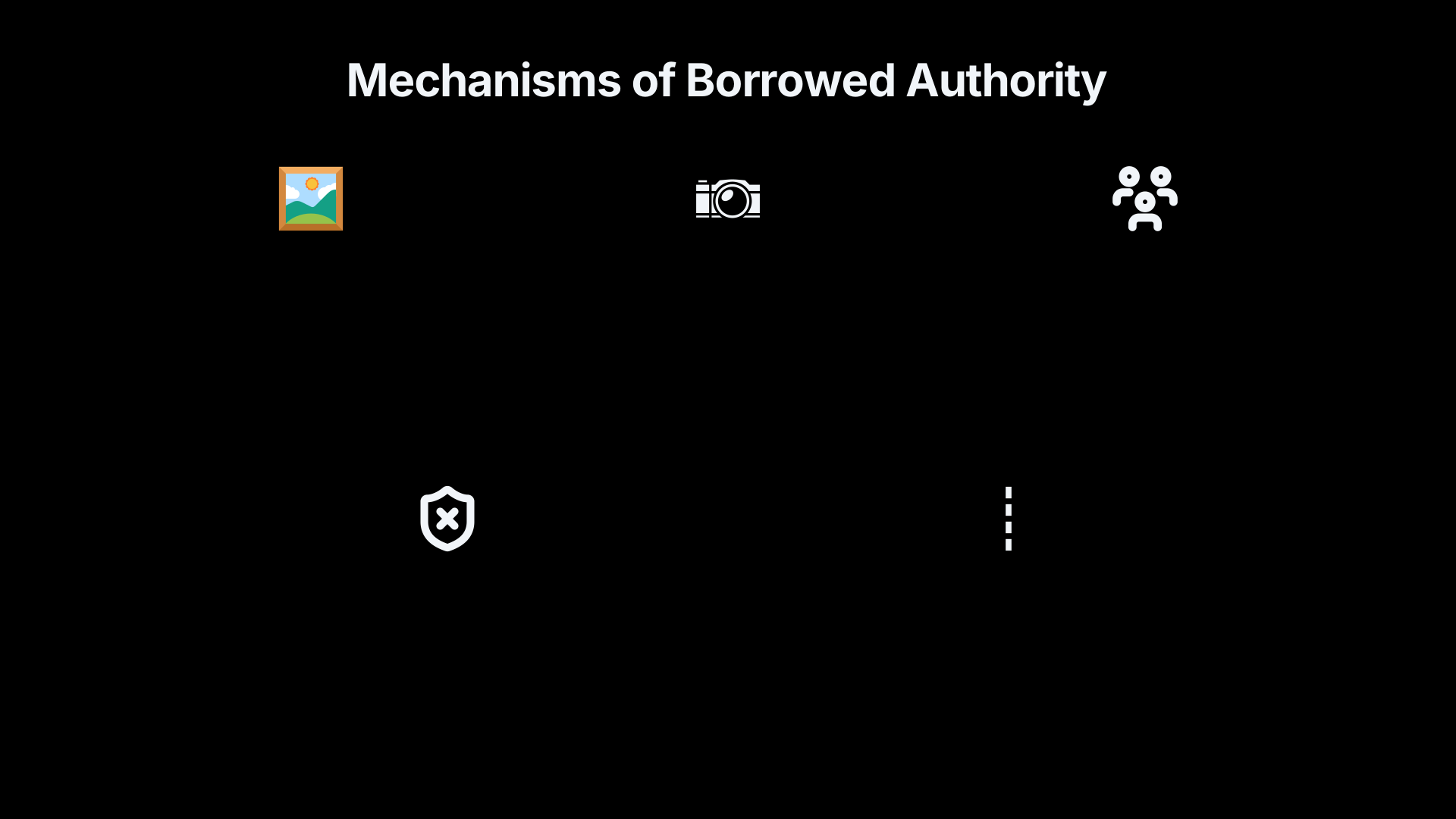
Why Useful Myths Survive Official Exposure
One reason borrowed authority can outlast debunking is that some myths provide practical benefits.
In the case of Šćepan Mali, many Montenegrins judged him not only by who he claimed to be but also by what he seemed able to accomplish. During his rule, clan conflict decreased and central authority strengthened. Even Russian investigators discovered that removing him created new instability. When Yuri Dolgorukov exposed the imposture and imprisoned him, old rivalries quickly reappeared. The practical value people associated with his leadership helped preserve support even after doubts about his identity became harder to ignore.[Wikipedia]WikipediaŠćepan MaliŠćepan Mali
This is a recurring feature of authority-based deception. A claim can survive because it serves a useful purpose:
- It promises protection.
- It creates political unity.
- It offers access to prestige.
- It provides a story people prefer to believe.
- It strengthens group identity.
Once a belief becomes socially useful, disproving it becomes more difficult. The debate is no longer only about facts; it is also about what people fear losing if the claim collapses.
That helps explain why the revelation that Šćepan was not Peter III did not instantly remove him from public life. After exposure, many supporters simply shifted from believing he was Peter to accepting him as a capable ruler whose authority now seemed indirectly connected to Russia anyway.[Wikipedia]WikipediaŠćepan MaliŠćepan Mali
From Sealed Letters to Social Media Photographs
The tools have changed, but the mechanism remains remarkably similar.
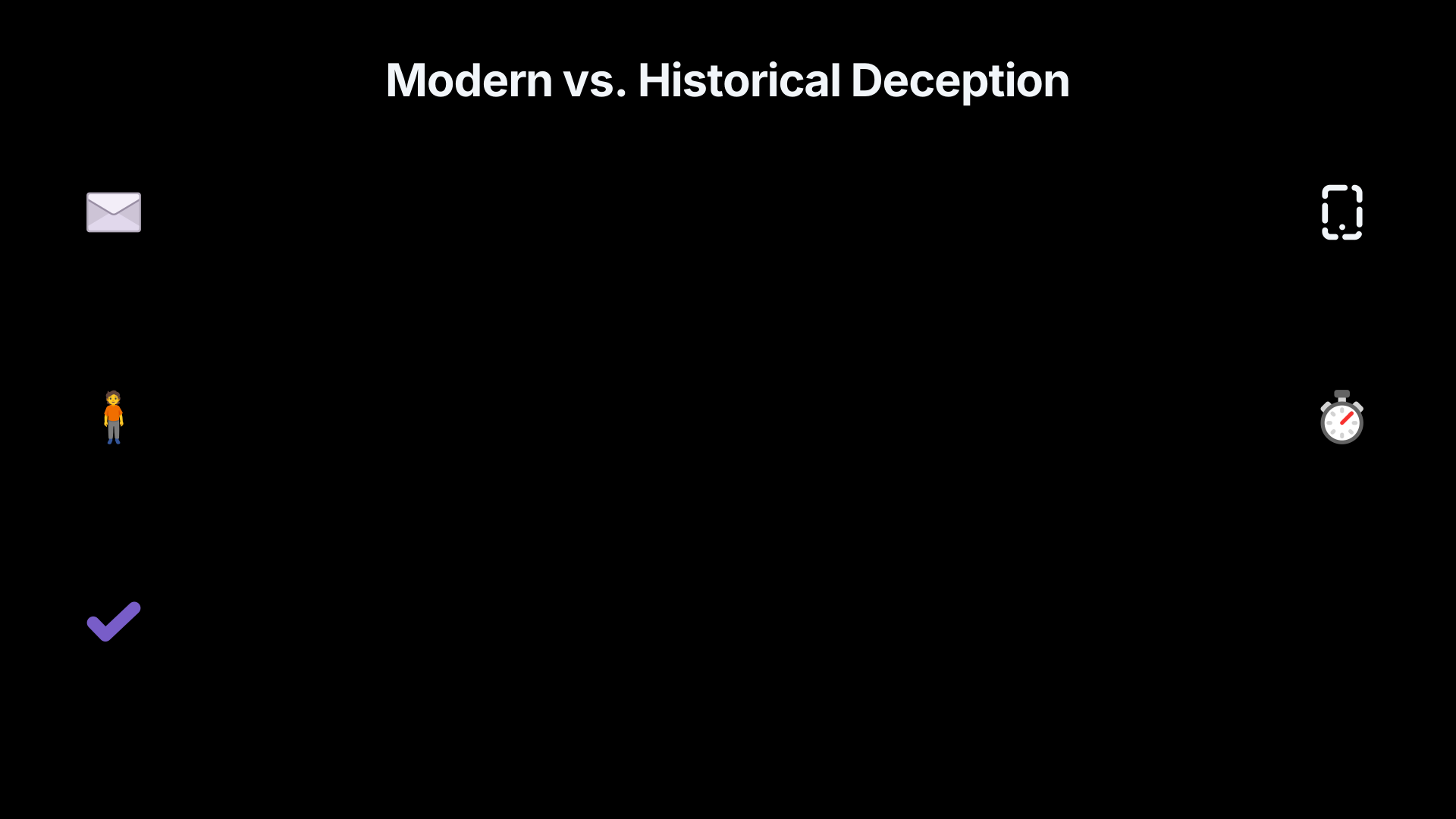
In the eighteenth century, authority travelled through letters, church networks, proclamations and elite recognition. Today it often travels through photographs, viral posts, institutional logos and online audiences.
Stefano Černetić’s public persona illustrates the modern version. Images showing him with famous figures, attendance at high-profile events and the display of noble orders and heraldic symbols created a powerful impression of legitimacy. Even when questions arose about his claims, the visual evidence continued circulating because it looked authoritative. Many people encountered the symbols before encountering the criticisms.[wikipedia.org]WikipediaStefano ČernetićStefano Černetić
The same logic appears across contemporary misinformation:
- A claim acquires a prestigious association.
- The association is photographed, quoted or repeated.
- The repetition becomes evidence of credibility.
- Verification happens later, if at all.
Social media accelerates this process because images travel faster than investigations. A photograph with a politician, royal figure or public institution can be shared thousands of times before anyone examines the underlying claim.
What Montenegro’s Impostors Reveal About Belief
Montenegro’s most famous impostures are often remembered as colourful stories about fake emperors and counterfeit princes. Their deeper significance lies elsewhere.
They demonstrate that authority is frequently social rather than purely factual. People often assess credibility through visible cues: who appears to support a claim, what symbols surround it, whether institutions seem to recognise it and whether respected individuals behave as though it is true.
Šćepan Mali gained power because recognition spread faster than verification. Stefano Černetić gained visibility because aristocratic imagery and elite connections appeared to confirm his status. Centuries apart, both cases reveal the same mechanism: when authority looks established, many observers assume someone else has already checked the facts.[Wikipedia]WikipediaŠćepan MaliŠćepan Mali
That is why borrowed authority remains one of the most durable engines of deception. The strongest falsehoods are often not those supported by the best evidence, but those wrapped in the most convincing signs that evidence supposedly exists somewhere else.
Amazon book picks
Further Reading
Books and field guides related to Why Impressive Symbols Can Outrun Verification. Use these as the next step if you want deeper reading beyond the article.
Thinking, Fast and Slow
Shows cognitive shortcuts that encourage trust in authority cues.
The Demon-Haunted World
Rating: 4.5/5 from 43 Google Books ratings
Focuses on evaluating claims rather than symbols.
eBay marketplace picks
Marketplace Samples
Live-tested eBay searches with available results related to this page.

Endnotes
1.
Source: Wikipedia
Title: Šćepan Mali
Link:https://en.wikipedia.org/wiki/%C5%A0%C4%87epan_Mali
2.
Source: Wikipedia
Title: Stefano Černetić
Link:https://en.wikipedia.org/wiki/Stefano_%C4%8Cerneti%C4%87
3.
Source: jstor.org
Link:https://www.jstor.org/stable/3000742
Source snippet
Catherine II and a False Peter III in Montenegroby MB Petrovich · 1955 · Cited by 8 — Peter III, Tsar of All the Russias, had honore...
4.
Source: Wikipedia
Title: Montenegro–Russia relations
Link:https://en.wikipedia.org/wiki/Montenegro%E2%80%93Russia_relations
5.
Source: Wikipedia
Title: Stefano Černetić
Link:https://es.wikipedia.org/wiki/Stefano_%C4%8Cerneti%C4%87
6.
Source: longreads.com
Title: the prince
Link:https://longreads.com/2023/04/19/the-prince/
Source snippet
The Prince19 Apr 2023 — Stefano [Cernetic]({{ 'cernetic/' | relative_url }}) was the Prince of Montenegro. he bestowed titles upon ordinary people not born into nob...
7.
Source: en.vijesti.me
Link:https://en.vijesti.me/news-b/black-chronicle/669461/no-one-chases-the-false-prince-of-Montenegro%2C-he-claims-to-be-a-descendant-of-a-black-woman
Source snippet
one is chasing the fake prince of Montenegro14 Aug 2023 — A man posing as the Prince of Montenegro organized balls, awarded the titles of...
8.
Source: balkaninsight.com
Link:https://balkaninsight.com/2022/07/19/montenegrin-president-seeks-probe-after-fake-prince-attends-state-event/bi/montenegro/
9.
Source: sigedon.com
Title: peter iii of russia
Link:https://sigedon.com/peter-iii-of-russia/
Additional References
10.
Source: trulyadventure.us
Link:https://www.trulyadventure.us/the-prince
Source snippet
Truly*AdventurousThe PrinceAt cocktail parties and dinners, some whispered that Stefano Cernetic couldn't be the legitimate prince of Mon...
11.
Source: newsweek.com
Title: man faked being montenegrin prince free trips meet pamela anderson 626006
Link:https://www.newsweek.com/man-faked-being-montenegrin-prince-free-trips-meet-pamela-anderson-626006
Source snippet
Police Hunt Fake Prince Who Met Pamela Anderson and...15 Jun 2017 — Italian police are trying to catch a man who fooled local au...
12.
Source: reddit.com
Link:https://www.reddit.com/r/ActLikeYouBelong/comments/kl8xj5/random_guy_shows_up_to_the_small_country_of/
Source snippet
the ruler of Montenegro from 1767 to 1773, Šćepan Mali ('Stephen the Little') gained power by pretending to be Tsar Pet...
13.
Source: facebook.com
Link:https://www.facebook.com/groups/27153053115/posts/10159948610153116/
14.
Source: instagram.com
Link:https://www.instagram.com/hirh_stefan/?hl=en
15.
Source: labrujulaverde.com
Link:https://www.labrujulaverde.com/en/2024/08/[scepan-mali
16.
Source: youtube.com
Title: Why We Trust Powerful People (Even When We Shouldn’t)
Link:https://www.youtube.com/watch?v=E3WBDAkW1AU
Source snippet
Why You Follow Influencers (Authority Bias)...
17.
Source: youtube.com
Title: Why You Follow Influencers (Authority Bias)
Link:https://www.youtube.com/watch?v=KldlcD6ZdwM
Source snippet
Why Everyone Copies Everyone Else | Social Proof Explained...
18.
Source: youtube.com
Link:https://www.youtube.com/shorts/Lu6bSnU_bew
19.
Source: youtube.com
Title: Science Of Persuasion
Link:https://www.youtube.com/watch?v=cFdCzN7RYbw
Source snippet
CON ARTIST - Why Anna Delvey's Confident Behavior is a Sign...
Topic Tree