Which Guinea Bissau Stories Survived the Truth?
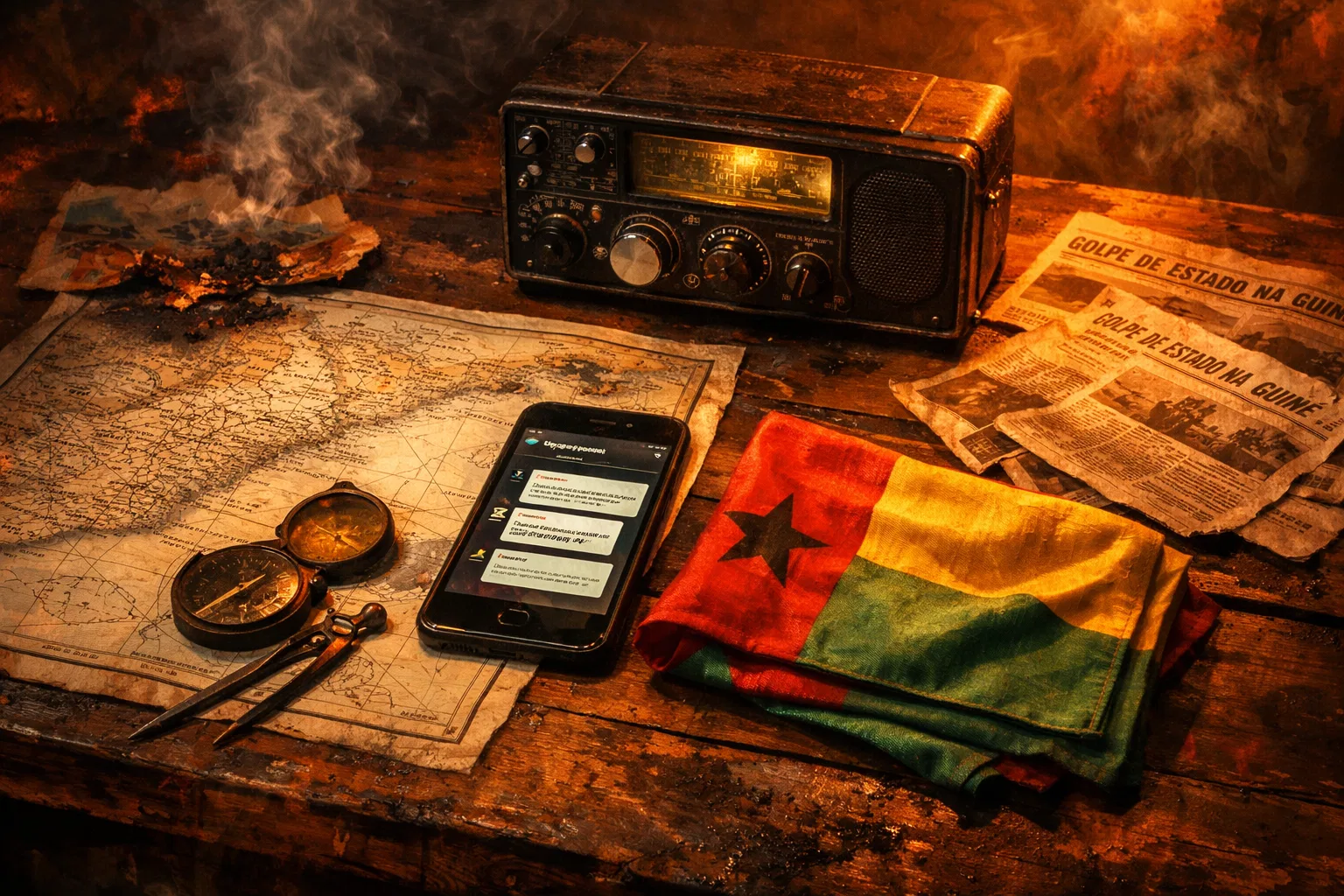
Guinea-Bissau does not have a well-documented national catalogue of famous monsters, forged relics or theatrical newspaper hoaxes.
Page outline Jump by section
Introduction
The most important lesson is that these episodes are not interchangeable. A false medical message is readily disproved; colonial “discovery” stories are better understood as constructed national mythology; and allegations that a coup was staged remain serious but unresolved claims, not established hoaxes. Guinea-Bissau’s limited news resources, strong oral communication networks, political instability and growing use of social media have all helped uncertain information travel faster than verification. Researchers examining the country’s information environment have found political parties, supporters and activists particularly prominent in producing and circulating misleading material.[CDD]cddwestafrica.orgguinea bissau s fake news ecosystem an overviewCDDGuinea Bissau's Fake News Ecosystem: An Overview1 Feb 2022 — Misinformation involves the spread of falsehoods without a deliberate att…
The colonial “discovery” that became official history
One of Guinea-Bissau’s most durable contested stories concerns the Portuguese navigator Nuno Tristão. Colonial accounts credited him with reaching the territory in the fifteenth century and treated him as the European “discoverer” of what Portugal later called Portuguese Guinea. The claim was repeated through commemorations, monuments and historical writing until it acquired the appearance of settled fact.
Modern scholarship has challenged both the geography and the language of that story. Historians using early navigation accounts have argued that Tristão probably travelled no farther than the coast of present-day Senegal or, at most, the Gambia River. That would mean he never reached the territory now called Guinea-Bissau. A recent study describes the identification of Tristão as its “discoverer” as part of a deliberately constructed colonial narrative rather than a neutral finding about the past.[Taylor & Francis Online]tandfonline.comTaylor & Francis OnlineFull article: The Invention of Portuguese Guineaby V Barros · 2026 — Fifth Centenary and the invention of Portugue…
The deception here was not a simple one-person fraud. It was closer to an invented historical tradition: an uncertain voyage was converted into a founding episode that placed Portuguese action at the beginning of the country’s recorded history. The word “discovery” also concealed the obvious presence of established African communities, political authorities and trading systems before Portuguese arrival.
This narrative served several colonial purposes. It gave Portuguese rule an origin story, implied a long-standing national entitlement to the territory and made conquest appear to follow naturally from exploration. The story fitted the broader claim that Portugal was conducting a “civilising mission” in Africa. Historian Peter Mendy’s examination of colonial Guinea-Bissau contrasts that rhetoric with the coercion, racial hierarchy and limited social provision of actual Portuguese rule.[JSTOR]jstor.orgPortugal's Civilizing Mission in Colonial Guinea-Bissauby PK Mendy · 2003 · Cited by 78 — Portugal's African colonies as the mere pr…
What exposed the weakness of the Tristão legend was not one dramatic confession but patient comparison of navigational evidence, later eyewitness accounts and plausible sailing distances. It remains a useful example of how a historical error can become more powerful than an ordinary hoax when governments, schools and public monuments repeat it for generations.
Political rumours thrive where institutions cannot settle the facts
Guinea-Bissau’s recent information problems are closely tied to its unstable politics. Disputes over presidencies, elections, military interventions and alleged plots repeatedly create periods when several factions issue incompatible accounts and trusted institutions cannot provide a quick, authoritative answer.
A 2022 study of the country’s “fake news ecosystem” found that misleading material concentrated heavily on politics and the political and military elite. Blogs and social platforms were major channels, while political activists and party supporters were identified as leading creators and distributors. Images were especially useful because they could be detached from their original setting, captioned with a new claim and circulated among audiences with varying levels of literacy.[CDD]cddwestafrica.orgguinea bissau s fake news ecosystem an overviewCDDGuinea Bissau's Fake News Ecosystem: An Overview1 Feb 2022 — Misinformation involves the spread of falsehoods without a deliberate att…
Private messaging makes investigation particularly difficult. A rumour passed through WhatsApp arrives from a friend, relative or colleague rather than an unfamiliar publisher. That personal route can make it feel trustworthy, while encryption prevents journalists and researchers from seeing the full chain of distribution. The result is often not a single famous fabrication but a rapidly shifting mixture of genuine reports, partisan interpretation, reused pictures and unsupported warnings.
Older media have also faced accusations of spreading falsehoods. In 2003, the authorities removed the private station Radio Bombolom from the air after accusing it of broadcasting information that threatened national sovereignty. Because governments can use “false information” allegations to silence criticism, such episodes must be treated carefully: an official accusation is not itself proof that a broadcaster fabricated anything.[ReliefWeb]reliefweb.intguinea bissau hopes future depend clean electionsguinea bissau hopes future depend clean elections
That distinction matters throughout Guinea-Bissau’s political history. Falsehood certainly circulates, but so do truthful reports that powerful people would prefer to label false. Restrictions imposed in the name of fighting rumours can therefore become part of the same struggle over who is allowed to define reality.
Was the 2025 takeover a “fake coup”?
The most striking recent case is the military takeover of 26 November 2025, which occurred after national elections but before provisional results were due. Soldiers appeared on state television, suspended state institutions and the electoral process, closed borders and restricted media activity. They said they were acting against a plan involving politicians, foreign participants and a drug trafficker who intended to manipulate the election, but initially offered no detailed public evidence for that allegation.[AP News]apnews.comOpen source on apnews.com.
Opposition candidate Fernando Dias and the civil-society coalition Popular Front advanced the opposite account. They alleged that President Umaro Sissoco Embaló and military figures had arranged a “false” or “simulated” coup to prevent publication of results and preserve Embaló’s political position. Election officials and opposition figures were detained, and the electoral commission’s work was interrupted.[Reuters]reuters.comOpen source on reuters.com.
Several circumstances made the allegation persuasive to critics:
- The intervention came one day before provisional results were expected.
- Both leading candidates had already claimed victory without an official declaration.
- The armed forces stopped the count rather than merely securing electoral institutions.
- The military’s account of a criminal destabilisation plan was initially vague.
- Embaló’s opponents had previously accused him of manufacturing crises to justify political repression.[Reuters]reuters.comOpen source on reuters.com.
None of this, however, conclusively proves that the takeover was staged. Gunfire was independently reported, armed troops controlled the capital, officials were detained and a new military-led administration was installed. Those were real events with real consequences, regardless of any undisclosed coordination behind them. The African Union, the Economic Community of West African States and international observers treated the episode as an unconstitutional seizure of power and demanded the restoration of constitutional order.[Reuters]reuters.comOpen source on reuters.com.
The responsible description is therefore a coup surrounded by unresolved allegations of orchestration, not a confirmed hoax. Calling it simply “fake” would repeat one faction’s claim as fact. The episode nevertheless belongs in a history of contested deception because each side presented an alleged hidden plot: the military described an election-manipulation conspiracy, while its opponents described a simulated takeover designed to destroy the election itself.
It also shows why political hoax claims are hard to resolve. The institutions best placed to preserve evidence—the electoral commission, courts, government archives and independent media—may be disabled or controlled during the event. Later accounts then grow from partial documents, partisan testimony and the suspicious timing of actions rather than from a complete public record.
The false COVID-19 advice that could be directly checked
Unlike disputed coup narratives, some misinformation can be tested against clear medical evidence. In March 2020, UNICEF’s Guinea-Bissau office warned about messages circulating online and through WhatsApp that falsely claimed people could help prevent coronavirus infection by avoiding ice cream and other cold foods. UNICEF stated plainly that the advice was wrong and warned that such messages could encourage fear, stigma and unsafe behaviour.[UNICEF]unicef.orgOpen source on unicef.org.
The claim worked because it resembled familiar folk-health advice. Colds, chilled food and respiratory illness are often linked in everyday conversation, so the message did not need an elaborate conspiracy theory to sound plausible. It also circulated under conditions of uncertainty, when knowledge about the new virus was changing quickly and many people wanted simple preventive actions they could take immediately.
False cures and prevention tips offered psychological benefits even when nobody profited financially. They turned a frightening and unfamiliar disease into a manageable set of household rules. Sharing the warning could also feel like an act of care: a person forwarding it might sincerely believe they were protecting relatives.
Guinea-Bissau’s response included the creation of Nobaschecker, a fact-checking initiative supported by the United Nations Development Programme and the UN peacebuilding mission. The project brought together journalists, doctors and other specialists to assess claims, while radio spots carried corrections beyond the population reached by websites. UN officials said the service addressed unproved claims about the virus’s origin, prevention and treatment rather than merely labelling content “fake”.[UNDP]undp.orgOpen source on undp.org.
This episode illustrates an important difference between misinformation and disinformation. The cold-food message was false, but individual users may have shared it honestly. Without evidence identifying its original author and motive, it should not automatically be described as a deliberate hoax. The misleading mechanism lay in false authority, emotional urgency and repetition rather than in a proven organised fraud.
Why corrections struggle to catch up
Guinea-Bissau’s information environment gives rumours several structural advantages. Radio remains important, but stations have limited resources and have sometimes faced political pressure. Social media can publish faster than professional newsrooms, while private messages cross between online discussion and face-to-face conversation. Corrections must often travel through the same networks as the original claim but lack its novelty and emotional force.
Language adds another difficulty. Public information may need to move between formal Portuguese, locally spoken creole and several other community languages. A correction written for an official website will have limited effect unless radio presenters, community figures and trusted health workers can explain it in forms that different audiences use in daily life. The establishment of a locally focused checking service and the broadcasting of radio corrections reflected this practical reality.[UNDP]undp.orgOpen source on undp.org.
Political polarisation creates a further obstacle. When citizens distrust state institutions, a government denial may reinforce rather than dispel suspicion. Conversely, when authorities accuse journalists or opponents of spreading false information, the charge can blur the line between genuine verification and censorship. Effective debunking therefore depends not only on producing correct facts but also on making the evidence visible, naming its source and acknowledging what remains unknown.
What Guinea-Bissau’s cases reveal
The country’s most revealing deception stories are less about eccentric showmen than about authority. Colonial administrators used a questionable discovery narrative to legitimise an empire. Political factions exploit information gaps created by fragile institutions. Health misinformation borrows credibility from familiar advice and trusted personal relationships. Authorities, meanwhile, may use the language of “fake news” against both genuine fabrications and inconvenient reporting.
A careful history must keep four categories separate:
- Documented falsehood: claims such as the supposed protective effect of avoiding cold foods can be directly rejected using medical evidence.
- Constructed national legend: the Nuno Tristão discovery story grew through colonial commemoration despite serious historical problems.
- Unverified political allegation: claims that a coup, assassination attempt or electoral plot was staged require evidence beyond timing and partisan accusation.
- Sincere error or rumour: people may pass on inaccurate information without intending to deceive.
Guinea-Bissau’s record is therefore valuable precisely because it resists the easy label of “famous hoaxes”. Its contested stories show how misinformation emerges where history is written by ruling powers, where political crises interrupt verification and where urgent messages reach citizens before reliable institutions can answer them. The most effective scepticism is not automatic disbelief. It is the slower work of asking who first made a claim, what evidence was available, who gained from its circulation and whether later investigation actually settled the matter.
Amazon book picks
Further Reading
Books and field guides related to Which Guinea-Bissau Stories Survived the Truth?. Use these as the next step if you want deeper reading beyond the article.
The Fate of Africa
Provides context for political instability, state formation and contested narratives across Africa including Lusophone states.
How Propaganda Works
Explains how political narratives and misleading claims gain legitimacy.
Africa Since Independence
Places Guinea-Bissau's contested stories in broader postcolonial context.
eBay marketplace picks
Marketplace Samples
Example marketplace items related to this page. Use the search link to explore similar finds on eBay.
Endnotes
1.
Source: cddwestafrica.org
Title: guinea bissau s fake news ecosystem an overview
Link:https://www.cddwestafrica.org/reports/guinea-bissau-s-fake-news-ecosystem-an-overview/
Source snippet
CDDGuinea Bissau's Fake News Ecosystem: An Overview1 Feb 2022 — Misinformation involves the spread of falsehoods without a deliberate att...
2.
Source: jstor.org
Link:https://www.jstor.org/stable/3559318
Source snippet
Portugal's Civilizing Mission in Colonial Guinea-Bissauby PK Mendy · 2003 · Cited by 78 — Portugal's African colonies as the mere pr...
3.
Source: reliefweb.int
Title: guinea bissau hopes future depend clean elections
Link:https://reliefweb.int/report/guinea-bissau/guinea-bissau-hopes-future-depend-clean-elections
4.
Source: reuters.com
Link:https://www.reuters.com/world/africa/guinea-bissau-opposition-demands-vote-results-after-army-officers-seize-power-2025-11-27/
5.
Source: unicef.org
Link:https://www.unicef.org/guineabissau/press-releases/unicef-alerts-spreading-false-messages-increase-risk-misinformation-about-corona
6.
Source: undp.org
Link:https://www.undp.org/guinea-bissau/news/nobaschecker-platform-luso-fact-checking-fights-against-fake-news-guinea-bissau
7.
Source: jstor.org
Link:https://www.jstor.org/stable/3805130
8.
Source: cddwestafrica.org
Link:https://www.cddwestafrica.org/uploads/reports/file/A-Report-on-Fake-News-in-Guinea-Bissau-1.pdf
Source snippet
and social media platforms. Images...Read more...
9.
Source: tandfonline.com
Link:https://www.tandfonline.com/doi/full/10.1080/13688790.2026.2682004
Source snippet
Taylor & Francis OnlineFull article: The Invention of Portuguese Guineaby V Barros · 2026 — Fifth Centenary and the invention of Portugue...
10.
Source: tandfonline.com
Link:https://www.tandfonline.com/doi/abs/10.1080/13688790.2026.2682004
Source snippet
Víctor BarrosInstitute of... The 'discovery' narrative of so-called Portuguese Guinea was an...Read more...
11.
Source: Wikipedia
Title: Nuno Tristão
Link:https://en.wikipedia.org/wiki/Nuno_Trist%C3%A3o
12.
Source: apnews.com
Link:https://apnews.com/article/2a1371eb1ceb25596b99c4cc4062bc95
13.
Source: cddwestafrica.org
Title: Fake News West Africa (2)
Link:https://www.cddwestafrica.org/uploads/reports/file/Fake-News-West-Africa-%282%29.pdf
14.
Source: cddwestafrica.org
Title: influence fuels
Link:https://www.cddwestafrica.org/uploads/reports/file/Illiberal_Influence_Fuels_Disinformation_in_West_Africa_Hassan_and_Hiebert.pdf
15.
Source: icwa.org
Link:https://www.icwa.org/wp-content/uploads/2015/09/BHB-18.pdf
Additional References
16.
Source: citizenshiprightsafrica.org
Title: portugals civilizing mission in colonial guinea bissau rhetoric and reality
Link:https://citizenshiprightsafrica.org/en/portugals-civilizing-mission-in-colonial-guinea-bissau-rhetoric-and-reality/
Source snippet
Citizenship Rights AfricaPortugal's civilizing mission in colonial Guinea-Bissau1 Jan 2003 — This article explores Portugal's “civilizing...
17.
Source: youtube.com
Title: Guinea-Bissau opposition accuses president of faking coup to retain power
Link:https://www.youtube.com/watch?v=JGPu2rXn3XI
Source snippet
Jonathan: What Happened In Guinea-Bissau Was Not A Coup | Full Video...
18.
Source: youtube.com
Title: Jonathan: What Happened In Guinea-Bissau Was Not A Coup | Full Video
Link:https://www.youtube.com/watch?v=-Za-ydGnhis
Source snippet
Guinea-Bissau President Flees To Senegal, Opposition Calls Coup "Fake"...
19.
Source: youtube.com
Title: Guinea-Bissau President Flees To Senegal, Opposition Calls Coup “Fake”
Link:https://www.youtube.com/watch?v=OEs5gr0Eh2Y
Source snippet
What Happened In Guinea-Bissau Was Not A Coup - Jonathan...
20.
Source: researchgate.net
Link:https://www.researchgate.net/publication/367207296Dismantling_colonial_monuments_in_African_cities-_the_example_of_Bissau_Is_an_empty_plinth_still_a_monument
21.
Source: facebook.com
Link:https://www.facebook.com/groups/2507567036241397/posts/2857278054603625/
22.
Source: thecrucibleinstitute.org
Link:https://thecrucibleinstitute.org/wp-content/uploads/2025/02/Born-in-Blackness-Africa-Africans-and-the-Making-of-the-Modern-World-1471-to-the-Second-World-War-by-French-Howard-W.pdf
23.
Source: facebook.com
Link:https://www.facebook.com/groups/458799334153950/posts/25946491164958083/
24.
Source: instagram.com
Link:https://www.instagram.com/reel/DRl6bWfDB76/
25.
Source: polarjournal.org
Link:https://polarjournal.org/2024/09/21/guinea-bissau-cultural-heritage-materiality-frontier-and-communication/
Topic Tree
Follow this branch
Related pages 192
- Albanian Hoaxes
- Algerian Hoaxes
- Antigua Deceptions
- Argentina Hoaxes
- Armenian Hoaxes
- +187 more in sidebar