Within Denmark's False Stories
How a Bog Body Became a Viking Queen
A preserved Iron Age woman became a royal legend when archaeology was made to fit a dramatic medieval saga.
On this page
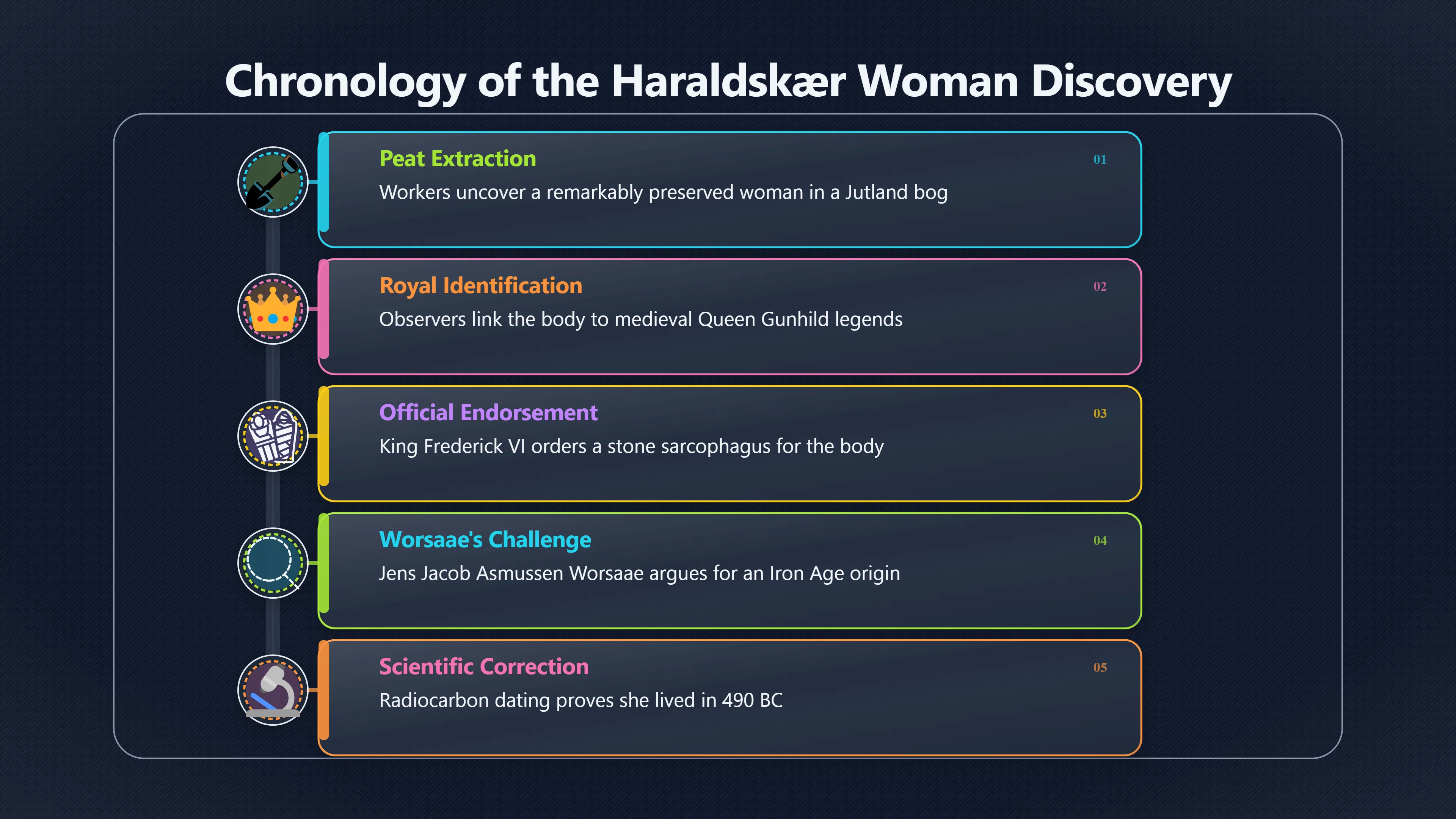
- The discovery and Queen Gunhild claim
- Why royal approval made the story persuasive
- How archaeology and radiocarbon dating overturned it
Page outline Jump by section
Introduction
The Haraldskær Woman is one of Denmark’s most revealing examples of how a powerful historical story can grow from a sincere mistake. When peat cutters uncovered the remarkably preserved body of a woman in a Jutland bog in 1835, many people quickly concluded that she was Queen Gunhild, a royal figure from medieval Scandinavian tradition who was said to have been drowned in a bog. The identification seemed to fit both the body and the saga. It was dramatic, patriotic and emotionally satisfying. Yet it was wrong. Later archaeological analysis and radiocarbon dating showed that the woman had died around the fifth century BC, roughly 1,500 years before the queen she was supposed to be.[Archaeology Magazine]archive.archaeology.orgMagazine Bodies of the BogsWhen they were found in the Gunnelsmose ("Gunhild's bog") on the Haraldskaer…Read more…

The story matters because it was not a deliberate forgery. Nobody invented the body. Instead, a genuine archaeological discovery was interpreted through the lens of a famous legend. The resulting “Viking queen” became a lesson in how authority, national pride and compelling narratives can sometimes outrun the evidence.
The Discovery and the Queen Gunhild Claim
In 1835, workers cutting peat on the Haraldskær estate near Vejle uncovered the body of a woman preserved by the acidic conditions of a bog. Her skin, hair and soft tissues survived in extraordinary condition, making the find appear almost recent despite its great age. The body had been carefully placed and weighed down with branches and poles, suggesting deliberate deposition in the bog.[Atlas Obscura]atlasobscura.comAtlas Obscura Haraldskær Woman in VejleAtlas ObscuraHaraldskær Woman in VejleMarch 23, 2012 — 23 Mar 2012 — In 1835, while excavating some peat on an estate in Jutland, Denmark…
Almost immediately, observers searched for a historical identity. They found one in the medieval stories surrounding Queen Gunhild, often known as Gunnhild, Mother of Kings. According to versions of the Jómsvíkinga saga and related traditions, Gunhild was drowned in a bog in Denmark on the orders of King Harald Bluetooth. The resemblance between a preserved woman found in a bog and a famous saga account appeared convincing to many nineteenth-century commentators.[Wikipedia]WikipediaGunnhild, Mother of KingsGunnhild, Mother of Kings
This was a classic case of matching evidence to a known story rather than asking whether the evidence independently supported the identification. The body was real. The saga was real. The leap was assuming that the two belonged together.
Why Royal Approval Made the Story Persuasive
The Gunhild identification gained extraordinary influence because it received support from powerful institutions. King Frederick VI accepted the idea that the remains belonged to a queen and ordered an elaborate stone sarcophagus for the body. The Haraldskær Woman was treated not as an anonymous archaeological find but as a royal personage worthy of honour.[archaeology.org]archive.archaeology.orgMagazine Bodies of the BogsWhen they were found in the Gunnelsmose ("Gunhild's bog") on the Haraldskaer…Read more…
Royal endorsement gave the theory an appearance of certainty. To the public, an official coffin suggested that the matter had been settled. In reality, the evidence remained circumstantial. The identification rested largely on the fact that a saga mentioned a queen dying in a bog and that a woman had been found in a bog.
The story also fitted the intellectual climate of the period. Early nineteenth-century archaeology was still developing its methods. Scholars often tried to connect discoveries directly to named figures from chronicles, legends and sagas. A spectacular body with an equally spectacular identity was more appealing than the possibility that the woman belonged to a distant and poorly understood prehistoric society.[Wikipedia]WikipediaJens Jacob Asmussen WorsaaeJens Jacob Asmussen Worsaae
The appeal spread beyond academic circles. Danish writers and playwrights incorporated the supposed queen into literature and popular culture. Some works reinforced the identification, while others mocked it, demonstrating how rapidly the debate entered public consciousness.[Wikipedia]WikipediaFemme d'HaraldskærFemme d'Haraldskær

The Archaeologist Who Questioned the Legend
The first serious challenge came from the young Danish archaeologist Jens Jacob Asmussen Worsaae. In the 1840s, Worsaae argued that the body belonged to the Iron Age rather than the Viking Age or medieval period. His conclusion was based on archaeological reasoning rather than literary tradition.[Wikipedia]WikipediaJens Jacob Asmussen WorsaaeJens Jacob Asmussen Worsaae
This was a significant moment in the history of archaeology. Worsaae belonged to a generation that increasingly relied on material evidence, stratigraphy and comparative analysis instead of trying to force finds into known historical narratives. He recognised that bog bodies appeared to belong to much earlier periods than the age of the Scandinavian sagas.[Wikipedia]WikipediaJens Jacob Asmussen WorsaaeJens Jacob Asmussen Worsaae
At the time, however, he could not provide the kind of precise dating that later science would make possible. His challenge was persuasive to some scholars but did not immediately erase the popular image of the murdered queen.
How Archaeology and Radiocarbon Dating Overturned the Story
The decisive evidence arrived more than a century later. Scientific dating methods, particularly radiocarbon analysis, established that the Haraldskær Woman lived around 490 BC during the pre-Roman Iron Age. That date placed her approximately fifteen centuries before the historical Gunhild described in medieval sources.[rug.nl]research.rug.nlQueen Gunhild of the Viking Age (we now know that the body actually predates this queen's reign by 1500.Read more…
The result transformed the case. The question was no longer whether the body belonged to Queen Gunhild. It demonstrably could not. Worsaae’s nineteenth-century objections had been correct.[Wikipedia]Wikipediawoman of the early Iron Age who lived…Read more…
Modern scientific work has continued to investigate the woman herself rather than searching for a legendary identity. Isotope studies have examined her movements and environment, suggesting that she may have travelled significant distances before her death. Researchers have analysed her clothing, hair and remains to learn about Iron Age life, mobility and ritual practices.[OpenEdition Journals]journals.openedition.orgOpenEdition JournalsStrontium isotope investigations of the Haraldskær WomanWe present the first comprehensive strontium isotope investig…
The focus shifted from “Which queen was she?” to questions that the evidence can actually answer.
Why the Viking Queen Story Refuses to Die
The mistaken identification survives because it offers something that archaeology often cannot: a complete narrative with named characters, motives and drama. “Unknown Iron Age woman” is historically accurate but emotionally sparse. “Murdered Viking queen” is vivid and memorable.
The Haraldskær Woman therefore occupies an unusual place in Denmark’s history of mistaken beliefs. Unlike a forgery, there was no fake object. Unlike a deliberate hoax, there was no obvious deceiver. The error emerged from a genuine attempt to understand an extraordinary discovery. What made the mistake powerful was the combination of a famous saga, an impressive archaeological find and the endorsement of respected authorities.[Archaeology Magazine]archive.archaeology.orgMagazine Bodies of the BogsWhen they were found in the Gunnelsmose ("Gunhild's bog") on the Haraldskaer…Read more…
The case remains a valuable reminder that official recognition is not the same as proof. A royal sarcophagus, a popular legend and widespread belief all gave the Gunhild theory prestige, but none of them supplied the evidence needed to establish identity. Only later scientific investigation could do that.
What the Haraldskær Woman Reveals About Historical Truth
The Haraldskær Woman stands at the boundary between legend and evidence. Her story shows how easily archaeology can be drawn into attractive historical narratives, especially when discoveries seem to confirm well-known texts. It also illustrates one of the strengths of modern archaeology: conclusions can be revised when new methods provide better evidence.
In Denmark’s wider history of debunked legends and mistaken identifications, the Haraldskær Woman is not remembered because anyone forged a queen. She is remembered because an anonymous Iron Age woman was transformed into one through interpretation alone. The later correction did more than identify an error. It demonstrated how historical knowledge advances when evidence is allowed to challenge even the most compelling stories.[rug.nl]research.rug.nlQueen Gunhild of the Viking Age (we now know that the body actually predates this queen's reign by 1500.Read more…
Amazon book picks
Further Reading
Books and field guides related to How a Bog Body Became a Viking Queen. Use these as the next step if you want deeper reading beyond the article.
Bog Bodies Uncovered
Directly covers interpretation of preserved bog bodies and their contexts.
Frauds, Myths, and Mysteries: Science and Pseudoscience in Ar...
Shows how attractive interpretations can outpace evidence.
Archaeology : theories, methods, and practice
Explains dating methods that corrected the mistaken identification.
eBay marketplace picks
Marketplace Samples
Live-tested eBay searches with available results related to this page.
Endnotes
1.
Source: archive.archaeology.org
Title: Magazine Bodies of the Bogs
Link:https://archive.archaeology.org/online/features/bog/gunhild.html
Source snippet
When they were found in the Gunnelsmose ("Gunhild's bog") on the Haraldskaer...Read more...
2.
Source: Wikipedia
Title: Gunnhild, Mother of Kings
Link:https://en.wikipedia.org/wiki/Gunnhild%2C_Mother_of_Kings
3.
Source: Wikipedia
Title: Jens Jacob Asmussen Worsaae
Link:https://en.wikipedia.org/wiki/Jens_Jacob_Asmussen_Worsaae
4.
Source: Wikipedia
Link:https://en.wikipedia.org/wiki/Haraldsk%C3%A6r_Woman
Source snippet
woman of the early Iron Age who lived...Read more...
5.
Source: Wikipedia
Title: Femme d’Haraldskær
Link:https://fr.wikipedia.org/wiki/Femme_d%27Haraldsk%C3%A6r
6.
Source: journals.openedition.org
Link:https://journals.openedition.org/archeosciences/4407?lang=en
Source snippet
OpenEdition JournalsStrontium isotope investigations of the Haraldskær WomanWe present the first comprehensive strontium isotope investig...
7.
Source: research.rug.nl
Link:https://research.rug.nl/files/6676734/2004JArchaeolScivdPlicht.pdf
Source snippet
Queen Gunhild of the Viking Age (we now know that the body actually predates this queen's reign by 1500.Read more...
8.
Source: atlasobscura.com
Title: Atlas Obscura Haraldskær Woman in Vejle
Link:https://www.atlasobscura.com/places/haraldsk-r-woman
Source snippet
Atlas ObscuraHaraldskær Woman in VejleMarch 23, 2012 — 23 Mar 2012 — In 1835, while excavating some peat on an estate in Jutland, Denmark...
Published: March 23, 2012
9.
Source: history.stackexchange.com
Link:https://history.stackexchange.com/questions/59019/why-did-frederick-vi-claim-the-haraldsk%C3%A6r-woman-was-a-norwegian-queen
Source snippet
History Stack ExchangeWhy did Frederick VI claim the Haraldskær Woman was a...4 May 2020 — Based upon the belief of her royal personage...
Published: May 2020
10.
Source: facebook.com
Link:https://www.facebook.com/archaeology22/photos/she-was-wrapped-in-careher-body-was-weighted-downand-she-was-placed-where-the-la/1475343131268398/
11.
Source: dlab.epfl.ch
Title: Haraldsk%C3%A6r Woman
Link:https://dlab.epfl.ch/wikispeedia/wpcd/wp/h/Haraldsk%25C3%25A6r_Woman.htm
Additional References
12.
Source: youtube.com
Title: Haraldskær Woman: The Bog Body That Was Nearly A Queen | Michaels Expeditions
Link:https://www.youtube.com/watch?v=7_iUyLkm52o
Source snippet
The Viking Witch Queen | Gunnhild the Mother of Kings...
13.
Source: youtube.com
Title: The Viking Witch Queen | Gunnhild the Mother of Kings
Link:https://www.youtube.com/watch?v=zGgMxlwLT-o
Source snippet
BOG BODIES! (Tollund Man, Grauballe Man, and Haraldskaer Woman)...
14.
Source: researchgate.net
Link:https://www.researchgate.net/publication/292816969Strontium_Isotope_Investigations_of_the_Haraldskaer_Woman-_A_Complex_Record_of_Various_Tissues
15.
Source: researchgate.net
Link:https://www.researchgate.net/figure/The-Haraldskaer-woman-and-Queen-Gunhild-Kulturmuseet-Spinderihallerne-Photograph-M_fig6_341121242
16.
Source: reddit.com
Link:https://www.reddit.com/r/wikipedia/comments/1tseiuj/the_haraldsk%C3%A6r_woman_is_the_name_given_to_a_bog/
17.
Source: scribd.com
Link:https://www.scribd.com/document/144182750/Haraldsk%C3%A6r-Woman
18.
Source: facebook.com
Link:https://www.facebook.com/groups/archaeologyhistore/posts/4420456018187678/
19.
Source: ancient-origins.net
Title: gunnhild misidentified bog body and mother kings norse sagas 005731
Link:https://www.ancient-origins.net/myths-legends-europe/gunnhild-misidentified-bog-body-and-mother-kings-norse-sagas-005731
20.
Source: nationalgeographic.com
Title: 140718 bog bodies denmark archaeology science iron age
Link:https://www.nationalgeographic.com/history/article/140718-bog-bodies-denmark-archaeology-science-iron-age
21.
Source: youtube.com
Link:https://www.youtube.com/watch?v=emg0cR1kMVM
Source snippet
Haraldskær Woman: The Bog Body That Was Nearly A Queen | Michaels Expeditions...
Topic Tree