Why America's Most Famous Hoaxes Seemed Believable
The history of hoaxes in the United States is not a simple parade of foolish people believing ridiculous things.
Page outline Jump by section
Introduction
From lunar “bat-men” and petrified giants to fake colonial relics, staged emergencies and invented online identities, American hoaxes repeatedly exploited the authority of science, journalism, museums or eyewitness testimony. Exposure usually came through patient checking rather than instant scepticism: examining materials, tracing provenance, reproducing physical tricks, comparing contradictory records or locating the supposedly missing person. The enduring lesson is that convincing falsehoods are rarely built from fantasy alone. They borrow the appearance of trusted institutions and spread through media systems that reward surprise before verification.
When newspapers discovered that wonder could sell
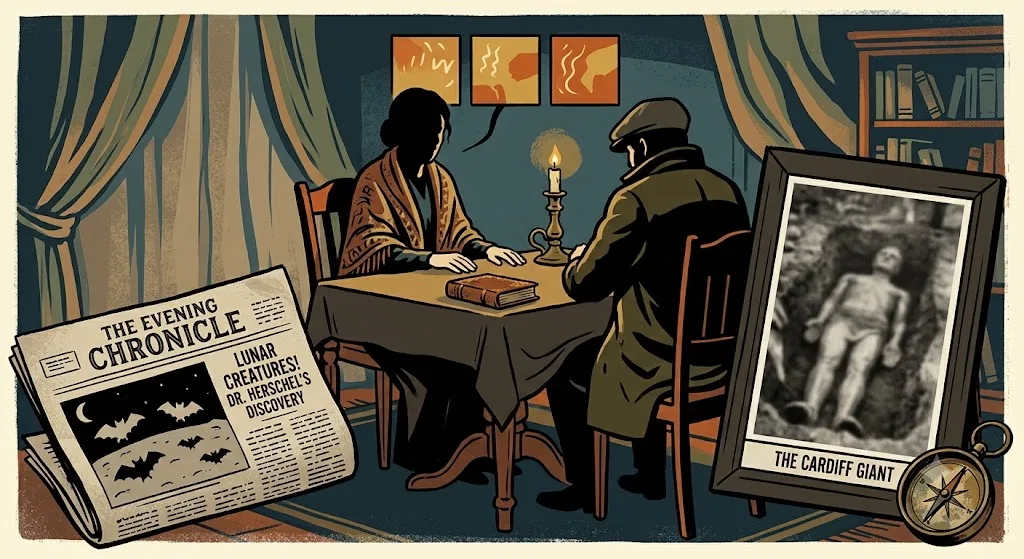
One of the earliest great American media hoaxes appeared in August 1835, when the New York Sun published a series claiming that astronomer Sir John Herschel had discovered life on the Moon through an extraordinary new telescope. The supposed inhabitants included unicorn-like animals, intelligent beavers and winged humanoids. Illustrations gave the story the visual authority of scientific reporting, while Herschel’s real reputation supplied a borrowed seal of credibility. The articles were fiction, written by Sun editor Richard Adams Locke, but they were presented as reports derived from a serious scientific publication.[loc.gov]loc.govOpen source on loc.gov.
The Great Moon Hoax belonged to the expanding “penny press”, which depended on mass sales rather than a small, elite readership. An astonishing discovery could therefore be profitable even if doubts followed later. The Sun gained attention and circulation, while readers encountered a mixture of scientific language, satire and spectacle whose status was deliberately unclear. The hoax also arrived when astronomy was producing genuine discoveries that were difficult for non-specialists to assess. Readers did not have to believe in lunar bat-people in general; they merely had to believe that a celebrated astronomer, using an unfamiliar instrument in a distant observatory, might have seen something extraordinary.
This formula became central to later American fakery: attach an unlikely claim to a genuine authority, place it beyond easy inspection and publish it through a medium whose apparent seriousness discourages immediate disbelief. Newspapers were not merely innocent conduits. Sensational stories increased sales, and later corrections rarely travelled with the force of the original marvel.
P. T. Barnum turned the same economy of curiosity into live entertainment. In 1842 he promoted the “Feejee Mermaid”, a grotesque preserved object presented as a genuine mermaid. It was apparently assembled from animal parts, but Barnum surrounded it with fabricated correspondence, a false naturalist and carefully distributed illustrations. Several newspapers reproduced the images believing they had privileged access, generating publicity before the object went on display. Ticket sales at Barnum’s American Museum reportedly surged.[livescience.com]livescience.comLive Science The Feejee Mermaid: Early Barnum HoaxBy Jessie… In 1897, Kimball's heirs donated a fake mermaid to Harvard University's Peabody Museum.Read more…
Barnum’s method was more sophisticated than simply announcing a monster. He manufactured an argument around it. Conflicting claims, supposed expert reluctance and newspaper discussion encouraged the public to pay for the opportunity to decide. Exposure did not necessarily destroy the attraction, because uncertainty was part of the product. The customer bought admission not only to see a mermaid but to participate in a public dispute over whether it was real.

Giants, skulls and relics that rewrote the past
Forged antiquities are especially persuasive when they appear to settle a disputed historical or religious question. The Cardiff Giant, “discovered” on a farm in Cardiff, New York, in October 1869, seemed to be the petrified body of an enormous man. Visitors paid to see the ten-foot figure, while arguments developed over whether it was a fossilised human or an ancient statue. In fact, George Hull had commissioned the carving, artificially aged it and arranged for its burial. His motives included profit and mockery of literal interpretations of biblical giants.[Smithsonian Magazine]smithsonianmag.comSmithsonian Magazine The Cardiff Giant Was Just a Big HoaxSmithsonian MagazineThe Cardiff Giant Was Just a Big HoaxOctober 16, 2017 — 16 Oct 2017 — The story, which began on this day in 1869, was…
The giant was plausible because it arrived at the meeting point of religion, archaeology and commercial exhibition. Its promoters did not need to prove one interpretation. It was enough to encourage clergy, scientists, reporters and spectators to disagree in public. P. T. Barnum even commissioned a copy after failing to obtain the original, producing the extraordinary spectacle of a fraudulent artefact competing with an unauthorised imitation.
California supplied two similarly instructive cases. The Calaveras Skull was presented in the 1860s as evidence that humans had lived in California in deep antiquity. The supposed association between the skull and ancient geological deposits supported state geologist Josiah Whitney’s ideas about early humanity in North America. Critics later concluded that a comparatively recent Indigenous skull had been planted as a practical joke on Whitney. Despite the exposure, the object continued to appear in arguments about human origins, showing how a discredited artefact can survive when it supports an existing ideological position.[Archaeology Magazine]archive.archaeology.orgMagazine Archaeology MagazineMagazine Archaeology Magazine
Drake’s Plate of Brass demonstrates how scholarly desire can overpower warning signs. Historical accounts said that the English privateer Francis Drake had left a metal plate in California in 1579. In the 1930s, a plate matching the description appeared and was enthusiastically accepted by the eminent University of California historian Herbert Eugene Bolton. It was acquired by the Bancroft Library and treated as a major colonial relic.[Berkeley News]newsarchive.berkeley.edu18 drake.shtml18 drake.shtml
The plate had been created by members of E Clampus Vitus, a historical fraternity, as a joke aimed at Bolton. Once the scholar publicly endorsed it, the prank became difficult to confess without causing serious embarrassment. Scientific testing decades later showed that the brass, manufacturing methods and chemical characteristics were modern. Researchers eventually reconstructed how a private joke had escaped its creators and become an institutional mistake.[berkeley.edu]newsarchive.berkeley.edu18 drake.shtml18 drake.shtml
The case matters because the plate did not fool experts by being flawless. It fooled them by satisfying a celebrated researcher’s long-held hope. Institutional prestige then amplified the initial error: once a respected scholar and library had accepted the plate, later observers had to challenge not merely an object but an established chain of authority.
The Kensington Runestone, found in Minnesota in 1898, occupies a more contested border between fraud, disputed artefact and regional legend. Its inscription appears to record a Scandinavian expedition to North America in 1362. Most specialists have regarded the inscription as inauthentic, pointing to linguistic and historical problems, but no universally accepted account has settled exactly who produced it or why. The stone therefore persists not as a fully resolved fraud but as a case in which local identity, migration history and hope for a dramatic pre-Columbian past continue to compete with the scholarly majority view.[mnhs.org]mnhs.orgKensington Runestone | MNopediaKensington Runestone | MNopedia
Spiritualism sold a technology of belief
The Fox sisters helped launch modern American Spiritualism after mysterious rapping noises were heard in their family home in Hydesville, New York, in 1848. The sounds appeared to answer questions through a coded sequence of knocks. Public demonstrations followed, and the sisters became famous mediums at a time when bereavement, religious experimentation and fascination with electricity and telegraphy encouraged belief that communication with the dead might be possible.[Wikipedia]WikipediaFox sistersFox sisters
The rappings were effective because they were simple, repeatable and apparently interactive. A spectator could ask a question and receive an answer without seeing an obvious apparatus. Critics investigated the physical conditions of the performances and noted that the sounds remained close to the sisters’ bodies. Examiners proposed that joints in the feet or legs produced the knocks, and some demonstrations failed when the sisters’ movement was restricted or their feet were cushioned.
In 1888, Margaret Fox publicly stated that the noises had been made by bodily manipulation and demonstrated loud raps before an audience. She later withdrew her confession, while Spiritualists argued that financial need or pressure had influenced her. That recantation means the episode cannot be reduced to a single neat moment of exposure. Nevertheless, the accumulated investigations, demonstrations of natural methods and contradictory statements severely weakened the supernatural claim.[Wikipedia]WikipediaFox sistersFox sisters
The Fox story also reveals why exposing a technique does not always dissolve a movement. Spiritualism offered community, consolation and a framework for understanding death. Many believers were therefore evaluating more than a noise made in a darkened room. A mechanical explanation threatened a wider emotional and religious commitment, making rejection of the debunking psychologically easier than abandoning the belief.
The famous Martian panic was partly a media creation
Orson Welles’s 1938 radio adaptation of The War of the Worlds is often described as a hoax that caused nationwide mass hysteria. Neither part of that familiar description is entirely accurate. The programme was a clearly fictional drama, although much of its opening used simulated news bulletins reporting explosions on Mars, a landing in New Jersey and a spreading alien attack. Some listeners who joined late or missed announcements did mistake the broadcast for genuine news. A small number fled, telephoned authorities or experienced intense fear.[Wikipedia]WikipediaThe War of the Worlds (1938 radio dramaThe War of the Worlds (1938 radio drama
What is doubtful is the scale of the panic. Later research indicates that the programme’s audience was smaller than early estimates suggested and that contemporary newspapers magnified scattered incidents into a story of national breakdown. Print publishers had a commercial reason to portray radio, their rapidly growing rival, as reckless and dangerous. Letters sent to Welles and the Federal Communications Commission show genuine alarm, but frightened correspondents were a minority rather than evidence that millions had taken to the streets.[wikipedia.org]WikipediaThe War of the Worlds (1938 radio dramaThe War of the Worlds (1938 radio drama
The episode therefore contains two layers of contested truth. First came a drama that borrowed the sound of emergency broadcasting. Then came an exaggerated newspaper narrative about what the drama had done. The lasting “panic” legend demonstrates how a debunked or qualified account can survive because it offers an irresistible parable: modern citizens, overwhelmed by a powerful new medium, mistake fiction for reality.
Photographs and flying objects borrowed the authority of the camera
Photography acquired a reputation as an objective witness, but American hoaxers quickly learnt that a photograph does not authenticate itself. It records whatever was placed before the lens, or whatever manipulation occurred during or after exposure. Distance, blur and lack of scale can make ordinary objects appear inexplicable.
Records from the US Air Force’s Project Blue Book include a 1951 photograph from Riverside, California, sold to a news agency as an image of an unidentified flying object. Investigators interviewed people who described the photographer as a capable prankster. After initially avoiding examination, he admitted in 1952 that the image was a hoax. The case was closed, but the photograph’s original news value had depended less on detailed evidence than on the apparently mechanical honesty of the camera.[Pieces of History]prologue.blogs.archives.govPieces of History UFOs: Man-Made, Made Up, and UnknownPieces of History UFOs: Man-Made, Made Up, and Unknown
Project Blue Book files also illustrate the need to distinguish hoaxes from unresolved sightings. Some reports were explained as aircraft, astronomical objects, photographic effects or deliberate fakes; others remained “unknown” because available information was too limited. Unknown did not mean extraterrestrial. It meant investigators lacked enough evidence for a confident identification. Treating every unexplained image as either an alien craft or a proven fraud collapses an important middle category: a claim can remain unresolved without becoming extraordinary.
That distinction is particularly useful in American monster folklore. Bigfoot photographs, films and footprints have generated confessions, allegations of costume use and demonstrable fakes, but not every sighting has a known hoaxer. Many may involve misidentification, folklore, expectation or sincere error. The appropriate conclusion is not that every witness deliberately lied, but that the evidence has not established the existence of the creature.
Viral publicity changed the speed, not the basic mechanism
By the late twentieth century, entertainment campaigns were deliberately blurring fiction and documentary form. The Blair Witch Project was released in 1999 as a found-footage horror film assembled from tapes supposedly left by three missing student filmmakers. Its marketing included a website with fabricated police material and news-style reports, while festival publicity presented the characters as missing. Some viewers encountered the invented background before learning that the film was fictional.[theguardian.com]theguardian.comThe Guardian How The Blair Witch Project changed horror for everThe Guardian How The Blair Witch Project changed horror for ever
This was not a fraud in the same legal or scholarly sense as the Cardiff Giant or Drake’s Plate. It was commercial storytelling whose deception was expected eventually to become clear. Yet the campaign is historically significant because it showed how the early web could make a fictional world appear independently documented. A film, mock documentary, missing-person notice and website seemed like separate sources when they were parts of one coordinated production.
The “balloon boy” incident in Colorado in October 2009 showed the same media dynamics operating during live news. Authorities were told that six-year-old Falcon Heene might be inside a homemade helium balloon drifting across the state. Television networks followed the balloon while emergency services mobilised. The child was later found at home. Suspicion deepened after he told his father during a television interview that they had done it “for the show”.[Wikipedia]WikipediaBalloon boy hoaxBalloon boy hoax
Officials concluded that the event had been staged to attract publicity, possibly for a reality television opportunity. Richard Heene pleaded guilty to attempting to influence a public servant, and Mayumi Heene pleaded guilty to making a false report; both were pardoned by Colorado’s governor in 2020. Richard later maintained that his guilty plea had been intended to protect his wife from possible immigration consequences, leaving the family’s later account in tension with the prosecutions and admissions.[theguardian.com]theguardian.comcouple behind 2009 balloon boy hoax in us granted pardonscouple behind 2009 balloon boy hoax in us granted pardons
The incident succeeded because rolling news could not pause for complete verification while a child might be in danger. The possible cost of ignoring the story was far greater than the cost of covering it. Hoaxers can exploit precisely this imbalance: responsible institutions must sometimes act on uncertain information when life appears to be at risk.
The Manti Te’o affair in 2013 demonstrated a different internet-era weakness. The celebrated college football player had spoken publicly about the death of his girlfriend, Lennay Kekua, from leukaemia. Deadspin reporters found that Kekua did not exist and that photographs associated with her belonged to another woman. A fictitious identity had been maintained through social-media accounts, messages and telephone calls.[deadspin.com]deadspin.commanti teos dead girlfriend the most heartbreaking an 5976517manti teos dead girlfriend the most heartbreaking an 5976517
The exposure also revealed failures in mainstream sports journalism. Reporters repeatedly retold the emotional story without locating an obituary, funeral record, family member or independent trace of Kekua’s life. Te’o was widely mocked, although later accounts treated him primarily as the victim of an elaborate catfishing deception. The episode shows how a compelling personal narrative can pass through several reputable outlets when each assumes that someone else has checked the basic facts.
Why American hoaxes keep their power after exposure
The best-known United States hoaxes tend to survive because the correction is less memorable than the claim. A petrified giant is vivid; a geological analysis is not. A radio audience fleeing Martians is a perfect cultural story; a qualified dispute over audience surveys is harder to repeat. A mysterious rune stone can become a symbol of regional heritage even when specialists reject its inscription.
Several recurring forces help these stories endure:
- Borrowed authority. Hoaxes imitate scientific papers, news bulletins, police files, museum labels, photographs or expert testimony.
- Commercial reward. Newspaper circulation, admission charges, television exposure, film publicity and online attention provide direct incentives.
- Emotional fit. Claims spread when they support hope, grief, religious conviction, local pride, fear or a satisfying moral lesson.
- Institutional momentum. Once a respected scholar, broadcaster or museum endorses something, reversing the judgement becomes socially costly.
- Unequal speed. A startling claim can circulate in minutes; laboratory testing, archival research and careful interviews may take months or decades.
- Ambiguous exposure. Confessions may be recanted, perpetrators may disagree, and incomplete records can leave enough uncertainty for believers to continue.
The central question is therefore not why Americans were gullible. Every case involved particular technologies, incentives and trusted authorities. The more useful question is what made verification difficult at that moment. The Great Moon Hoax exploited distance from scientific observation. Barnum exploited publicity disguised as debate. Forged artefacts exploited scholarly ambition and weak provenance. Spiritualist tricks exploited darkness, grief and bodily concealment. Modern media stunts exploit the urgency of live coverage and the tendency to confuse several coordinated accounts with independent confirmation.
A reliable response is equally consistent across eras: identify the original source, ask who benefits, separate eyewitness claims from physical evidence, examine the chain of custody and look for genuinely independent confirmation. Famous hoaxes remain entertaining, but their deeper value lies in showing how truth is established — and how easily the appearance of evidence can be manufactured before the real investigation begins.
Amazon book picks
Further Reading
Books and field guides related to Why America's Most Famous Hoaxes Seemed Believable. Use these as the next step if you want deeper reading beyond the article.
A Field Guide to Lies
Explains why misleading claims and persuasive falsehoods are believed.
Hoax: A History of Deception
Directly covers historical hoaxes and how they fooled people.
eBay marketplace picks
Marketplace Samples
Live-tested eBay searches with available results related to this page.


Endnotes
1.
Source: hoaxes.org
Title: the feejee mermaid
Link:https://hoaxes.org/archive/permalink/the_feejee_mermaid
Source snippet
(1842)Finally, the mermaid itself was a fake, and Barnum knew it. He had leased... Art Hoaxes · Bigfoot · Fake Viral Images · Hoax Photo...
2.
Source: Wikipedia
Title: Cardiff Giant
Link:https://en.wikipedia.org/wiki/Cardiff_Giant
3.
Source: archive.archaeology.org
Title: Magazine Archaeology Magazine
Link:https://archive.archaeology.org/online/features/hoaxes/calaveras.html
4.
Source: newsarchive.berkeley.edu
Title: 18 drake.shtml
Link:https://newsarchive.berkeley.edu/news/media/releases/2003/02/18_drake.shtml
5.
Source: Wikipedia
Title: Drake’s Plate of Brass
Link:https://en.wikipedia.org/wiki/Drake%27s_Plate_of_Brass
6.
Source: mnhs.org
Title: Kensington Runestone | MNopedia
Link:https://www.mnhs.org/mnopedia/search/index/thing/kensington-runestone
7.
Source: Wikipedia
Title: Fox sisters
Link:https://en.wikipedia.org/wiki/Fox_sisters
8.
Source: Wikipedia
Title: The War of the Worlds (1938 radio drama)
Link:https://en.wikipedia.org/wiki/The_War_of_the_Worlds_%281938_radio_drama%29
9.
Source: syfy.com
Title: blair witch project real fake 22nd anniversary
Link:https://www.syfy.com/syfy-wire/blair-witch-project-real-fake-22nd-anniversary
10.
Source: Wikipedia
Title: Balloon boy hoax
Link:https://en.wikipedia.org/wiki/Balloon_boy_hoax
11.
Source: reuters.com
Title: balloon boy parents pardoned by colorado governor over 2009 hoax 2020 12 24
Link:https://www.reuters.com/world/us/balloon-boy-parents-pardoned-by-colorado-governor-over-2009-hoax-2020-12-24/
12.
Source: history.com
Title: balloon boy parents sentenced in colorado
Link:https://www.history.com/this-day-in-history/december-23/balloon-boy-parents-sentenced-in-colorado
13.
Source: deadspin.com
Title: manti teos dead girlfriend the most heartbreaking an 5976517
Link:https://deadspin.com/manti-teos-dead-girlfriend-the-most-heartbreaking-an-5976517/
14.
Source: Wikipedia
Title: Fiji mermaid
Link:https://en.wikipedia.org/wiki/Fiji_mermaid
15.
Source: Wikipedia
Title: Great Moon Hoax
Link:https://en.wikipedia.org/wiki/Great_Moon_Hoax
16.
Source: Wikipedia
Title: Calaveras Skull
Link:https://en.wikipedia.org/wiki/Calaveras_Skull
17.
Source: Wikipedia
Title: Kensington Runestone
Link:https://en.wikipedia.org/wiki/Kensington_Runestone
18.
Source: hoaxes.org
Title: the calaveras skull
Link:https://hoaxes.org/archive/permalink/the_calaveras_skull
19.
Source: arf.berkeley.edu
Title: drake brass
Link:https://arf.berkeley.edu/videos/drake-brass
20.
Source: archive.archaeology.org
Link:https://archive.archaeology.org/online/features/hoaxes/giants.html
21.
Source: loc.gov
Link:https://www.loc.gov/pictures/item/2003665049/marc/
22.
Source: airandspace.si.edu
Title: service pnp pga 02600 02667rjpeg
Link:https://airandspace.si.edu/multimedia-gallery/image/service-pnp-pga-02600-02667rjpeg
Source snippet
National Air and Space MuseumThe Great Moon HoaxIn 1835, the New York newspaper The Sun published a series of stories about astronomers d...
23.
Source: livescience.com
Title: Live Science The Feejee Mermaid: Early Barnum Hoax
Link:https://www.livescience.com/56037-feejee-mermaid.html
Source snippet
By Jessie... In 1897, Kimball's heirs donated a fake mermaid to Harvard University's Peabody Museum.Read more...
24.
Source: smithsonianmag.com
Title: Smithsonian Magazine The Cardiff Giant Was Just a Big Hoax
Link:https://www.smithsonianmag.com/smart-news/cardiff-giant-was-just-big-hoax-180965274/
Source snippet
Smithsonian MagazineThe Cardiff Giant Was Just a Big HoaxOctober 16, 2017 — 16 Oct 2017 — The story, which began on this day in 1869, was...
Published: October 16, 2017
25.
Source: www2.lbl.gov
Link:https://www2.lbl.gov/Science-Articles/Archive/NSD-Drakes-plate.html
26.
Source: smithsonianmag.com
Title: a very common delusion spiritualism and the fox sisters 97825064
Link:https://www.smithsonianmag.com/history/a-very-common-delusion-spiritualism-and-the-fox-sisters-97825064/
27.
Source: vanityfair.com
Title: broadcast hysteria orson welles war of the worlds
Link:https://www.vanityfair.com/culture/2015/04/broadcast-hysteria-orson-welles-war-of-the-worlds
28.
Source: prologue.blogs.archives.gov
Title: Pieces of History UFOs: Man-Made, Made Up, and Unknown
Link:https://prologue.blogs.archives.gov/2018/04/23/ufos-man-made-made-up-and-unknown/
29.
Source: theguardian.com
Title: The Guardian How The Blair Witch Project changed horror for ever
Link:https://www.theguardian.com/film/2019/apr/08/how-the-blair-witch-project-changed-horror-for-ever
30.
Source: theguardian.com
Title: boy in balloon hoax
Link:https://www.theguardian.com/world/2009/nov/12/boy-in-balloon-hoax
31.
Source: theguardian.com
Title: couple behind 2009 balloon boy hoax in us granted pardons
Link:https://www.theguardian.com/us-news/2020/dec/24/couple-behind-2009-balloon-boy-hoax-in-us-granted-pardons
32.
Source: theguardian.com
Title: manti teo girlfriend hoax notre dame
Link:https://www.theguardian.com/sport/2013/jan/17/manti-teo-girlfriend-hoax-notre-dame
33.
Source: text-message.blogs.archives.gov
Title: fake news 1942 president roosevelt and the chicago tribune
Link:https://text-message.blogs.archives.gov/2018/02/01/fake-news-1942-president-roosevelt-and-the-chicago-tribune/
34.
Source: archives.gov
Link:https://www.archives.gov/publications/prologue/2016/winter/zimmermann-telegram
35.
Source: archives.gov
Title: old army
Link:https://www.archives.gov/research/alic/periodicals/nara-citations/old-army.html
36.
Source: text-message.blogs.archives.gov
Link:https://text-message.blogs.archives.gov/page/59/?cat=-1
37.
Source: hoover.archives.gov
Link:https://hoover.archives.gov/research/collections/manuscriptfindingaids/parrishfrances
38.
Source: trumpwhitehouse.archives.gov
Title: remarks president trump marine one departure 44
Link:https://trumpwhitehouse.archives.gov/briefings-statements/remarks-president-trump-marine-one-departure-44/
39.
Source: archives.gov
Title: rg156 birmingham 7130307
Link:https://www.archives.gov/atlanta/finding-aids/rg156-birmingham-7130307.html
40.
Source: archives.gov
Link:https://www.archives.gov/research/jfk/select-committee-report/references1-jfk.html
41.
Source: hoover.archives.gov
Link:https://hoover.archives.gov/research/manuscript-collections/knight
42.
Source: archives.gov
Link:https://www.archives.gov/research/guide-fed-records/groups/226.html
43.
Source: archives.gov
Link:https://www.archives.gov/research/alic/periodicals/nara-citations/justice.html
44.
Source: archives.gov
Title: R G 156
Link:https://www.archives.gov/atlanta/finding-aids/rg156-kingsport-6883884.html
45.
Source: archives.gov
Title: R G 156
Link:https://www.archives.gov/atlanta/finding-aids/rg156-milan-7050582.html
46.
Source: archives.gov
Title: 2020 mayjune
Link:https://www.archives.gov/files/kansas-city/press/newsletter/2020-mayjune.pdf
47.
Source: smithsonianmag.com
Title: the smithsonians crystal skull 51638609
Link:https://www.smithsonianmag.com/history/the-smithsonians-crystal-skull-51638609/
48.
Source: clements.umich.edu
Title: life on the moon
Link:https://clements.umich.edu/publication/the-heavens/life-on-the-moon/
49.
Source: publicdomainreview.org
Title: cardiff giant
Link:https://publicdomainreview.org/collection/cardiff-giant/
50.
Source: brucemuseum.org
Title: the cardiff giant
Link:https://brucemuseum.org/discover/the-cardiff-giant/
51.
Source: blogs.loc.gov
Title: the great moon hoax
Link:https://blogs.loc.gov/folklife/2014/08/the-great-moon-hoax/
52.
Source: nofilmschool.com
Title: blair witch project
Link:https://nofilmschool.com/blair-witch-project
53.
Source: ejumpcut.org
Title: Blair Witch
Link:https://www.ejumpcut.org/archive/onlinessays/JC43folder/BlairWitch.html
Additional References
54.
Source: newyorker.com
Link:https://www.newyorker.com/books/page-turner/lunatic-journalism
Source snippet
The Sun, a populist and abolitionist penny paper, published sensational articles by Richard Adams Locke, falsely claiming astronomer Sir...
55.
Source: newyorker.com
Title: The New Yorker What P
Link:https://www.newyorker.com/magazine/2019/08/05/what-p-t-barnum-understood-about-america
Source snippet
T. Barnum Understood About AmericaThe article discusses P. T. Barnum, a 19th-century American showman, who skillfully understood and capi...
56.
Source: youtube.com
Title: The ‘Great Moon Hoax’ that fooled the world – BBC REEL
Link:https://www.youtube.com/watch?v=93BHCewPiPU
Source snippet
The 10-Foot Giant That Fooled America — Thousands Believed It...
57.
Source: youtube.com
Title: The 10-Foot Giant That Fooled America — Thousands Believed It
Link:https://www.youtube.com/watch?v=xAAxXc2gEQg
Source snippet
The Real Story Behind The War Of The Worlds Panic...
58.
Source: wired.com
Link:https://www.wired.com/1999/07/black-magic
59.
Source: calaverashistory.org
Link:https://www.calaverashistory.org/calaveras-skull
60.
Source: reddit.com
Link:https://www.reddit.com/r/Scarymovies/comments/ym6tix/did_you_know_the_advertising_efforts_for_the/
61.
Source: facebook.com
Link:https://www.facebook.com/groups/quirkymn/posts/1801007780289692/
62.
Source: facebook.com
Link:https://www.facebook.com/groups/3216444998655835/posts/3610552985911699/
63.
Source: history.co.uk
Link:https://www.history.co.uk/shows/secrets-of-the-viking-stone/the-kensington-runestone-a-viking-mystery
Topic Tree
Follow this branch
Related pages 192
- Albanian Hoaxes
- Algerian Hoaxes
- Antigua Deceptions
- Argentina Hoaxes
- Armenian Hoaxes
- +187 more in sidebar