Within Haiti
Who Profited From Haiti's Black Legend?
Stories of cannibalism, sorcery and savagery helped recast foreign domination of Haiti as rescue rather than empire.
On this page
- How the legend formed after the revolution
- Cannibal cults, sorcery and invented savagery
- How occupation turned stereotypes into political cover
Page outline Jump by section
Introduction
Haiti’s “Black Legend” was not a single invented story but a long-running propaganda tradition that portrayed the world’s first independent Black republic as uniquely savage, irrational and incapable of governing itself. After Haiti won its independence in 1804 through a successful revolt against slavery and French colonial rule, hostile politicians, journalists, travellers and colonial interests repeatedly circulated tales of cannibalism, sorcery, blood rituals and permanent chaos. These claims varied in detail, but they served a common purpose: they transformed a revolutionary challenge to slavery and racial hierarchy into a cautionary tale about Black self-government. Historians have argued that such narratives helped justify diplomatic isolation, economic punishment, missionary intervention and military occupation by presenting foreign control as a civilising mission rather than an imperial project.[historytoday.com]historytoday.comhaitis black legend zombies cannibals and werewolvesHistory TodayHaiti's Black Legend: Zombies, Cannibals and WerewolvesMar 3, 2021 — The complexities of Haitian Vodou were misunderstood an…
The importance of the Black Legend lies not in whether every sensational story was entirely fabricated. Some accounts drew on real crimes, genuine religious practices or political violence. The propaganda mechanism worked by treating isolated incidents as proof of a national character and by presenting Haitian culture through the most frightening stereotypes available to foreign audiences.[historytoday.com]historytoday.comhaitis black legend zombies cannibals and werewolvesHistory TodayHaiti's Black Legend: Zombies, Cannibals and WerewolvesMar 3, 2021 — The complexities of Haitian Vodou were misunderstood an…
Who Profited From Haiti’s Black Legend?
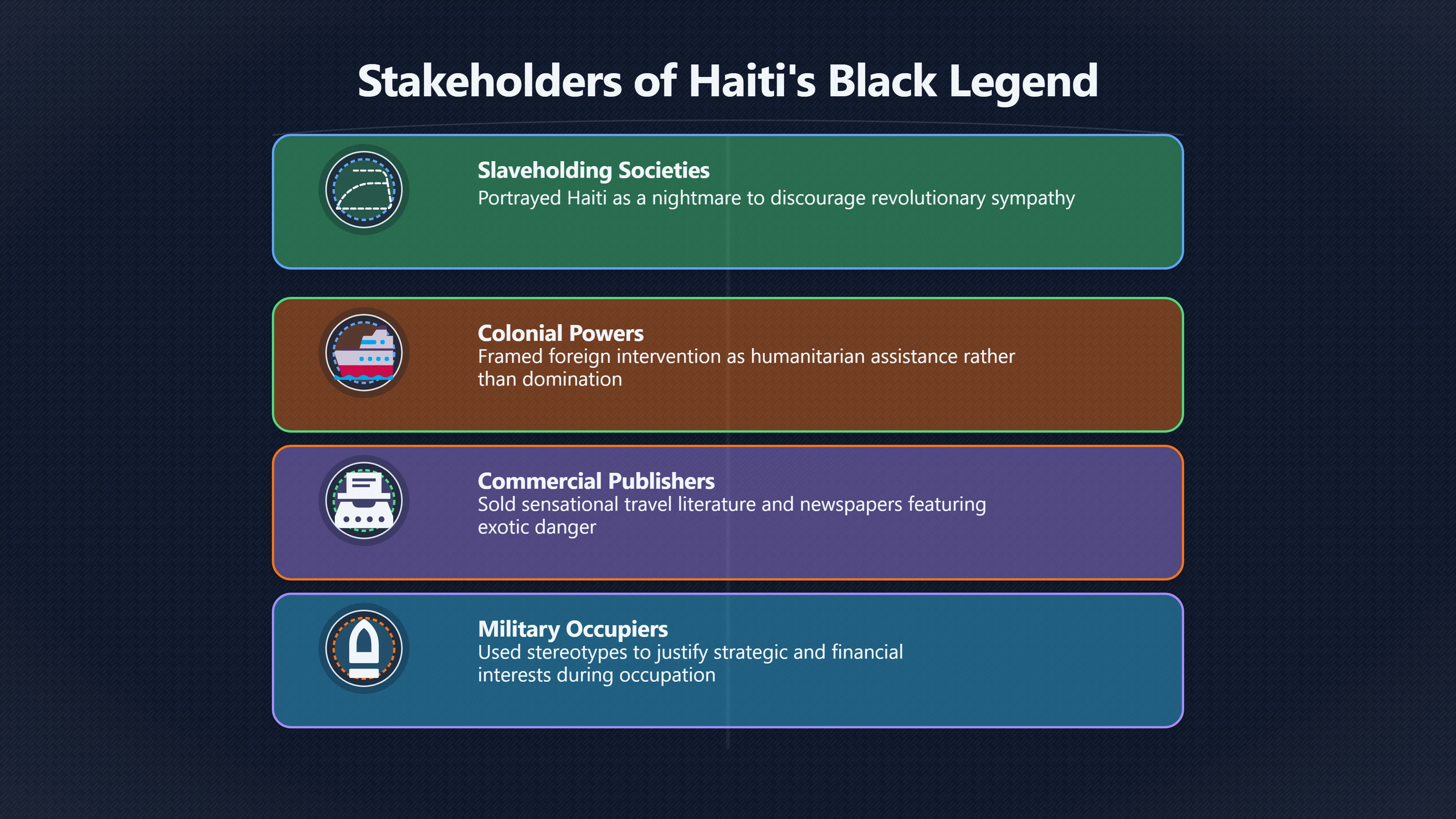
The Black Legend benefited a wide range of interests. Slaveholding societies in the Americas had an obvious reason to portray Haiti as a nightmare. The Haitian Revolution demonstrated that enslaved people could overthrow colonial rule and establish an independent state. Depicting the new republic as barbaric helped discourage sympathy for similar movements elsewhere and reinforced arguments that slavery and racial hierarchy were necessary for social order.[HNN]historynewsnetwork.orgoverturning five myths of the haitian revolutionHNNOverturning Five Myths of the Haitian RevolutionAug 4, 2021 — Recent media efforts to contextualize the assassination of Haiti's presi…
Colonial powers also gained a useful political narrative. If Haiti could be represented as a failed experiment in Black freedom, then foreign intervention could be framed as humanitarian assistance rather than domination. Throughout the nineteenth century, Haiti faced diplomatic isolation and economic pressure, including France’s demand for a massive indemnity in exchange for recognising Haitian independence. The image of Haiti as unstable and uncivilised made such treatment easier to defend in international politics.[Le Monde.fr]lemonde.frLe Monde.fr The grim legacy of Haiti's 'double debtIn 1825, under threat from a French naval fleet, Haitian President Jean-Pierre Boyer accepted an ordinance from French King Charles X tha…
Commercial publishers profited as well. Sensational travel literature, newspaper features and later popular culture found eager audiences for stories about zombies, secret societies, human sacrifice and exotic danger. Fear sold books, newspapers and entertainment far more effectively than nuanced descriptions of Haitian society.[History Today]historytoday.comhaitis black legend zombies cannibals and werewolvesHistory TodayHaiti's Black Legend: Zombies, Cannibals and WerewolvesMar 3, 2021 — The complexities of Haitian Vodou were misunderstood an…
How the Legend Formed After the Revolution
The roots of the Black Legend appeared almost immediately after independence. The success of a revolution led by formerly enslaved people challenged deeply entrenched racial assumptions across Europe and the Americas. Many observers struggled to fit Haiti into prevailing ideas about race, civilisation and political authority.
Rather than treating Haiti as evidence that enslaved people could successfully fight for freedom, many writers reframed the revolution as proof of racial violence and revenge. Images, pamphlets and newspaper accounts disproportionately highlighted attacks on whites while ignoring the wider context of slavery, colonial warfare and the brutal French attempt to restore slavery. The result was a distorted memory in which Haitian violence appeared inexplicable while colonial violence faded into the background.[race.ed.ac.uk]race.ed.ac.ukOpen source on ed.ac.uk.
Historian Michel-Rolph Trouillot famously argued that the Haitian Revolution was often “silenced” or rendered difficult to comprehend within dominant Western historical narratives. One response to that challenge was to reduce Haiti to a story of disorder. Rather than recognising a revolutionary state founded on anti-slavery principles, critics portrayed a land supposedly trapped by primitive instincts and incapable of modern government.[The New Yorker]newyorker.comDespite Louverture's significant achievements, including the abolition of slavery in the French colonies, his contributions are largely a…
This process gave the Black Legend remarkable durability. New generations inherited a ready-made framework into which almost any alarming rumour about Haiti could be inserted.
Cannibal Cults, Sorcery and Invented Savagery
Perhaps the most powerful element of the Black Legend was the repeated accusation that Haiti was a nation of cannibals, sorcerers and devil worshippers. These themes appeared so frequently that they became inseparable from many foreign perceptions of the country.
Reports of Vodou were particularly vulnerable to distortion. Outsiders often lacked any serious understanding of the religion and instead interpreted ceremonies through racial and colonial assumptions. Animal sacrifice, spirit possession and ritual practices were recast as evidence of human sacrifice, cannibalism or demonic worship. Sensational newspapers and travel writers amplified the most extreme interpretations because they attracted readers.[historytoday.com]historytoday.comhaitis black legend zombies cannibals and werewolvesHistory TodayHaiti's Black Legend: Zombies, Cannibals and WerewolvesMar 3, 2021 — The complexities of Haitian Vodou were misunderstood an…
A notable example was the way the 1864 Bizoton affair—a criminal case involving child murder and cannibalism—became internationally famous. Although the case involved a small number of individuals, foreign observers frequently treated it as proof of the nature of Haitian religion and society as a whole. The event became one of the central building blocks of anti-Haitian stereotypes for generations afterward.[Smithsonian Magazine]smithsonianmag.comSmithsonian Magazine The Trial That Gave Vodou A Bad NameSmithsonian MagazineThe Trial That Gave Vodou A Bad NameMay 29, 2013 — An 1864 case that ended with the execution of eight Haitians for c…
The same pattern repeated throughout the nineteenth and twentieth centuries:
- A rumour, crime or accusation emerged.
- Foreign journalists presented it as representative of Haiti.
- Religious and racial stereotypes filled gaps in evidence.
- Readers accepted the story because it matched expectations already created by earlier accounts.
The resulting image of Haiti owed less to everyday Haitian life than to a self-reinforcing cycle of sensationalism.[canadiandimension.com]canadiandimension.comOpen source on canadiandimension.com.

How Occupation Turned Stereotypes Into Political Cover
The Black Legend became especially useful during the United States occupation of Haiti between 1915 and 1934. American officials justified intervention through arguments about instability, security and governance, but the occupation also protected strategic and financial interests.[History Today]historytoday.comhaitis black legend zombies cannibals and werewolvesHistory TodayHaiti's Black Legend: Zombies, Cannibals and WerewolvesMar 3, 2021 — The complexities of Haitian Vodou were misunderstood an…
Popular depictions of Haiti during this period frequently emphasised witchcraft, zombies, cannibalism and supposed primitive customs. Such stories helped create an image of Haitians as people needing supervision by a more advanced power. The stereotype performed an important political function: it reduced public scrutiny of what military occupation actually involved.
By portraying Haiti as incapable of self-rule, occupation advocates could present foreign control as benevolent assistance. Discussions about forced labour, censorship, racial segregation and external economic control became easier to sideline when audiences had already accepted the idea that Haiti represented chaos rather than a sovereign nation defending its autonomy.[History Today]historytoday.comhaitis black legend zombies cannibals and werewolvesHistory TodayHaiti's Black Legend: Zombies, Cannibals and WerewolvesMar 3, 2021 — The complexities of Haitian Vodou were misunderstood an…
This was not unique to Haiti. Similar narratives appeared elsewhere in the Caribbean and Latin America, where stories of “voodoo,” barbarism and superstition were used to support imperial intervention. Haiti became one of the most famous examples because the country already occupied a special place in the racial imagination of colonial societies.[OUP Academic]academic.oup.comOpen source on oup.com.
Why the Cannibal Story Never Quite Disappeared
One striking feature of Haiti’s Black Legend is its persistence. Claims of cannibalism and extreme savagery continue to reappear long after historians have challenged the underlying stereotypes.
Modern fact-checking efforts have noted that contemporary rumours about Haitians engaging in cannibalism often repeat themes that circulated during the nineteenth century. Scholars point out that such accusations belong to a much older tradition of dehumanising racial propaganda. The details change, but the structure remains familiar: Haitians are depicted as fundamentally different from ordinary society, and shocking stories are presented as confirmation.[politifact.com]politifact.comcannibalism in haiti fact checking the unfounded ccannibalism in haiti fact checking the unfounded c
The persistence of these myths demonstrates how effective propaganda can become when repeated over generations. Once a stereotype is embedded in literature, journalism, film and popular culture, later audiences may encounter it without knowing its colonial origins.
What the Black Legend Reveals About Colonial Propaganda
Haiti’s Black Legend illustrates a broader propaganda technique: turning political opposition into cultural pathology. Rather than arguing openly that a Black republic should be controlled because it threatened colonial interests, critics often claimed that Haiti required outside guidance because of alleged defects in its people, religion or culture.
The legend worked because it mixed fragments of reality with exaggeration and invention. Real religious practices became evidence of devil worship. Real political instability became proof of racial incapacity. Isolated crimes became symbols of an entire nation. Through repetition, these claims transformed colonial domination into an apparently reasonable response to a supposedly dangerous society.[historytoday.com]historytoday.comhaitis black legend zombies cannibals and werewolvesHistory TodayHaiti's Black Legend: Zombies, Cannibals and WerewolvesMar 3, 2021 — The complexities of Haitian Vodou were misunderstood an…
For historians of propaganda, Haiti provides a particularly revealing case because the target was not merely a government but the very idea of Black independence. The Black Legend helped explain away a fact that many colonial observers found difficult to accept: that formerly enslaved people had defeated one of the most powerful imperial systems in the world and established a sovereign state. By portraying Haiti as permanently trapped in savagery, the legend attempted to turn that revolutionary achievement into evidence of failure instead of success.[uconn.edu]digitalcommons.lib.uconn.eduMark, "'Cannibals of the Terrible Republic': Representation and the Haitian Revolution" (2010). Doctoral Dissertations. AAI3476…

Amazon book picks
Further Reading
Books and field guides related to Who Profited From Haiti's Black Legend?. Use these as the next step if you want deeper reading beyond the article.
The Black Jacobins
Directly addresses the revolution that inspired hostile narratives about Haiti.
Haiti: The Aftershocks of History
Examines how outsiders have represented Haiti over time.
Silencing the Past
Rating: 4.5/5 from 5 Google Books ratings
Explains how power shapes historical narratives and omissions.
eBay marketplace picks
Marketplace Samples
Live-tested eBay searches with available results related to this page.



Endnotes
1.
Source: digitalcommons.lib.uconn.edu
Link:https://digitalcommons.lib.uconn.edu/dissertations/AAI3476614/
Source snippet
Mark, "'Cannibals of the Terrible Republic': Representation and the Haitian Revolution" (2010). Doctoral Dissertations. AAI3476...
6
1
- https
2.
Source: canadiandimension.com
Link:https://canadiandimension.com/articles/view/cannibals-and-savages
3.
Source: historynewsnetwork.org
Title: overturning five myths of the haitian revolution
Link:https://www.historynewsnetwork.org/article/overturning-five-myths-of-the-haitian-revolution
Source snippet
HNNOverturning Five Myths of the Haitian RevolutionAug 4, 2021 — Recent media efforts to contextualize the assassination of Haiti's presi...
4.
Source: thecollector.com
Title: voodoo history misunderstood religion
Link:https://www.thecollector.com/voodoo-history-misunderstood-religion/
5.
Source: race.ed.ac.uk
Link:https://www.race.ed.ac.uk/blog/2020/all-devils-are-here-how-visual-history-haitian-revolution-misrepresents-black-suffering
6.
Source: academic.oup.com
Link:https://academic.oup.com/book/46772/chapter/413378431
7.
Source: politifact.com
Title: cannibalism in haiti fact checking the unfounded c
Link:https://www.politifact.com/article/2024/mar/18/cannibalism-in-haiti-fact-checking-the-unfounded-c/
8.
Source: international.ucla.edu
Link:https://www.international.ucla.edu/lai/article/283431
9.
Source: youtube.com
Title: Ayiti Re-imagined: The First Black Sovereign Nation
Link:https://www.youtube.com/watch?v=Bl7H_X8WcB8
Source snippet
The Haitian Revolution - Lies - Extra History...
10.
Source: youtube.com
Title: The Haitian Revolution
Link:https://www.youtube.com/watch?v=oOeLmULRaco
Source snippet
Haitian Revolutions: Crash Course World History #30...
11.
Source: youtu.be
Title: William C. Fox
Link:https://youtu.be/HyOJz3XKNxE
Source snippet
The Haitian Revolution - One Minute History One Minute History...
12.
Source: historytoday.com
Title: haitis black legend zombies cannibals and werewolves
Link:https://www.historytoday.com/archive/history-matters/haitis-black-legend-zombies-cannibals-and-werewolves
Source snippet
History TodayHaiti's Black Legend: Zombies, Cannibals and WerewolvesMar 3, 2021 — The complexities of Haitian Vodou were misunderstood an...
13.
Source: smithsonianmag.com
Title: Smithsonian Magazine The Trial That Gave Vodou A Bad Name
Link:https://www.smithsonianmag.com/history/the-trial-that-gave-vodou-a-bad-name-83801276/
Source snippet
Smithsonian MagazineThe Trial That Gave Vodou A Bad NameMay 29, 2013 — An 1864 case that ended with the execution of eight Haitians for c...
Published: May 29, 2013
14.
Source: newyorker.com
Link:https://www.newyorker.com/culture/culture-desk/the-haitian-revolution-and-the-hole-in-french-high-school-history
Source snippet
Despite Louverture's significant achievements, including the abolition of slavery in the French colonies, his contributions are largely a...
15.
Source: lemonde.fr
Title: Le Monde.fr The grim legacy of Haiti’s ‘double debt’
Link:https://www.lemonde.fr/en/history/article/2025/04/17/the-grim-legacy-of-haiti-s-double-debt_6740352_157.html
Source snippet
In 1825, under threat from a French naval fleet, Haitian President Jean-Pierre Boyer accepted an ordinance from French King Charles X tha...
16.
Source: canopyforum.org
Title: masked discrimination against vodou and other african diaspora religions
Link:https://canopyforum.org/2024/12/20/masked-discrimination-against-vodou-and-other-african-diaspora-religions/
17.
Source: websites.umich.edu
Link:https://websites.umich.edu/~uncanny/zombies.html
Additional References
18.
Source: aaihs.org
Link:https://www.aaihs.org/haiti-and-black-internationalism-in-the-twenty-first-century/
Source snippet
Haiti and Black Internationalism in the Twenty-First CenturyDec 9, 2020 — Others suggested that Haiti was overrun with practices inc...
19.
Source: youtube.com
Title: Haitian Revolutions: Crash Course World History #30
Link:https://www.youtube.com/watch?v=5A_o-nU5s2U
Source snippet
Haiti propaganda history revolution The Haitian Revolution | Caribbean History | Extra History Complete Extra History...
20.
Source: youtube.com
Link:https://www.youtube.com/watch?v=pOwreDeHb3g
Source snippet
Ayiti Re-imagined: The First Black Sovereign Nation...
21.
Source: youtube.com
Title: The [Zombie Myth]({{ ‘zombie-myth/’ | relative_url }}) in the Service of Colonialism in Haiti
Link:https://www.youtube.com/watch?v=_Kmv8ZGqmME
Source snippet
The Betrayal Of Haiti: How the West Destroyed The First Black Republic & Richest Colony on Earth...
22.
Source: facebook.com
Link:https://www.facebook.com/100086688693543/posts/for-more-than-200-years-haiti-has-been-portrayed-as-dangerous-uncivilized-and-so/1002649139301367/
23.
Source: facebook.com
Link:https://www.facebook.com/leparadishaitien/posts/haitian-history-is-black-history-haiti-in-its-essence-had-the-vocation-to-be-a-c/889628089833682/
24.
Source: dokumen.pub
Link:https://dokumen.pub/the-black-republic-african-americans-and-the-fate-of-haiti-9780812296549.html
25.
Source: instagram.com
Link:https://www.instagram.com/reel/DIfDfvwskTu/?hl=en
26.
Source: languageplease.org
Link:https://languageplease.org/vodou/
27.
Source: undergradjournal.history.ucsb.edu
Link:https://undergradjournal.history.ucsb.edu/communication-networks-that-tied-together-free-and-enslaved-people-in-the-era-of-the-haitian-revolution-catriona-hobson/
Topic Tree