How Madagascar Became a Label for Impossible Wonders
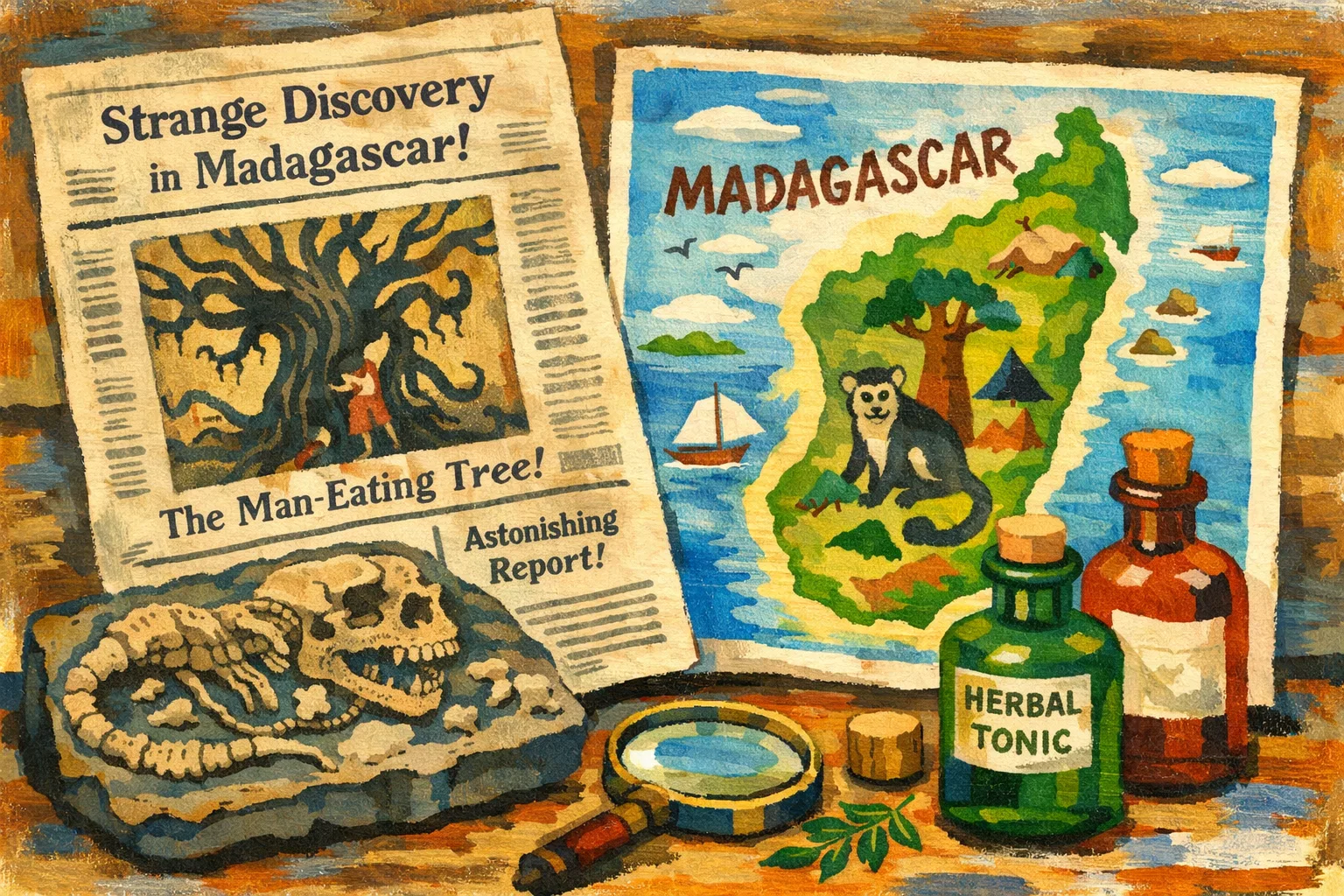
Madagascar’s best-known hoax is not a local legend at all, but a nineteenth-century newspaper invention: the “man-eating tree”, supposedly witnessed devouring a human sacrifice. The explorer, community and plant named in the story were fictional, yet repeated publication turned the tale into apparent fact.
Page outline Jump by section
Introduction
Madagascar’s best-known hoax is not a local legend at all, but a nineteenth-century newspaper invention: the “man-eating tree”, supposedly witnessed devouring a human sacrifice. The explorer, community and plant named in the story were fictional, yet repeated publication turned the tale into apparent fact. Madagascar’s genuine biological strangeness made the fabrication seem just plausible enough, while colonial stereotypes made distant readers less likely to question its lurid account of unnamed “savages”.
Two later cases show the same machinery in different forms. A forged fossil from Madagascar exploited the commercial value and scientific authority attached to rare specimens. During the COVID-19 pandemic, unsupported claims surrounding the herbal product Covid-Organics were amplified into false reports of international endorsements, presidential bribery accusations and Madagascar leaving the World Health Organization. Together, these episodes show how a real place can become a powerful label for invented wonders: first through newspapers, then through scientific markets and finally through social media.
The man-eating tree that newspapers made real
On 26 April 1874, the New York World published an article by journalist Edmund Spencer describing an extraordinary discovery in Madagascar. According to the report, a German explorer named Karl Leche had encountered a community called the Mkodo and watched its members force a woman to climb upon a giant carnivorous tree. Its moving tendrils supposedly seized, crushed and consumed her. The tale offered several layers of borrowed authority: a European eyewitness, a scientific-sounding plant, an exotic location and the suggestion that the account had already passed through learned publications.[Royal Botanical Gardens]rbg.caRoyal Botanical Gardens Botanicult Fiction: The Man-eating Tree of MadagascarRoyal Botanical GardensBotanicult Fiction: The Man-eating Tree of Madagascar - Royal Botanical Gardens…
None of the central elements checked out. The explorer was fictitious, as were the Mkodo and the monstrous plant. The supposed supporting names and publications did not provide an independent chain of evidence. The entire construction was a literary fabrication dressed as a report from the field. Royal Botanical Gardens describes the tree, community and explorers as inventions, while later historical examination also found that one purported scientific source had been misrepresented.[Royal Botanical Gardens]rbg.caRoyal Botanical Gardens Botanicult Fiction: The Man-eating Tree of MadagascarRoyal Botanical GardensBotanicult Fiction: The Man-eating Tree of Madagascar - Royal Botanical Gardens…
The hoax nevertheless travelled with remarkable speed. The South Australian Register printed the story in October 1874, demonstrating how nineteenth-century newspapers could circulate material across continents without conducting their own investigation. Other Australian papers reproduced it in subsequent years, sometimes presenting the same narrative as a curious scientific report rather than recycled fiction. Each reprint acted as apparent corroboration, even though the papers were copying one another rather than confirming anything in Madagascar.[Trove]trove.nla.gov.auSouth Australian Register (Adelaide, SA: 1839 - 1900), Tue 27 Oct 1874, Page 6 - THE MAN…Read more…
That mechanism remains familiar today. A claim repeated by many outlets can look independently verified when all versions descend from one untested source. In the tree story, minor alterations also helped obscure the common origin: Leche’s name changed spelling, publication dates varied, and later writers supplied additional details. The resulting family of accounts looked like accumulated testimony rather than the afterlife of a single newspaper invention.
Why readers found it believable
Madagascar was a particularly effective setting because it truly does possess exceptional wildlife. The Convention on Biological Diversity records very high levels of endemism among the island’s plants, reptiles, amphibians, mammals and other groups. Genuine discoveries of species found nowhere else created space in the popular imagination for almost any biological marvel.[Convention on Biological Diversity]cbd.intConvention on Biological Diversity MadagascarConvention on Biological DiversityMadagascar - Country ProfileCurrently, these unique ecosystems are home to approximately 12,000 species…
There was also a grain of botanical truth behind the fantasy. Carnivorous plants do trap insects and other small organisms, so the story enlarged a real natural phenomenon into a human-killing monster. Nineteenth-century fiction frequently used dangerous plants and fictionalised travel narratives, making Spencer’s account part of a wider literary fashion rather than an isolated invention.[JSTOR]jstor.orgOpen source on jstor.org.
More troublingly, the report relied on colonial prejudice. Its invented African community was portrayed as violent, irrational and available for observation by a supposedly trustworthy European traveller. The story asked readers to scrutinise neither the explorer’s credentials nor the humanity of the people being described. The Royal Botanical Gardens assessment explicitly connects the hoax’s longevity with racism and fear of supposedly unknown peoples and environments.[Royal Botanical Gardens]rbg.caRoyal Botanical Gardens Botanicult Fiction: The Man-eating Tree of MadagascarRoyal Botanical GardensBotanicult Fiction: The Man-eating Tree of Madagascar - Royal Botanical Gardens…
The deception therefore worked on two levels. Its botanical details made the monster seem scientific, while its stereotypes made the alleged human sacrifice seem credible to readers already accustomed to sensational accounts of distant societies.
How the legend survived exposure
The fiction was identified as such by around 1890, but exposure did not kill it. Chase Salmon Osborn, a former governor of Michigan, revived the subject in his 1924 book Madagascar: Land of the Man-eating Tree. Although Osborn did not unequivocally certify the creature’s existence, he treated the legend as an enticing doorway into a supposedly mysterious country. The book’s very title gave the invented plant another layer of cultural authority.[HathiTrust]catalog.hathitrust.orgOpen source on hathitrust.org.
Newspapers were still reporting proposed searches for the tree in the early 1930s. Contemporary coverage described expeditions supposedly preparing to locate it, while other articles were already calling it a myth. The legend had become self-sustaining: a new search was newsworthy because earlier stories existed, and the new coverage then became “evidence” that serious people still considered the tree possible.[rbg.ca]rbg.caRoyal Botanical Gardens Botanicult Fiction: The Man-eating Tree of MadagascarRoyal Botanical GardensBotanicult Fiction: The Man-eating Tree of Madagascar - Royal Botanical Gardens…
Science writer Willy Ley later dismantled the story by checking its basic components rather than arguing about whether a giant carnivorous plant was theoretically conceivable. There was no verified specimen, no traceable eyewitness and no identifiable community matching the report. This is the decisive lesson of the case: spectacular claims often collapse fastest when investigators examine names, documents and provenance before debating extraordinary mechanisms.[Wikipedia]WikipediaMan-eating plantMan-eating plant
A fossil assembled to look more valuable
Madagascar’s rich fossil record creates another market for wonder. In 2010, palaeontologists Bernhard Zipfel, Celeste Yates and Adam Yates documented a vertebrate fossil forgery said to have come from Madagascar. Their study placed the specimen within a broader trade in altered fossils, in which genuine material may be rearranged, completed or disguised to produce something more impressive than the original find.[WIReDSpace]wiredspace.wits.ac.zaWIRe DSpace A case of vertebrate fossil forgery from MadagascarWIRe DSpace A case of vertebrate fossil forgery from Madagascar
The specimen was not simply an imaginary fossil carved from blank stone. It incorporated real fossil material, which is one reason such objects can deceive buyers and even specialists. Forgers may combine unrelated pieces, sculpt missing anatomy, use resin to join fragments and cover the joins with paint or artificial matrix. A composite can therefore pass an initial authenticity test—some of it is genuinely ancient—while being false in the scientifically important sense that the displayed animal never existed in that form.[Academia]academia.eduOpen source on academia.edu.
This kind of fraud benefits from the difference between a fossil as a collectible and a fossil as evidence. A dramatic, complete-looking specimen commands more money and attention than a tray of unattractive fragments. Yet scientific interpretation depends upon exact relationships: which bones were found together, their position in the rock, the surrounding geology and the documented route from excavation to collection. Once dealers or restorers alter those relationships, a genuine fragment can become part of a false claim.
Investigators look for anatomical contradictions, unnatural joins, mismatched preservation and substances that should not be present. Acids may reveal differences between a fossil and an artificially prepared matrix; solvents, heat or ultraviolet examination can expose paint, resin and reconstructed surfaces. The most important safeguard, however, is provenance—a documented history showing where, when and by whom a specimen was excavated and handled.[Deposits Earth Science Archive]depositsmag.comfossil fakes and their recognitionfossil fakes and their recognition
The Madagascar case is less famous than the man-eating tree, but it demonstrates a more subtle form of deception. The tree was wholly fictional. A forged fossil can be materially real yet scientifically fraudulent, because its parts have been arranged to tell a false story.

Covid-Organics and the misinformation built around it
In April 2020, Madagascar’s president, Andry Rajoelina, publicly promoted Covid-Organics, an herbal drink based largely on Artemisia annua, as a preventive and treatment for COVID-19. The product emerged from the Malagasy Institute of Applied Research and quickly became a symbol of African scientific independence and traditional medicine. At launch, however, publicly available evidence was not sufficient to establish that the drink prevented or cured the disease. The World Health Organization’s position was not that traditional medicine should be rejected, but that proposed treatments required proper testing for efficacy and adverse effects.[who.int]afro.who.intsupports scientifically proven traditional medicinesupports scientifically proven traditional medicine
This episode needs careful classification. The product itself should not simply be called a fabricated hoax: it was a real preparation, its promoters may have believed in its value, and later versions entered formal clinical assessment. The deceptive layer arose from claims that ran ahead of evidence, followed by an expanding cloud of false reports about what foreign governments and international bodies had supposedly said.
Posts and articles falsely announced that the World Health Organization had endorsed Covid-Organics as a cure. In reality, agreeing to assist with research or clinical observation was not an approval of the product. WHO later convened expert structures to assess traditional therapies and reviewed work on a capsule formulation, but scientific evaluation and regulatory endorsement are distinct stages.[africacheck.org]africacheck.orgmadagascars president said who supporting clinicalmadagascars president said who supporting clinical
Other stories were more clearly invented. Fact-checkers found no evidence that Rajoelina had accused WHO of offering him US$20 million to poison the remedy; Madagascar’s presidency denied that he had made the statement. Reports that Madagascar had withdrawn from WHO were also false. Separate posts claimed that multiple African leaders had endorsed the drink as a vaccine, or that Russia had ordered a million bottles, without adequate evidence.[afp.com]factcheck.afp.comOpen source on afp.com.
The surrounding misinformation spread far beyond Madagascar. WHO reported that, at its peak, the Covid-Organics story was reaching almost 14 million people a day, with intense discussion in Madagascar, Nigeria, South Africa, Ghana and Senegal. Its monitoring found that claims about effectiveness and supposed international support circulated through both social networks and mainstream media.[World Health Organization]who.intWorld Health Organization
Several forces made the story persuasive. The pandemic created intense demand for hope before proven treatments and vaccines were widely available. Artemisia annua also has a legitimate association with artemisinin, an important antimalarial compound, allowing promoters and readers to slide from “this plant has medical value” to “this particular untested preparation cures a new viral disease”. Political memories of colonial exploitation and unequal access to medicine gave further emotional weight to arguments that Western institutions were dismissing an African discovery. Academic analysis of the controversy found that Covid-Organics became bound up with pride in local knowledge, suspicion of outside authorities and hopes that a marginalised country might produce a globally important remedy.[PMC]pmc.ncbi.nlm.nih.govOpen source on nih.gov.
Those concerns were not frivolous, but they did not settle the medical question. A treatment is demonstrated through transparent trials, suitable comparison groups, reproducible results and independent scrutiny—not through national origin, presidential confidence or the number of governments willing to receive samples. The fairest assessment therefore avoids two errors at once: dismissing traditional medicine merely because it is traditional, and treating political symbolism as proof of clinical effectiveness.
Fake wildlife in the age of altered images
Madagascar’s reputation for unique species also makes it an attractive label for manipulated wildlife photographs. In 2019, a striking image circulated online with claims that it showed a blue owl from Madagascar. AFP traced it to a photograph of a brown Guatemalan pygmy owl whose colouring had been digitally altered. The original animal was neither blue nor Madagascan.[AFP Fact Check]factcheck.afp.comno not genuine photo blue owl madagascarno not genuine photo blue owl madagascar
The deception was simple, but its success rested on the same foundation as the man-eating tree. Viewers knew that Madagascar contains unusual endemic animals, so an implausibly coloured bird did not immediately seem impossible. The caption supplied a location that functioned as a credibility shortcut: “Madagascar” explained the marvel before anyone asked for a species name, photographer, date or original file.
Reverse-image searching exposed the alteration by locating the earlier photograph. This illustrates how photographic debunking differs from arguing over appearance. Colour, compression and screen settings can all mislead the eye; provenance is stronger. Finding the earliest available version, identifying the photographer and comparing details across copies can reveal both manipulation and false location claims.[DataJournalism.com]datajournalism.comOpen source on datajournalism.com.
What these cases reveal
Madagascar’s hoax history is not evidence that people in Madagascar are unusually susceptible to deception. In the most famous case, the deception was created and circulated by foreign newspapers for foreign readers. The country served as a distant stage on which outsiders projected fantasies about dangerous nature and supposedly primitive people.
Across the documented cases, several recurring mechanisms stand out:
- Real rarity lends cover to false marvels. Madagascar’s extraordinary biodiversity makes invented plants, coloured animals and sensational fossils sound less implausible.
- Repetition masquerades as confirmation. Newspaper reprints, copied websites and viral posts can all create the illusion of many sources when only one claim exists.
- Authority is borrowed rather than demonstrated. Fictional explorers, scientific terminology, presidential promotion and alleged WHO support each substitute status for independently checkable evidence.
- Provenance defeats spectacle. The strongest questions are often mundane: Who first reported this? Where is the original photograph? Which laboratory tested it? Were fossil pieces excavated together?
- Correction rarely travels as well as the claim. The man-eating tree survived formal exposure, just as online falsehoods about Covid-Organics continued after fact-checks and official denials.
The man-eating tree remains the defining Madagascar hoax because it combined all these techniques in one memorable narrative. It borrowed credibility from real science, used a fabricated eyewitness, exploited racist expectations, spread through media copying and outlived its exposure by becoming folklore. The later fossil and pandemic cases show that the technologies changed, but the essential trick did not: attach an extraordinary claim to a place already associated with extraordinary nature, and many readers will accept the setting as evidence.
Amazon book picks
Further Reading
Books and field guides related to How Madagascar Became a Label for Impossible Wonders. Use these as the next step if you want deeper reading beyond the article.
The Demon-Haunted World
Rating: 4.5/5 from 43 Google Books ratings
Explores extraordinary claims, hoaxes and critical thinking.
Why People Believe Weird Things
Directly addresses myths, legends and pseudoscientific claims.
eBay marketplace picks
Marketplace Samples
Live-tested eBay searches with available results related to this page.


Endnotes
1.
Source: Wikipedia
Title: Man-eating plant
Link:https://en.wikipedia.org/wiki/Man-eating_plant
2.
Source: jstor.org
Link:https://www.jstor.org/stable/24575702
3.
Source: catalog.hathitrust.org
Link:https://catalog.hathitrust.org/Record/001610069
4.
Source: academia.edu
Link:https://www.academia.edu/92718846/A_case_of_vertebrate_fossil_forgery_from_Madagascar
5.
Source: afro.who.int
Title: supports scientifically proven traditional medicine
Link:https://www.afro.who.int/news/who-supports-scientifically-proven-traditional-medicine
6.
Source: time.com
Link:https://time.com/5840148/coronavirus-cure-covid-organic-madagascar/
7.
Source: afro.who.int
Title: launch regional expert advisory committee traditional medicine
Link:https://www.afro.who.int/regional-director/speeches-messages/launch-regional-expert-advisory-committee-traditional-medicine
8.
Source: afro.who.int
Title: statement clinical trial cvo remedy
Link:https://www.afro.who.int/news/who-statement-clinical-trial-cvo-remedy
9.
Source: factcheck.afp.com
Link:https://factcheck.afp.com/there-no-evidence-madagascan-president-said-who-offered-bribe-poison-covid-19-remedy
10.
Source: who.int
Title: World Health Organization
Link:https://www.who.int/docs/default-source/coronaviruse/situation-reports/20200804-covid-19-sitrep-197.pdf
11.
Source: pmc.ncbi.nlm.nih.gov
Link:https://pmc.ncbi.nlm.nih.gov/articles/PMC9758394/
12.
Source: factcheck.afp.com
Title: no not genuine photo blue owl madagascar
Link:https://factcheck.afp.com/no-not-genuine-photo-blue-owl-madagascar
13.
Source: datajournalism.com
Link:https://datajournalism.com/read/handbook/verification-1/verifying-images/4-verifying-images/4-2-verifying-two-suspicious-street-sharks-dur-ing-hurricane-sandy
14.
Source: afp.com
Link:https://www.afp.com/en/our-offer/afp-fact-check
15.
Source: factcheck.afp.com
Link:https://factcheck.afp.com/
16.
Source: factcheck.afp.com
Link:https://factcheck.afp.com/doc.afp.com.32863GY
17.
Source: factcheck.afp.com
Link:https://factcheck.afp.com/doc.afp.com.B29C7WF
18.
Source: factcheck.afp.com
Title: african mistrust western vaccines threatens coronavirus fight
Link:https://factcheck.afp.com/african-mistrust-western-vaccines-threatens-coronavirus-fight
19.
Source: factcheck.afp.com
Link:https://factcheck.afp.com/doc.afp.com.36VR9VX
20.
Source: factcheck.afp.com
Title: Covid 19 debunked rumours and hoaxes
Link:https://factcheck.afp.com/Covid-19-debunked-rumours-and-hoaxes
21.
Source: factcheck.afp.com
Title: busting coronavirus myths
Link:https://factcheck.afp.com/busting-coronavirus-myths
22.
Source: factcheck.afp.com
Link:https://factcheck.afp.com/AFP-Africa
23.
Source: factcheck.afp.com
Title: rwandan government rejects claim leader paul kagame opposed who over virus tonic
Link:https://factcheck.afp.com/rwandan-government-rejects-claim-leader-paul-kagame-opposed-who-over-virus-tonic
24.
Source: who.int
Link:https://www.who.int/about/accountability/results/who-results-report-2020-2021/country-profile/2021/madagascar
25.
Source: afro.who.int
Title: african traditional medicine day 2021
Link:https://www.afro.who.int/regional-director/speeches-messages/african-traditional-medicine-day-2021
26.
Source: afro.who.int
Title: african traditional medicine day 2022
Link:https://www.afro.who.int/regional-director/speeches-messages/african-traditional-medicine-day-2022
27.
Source: afro.who.int
Title: SITREP N 34 COVID 19 CONGO 06 05 2020
Link:https://www.afro.who.int/sites/default/files/2021-09/SITREP%20N%2034-COVID-19-CONGO-06-05-2020.pdf
28.
Source: afro.who.int
Link:https://www.afro.who.int/sites/default/files/2021-04/Report%20of%2034th%20session%20of%20the%20AACHRD_2020_Final%20.pdf
29.
Source: afro.who.int
Title: Sitrep 36
Link:https://www.afro.who.int/sites/default/files/2021-09/Sitrep%2036.pdf
30.
Source: afro.who.int
Title: WHO AFR Covid 19 2021 SRP Final 16042021
Link:https://www.afro.who.int/sites/default/files/2021-04/WHO%20AFR%20Covid-19%202021%20SRP_Final_16042021.pdf
31.
Source: afro.who.int
Link:https://www.afro.who.int/fr/news/burkina-faso-les-tradipraticiens-de-sante-de-la-region-du-sud-ouest-lecole-de-la-surveillance
32.
Source: afro.who.int
Link:https://www.afro.who.int/fr/news/un-panel-dexperts-approuve-le-protocole-des-essais-cliniques-de-phytotherapie-pour-la-covid-19
33.
Source: afro.who.int
Title: journee de la medecine traditionnelle africaine 2020
Link:https://www.afro.who.int/fr/regional-director/speeches-messages/journee-de-la-medecine-traditionnelle-africaine-2020
34.
Source: afro.who.int
Title: WHO AFRO Regional Director’s Report 2019 2020
Link:https://www.afro.who.int/sites/default/files/2020-08/WHO-AFRO_Regional%20Director%27s%20Report%202019-2020.pdf
35.
Source: afro.who.int
Link:https://www.afro.who.int/fr/news/niamey-celebration-de-la-18eme-journee-africaine-de-la-medecine-traditionnelle-deux-decennies
36.
Source: espen.afro.who.int
Title: Day 2 Slides Session 9 10 min
Link:https://espen.afro.who.int/sites/default/files/content/document/Day%202%20-%20Slides%20Session%209%20-%2010-min.pdf
37.
Source: afro.who.int
Link:https://www.afro.who.int/sites/default/files/2017-06/ahm18.pdf
38.
Source: academia.edu
Link:https://www.academia.edu/26180496/Fossil_fakes_and_their_recognition
39.
Source: academia.edu
Link:https://www.academia.edu/63328337/The_fossil_merchant_from_Verona_the_first_written_testimony_of_paleontological_forgery_in_Italy
40.
Source: Wikipedia
Title: COVID 19 misinformation
Link:https://en.wikipedia.org/wiki/COVID-19_misinformation
41.
Source: Wikipedia
Title: Covid Organics
Link:https://en.wikipedia.org/wiki/Covid-Organics
42.
Source: rbg.ca
Title: Royal Botanical Gardens Botanicult Fiction: The Man-eating Tree of Madagascar
Link:https://www.rbg.ca/the-man-eating-tree-of-madagascar/
Source snippet
Royal Botanical GardensBotanicult Fiction: The Man-eating Tree of Madagascar - Royal Botanical Gardens...
43.
Source: trove.nla.gov.au
Link:https://trove.nla.gov.au/newspaper/article/39810790
Source snippet
South Australian Register (Adelaide, SA: 1839 - 1900), Tue 27 Oct 1874, Page 6 - THE MAN...Read more...
44.
Source: trove.nla.gov.au
Link:https://trove.nla.gov.au/newspaper/article/70614829
Source snippet
05 Jan 1878 - The Man-Eating Tree of Madagascar. - TroveThe Man-Eating Tree of. Madagascar.Read more...
45.
Source: trove.nla.gov.au
Link:https://trove.nla.gov.au/newspaper/article/244524755
Source snippet
22 Oct 1877 - Miscellany. - TroveTHE MAN-EATING TREE OF MADAGASCAR. The following description of a singular tree which is alleged to...
46.
Source: cbd.int
Title: Convention on Biological Diversity Madagascar
Link:https://www.cbd.int/countries/profile/?country=mg
Source snippet
Convention on Biological DiversityMadagascar - Country ProfileCurrently, these unique ecosystems are home to approximately 12,000 species...
47.
Source: trove.nla.gov.au
Link:https://trove.nla.gov.au/newspaper/article/94241104
48.
Source: trove.nla.gov.au
Link:https://trove.nla.gov.au/newspaper/article/32594665
49.
Source: wiredspace.wits.ac.za
Title: WIRe DSpace A case of vertebrate fossil forgery from Madagascar
Link:https://wiredspace.wits.ac.za/items/a76c47bc-c841-4c8b-9726-60a13f79e9ce
50.
Source: depositsmag.com
Title: fossil fakes and their recognition
Link:https://depositsmag.com/2015/12/19/fossil-fakes-and-their-recognition/
51.
Source: africacheck.org
Title: no evidence madagascars artemisia based tonic cures covid 19
Link:https://africacheck.org/fact-checks/meta-programme-fact-checks/no-evidence-madagascars-artemisia-based-tonic-cures-covid-19
52.
Source: africacheck.org
Title: madagascars president said who supporting clinical
Link:https://africacheck.org/fact-checks/meta-programme-fact-checks/madagascars-president-said-who-supporting-clinical
53.
Source: africacheck.org
Title: no madagascar president didnt say interview who offered him
Link:https://africacheck.org/fact-checks/meta-programme-fact-checks/no-madagascar-president-didnt-say-interview-who-offered-him
54.
Source: africacheck.org
Title: no madagascar hasnt quit world health organization
Link:https://africacheck.org/fact-checks/meta-programme-fact-checks/no-madagascar-hasnt-quit-world-health-organization
55.
Source: africacheck.org
Title: no african leaders havent endorsed madagascars herbal
Link:https://africacheck.org/fact-checks/meta-programme-fact-checks/no-african-leaders-havent-endorsed-madagascars-herbal
56.
Source: africacheck.org
Title: no evidence russian president putin ordered madagascars
Link:https://africacheck.org/fact-checks/meta-programme-fact-checks/no-evidence-russian-president-putin-ordered-madagascars
57.
Source: trove.nla.gov.au
Link:https://trove.nla.gov.au/newspaper/article/8935353
58.
Source: trove.nla.gov.au
Link:https://trove.nla.gov.au/newspaper/article/32594696?browse=ndp%3Abrowse%2Ftitle%2FW%2Ftitle%2F30%2F1932%2F12%2F31%2Fpage%2F2816057%2Farticle%2F32594696
59.
Source: trove.nla.gov.au
Link:https://trove.nla.gov.au/newspaper/article/32594670?browse=ndp%3Abrowse%2Ftitle%2FW%2Ftitle%2F30%2F1932%2F12%2F31%2Fpage%2F2816057%2Farticle%2F32594670
60.
Source: africacheck.org
Title: yes new lockdown madagascars capital after covid 19 surge
Link:https://africacheck.org/fact-checks/meta-programme-fact-checks/yes-new-lockdown-madagascars-capital-after-covid-19-surge
61.
Source: africacheck.org
Title: no rwandan president kagame hasnt lashed out world health
Link:https://africacheck.org/fact-checks/meta-programme-fact-checks/no-rwandan-president-kagame-hasnt-lashed-out-world-health
62.
Source: africacheck.org
Title: manipulated or out context videos images headlines
Link:https://africacheck.org/fact-checks/spotchecks/manipulated-or-out-context-videos-images-headlines
63.
Source: africacheck.org
Title: cures and prevention
Link:https://africacheck.org/fact-checks/spotchecks/cures-and-prevention
64.
Source: dinohunter.info
Link:https://www.dinohunter.info/html/2010/2010.htm
65.
Source: pmc.ncbi.nlm.nih.gov
Link:https://pmc.ncbi.nlm.nih.gov/articles/PMC7893249/
66.
Source: pmc.ncbi.nlm.nih.gov
Link:https://pmc.ncbi.nlm.nih.gov/articles/PMC10546230/
67.
Source: worldwildlife.org
Link:https://www.worldwildlife.org/places/madagascar/
Additional References
68.
Source: thegardenhistory.blog
Title: darwin and the man eating tree of madagascar
Link:https://thegardenhistory.blog/2024/01/06/darwin-and-the-man-eating-tree-of-madagascar/
Source snippet
Karl Leche, Dr. Omelius Friedlowski, the Mkodi tribe...Read more...
69.
Source: loc.gov
Link:https://www.loc.gov/resource/sn84020558/1920-03-05/ed-1/?dl=page&q=thomas+cartledge&sp=12&st=text
70.
Source: loc.gov
Link:https://www.loc.gov/resource/sn83030214/1893-09-10/ed-1/?dl=page&q=clifford+dean&sp=2&st=text
71.
Source: loc.gov
Link:https://www.loc.gov/resource/sn82015137/1885-06-30/ed-1/?sp=4&st=text
72.
Source: loc.gov
Link:https://www.loc.gov/resource/sn84022644/1884-12-26/ed-1/?sp=4&st=text
73.
Source: loc.gov
Link:https://www.loc.gov/resource/sn82014248/1917-07-06/ed-1/?sp=6&st=text
74.
Source: tile.loc.gov
Link:https://tile.loc.gov/storage-services/service/gdc/gdclccn/05/01/52/49/05015249/05015249.pdf
75.
Source: youtube.com
Title: Rajoelina hits back at Covid-organics detractors
Link:https://www.youtube.com/watch?v=qOhFg_kwAiw
Source snippet
"Man-eating tree of madagascar" The Man-Eating Tree of Madagascar Crypticc...
76.
Source: science.org
Link:https://www.science.org/doi/10.1126/science.abf0869
Source snippet
It is estimated that over 14,000 vascular plant species occur on the island (76)...Read more...
77.
Source: youtube.com
Title: THE MAN EATING TREE// Mysterious Tree of Madagascar
Link:https://www.youtube.com/watch?v=hSbZBXu7jXc
Source snippet
Rajoelina hits back at Covid-organics detractors...
Topic Tree
Follow this branch
Related pages 192
- Albanian Hoaxes
- Algerian Hoaxes
- Antigua Deceptions
- Argentina Hoaxes
- Armenian Hoaxes
- +187 more in sidebar