Why Switzerland's Most Famous Fakes Seemed Believable
Switzerland’s history of hoaxes is less a parade of simple practical jokes than a study in how authority makes doubtful stories believable.
Page outline Jump by section
Introduction
These cases are not all morally equivalent. Some were deliberate frauds, others propaganda, satire, disputed memory or patriotic folklore. What links them is the machinery of persuasion: trusted institutions, emotionally powerful narratives, impressive-looking evidence and audiences whose existing hopes or fears made the claim feel plausible. Switzerland is therefore not a story about national gullibility. It is a particularly revealing setting in which courts, historians, journalists and scientists have repeatedly had to separate useful myth, sincere belief and calculated deception.
The monks who manufactured miracles
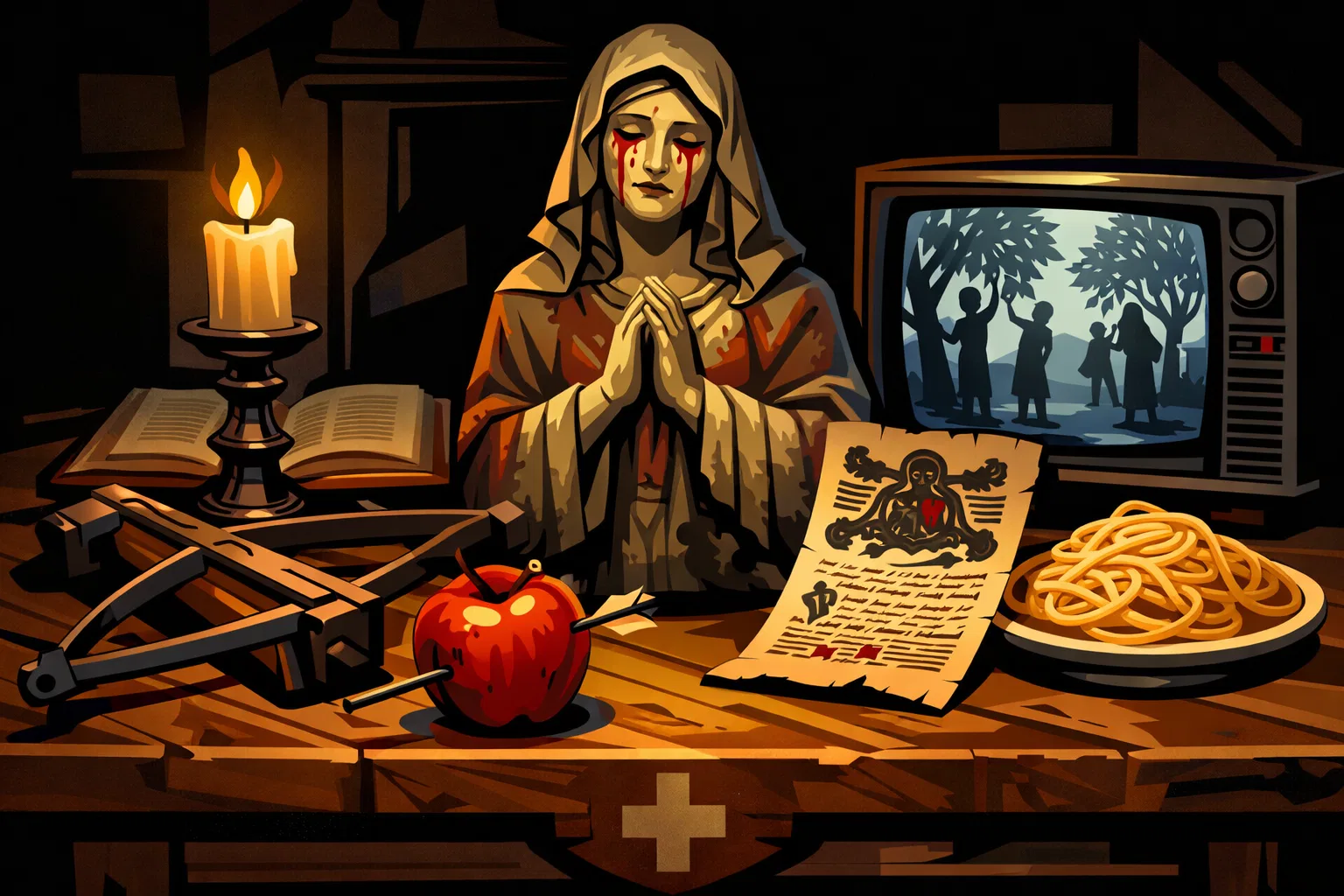
One of Switzerland’s most extraordinary documented religious frauds began in the Dominican monastery at Bern in 1507. A young lay brother, Hans Jetzer, reported visions, supernatural voices and the appearance of wounds resembling Christ’s stigmata. A statue of the Virgin Mary appeared to shed bloody tears. These supposed signs conveniently supported the Dominican position in a fierce theological dispute over whether Mary had been conceived free from original sin.[Swiss History Blog]blog.nationalmuseum.chIt later emerged thatSwiss History BlogThe Jetzer Affair – Swiss National MuseumMarch 16, 2023 — 16 Mar 2023 — In the night of 24 June 1507, the statue of the…
The effects depended on theatre as much as theology. According to the surviving judicial and chronicle tradition, senior friars dressed as holy figures, operated staged apparitions and painted blood onto a statue. Jetzer eventually said that he recognised members of the monastery playing Mary and angels during one supposed vision. Crowds nevertheless came to watch his public displays of suffering, showing how quickly a controlled performance could become a civic spectacle once religious authority endorsed it.[Wikipedia]WikipediaJetzer affairJetzer affair
The affair was exposed through interrogation and trial, but the evidence requires care. Jetzer and the friars were tortured, and testimony obtained under torture cannot be treated as straightforward fact. Historians continue to debate how much Jetzer knew, whether he was initially manipulated and whether he later cooperated under pressure. The broad conclusion that miracles were staged is well supported, but the precise allocation of guilt remains less certain. Four Dominican friars were convicted and burned in Bern in 1509.[Swiss History Blog]blog.nationalmuseum.chIt later emerged thatSwiss History BlogThe Jetzer Affair – Swiss National MuseumMarch 16, 2023 — 16 Mar 2023 — In the night of 24 June 1507, the statue of the…
The Jetzer affair mattered because the fabricated signs were not merely intended to collect money from credulous pilgrims. They were designed to settle a doctrinal argument by manufacturing supernatural evidence. The case demonstrates an enduring pattern: when ordinary proof is unavailable, interested parties may create a dramatic event that appears to make further argument unnecessary.
When national memory looks like documentary history
William Tell occupies a different category. His story is not best described as a commercial fraud or a planned hoax. It is a national legend whose later retellings often blurred the boundary between symbolic truth and verifiable history.
The familiar account places Tell in the early fourteenth century. He refuses to honour the Habsburg official Gessler’s hat, is forced to shoot an apple from his son’s head, escapes captivity and kills the tyrant. Yet the earliest surviving written account appears in the White Book of Sarnen, compiled around 1470—roughly a century and a half after the events it describes. The manuscript also contains stories about the founding struggles of the early Swiss Confederation.[nationalmuseum.ch]blog.nationalmuseum.chSwiss History Blog The White Book of SarnenCreated in 1470 by Obwalden state secretary Hans Schriber, in the 17th century the volume of records was…Read more…
That late appearance does not prove that every element was invented in 1470, since the writer may have drawn on older oral traditions. It does mean that the detailed story cannot be confirmed from contemporary records. Similar motifs, including a master archer forced to shoot a small object from a child’s head, appear in other European heroic traditions. Swiss historical presentations therefore generally describe Tell as a legendary figure and national symbol rather than an established individual whose biography can be reconstructed.[Swiss History Blog]blog.nationalmuseum.chSwiss History Blog Guglielmo Tell – Swiss National MuseumSwiss History BlogGuglielmo Tell – Swiss National MuseumNovember 7, 2023 — 7 Nov 2023 — The legend of Tell as a historical narrative, fea…
Tell survived historical criticism because the story performed valuable cultural work. During periods of political tension, the lone marksman became a flexible emblem of liberty, resistance and opposition to foreign rule. Friedrich Schiller’s play greatly expanded his international fame, while monuments, festivals and school narratives embedded him in Switzerland’s public identity. The tale’s historical weakness did not diminish its symbolic strength; indeed, the uncertainty allowed each generation to adapt it.[Swiss History Blog]blog.nationalmuseum.chSwiss History Blog Guglielmo Tell – Swiss National MuseumSwiss History BlogGuglielmo Tell – Swiss National MuseumNovember 7, 2023 — 7 Nov 2023 — The legend of Tell as a historical narrative, fea…
The important distinction is between saying “Tell certainly existed” and saying “the Tell story helped Switzerland explain itself”. The first is an unsupported historical claim. The second is demonstrably true. Treating such legends as deliberate frauds misses how national traditions usually develop: gradually, through repetition, commemoration and the conversion of memorable narrative into apparently settled history.
Bern puts a poisonous forgery on trial
The most consequential exposure associated with Switzerland concerned a fabrication created elsewhere. The Protocols of the Elders of Zion purported to record secret plans by Jewish leaders to dominate the world. In reality, it was an antisemitic forgery assembled through plagiarism and political invention. Despite repeated demonstrations of its fraudulent origins, it spread internationally because it provided believers with a seemingly documentary explanation for social and political change.
In June 1933, members and sympathisers of the far-right Swiss National Front distributed the text at a meeting in Bern. The Swiss Federation of Jewish Communities and the Jewish Community of Bern brought a legal action against the distributors under a cantonal law governing indecent publications. Their broader purpose was to demonstrate publicly, through witnesses and documents, that the supposed conspiracy text was fabricated.[wiener.soutron.net]wiener.soutron.netRecord ViewBern Trials concerning the dissemination of the Protocols…The plaintiffs used a Swiss law of 1916 against indecent literature but the…
The proceedings attracted international attention. Participants in the First Zionist Congress in Basel gave evidence, while researchers traced substantial portions of the Protocols to earlier political satire and polemical literature unrelated to Jews. In 1935, the Bern court accepted the plaintiffs’ case, condemned the publication and treated the work as a forgery.[YIVO Institute for Jewish Research]yivo.orgThe Bern TrialThe Bern Trial
An appeal court reversed the convictions in 1937 because it interpreted the relevant Swiss statute more narrowly. That legal reversal is sometimes misleadingly presented as though the Protocols had been authenticated. It was not a historical vindication of the document. The appeal concerned whether the publication fell within the precise scope of the cantonal law, while contemporary accounts continued to describe the text as fake and plagiarised.[EHRI Portal]portal.ehri-project.euEHRI Portal Newspaper articles on the Bern Trial AppealEHRI Portal Newspaper articles on the Bern Trial Appeal
The trial also revealed why exposing a forgery does not necessarily destroy it. For committed propagandists, the document’s evidential failure was irrelevant; some claimed that it expressed a deeper or “inner” truth even if its literal origins were false. That manoeuvre—retreating from factual authenticity to emotional or ideological truth—allows propaganda to survive almost any disproof.[OUP Academic]academic.oup.comOpen source on oup.com.

Why Britain believed in Swiss spaghetti trees
The most affectionate Swiss-linked hoax was not created by Swiss authorities at all. On 1 April 1957, the BBC current-affairs programme Panorama broadcast a short report showing a family in southern Switzerland harvesting strands of spaghetti from trees. The film referred solemnly to a good crop, a mild winter and the defeat of the spaghetti weevil.[Wikipedia]WikipediaSpaghetti-tree hoaxSpaghetti-tree hoax
The setting was essential. Ticino’s lakeside landscape looked both picturesque and plausibly agricultural to British viewers. Switzerland was familiar enough to be credible but foreign enough that unusual farming practices might escape an audience’s everyday knowledge. The sequence was filmed partly around Castagnola, near Lugano, and used real people carefully placing cooked spaghetti on branches.[Wikipedia]WikipediaSpaghetti-tree hoaxSpaghetti-tree hoax
The deeper trick was institutional. Richard Dimbleby, one of Britain’s most respected broadcasters, delivered the commentary in his customary authoritative style. Panorama normally reported serious international affairs, so viewers had few cues that the programme had temporarily become satire. Pasta was also less familiar in 1950s Britain than it is today; many people knew spaghetti chiefly as a packaged or tinned food and had never considered how it was made.[The Guardian]theguardian.comHighlighting historic and contemporary pranks, the author details notable hoaxes such as the BBC’s 1957 “spaghetti tree” broadcast and th…
Some viewers contacted the BBC to ask whether the report was genuine or how they might grow their own spaghetti. The broadcaster jokingly advised callers to place a strand in tomato sauce and hope for the best. Although later retellings sometimes inflate the scale of public belief, the surviving response was sufficient to establish the broadcast as one of television’s defining April Fool jokes.[Bon Appétit]bonappetit.comwatch the swiss spaghetti harvest of 1957watch the swiss spaghetti harvest of 1957
The episode remains instructive because no sophisticated falsification was required. The hoax combined authentic scenery, documentary photography, confident narration and a gap in the audience’s knowledge. Each element supported the others. It was also ethically contained: the date signalled a tradition of joking, the deception was quickly revealed and nobody was being induced to surrender money or accept a harmful political belief.
The false memoir that institutions wanted to believe
In 1995, a Swiss musician writing as Binjamin Wilkomirski published Fragments, presented as the memories of a Latvian Jewish child who had survived Nazi concentration camps. The book’s broken, impressionistic style seemed to reproduce traumatic childhood memory rather than a conventional adult narrative. It was translated widely, praised by reviewers and honoured with literary awards. Wilkomirski also appeared publicly as a survivor and witness.[Wikipedia]WikipediaFragments: Memories of a Wartime ChildhoodFragments: Memories of a Wartime Childhood
The account began to collapse in 1998 when Swiss writer and journalist Daniel Ganzfried investigated the author’s background. Records indicated that Wilkomirski was Bruno Grosjean, born in Biel in 1941, and that he had spent the war years in Switzerland rather than in camps in occupied Poland. His literary agency commissioned historian Stefan Maechler to examine the dispute. Maechler’s research supported the documentary identity and concluded that the supposed autobiography could not be historically true. Publishers subsequently withdrew the work.[Wikipedia]WikipediaFragments: Memories of a Wartime ChildhoodFragments: Memories of a Wartime Childhood
The case is more complicated than a conventional imposture because Wilkomirski appeared to maintain his account even after contrary records emerged. Maechler did not portray him simply as a calculating swindler. The memoir may have transformed experiences from a painful Swiss childhood into a Holocaust narrative through suggestion, identification and recovered-memory practices. Whether the author knowingly lied at every stage, came to believe an invented identity, or moved between performance and conviction cannot be resolved with complete confidence.[jstor.org]jstor.orgOpen source on jstor.org.
That uncertainty does not make the book a valid memoir. Historical testimony depends on identity, place and experience, all of which were contradicted by documentary evidence. Nor does exposing the book undermine genuine survivor testimony; it shows why careful verification protects the historical record rather than threatening it.
The scandal also exposed weaknesses in publishing and cultural institutions. Reviewers often treated emotional intensity as evidence of authenticity. Awards, interviews and endorsements then reinforced one another, making later doubt appear almost indecent. Because the narrative fitted familiar expectations of trauma, its very literary persuasiveness discouraged basic biographical checking.

Ancient aliens as a Swiss export
Erich von Däniken, the Swiss author of Chariots of the Gods?, belongs on the boundary between pseudoscience, entertainment and commercial misinformation. Beginning in 1968, he argued that extraterrestrial visitors had influenced ancient societies and that monuments, religious texts and artworks preserved distorted memories of alien technology. His books sold tens of millions of copies and helped create the modern “ancient astronauts” genre.[Reuters]reuters.comswiss author erich von daeniken diesVon Däniken's early life included a hotel management career and a prison sentence for fraud, but his fame grew rapidly after his book’s s…
Unlike the Jetzer miracles or the spaghetti harvest, von Däniken’s central claims were not exposed by catching someone operating hidden machinery. The weakness lay in his method. He treated visual resemblance as proof, isolated objects from their archaeological setting and repeatedly presented ancient engineering as inexplicable without outside intervention. Specialists rejected the arguments because known human cultures, labour systems, tools and building traditions already account for the monuments he portrayed as mysteries.[Reuters]reuters.comswiss author erich von daeniken diesVon Däniken's early life included a hotel management career and a prison sentence for fraud, but his fame grew rapidly after his book’s s…
The claims were persuasive because they offered an accessible alternative to the slower work of archaeology. A photograph of a carving could be labelled an astronaut; a ritual object could become machinery; gaps in popular knowledge could be presented as gaps in scholarship. The books also arrived during intense public interest in space exploration and unidentified flying objects, giving the idea a modern scientific appearance without scientific testing.
Von Däniken’s separate convictions for financial fraud and forgery are part of his biography, but they do not by themselves disprove his archaeological claims. Those claims fail because the offered evidence does not support the conclusions. Conflating character evidence with scientific rebuttal would reproduce the same poor reasoning that sceptical analysis is meant to correct.[Wikipedia]WikipediaErich von DänikenErich von Däniken
His influence nevertheless shows how a debunked framework can thrive when it becomes a reusable entertainment format. Each ancient site provides a new episode, while the absence of evidence can be reframed as mystery or suppression. Commercial success then creates its own appearance of authority: bestsellers, documentaries, lectures and attractions make a speculative idea feel culturally established even when its evidential basis has not improved.
What Switzerland’s hoaxes reveal
The strongest Swiss cases did not succeed because audiences lacked intelligence. They succeeded because belief was socially supported.
The Bernese monks supplied sacred authority and public spectacle. The Tell tradition offered a nation a memorable origin story. Antisemitic propagandists circulated a document that confirmed prejudices already held by their audience. The BBC borrowed the visual language of serious television. Fragments gained credibility from publishers, prizes and the moral power of survivor testimony. Von Däniken converted speculation into a global multimedia brand.
Their exposures used equally varied methods. Costumes and painted blood were uncovered through investigation and confession. National legends were tested against the dates and origins of surviving manuscripts. The Protocols were traced through textual comparison and courtroom evidence. The spaghetti report depended on eventual disclosure. Wilkomirski’s identity was checked against civil and institutional records. Ancient-alien claims were challenged through archaeological context rather than ridicule.
The central lesson is that “hoax” should not become a careless label for everything untrue. A joke that expects later recognition differs from propaganda designed to sustain hatred. A traditional hero with doubtful historicity differs from a forged memoir. A person may repeat a falsehood sincerely, while an institution can promote it negligently without having invented it. Understanding those distinctions makes the history more accurate—and makes present-day deception easier to recognise.
Amazon book picks
Further Reading
Books and field guides related to Why Switzerland's Most Famous Fakes Seemed Believable. Use these as the next step if you want deeper reading beyond the article.
Mistakes Were Made (but Not by Me)
Explains why people defend cherished beliefs despite contrary evidence.
The Demon-Haunted World
Rating: 4.5/5 from 43 Google Books ratings
Fits a broad page about believable hoaxes, myths, and questionable evidence.
Extraordinary Popular Delusions and the Madness of Crowds
Rating: 4.0/5 from 5 Google Books ratings
Covers recurring patterns behind persuasive falsehoods.
A Short History of Switzerland
Provides context for Swiss legends, controversies, and institutions.
eBay marketplace picks
Marketplace Samples
Live-tested eBay searches with available results related to this page.




Endnotes
1.
Source: Wikipedia
Title: Jetzer affair
Link:https://en.wikipedia.org/wiki/Jetzer_affair
2.
Source: iiif.biblissima.fr
Link:https://iiif.biblissima.fr/collections/manifest/a2e7b9ee9a8d930dbc9b6a8cc6bdb604d96eac6e
Source snippet
Staatsarchiv Obwalden, Sig. A.02.CHR.00031 Description The "White Book of Sarnen" was written for the most part in the years 1470/1471. T...
3.
Source: wiener.soutron.net
Title: Record View
Link:https://wiener.soutron.net/Portal/Default/en-GB/RecordView/Index/93196
Source snippet
[Bern Trials]({{ 'bern-trial/' | relative_url }}) concerning the dissemination of the Protocols...The plaintiffs used a Swiss law of 1916 against indecent literature but the...
4.
Source: yivo.org
Title: The Bern Trial
Link:https://www.yivo.org/The-Bern-Trial
5.
Source: Wikipedia
Link:https://en.wikipedia.org/wiki/Berne_Trial
6.
Source: academic.oup.com
Link:https://academic.oup.com/hgs/article/29/2/212/562402?login=false
7.
Source: Wikipedia
Title: Spaghetti-tree hoax
Link:https://en.wikipedia.org/wiki/Spaghetti-tree_hoax
8.
Source: Wikipedia
Title: Fragments: Memories of a Wartime Childhood
Link:https://en.wikipedia.org/wiki/Fragments%3A_Memories_of_a_Wartime_Childhood
9.
Source: jstor.org
Link:https://www.jstor.org/stable/10.2979/his.2001.13.2.59
10.
Source: reuters.com
Title: swiss author erich von daeniken dies 90 2026 01 11
Link:https://www.reuters.com/technology/space/swiss-author-erich-von-daeniken-dies-90-2026-01-11/
Source snippet
Von Däniken's early life included a hotel management career and a prison sentence for fraud, but his fame grew rapidly after his book’s s...
11.
Source: Wikipedia
Title: Erich von Däniken
Link:https://en.wikipedia.org/wiki/Erich_von_D%C3%A4niken
12.
Source: Wikipedia
Title: List of hoaxes
Link:https://en.wikipedia.org/wiki/List_of_hoaxes
13.
Source: Wikipedia
Title: The Protocols of the Elders of Zion
Link:https://en.wikipedia.org/wiki/The_Protocols_of_the_Elders_of_Zion
14.
Source: Wikipedia
Title: William Tell
Link:https://en.wikipedia.org/wiki/William_Tell
15.
Source: Wikipedia
Title: White Book of Sarnen
Link:https://en.wikipedia.org/wiki/White_Book_of_Sarnen
16.
Source: history.com
Title: s most famous literary hoaxes
Link:https://www.history.com/articles/historys-most-famous-literary-hoaxes
17.
Source: academic.oup.com
Link:https://academic.oup.com/hgs/article/29/2/212/562402
18.
Source: blog.nationalmuseum.ch
Title: It later emerged that
Link:https://blog.nationalmuseum.ch/en/2023/03/the-jetzer-affair/
Source snippet
Swiss History BlogThe Jetzer Affair – Swiss National MuseumMarch 16, 2023 — 16 Mar 2023 — In the night of 24 June 1507, the statue of the...
Published: March 16, 2023
19.
Source: blog.nationalmuseum.ch
Title: Swiss History Blog The White Book of Sarnen
Link:https://blog.nationalmuseum.ch/en/2019/04/tells-birth-in-the-white-book-of-sarnen/
Source snippet
Created in 1470 by Obwalden state secretary Hans Schriber, in the 17th century the volume of records was...Read more...
20.
Source: blog.nationalmuseum.ch
Title: Swiss History Blog Guglielmo Tell – Swiss National Museum
Link:https://blog.nationalmuseum.ch/en/2023/11/guglielmo-tell-in-ticino/
Source snippet
Swiss History BlogGuglielmo Tell – Swiss National MuseumNovember 7, 2023 — 7 Nov 2023 — The legend of Tell as a historical narrative, fea...
Published: November 7, 2023
21.
Source: portal.ehri-project.eu
Title: EHRI Portal Newspaper articles on the Bern Trial Appeal
Link:https://portal.ehri-project.eu/units/il-002820-9932929394904146-9932919195804146
22.
Source: theguardian.com
Link:https://www.theguardian.com/commentisfree/2006/apr/01/uk.comment
Source snippet
Highlighting historic and contemporary pranks, the author details notable hoaxes such as the BBC’s 1957 “spaghetti tree” broadcast and th...
23.
Source: bonappetit.com
Title: watch the swiss spaghetti harvest of 1957
Link:https://www.bonappetit.com/entertaining-style/pop-culture/article/watch-the-swiss-spaghetti-harvest-of-1957
24.
Source: newyorker.com
Link:https://www.newyorker.com/magazine/2002/02/04/a-life-in-pieces
25.
Source: theguardian.com
Link:https://www.theguardian.com/uk/1999/oct/15/fiachragibbons
26.
Source: newyorker.com
Link:https://www.newyorker.com/magazine/2018/12/24/letters-from-the-december-24-and-31-2018-issue
27.
Source: abcnews.com
Link:https://abcnews.com/International/swiss-exhibit-features-world-class-forgeries/story?id=14436482
28.
Source: theguardian.com
Link:https://www.theguardian.com/theguardian/1999/oct/15/features11.g24
29.
Source: theguardian.com
Link:https://www.theguardian.com/media/2001/feb/06/tvandradio.television1
30.
Source: blog.nationalmuseum.ch
Title: a thousand year old business
Link:https://blog.nationalmuseum.ch/en/2017/07/a-thousand-year-old-business/
31.
Source: blog.nationalmuseum.ch
Title: the swiss foundation legend
Link:https://blog.nationalmuseum.ch/en/2017/08/the-swiss-foundation-legend/
32.
Source: books.google.nl
Link:https://books.google.nl/books?cad=1&hl=nl&id=SRSPEAAAQBAJ&source=gbs_book_other_versions_r
33.
Source: portal.ehri-project.eu
Link:https://portal.ehri-project.eu/units/il-002820-9932929394804146/search?country=il&lang=eng&page=5
34.
Source: encyclopedia.ushmm.org
Title: protocols of the elders of zion
Link:https://encyclopedia.ushmm.org/content/en/article/protocols-of-the-elders-of-zion
Additional References
35.
Source: apnews.com
Link:https://apnews.com/article/57a8a84b8976475791eee82461d53138
Source snippet
Born in Schaffhausen, Switzerland in 1935, von Däniken worked in the hospitality industry before launching his writing career. His unorth...
36.
Source: aboutswitzerland.eda.admin.ch
Title: william tell a symbol of switzerland known throughout the world
Link:https://www.aboutswitzerland.eda.admin.ch/en/william-tell-a-symbol-of-switzerland-known-throughout-the-world
Source snippet
About SwitzerlandWilliam Tell, a symbol of Switzerland known throughout the...25 Nov 2025 — First mentioned in the White Book of Sarnen...
37.
Source: swissinfo.ch
Title: william tell killer or freedom fighter
Link:https://www.swissinfo.ch/eng/culture/william-tell-killer-or-freedom-fighter/31244332
Source snippet
SWI swissinfo.chWilliam Tell: killer or freedom fighter?29 Sept 2011 — The earliest reference to William Tell appeared in the “White Book...
38.
Source: youtube.com
Link:https://www.youtube.com/watch?v=vHlbRv7HTPc
Source snippet
A Brief History of Authorship: Lecture 2, Notorious Cases...
39.
Source: youtube.com
Link:https://www.youtube.com/watch?v=8scpGwbvxvI
Source snippet
BBC: Spaghetti-Harvest in Ticino | Switzerland Tourism...
40.
Source: youtube.com
Title: BBC: Spaghetti-Harvest in Ticino | Switzerland Tourism
Link:https://www.youtube.com/watch?v=tVo_wkxH9dU
Source snippet
The Original Ancient Aliens Documentary | Erich von Däniken's Chariots of the Gods...
41.
Source: youtube.com
Title: A Brief History of Authorship: Lecture 2, Notorious Cases
Link:https://www.youtube.com/watch?v=4HoAOsVrk3g
Source snippet
Robin Hood vs William Tell: Who Was the Greatest Archer in History?...
42.
Source: facebook.com
Link:https://www.facebook.com/BBCArchive/posts/for-those-who-love-this-dish-there-is-nothing-like-real-home-grown-spaghettionth/158417463249856/
43.
Source: researchgate.net
Link:https://www.researchgate.net/publication/291523155_Assessing_the_potential_of_historic_archaeological_collections_a_pilot_study_of_the_British_Museum%27s_Swiss_lake_dwelling_textiles
44.
Source: landesmuseum.ch
Link:https://www.landesmuseum.ch/en/your-visit/groups/archaeology
Topic Tree
Follow this branch
Related pages 192
- Albanian Hoaxes
- Algerian Hoaxes
- Antigua Deceptions
- Argentina Hoaxes
- Armenian Hoaxes
- +187 more in sidebar