Within Bosnian Hoaxes
How False Images Fuelled Fear During the Bosnian War
Old art and invented threats were presented as current evidence, turning fear and grief into tools of wartime mobilisation.
On this page
- The Uros Predic painting recast as wartime evidence
- How captions made fabricated stories feel immediate
- Why propaganda blurred real crimes with invented claims
Page outline Jump by section
Introduction
During the Bosnian War of 1992–1995, propaganda did not always rely on forged photographs. Some of the most effective deceptions used genuine images that were stripped of their original context and presented as evidence of current atrocities or threats. Old paintings, historical photographs and misleading captions were repackaged as wartime documentation, allowing political actors and partisan media outlets to turn emotion into persuasion. The result was a powerful form of visual manipulation: audiences believed they were seeing proof of contemporary crimes when they were actually looking at artworks or images from entirely different times and places.[Wikipedia]WikipediaPropaganda during the Yugoslav WarsPropaganda during the Yugoslav Wars
In Bosnia and Herzegovina, where fear, displacement and violence were already real, such material gained traction because it blended invention with genuine suffering. Propaganda did not need to fabricate every atrocity. Instead, it often amplified existing fears by attaching false narratives to emotionally charged images.[Wikipedia]WikipediaPropaganda during the Yugoslav WarsPropaganda during the Yugoslav Wars
The Uroš Predić Painting Recast as Wartime Evidence
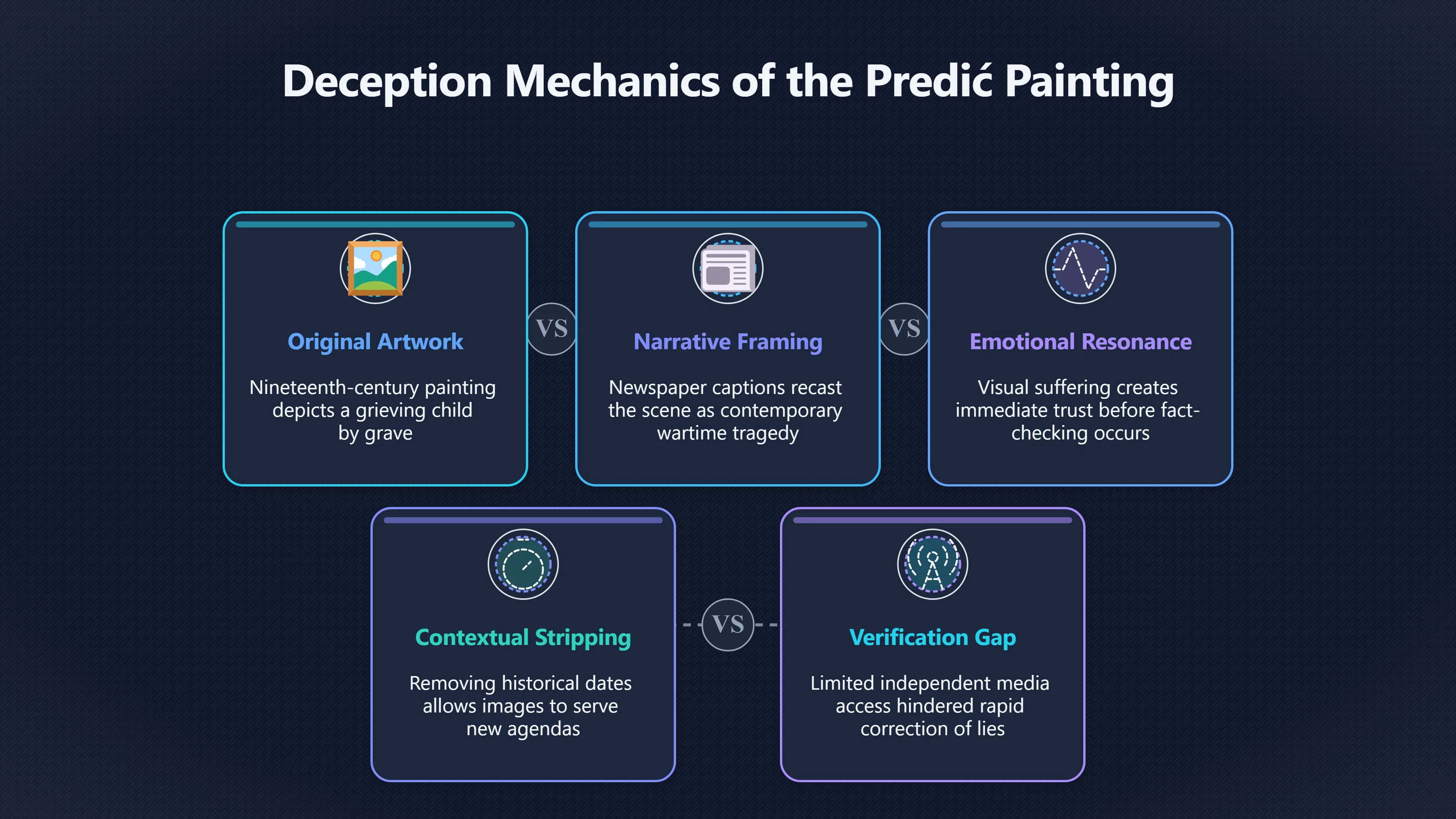
One of the most striking examples involved a nineteenth-century painting by the Serbian realist artist Uroš Predić. His 1888 work Orphan on Mother’s Grave depicts a grieving child standing beside a grave. More than a century after it was painted, the image resurfaced during the Yugoslav conflicts with a completely different story attached to it.[Wikipedia]WikipediaUroš PredićUroš Predić
A Serbian newspaper presented a modified version of the painting as though it were a contemporary wartime image. Readers were told that the child had lost his family as a result of atrocities committed during the Bosnian conflict. The emotional force of the picture came from its apparent authenticity: viewers assumed they were looking at documentary evidence rather than a nineteenth-century artwork. In reality, the image predated Yugoslavia itself by decades. Later fact-checking and media analysis exposed the deception and traced the image back to Predić’s original painting.[sarajevotimes.com]sarajevotimes.comfake news in bihSarajevo TimesFake News in Bosnia and Herzegovina16 Jul 2019 —… painter Uros Predic. Vecernje Novosti published a retouched picture an…
The case illustrates a recurring feature of wartime propaganda. The image itself was not fake. What was false was the caption, the context and the implied claim that it documented a recent event. Because many people instinctively trust photographs and realistic paintings, the emotional message often reached audiences before any verification could occur.[ResearchGate]researchgate.netVisual trust: Fake images in the Russia‐Ukraine warDecember 15, 2022 — 29 Dec 2022 — This article analyses some of the meanin…
How Captions Made Fabricated Stories Feel Immediate
The success of these campaigns depended less on image manipulation than on narrative framing. A picture accompanied by a detailed story could acquire an entirely new meaning. Once an image was presented as evidence of a massacre, an orphaned child or an enemy plot, readers often accepted the interpretation without asking where the image originated.[Wikipedia]WikipediaPropaganda during the Yugoslav WarsPropaganda during the Yugoslav Wars
Several factors made this especially effective during the Bosnian War:
- News consumers had limited access to independent verification.
- Media systems were increasingly divided along ethnic and political lines.
- People were already exposed to genuine reports of violence, making dramatic claims seem plausible.
- Emotional images travelled faster than corrections.[Wikipedia]WikipediaPropaganda during the Yugoslav WarsPropaganda during the Yugoslav Wars
Propaganda outlets understood that an image of suffering could communicate a political message more quickly than a lengthy article. By changing a caption, publishers could transform a historical artwork into apparent evidence of contemporary victimhood or aggression.[Wikipedia]WikipediaPropaganda during the Yugoslav WarsPropaganda during the Yugoslav Wars
Why Invented Threats Were So Persuasive
Visual propaganda during the Bosnian War was not limited to individual images. Competing media networks regularly circulated stories portraying entire civilian populations as existential threats. Reports frequently exaggerated enemy atrocities, fabricated incidents or presented unverified claims as established fact. Some outlets even spread sensational stories that were later shown to be false.[Wikipedia]WikipediaPropaganda during the Yugoslav WarsPropaganda during the Yugoslav Wars
The mechanism was straightforward. Fear encourages people to seek certainty and protection. If an audience could be convinced that another ethnic community posed a mortal danger, then military action, discrimination or harsh security measures became easier to justify. Images played a central role because they appeared to provide direct proof of those claims.[Wikipedia]WikipediaHistory of propagandaHistory of propaganda
Political leaders and media organisations benefited from this atmosphere. Propaganda helped mobilise supporters, strengthen group identity and silence criticism by framing opponents as enemies rather than fellow citizens. The image itself became a political weapon.[Wikipedia]WikipediaPropaganda during the Yugoslav WarsPropaganda during the Yugoslav Wars
When Real Crimes and False Claims Became Entangled
One reason these deceptions proved difficult to challenge is that they existed alongside genuine wartime atrocities. Bosnia and Herzegovina experienced documented ethnic cleansing, mass killings, detention camps and the displacement of civilians. Because real crimes were occurring, fabricated stories could hide within a broader landscape of authentic suffering.[Wikipedia]WikipediaPropaganda during the Yugoslav WarsPropaganda during the Yugoslav Wars
This created a dangerous feedback loop. False images and invented narratives encouraged hostility, while real violence generated new material that propagandists could selectively reinterpret. Audiences often struggled to distinguish verified evidence from emotionally compelling fabrications. The existence of authentic horrors did not make the false stories true, but it made them easier to believe.[Wikipedia]WikipediaPropaganda during the Yugoslav WarsPropaganda during the Yugoslav Wars
The Predić painting episode demonstrates this clearly. The image exploited genuine wartime grief, but the specific story attached to it was invented. The deception worked precisely because it echoed experiences that many families had actually endured.[Sarajevo Times]sarajevotimes.comfake news in bihSarajevo TimesFake News in Bosnia and Herzegovina16 Jul 2019 —… painter Uros Predic. Vecernje Novosti published a retouched picture an…

What the Episode Reveals About Wartime Propaganda
The repurposing of historical images during the Bosnian War shows that propaganda does not always require sophisticated forgery. Sometimes the most effective deception is simply removing an image from its original context and attaching a new story to it. The emotional impact remains genuine even when the factual claim is not.[ResearchGate]researchgate.netVisual trust: Fake images in the Russia‐Ukraine warDecember 15, 2022 — 29 Dec 2022 — This article analyses some of the meanin…
The case of the Uroš Predić painting remains memorable because it demonstrates how easily visual evidence can be transformed into a political message. A nineteenth-century artwork became apparent proof of a twentieth-century crime. The image’s power came not from what it showed, but from what viewers were told it showed.[Sarajevo Times]sarajevotimes.comfake news in bihSarajevo TimesFake News in Bosnia and Herzegovina16 Jul 2019 —… painter Uros Predic. Vecernje Novosti published a retouched picture an…
More broadly, these episodes reveal a recurring lesson from Bosnia and Herzegovina’s wartime history: in periods of fear and uncertainty, captions, narratives and assumptions can be as influential as the images themselves. Propaganda succeeds not only by inventing facts, but by persuading people to see familiar images through a carefully constructed lens.[Wikipedia]WikipediaPropaganda during the Yugoslav WarsPropaganda during the Yugoslav Wars
Amazon book picks
Further Reading
Books and field guides related to How False Images Fuelled Fear During the Bosnian War. Use these as the next step if you want deeper reading beyond the article.
Regarding the Pain of Others
Directly relates to emotionally powerful images used during conflict.
The War is Dead, Long Live the War
Examines reporting, memory and contested narratives surrounding the war.
eBay marketplace picks
Marketplace Samples
Live-tested eBay searches with available results related to this page.
Endnotes
1.
Source: Wikipedia
Title: Propaganda during the Yugoslav Wars
Link:https://en.wikipedia.org/wiki/Propaganda_during_the_Yugoslav_Wars
2.
Source: Wikipedia
Title: History of propaganda
Link:https://en.wikipedia.org/wiki/History_of_propaganda
3.
Source: Wikipedia
Title: Uroš Predić
Link:https://en.wikipedia.org/wiki/Uro%C5%A1_Predi%C4%87
4.
Source: reddit.com
Link:https://www.reddit.com/r/PropagandaPosters/comments/bvzm25/serbian_boy_whose_whole_family_was_killed_by/
Source snippet
Reddit"Serbian boy whose whole family was killed by Bosnian...From The 115-Year-Old Orphan (November 28, 1994): How Belgrade's "Vecernje...
Published: November 28, 1994
5.
Source: researchgate.net
Link:https://www.researchgate.net/publication/366315124_Visual_trust_Fake_images_in_the_Russia-Ukraine_war
Source snippet
Visual trust: Fake images in the Russia‐Ukraine warDecember 15, 2022 — 29 Dec 2022 — This article analyses some of the meanin...
Published: December 15, 2022
6.
Source: Wikipedia
Title: Mass media in Bosnia and Herzegovina
Link:https://en.wikipedia.org/wiki/Mass_media_in_Bosnia_and_Herzegovina
7.
Source: Wikipedia
Title: Croat–Bosniak War
Link:https://en.wikipedia.org/wiki/Croat%E2%80%93Bosniak_War
8.
Source: Wikipedia
Title: Foreign fighters in the Bosnian War
Link:https://en.wikipedia.org/wiki/Foreign_fighters_in_the_Bosnian_War
9.
Source: researchgate.net
Link:https://www.researchgate.net/publication/394086954_Manipulating_Public_Opinion_The_Impact_of_Propaganda_on_Human_Rights_in_Times_of_International_Conflict
10.
Source: sarajevotimes.com
Title: fake news in bih
Link:https://sarajevotimes.com/fake-news-in-bih/
Source snippet
Sarajevo TimesFake News in Bosnia and Herzegovina16 Jul 2019 —... painter Uros Predic. Vecernje Novosti published a retouched picture an...
Additional References
11.
Source: international-review.icrc.org
Link:https://international-review.icrc.org/articles/how-harmful-information-on-social-media-impacts-people-affected-by-armed-conflict-926
Source snippet
International Review of the Red CrossHow harmful information on social media impacts people...1 Aug 2024 — Harmful information spreading...
12.
Source: youtube.com
Title: How Serbia’s students are fighting the media war
Link:https://www.youtube.com/watch?v=Wbt2qRq8VRQ
Source snippet
Propaganda during yugoslav wars balkan conflict Uncut Slobodan Milošević Interview on Bosnian War I Yugoslav Wars (1992) Frontline by ITN...
13.
Source: youtube.com
Link:https://www.youtube.com/watch?v=q-bUxkmjBQY
Source snippet
The Most Dangerous Propaganda Campaigns in History...
14.
Source: commons.wikimedia.org
Title: Commons File:Uroš Predić
Link:https://commons.wikimedia.org/wiki/File%3AUro%C5%A1Predi%C4%87-_Siro%C4%8De.jpg
Source snippet
Title. Orphan on... Propaganda during the Yugoslav Wars · Orphan. Usage on es.wikipedia.org.Read more...
15.
Source: youtube.com
Link:https://www.youtube.com/watch?v=ifGAo-81_Dg
Source snippet
How Serbia's students are fighting the media war...
16.
Source: academia.edu
Link:https://www.academia.edu/93265780/Visual_trust_Fake_images_in_the_Russia_Ukraine_war
17.
Source: coe.int
Link:https://www.coe.int/en/web/campaign-free-to-speak-safe-to-learn/dealing-with-propaganda-misinformation-and-fake-news
18.
Source: zastone.ba
Link:https://zastone.ba/app/uploads/2019/05/Disinformation_in_the_online_sphere_The_case_of_BiH_ENG.pdf
19.
Source: facebook.com
Link:https://www.facebook.com/bojangurbaj/posts/finished-the-reproduction-of-serbian-painter-uro%C5%A1-predi%C4%87-named-kosovo-maiden-in-/1269490908512740/
20.
Source: picryl.com
Link:https://picryl.com/topics/paintings%2Bby%2Buros%2Bpredic
Topic Tree