Within Philippine Hoaxes
Were the Tasaday a Hoax or Misrepresented?
The Tasaday were real people, but controlled access and dramatic publicity created a false image of total prehistoric isolation.
On this page
- How the Stone Age story was presented
- Why later visitors challenged the spectacle
- What subsequent research concluded
Page outline Jump by section
Introduction
Were the Tasaday a hoax or simply misrepresented? The answer accepted by most later researchers is more complicated than either extreme. The Tasaday were real people living in the forests of Mindanao, but the famous image presented to the world in the 1970s—that they were a completely isolated “Stone Age” tribe frozen in prehistory—was heavily shaped by controlled access, dramatic publicity and political circumstances. What became controversial was not the existence of the Tasaday, but the claim that they represented a living window into humanity’s distant past. When independent visitors finally gained access after the fall of Ferdinand Marcos in 1986, they found evidence that challenged the carefully managed story and triggered one of the most famous anthropological disputes in modern history.[Wikipedia]WikipediaOpen source on wikipedia.org.
The case remains important because it demonstrates how a real community can be transformed into a global spectacle. The controversy sits at the boundary between hoax, exaggeration, political theatre and scientific misunderstanding, making it one of the most debated episodes in the history of the Philippines.
How the Stone Age Story Was Presented
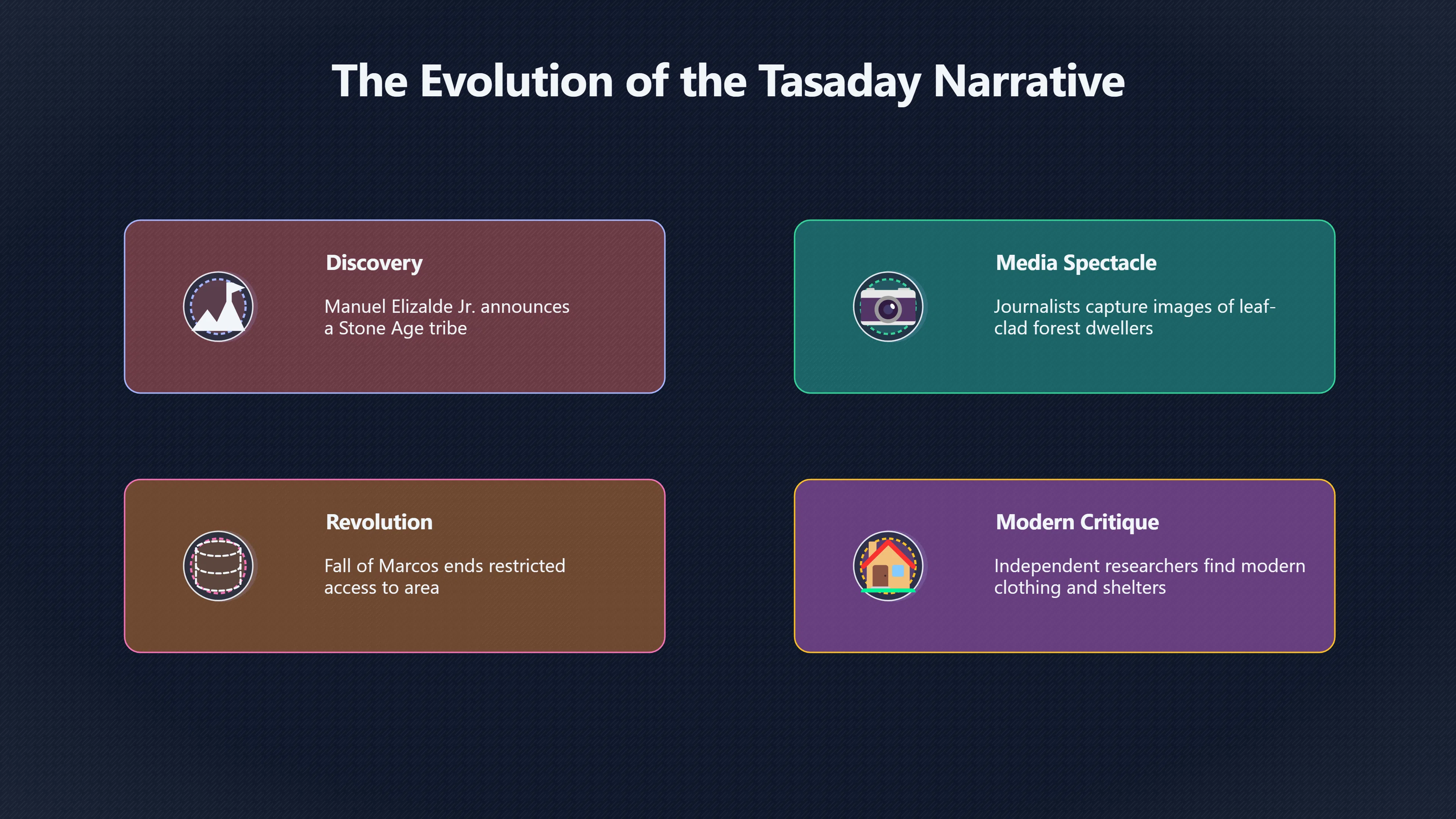
The Tasaday first attracted international attention in 1971 after businessman and government official Manuel Elizalde Jr. announced that a small group of forest-dwelling people had been found in the mountains of Mindanao. The public was told that they lived in caves, used simple stone tools, had little or no agriculture and had remained isolated from the wider world for centuries. Journalists and photographers produced striking images of people wearing leaf garments and living in what appeared to be a prehistoric setting.[wikipedia.org]WikipediaOpen source on wikipedia.org.
The story spread rapidly because it seemed to offer something extraordinarily rare: a surviving community untouched by modern civilisation. Reports often emphasised claims that the Tasaday were peaceful, unfamiliar with warfare and preserved a way of life resembling humanity’s distant past. The discovery attracted worldwide media attention and became one of the most celebrated anthropological stories of the decade.[Wikipedia]WikipediaOpen source on wikipedia.org.
A crucial detail, however, was that access to the Tasaday was tightly controlled. Elizalde’s organisation managed visits, restricted independent research and acted as gatekeeper between the community and the outside world. Because outsiders could not freely investigate the claims, the public image of the Tasaday depended heavily on carefully organised encounters and official narratives.[Wikipedia]WikipediaManuel ElizaldeManuel Elizalde
Why Later Visitors Challenged the Spectacle
The controversy exploded after the 1986 People Power Revolution ended the Marcos era. Restrictions around the Tasaday area weakened, allowing journalists and researchers to visit without the previous controls.
Swiss journalist and anthropologist Oswald Iten, together with Filipino journalist Joey Lozano, reported that the famous caves were largely deserted. They encountered people wearing ordinary modern clothing and living in more conventional shelters rather than permanently inhabiting caves. Some local residents alleged that individuals had been encouraged to adopt leaf clothing and perform a more primitive lifestyle when visitors arrived. These reports generated headlines around the world claiming that the entire discovery had been fabricated.[Wikipedia]WikipediaOpen source on wikipedia.org.
Several features of the original presentation now appeared suspicious:
- Independent scholars had been denied unrestricted access during the height of the publicity.
- The image shown to foreign visitors seemed unusually dramatic and media-friendly.
- Testimony emerged suggesting that some aspects of the public display had been staged.
- The story had flourished within a political environment where controlling information was common.[Wikipedia]WikipediaManuel ElizaldeManuel Elizalde
As a result, the Tasaday became a symbol of broader doubts about information emerging from the Marcos period. For many observers, exposing the “Stone Age tribe” became intertwined with exposing political manipulation more generally.[newslab.philstar.com]newslab.philstar.comThe Stone Age tribe that never was | 31 years of amnesiaIn the 1970s, Marcos fabricated tales of the Tasaday, supposedly a Stone Age trib…
What Subsequent Research Concluded
The most enduring finding of later research was that the simplest explanation—either “completely authentic Stone Age tribe” or “entirely invented people”—failed to fit the evidence.
Linguistic and anthropological investigations conducted during the 1990s suggested that the Tasaday were indeed a distinct community. Research by linguist Lawrence Reid found that their speech differed from neighbouring groups and could not easily be explained as a recently invented performance. Reid concluded that the Tasaday had probably experienced genuine isolation and had lived as hunter-gatherers with limited outside contact, although not for thousands of years as some popular accounts implied.[Wikipedia]WikipediaOpen source on wikipedia.org.
Later scholarship increasingly converged on several points:
- The Tasaday were real people, not fictional characters invented by outsiders.
- They had experienced periods of relative isolation from surrounding populations.
- Their lifestyle was simpler and more forest-based than that of many neighbouring communities.
- The claim that they represented a completely untouched “Stone Age” society was misleading and exaggerated.[wikipedia.org]WikipediaOpen source on wikipedia.org.
Researchers also noted that isolation is not an all-or-nothing condition. Communities may have occasional contact, trade relationships or shared ancestry with neighbouring groups while still maintaining distinctive cultural practices. The popular media narrative tended to ignore these complexities in favour of a dramatic prehistoric image.[Philippine Social Science Council]pssc.org.phTasaday people and their current identity as ancestral domain claimants more than twenty years after they were first 'discovered' by Manu…
Why the Story Was So Convincing
The Tasaday story succeeded because it appealed to powerful cultural expectations. Journalists, scientists and the public were fascinated by the possibility of discovering a community that seemed to exist outside modern history. Images of cave dwellers in a tropical forest fit long-standing ideas about “lost tribes” and untouched worlds.
The political environment also mattered. During the Marcos era, access to information could be tightly managed, making it difficult for sceptics to verify claims independently. Meanwhile, the Tasaday story generated international prestige, media attention and support for programmes presented as protecting indigenous peoples.[Wikipedia]WikipediaManuel ElizaldeManuel Elizalde
The controversy demonstrates how photographs and controlled visits can create a powerful impression of authenticity. Viewers around the world saw genuine members of a real community, yet the context surrounding those images may have been carefully curated. The result was not necessarily a fabricated people, but a misleading picture of who they were and how they lived.[Wikipedia]WikipediaManuel ElizaldeManuel Elizalde
The Real Lesson of the Tasaday Case
The Tasaday controversy is often remembered as a famous hoax, but that description oversimplifies what happened. Unlike forged artefacts or invented documents, the central subject of the story was real. The dispute concerns how that reality was presented.
What later investigations challenged was the transformation of a small indigenous community into a symbol of humanity’s prehistoric past. The most important lesson is therefore not that the Tasaday did not exist, but that selective access, political control and sensational storytelling can turn real people into misleading spectacles. In the history of Philippine controversies, the Tasaday remain one of the clearest examples of how truth can become distorted not through complete invention, but through exaggeration, staging and the powerful appeal of an irresistible story.[wikipedia.org]WikipediaOpen source on wikipedia.org.
Amazon book picks
Further Reading
Books and field guides related to Were the Tasaday a Hoax or Misrepresented?. Use these as the next step if you want deeper reading beyond the article.
The Demon-Haunted World
Rating: 4.5/5 from 43 Google Books ratings
Useful framework for evaluating extraordinary public claims.
The Art of Not Being Governed
Explores upland Southeast Asian societies often misrepresented by outsiders.

Invented knowledge
Strong fit for the Tasaday debate over authenticity and representation.
eBay marketplace picks
Marketplace Samples
Live-tested eBay searches with available results related to this page.
Endnotes
1.
Source: Wikipedia
Link:https://en.wikipedia.org/wiki/Tasaday
2.
Source: Wikipedia
Title: Manuel Elizalde
Link:https://en.wikipedia.org/wiki/Manuel_Elizalde
3.
Source: sova.si.edu
Link:https://sova.si.edu/record/naa.photolot.86-49
Source snippet
, who were an isolated "stone age" level tribe. In the 1980s, the discovery was...
4.
Source: newslab.philstar.com
Link:https://newslab.philstar.com/31-years-of-amnesia/tasaday
Source snippet
The Stone Age tribe that never was | 31 years of amnesiaIn the 1970s, Marcos fabricated tales of the Tasaday, supposedly a Stone Age trib...
5.
Source: Wikipedia
Title: Ethnic groups in the Philippines
Link:https://en.wikipedia.org/wiki/Ethnic_groups_in_the_Philippines
6.
Source: youtube.com
Title: The Most Controversial Tribe In The Philippines
Link:https://www.youtube.com/watch?v=Gvo8wj_lxBM
Source snippet
Tasaday - Stone Age People of the Philippines or National Geographic 1972 Hoax?...
7.
Source: youtube.com
Link:https://www.youtube.com/watch?v=0TBBzgoQ2-E
Source snippet
Probe Archives: Tasaday's Authenticity...
8.
Source: pssc.org.ph
Link:https://pssc.org.ph/wp-content/pssc-archives/Aghamtao/2009/09The%20Tasaday%20Twenty%20Four%20Years%20After%20Insigths%20on%20Ethnicity%20and%20the%20Rights%20Framework.pdf
Source snippet
Tasaday people and their current identity as ancestral domain claimants more than twenty years after they were first 'discovered' by Manu...
Additional References
9.
Source: reddit.com
Link:https://www.reddit.com/r/nonmurdermysteries/comments/1n63bqz/in_1971_a_supposed_stone_age_tribe_called_the/
Source snippet
In 1971, a supposed Stone Age tribe called the Tasaday...Later in 1986, the Tasaday were widely reported as a hoax. the Tasaday were not...
10.
Source: bobcouttie.wordpress.com
Title: the tasaday mystery solved
Link:https://bobcouttie.wordpress.com/2011/12/07/the-tasaday-mystery-solved/
Source snippet
Bob's Histories & MysteriesThe Tasaday Mystery Solved12 Jul 2011 — For others, the presence of a real Tasaday tribe blocked their ambitio...
11.
Source: tandfonline.com
Link:https://www.tandfonline.com/doi/pdf/10.1080/14672715.1990.10413101
Source snippet
Surallah denounced the Tasaday as a hoax and Elizalde for using them as a supposed Stone Age people...Read more...
12.
Source: youtube.com
Link:https://www.youtube.com/watch?v=ykUgB-8eV8k
Source snippet
The Most Controversial Tribe In The Philippines...
13.
Source: facebook.com
Link:https://www.facebook.com/DdosagePH/posts/stone-age-tribe-in-levis-jeans-they-fooled-the-world-for-15-years-until-someone-/1012667058350481/
14.
Source: journalofcreation.com
Title: The Tasaday Stone Age people hoax
Link:https://www.journalofcreation.com/journalofcreation/2021_volume_35_issue_1/MobilePagedArticle.action?articleId=1678683
15.
Source: youtube.com
Title: Probe Archives: Tasaday’s Authenticity
Link:https://www.youtube.com/watch?v=pr-5bnFXuqY
Source snippet
Tasaday Story 1of 2...
16.
Source: tandfonline.com
Link:https://www.tandfonline.com/doi/full/10.1080/14672715.1990.10413101
17.
Source: time.com
Title: the tribe out of time
Link:https://time.com/archive/6894285/the-tribe-out-of-time/
18.
Source: theguardian.com
Link:https://www.theguardian.com/books/2003/jun/23/londonreviewofbooks
Topic Tree