How Iran's Most Famous Hoaxes Were Exposed
Iran’s history of hoaxes is not a catalogue of national gullibility. It is a history of valuable antiquities without secure excavation records, spectacular technological claims amplified before verification, military images designed to project strength, and foreign rumours that use Iran as an exotic or threatening backdrop.
Page outline Jump by section
Introduction
The recurring pattern is straightforward: a claim arrives with the appearance of authority — a royal inscription, an official photograph, a scientific title or a state news report — and reaches the public before specialists can examine its origins. Exposure usually comes from less glamorous evidence: faulty grammar, modern materials, duplicated pixels, inconsistent photographs, missing documentation or claims that cannot be independently tested. The best-known examples, from the “Persian Princess” mummy to digitally multiplied missiles, show how commercial incentives, nationalism and fast-moving media can reinforce one another.
The “Persian Princess” who was recently dead
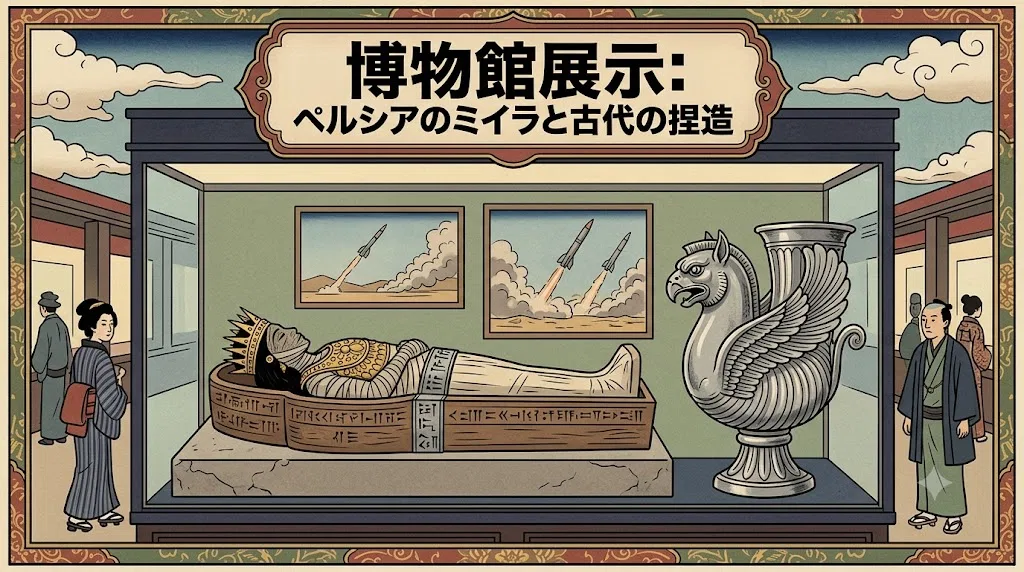
In October 2000, police in Pakistan recovered what appeared to be an extraordinary archaeological discovery: the mummified body of a young woman presented as an Achaemenid royal princess. She lay in a carved coffin and stone sarcophagus, wore a gold crown and breastplate, and was surrounded by inscriptions identifying her as a daughter of the Persian king Xerxes. The find seemed capable of transforming knowledge of ancient Persian burial practices, since royal mummification of this kind was not known from Iran. Pakistan displayed the body in its national museum, while Iran asserted an interest in recovering what appeared to be part of its ancient heritage.[Archaeology Magazine]archive.archaeology.orgArchaeology MagazineSpecial Report: Saga of the Persian Princess"Since the beginning, Iran reserved the legal right to own the 'fake' or…
The story was engineered to look persuasive at several levels. Egyptian-style mummification supplied instant visual drama. Persian royal names gave the body historical importance. Its alleged movement through the borderlands of Iran, Afghanistan and Pakistan made the absence of an excavated archaeological site seem plausible. Most importantly, the object entered public view through police and museum authorities rather than through an obvious carnival promoter. A reported asking price of millions of dollars reveals the commercial purpose behind the spectacle: royal identity, rarity and geopolitical controversy all increased its potential value on the illicit antiquities market.[UNODC]unodc.orgThe Persian Mummy CaseWith the mummy's accoutrements shown to be fake, attention shifted to the body itself, which was that of an ad…
The fabrication began to unravel when specialists examined details rather than the overall theatrical effect. The coffin wood proved comparatively recent. The cuneiform inscription contained historical and grammatical mistakes, including the use of an inappropriate form of the princess’s name. The text borrowed from the Behistun inscription, created under Darius rather than Xerxes. Medical imaging also showed that the body had not been prepared according to ancient Egyptian practice. Tendons and other tissues were far too well preserved for a person supposedly dead for more than two millennia.[UNODC]unodc.orgThe Persian Mummy CaseWith the mummy's accoutrements shown to be fake, attention shifted to the body itself, which was that of an ad…
The most disturbing discovery was that the body itself was modern. Investigators concluded that the woman had probably died during the 1990s, possibly after a violent injury, and had been artificially dried and placed inside the counterfeit burial assemblage. The case therefore ceased to be merely an archaeological forgery and became a possible homicide investigation. Her identity was never securely established. The anonymous woman was eventually buried in Pakistan after years of uncertainty.[UNODC]unodc.orgThe Persian Mummy CaseWith the mummy's accoutrements shown to be fake, attention shifted to the body itself, which was that of an ad…
The “Persian Princess” remains compelling because nearly every institution involved initially had an incentive to accept her. Dealers saw a fortune; museums saw a major exhibit; governments saw cultural prestige; newspapers saw a sensational international dispute. The decisive evidence came instead from combining archaeology, ancient languages, radiocarbon dating and forensic medicine. It is a model case of why an impressive object without a documented excavation history should be treated cautiously.
How fake Persian antiquities entered respectable collections
The mummy was unusually spectacular, but forged Iranian antiquities have a much longer and broader history. Demand for objects associated with ancient Persia encouraged workshops and dealers to produce metal vessels, reliefs, seals, ceramics and inscribed objects that imitated recognised ancient styles. Some were wholly modern. Others were genuine but altered, decorated or supplied with false histories to make them more valuable. Encyclopaedia Iranica records reports of forgery workshops and dealer networks operating both inside and outside Iran, serving an international market centred on major European, American and Middle Eastern cities.[Iranica Online]iranicaonline.orgIranica Online FORGERIES iiOF PRE-ISLAMIC ART OBJECTSMany forgeries were sold by dealers in Iran, primarily in Tehran and Hamadān, and sometimes by local villagers…
These objects succeeded because the antiquities trade traditionally placed too much trust in stylistic resemblance and too little in secure provenance — the documented history of where an object was found and who subsequently owned it. Looted objects rarely arrive with excavation records, so the market’s secrecy creates ideal conditions for forgery. A convincing dealer’s story can turn an unverified object into a supposed discovery from Persepolis, western Iran or a famous treasure site. Once acquired, published or displayed by a respected institution, its museum label begins to function as evidence of authenticity, even when the museum originally relied on the seller’s account.
The so-called Ziwiye hoard illustrates the danger of creating an archaeological “find” from objects circulating through dealers. Numerous gold, ivory and other artefacts were attributed to a single site in north-western Iran after material began appearing on the market in the twentieth century. Scholars later argued that there was no reliable basis for treating all the pieces as one excavated group. Some objects may have been ancient, while others were suspected or identified as modern creations. The misleading element was not necessarily one fabricated treasure chest but the construction of a marketable provenance around unrelated material.[Wikipedia]WikipediaZiwiye hoardZiwiye hoard
A group of reliefs once attributed to Achaemenid Persia provides a clearer example of stylistic exposure. Scholars compared the carvings with securely documented reliefs from Persepolis and found awkward anatomy, confused details and combinations that copied ancient motifs without understanding their original conventions. The pieces could resemble Persian art to a general buyer while appearing fundamentally wrong to specialists familiar with how genuine workshops represented clothing, posture and royal ceremony.[Penn Museum]penn.museumOpen source on penn.museum.
The silver griffin presented as a diplomatic prize
In 2013, the United States returned a silver griffin-shaped vessel to Iran as a gesture during a period of diplomatic engagement. The object was described as an ancient Persian artefact associated with illicit trafficking. Yet several prominent specialists said it was probably a modern fabrication. Critics pointed to its style, construction and resemblance to other suspicious objects circulating on the market. Iranian cultural heritage officials also publicly rejected its authenticity.[theartnewspaper.com]theartnewspaper.comArt Newspaper British Museum expert says griffin returned to Iran is fakeArt Newspaper British Museum expert says griffin returned to Iran is fake
The episode was embarrassing because symbolic value had overtaken verification. An artefact meant to represent respect for Iranian civilisation instead demonstrated the hazards of treating possession, confiscation or high price as proof of age. It also showed that repatriation and authenticity are separate questions. Returning cultural property is an ethical and legal process, but an object should not be declared ancient merely because governments and museums find its story diplomatically useful.
Forgery specialists repeatedly stress that laboratory testing alone cannot always settle such cases. Ancient metal can be melted down and reused; genuine fragments can be attached to modern bodies; artificial corrosion can imitate age. Reliable judgement normally requires several kinds of evidence at once: scientific analysis, manufacturing technique, stylistic comparison, inscriptional accuracy and, above all, a traceable history before the object entered the art market.[Iranica Online]iranicaonline.orgIranica Online FORGERIES iiOF PRE-ISLAMIC ART OBJECTSMany forgeries were sold by dealers in Iran, primarily in Tehran and Hamadān, and sometimes by local villagers…
Missiles multiplied by digital editing
On 9 July 2008, an image released through a website associated with Iran’s Revolutionary Guards appeared to show four missiles rising simultaneously from a desert launch site. The photograph was distributed internationally by Agence France-Presse and reproduced by major news organisations. It arrived during heightened concern over Iran’s missile programme, so the apparent display of readiness had immediate political and economic significance.[WIRED]wired.comIran Missile Photo Faked (UpdatedIran Missile Photo Faked (Updated
Online observers soon noticed that smoke, dust and flame patterns beneath two of the missiles appeared identical. Comparison with another photograph suggested that one missile had failed to launch and that the empty or defective position had been covered by copying elements from a successful launch. Agence France-Presse issued a correction stating that the image appeared to have been digitally altered. By then, however, it had already appeared on prominent news websites and newspaper front pages.[WIRED]wired.comIran Missile Photo Faked (UpdatedIran Missile Photo Faked (Updated
This was not a fabricated military exercise: missiles had been launched. The deception concerned the visual record and the appearance of complete success. That distinction matters. Propaganda often works most effectively by altering a real event rather than inventing one from nothing. The authentic landscape, genuine launch and legitimate news interest gave the picture credibility; one copied missile converted a mixed result into a flawless demonstration.
The episode also exposed weaknesses in international news distribution. Picture agencies and editors were working under pressure, and the image carried an apparently official source line. Verification focused on whether the launch had occurred, not whether every part of the photograph was genuine. Once the agency transmitted it, later publishers treated its presence on a professional wire service as a substitute for inspecting the image themselves.
Digital-forensics experts nevertheless warned against overconfidence. Compression, cropping and the existence of different-resolution copies can complicate comparisons between files. The strongest case did not depend on one suspicious pixel but on repeated shapes, alternative frames from the launch and the later agency correction.[Scientific American]scientificamerican.comis that iranian missileis that iranian missile
The stealth fighter that flew through Photoshop
In February 2013, Iran unveiled the Qaher-313, presented as an advanced domestically produced stealth fighter. Photographs showed a sharply angled aircraft with features associated with radar-evading design. Officials described it as agile, difficult to detect and capable of operating from short runways. Outside aviation specialists, however, quickly questioned whether the displayed craft was an operational aircraft, a prototype or simply a full-sized model. They pointed to its small air intakes, unusual cockpit, apparently basic instruments and other features that seemed incompatible with the claims being made.[The Independent]independent.co.ukThe Independent Iran's new stealth fighter jet caught out by bloggers in 'fakedThe Independent Iran's new stealth fighter jet caught out by bloggers in 'faked
Those technical arguments required specialist knowledge and remained open to some uncertainty because Iran released little engineering information. A subsequent promotional photograph was easier to judge. It showed the aircraft apparently flying over Mount Damavand, but Iranian bloggers and photography analysts traced the mountain background to an existing image and the aircraft to a photograph taken during its public unveiling. The two had been combined digitally.[PetaPixel]petapixel.comPeta Pixel Iranian Stealth Fighter Image Called Out as PhotoshopPeta Pixel Iranian Stealth Fighter Image Called Out as Photoshop
The fake flight photograph did not, by itself, prove that no development programme existed. Governments commonly reveal mock-ups before an aircraft is ready to fly, and prototypes can change radically. What the image did prove was that the particular scene presented to the public was not documentary evidence of a test flight. Coverage sometimes blurred these two conclusions, calling the entire aircraft a “hoax” when the best-established falsification concerned the photograph and when the machine’s true developmental status remained unverified.
This is an important distinction in the study of propaganda. A staged image can be fraudulent even when the underlying programme is real. Conversely, exposing one photograph does not automatically settle every technical question about the object depicted. The reliable conclusion is narrower: authorities or aligned media attempted to create the visual appearance of operational flight before providing independently verifiable evidence of it.
The mystery of the two space monkeys
Iran announced in January 2013 that it had successfully sent a monkey on a suborbital flight and returned it alive. The achievement was presented as progress towards human space flight. Suspicion arose when photographs published before and after the mission appeared to show different animals. One monkey had a prominent mole above an eye; the animal shown after the flight did not. Other facial differences further encouraged claims that the original monkey had died and been replaced.[ABC News]abcnews.comABC News Iran Denies Space Monkey HoaxABC News Iran Denies Space Monkey Hoax
Iranian space officials acknowledged that state media had used photographs of two different monkeys. Their explanation was that journalists had mistakenly illustrated early reports with images of another animal from the group trained for the mission. They insisted that the actual passenger had survived. This admission established a serious media error but did not establish the more dramatic allegation that a dead monkey had been secretly substituted.[ABC News]abcnews.comABC News Iran Denies Space Monkey HoaxABC News Iran Denies Space Monkey Hoax
The case is therefore best understood as contested documentation rather than a proven fake mission. A photograph presented as evidence was incorrectly labelled, making doubt entirely reasonable. Yet the mismatch alone could not determine what happened during the flight. Independent access to the animal, complete mission records and clearer release procedures would have been needed to resolve the matter conclusively.
The controversy demonstrates how an institution’s credibility can be damaged by a seemingly small illustrative shortcut. Once officials admit that the wrong “before” photograph was supplied, every later image becomes suspect. In secretive scientific or military programmes, the public cannot easily separate an innocent newsroom mix-up from an attempt to conceal failure. Transparency is not merely a public-relations benefit; it is part of the evidence.

The “time machine” built from a news cycle
A particularly strange Iranian story circulated internationally in April 2013. Reports said that a young inventor named Ali Razeghi had registered a “time machine” capable of predicting the next five to eight years of a person’s life with 98 per cent accuracy. The device supposedly used algorithms and information taken from a user’s touch. It did not claim to transport anyone through time, but headlines understandably preferred the more spectacular description.[The Washington Post]washingtonpost.comOpen source on washingtonpost.com.
The story was attributed to the semi-official Fars News Agency and then repeated by foreign newspapers and broadcasters. Fars subsequently removed the report, leaving uncertainty about its provenance and wording. Some commentators concluded that an eccentric claim had been published and withdrawn. Others questioned whether international outlets had relied on a mistranslation, a recycled item or a report that could not be independently confirmed.[The Washington Post]washingtonpost.comOpen source on washingtonpost.com.
Even in its reported form, the machine was not supported by a public demonstration, technical paper or controlled test. “Algorithms” supplied a scientific-sounding explanation without showing what data were used or how predictions could be measured. The advertised accuracy was especially meaningless without a defined outcome: predicting a person’s employment, illness, marriage and finances requires different evidence, and vague forecasts can be interpreted after the event to appear successful.
The episode shows how a story can become famous even when its evidential foundations are unstable. An Iranian source lent national and geopolitical interest; the phrase “time machine” offered an irresistible headline; Western coverage then became evidence that the original claim was important. By the time doubts arose over the source report itself, the narrative had already detached from it.
It also reveals the difference between reporting a claim and validating one. Many articles correctly stated that an inventor had supposedly made the assertion, but their humorous treatment encouraged readers to remember “Iran claimed to invent time travel”. A claim by one individual, briefly carried by one news agency, gradually became a national boast in retellings.
Why these stories were believable
Iranian hoaxes and disputed claims repeatedly exploit several powerful expectations, some created inside the country and others imposed from abroad.
The authority of ancient Persia. Objects linked to famous kings, royal tombs or major archaeological sites carry exceptional cultural and financial value. A buyer may be more willing to overlook missing provenance when the possible reward is an unknown princess or a masterpiece from an imperial court.
Official appearance. A state-linked website, museum display or government ceremony can give weak evidence an institutional frame. Readers may assume that specialists have already checked a photograph or artefact when the institution itself is relying on incomplete information.
Secrecy. Military and space projects cannot easily be inspected by outsiders. This gives authorities room to exaggerate, but it also makes false accusations difficult to disprove. A genuine prototype may be dismissed as fake, while a staged photograph may circulate as operational proof.
Geopolitical expectation. International audiences are primed for stories depicting Iran as technologically formidable, secretive, irrational or bizarre. These contradictory stereotypes can all increase circulation. A missile photograph spreads because Iran is considered dangerous; a time-machine story spreads because Iran is portrayed as absurd.
Speed over verification. The missile image, space-monkey photographs and time-machine report all moved rapidly through international media. Corrections were slower and less memorable. Reuters’ investigation of Iranian-linked disinformation networks later found a similar structure online: genuine reports, copied material and partisan falsehoods were mixed together, making the network more credible than an outlet publishing obvious fabrications alone.[Reuters]reuters.comSpecial Report: How Iran spreads disinformation aroundSpecial Report: How Iran spreads disinformation around
From altered photographs to synthetic war footage
Modern misinformation concerning Iran no longer comes only from Iranian institutions. Governments, activists, anonymous engagement farmers and ordinary social-media users circulate miscaptioned or computer-generated material supporting opposing sides. Old explosions are relabelled as new attacks; video-game footage is passed off as combat; genuine images are sometimes dismissed as artificial merely because viewers have become accustomed to fakes.
During the Iran–Israel confrontation of 2025, for example, Reuters identified a computer-generated video shared as authentic footage of an Iranian attack on a United States air base. Other false posts used older photographs of Iranian military parades and claimed that they showed current weapons movements. These cases were exposed through watermarks, reverse-image searches, comparison with archived photographs and checks against known locations and dates.[Reuters]reuters.comAI-watermarked video shared as if authentic visual of Iran'sAI-watermarked video shared as if authentic visual of Iran's
By 2026, fact-checkers were documenting a still denser mixture of synthetic and recycled imagery associated with war involving Iran. Fabricated missile strikes, unrelated festival crowds, old ammunition-depot fires, video-game aircraft and invented pictures of political leaders circulated alongside authentic evidence of real destruction. The central difficulty was no longer simply persuading people to distrust a false image. It was preventing the flood of falsehoods from making every genuine image appear doubtful.[apnews.com]apnews.comAP News FACT FOCUS: Misrepresented images as Iran war progressesFootage claimed to show Iranian missile strikes in Israel was actually from Algerian football celebrations in 2024. - A video purportedly…
This “everything might be fake” response benefits propagandists even when a particular forgery is quickly exposed. Synthetic images create dramatic claims, while the existence of synthetic images can later be invoked to deny authentic photographs. Verification therefore depends less on visual intuition than on provenance: who first published the file, whether earlier copies exist, whether landmarks and shadows match the claimed location, and whether independent witnesses or satellite records support the event.
What the exposures teach us
Iran’s most famous deception cases were not defeated by a single kind of expert. The Persian mummy required forensic doctors, archaeologists, language specialists and dating laboratories. Forged antiquities are identified through provenance research, technical examination and close comparison with excavated objects. Altered military photographs are tested against other frames, original files and repeated visual patterns. Scientific claims require methods that outsiders can inspect and results they can reproduce.
They also show why “fake” should be used precisely. The Persian Princess was a deliberate criminal fabrication. The duplicated missile was a manipulated photograph of a real launch. The Qaher flight image was a composite, although the status of the broader aircraft programme was a separate issue. The space-monkey photographs were incorrectly matched, but the substitution theory was never conclusively proved. The time-machine affair may have begun with an unsupported inventor’s claim and then grown through careless international repetition.
Treating all these episodes as identical hoaxes hides what makes each one instructive. Fraud seeks money; propaganda seeks strategic effect; publicity stunts seek attention; journalism can turn error into apparent fact; folklore and repetition preserve stories long after their original evidence disappears. Iran’s history of contested truth is most useful not as a source of ridicule, but as a set of case studies in how authority is manufactured — and how patient examination can take it apart.

Amazon book picks
Further Reading
Books and field guides related to How Iran's Most Famous Hoaxes Were Exposed. Use these as the next step if you want deeper reading beyond the article.
Frauds, Myths, and Mysteries: Science and Pseudoscience in Ar...
Relevant to forged antiquities and archaeological sensationalism.
The Demon-Haunted World
Rating: 4.5/5 from 43 Google Books ratings
Useful for understanding how dramatic claims gain credibility.
The Persian Empire
Provides historical context for several famous Iranian hoax stories.
eBay marketplace picks
Marketplace Samples
Live-tested eBay searches with available results related to this page.

Endnotes
1.
Source: archive.archaeology.org
Link:https://archive.archaeology.org/0101/etc/persia.html
Source snippet
Archaeology MagazineSpecial Report: Saga of the Persian Princess"Since the beginning, Iran reserved the legal right to own the 'fake' or...
2.
Source: unodc.org
Link:https://www.unodc.org/cld/case-law-doc/traffickingculturalpropertycrimetype/pak/2001/the_persian_mummy_case.html
Source snippet
The Persian Mummy CaseWith the mummy's accoutrements shown to be fake, attention shifted to the body itself, which was that of an ad...
3.
Source: Wikipedia
Title: Persian Princess
Link:https://en.wikipedia.org/wiki/Persian_Princess
4.
Source: Wikipedia
Title: Ziwiye hoard
Link:https://en.wikipedia.org/wiki/Ziwiye_hoard
5.
Source: penn.museum
Link:https://www.penn.museum/sites/expedition/three-achaemenid-fakes/
6.
Source: wired.com
Title: [Iran Missile Photo]({{ ‘missile-photo/’ | relative_url }}) Faked (Updated)
Link:https://www.wired.com/2008/07/iran-missile-ph
7.
Source: Wikipedia
Title: Great Prophet III
Link:https://en.wikipedia.org/wiki/Great_Prophet_III
8.
Source: Wikipedia
Title: IAIO Qaher-313
Link:https://en.wikipedia.org/wiki/IAIO_Qaher-313
9.
Source: petapixel.com
Title: Peta Pixel Iranian Stealth Fighter Image Called Out as Photoshop
Link:https://petapixel.com/2013/02/16/iran-stealth-fighter-image-called-out-as-photoshop-fake-by-bloggers/
10.
Source: reuters.com
Title: Special Report: How Iran spreads disinformation around
Link:https://www.reuters.com/article/world/special-report-how-iran-spreads-disinformation-around-the-world-idUSKCN1NZ1FE/
11.
Source: reuters.com
Title: AI-watermarked video shared as if authentic visual of Iran’s
Link:https://www.reuters.com/fact-check/ai-watermarked-video-shared-if-authentic-visual-irans-us-air-base-attack-2025-06-30/
12.
Source: reuters.com
Title: image does not show iran moving weapons trucks 2024 2024 04 10
Link:https://www.reuters.com/fact-check/image-does-not-show-iran-moving-weapons-trucks-2024-2024-04-10/
13.
Source: reutersinstitute.politics.ox.ac.uk
Title: trolling memes and deepfakes how ai thickening fog war
Link:https://reutersinstitute.politics.ox.ac.uk/news/trolling-memes-and-deepfakes-how-ai-thickening-fog-war
14.
Source: Wikipedia
Title: Archaeological forgery
Link:https://en.wikipedia.org/wiki/Archaeological_forgery
15.
Source: Wikipedia
Title: Oxus Treasure
Link:https://en.wikipedia.org/wiki/Oxus_Treasure
16.
Source: Wikipedia
Title: Misinformation during the 2026 Iran war
Link:https://en.wikipedia.org/wiki/Misinformation_during_the_2026_Iran_war
17.
Source: wired.com
Title: iran time machine
Link:https://www.wired.com/2013/04/iran-time-machine/
18.
Source: unodc.org
Link:https://www.unodc.org/cld/uploads/res/case-law-doc/traffickingculturalpropertycrimetype/pak/the_persian_mummy_case_html/fake_persian_mummy.pdf
19.
Source: iranicaonline.org
Title: Iranica Online FORGERIES ii
Link:https://www.iranicaonline.org/articles/forgeries-ii/
Source snippet
OF PRE-ISLAMIC ART OBJECTSMany forgeries were sold by dealers in Iran, primarily in Tehran and Hamadān, and sometimes by local villagers...
20.
Source: iranicaonline.org
Link:https://www.iranicaonline.org/articles/forgeries-i/
Source snippet
Iranica OnlineFORGERIES i. INTRODUCTIONForgeries have had a long and varied history, occurring in such diverse fields as genealogies, off...
21.
Source: iranicaonline.org
Title: forgeries iii
Link:https://www.iranicaonline.org/articles/forgeries-iii/
Source snippet
Iranica OnlineFORGERIES iii. OF ISLAMIC ART19 Aug 2015 — Ceramics have also been forged and faked since the late 19th century (Watson, p...
22.
Source: theartnewspaper.com
Title: Art Newspaper British Museum expert says griffin returned to Iran is fake
Link:https://www.theartnewspaper.com/archive/british-museum-expert-says-griffin-returned-to-iran-is-fake
23.
Source: rferl.org
Link:https://www.rferl.org/a/iran-us-gift-fake/25136619.html
24.
Source: scientificamerican.com
Title: is that iranian missile
Link:https://www.scientificamerican.com/article/is-that-iranian-missile/
25.
Source: independent.co.uk
Title: The Independent Iran’s new stealth fighter jet caught out by bloggers in ‘faked’
Link:https://www.independent.co.uk/news/world/middle-east/iran-s-new-stealth-fighter-jet-caught-out-by-bloggers-in-faked-photoshop-image-blunder-8493530.html
26.
Source: abcnews.com
Title: ABC News Iran Denies Space Monkey Hoax
Link:https://abcnews.com/Blotter/iran-denies-space-monkey-hoax/story?id=18404781
27.
Source: washingtonpost.com
Link:https://www.washingtonpost.com/news/worldviews/wp/2013/04/11/what-time-machine-iranian-state-media-quietly-deletes-a-report-that-iran-had-built-one/
28.
Source: rferl.org
Link:https://www.rferl.org/a/iran-scientist-razeghi-time-machine/24954771.html
29.
Source: apnews.com
Title: AP News FACT FOCUS: Misrepresented images as Iran war progresses
Link:https://apnews.com/article/787b6a21a4fef4cc32ccca9bc59980f0
Source snippet
Footage claimed to show Iranian missile strikes in Israel was actually from Algerian football celebrations in 2024. - A video purportedly...
30.
Source: ahnp.ub.uni-heidelberg.de
Link:https://ahnp.ub.uni-heidelberg.de/journals/ba/article/view/114611/110648
31.
Source: archive.org
Link:https://archive.org/download/ancientiranianme00arth/ancientiranianme00arth.pdf
32.
Source: reddit.com
Title: Qaher 313
Link:https://www.reddit.com/r/WeirdWings/comments/ouf48l/qaher_313_irans_stealth_fighter_many_experts/
33.
Source: independent.co.uk
Link:https://www.independent.co.uk/news/world/middle-east/was-iran-s-monkey-in-space-launch-faked-before-and-after-pictures-of-spacetravelling-simian-appear-to-show-different-animals-8477551.html
34.
Source: vredespaleis.nl
Link:https://www.vredespaleis.nl/peace-palace/interior/an-international-collection/iran/?lang=en
35.
Source: muttermuseum.org
Title: persian princess
Link:https://muttermuseum.org/stories/posts/persian-princess/
Additional References
36.
Source: theguardian.com
Link:https://www.theguardian.com/commentisfree/2026/mar/13/ai-generated-fake-iran-images
Source snippet
Experts like David Clinch emphasize the importance of critical thinking and caution in digesting and sharing online content. He advises c...
37.
Source: youtube.com
Title: AI-generated deepfakes flood social media amid Iran war disinformation surge
Link:https://www.youtube.com/watch?v=Ht7n1CfFP-g
Source snippet
Disinformation exaggerates Iran's military successes against US and Israel • FRANCE 24 English...
38.
Source: theguardian.com
Link:https://www.theguardian.com/world/2000/nov/26/pakistan.iran
Source snippet
The GuardianPakistan and Iran fight over mummified princess | World news25 Nov 2000 — The mummified corpse of the 20-year-old Persian pri...
39.
Source: youtube.com
Title: The Curious Case of the “Persian Princess”
Link:https://www.youtube.com/watch?v=XyPJBZmLN_Y
Source snippet
AI-generated deepfakes flood social media amid Iran war disinformation surge...
40.
Source: academia.edu
Link:https://www.academia.edu/59187765/INVESTIGATING_PROVENANCE_AND_AUTHENTICITY_USING_ICP_MS_IN_THE_UNIVERSITY_OF_WISCONSIN_MILWAUKEE_ART_COLLECTION_A_CASE_STUDY_OF_LURISTAN_BRONZES
41.
Source: facebook.com
Link:https://www.facebook.com/CBSNews/posts/a-video-shared-by-israels-foreign-ministry-on-its-persian-language-social-media-/1345127984145709/
42.
Source: facebook.com
Link:https://www.facebook.com/thehistoriansden/posts/in-2000-a-sensational-discovery-surfaced-in-pakistan-when-a-remarkably-preserved/885418731199803/
43.
Source: facebook.com
Link:https://www.facebook.com/deutschewellenews/posts/fake-images-of-the-iran-war-are-going-viral-and-creators-worldwide-are-cashing-i/1376167287871915/
44.
Source: facebook.com
Link:https://www.facebook.com/abcnews.au/posts/huge-amounts-of-false-images-and-video-circulating-about-the-conflict-in-iran-ar/1512643493550249/
45.
Source: nationalinterest.org
Link:https://nationalinterest.org/blog/buzz/irans-qaher-f-313-fake-stealth-fighter-was-sad-joke-79096
Topic Tree
Follow this branch
Related pages 192
- Albanian Hoaxes
- Algerian Hoaxes
- Antigua Deceptions
- Argentina Hoaxes
- Armenian Hoaxes
- +187 more in sidebar