How Brazil's Most Famous Hoaxes Took Hold
Brazils best-known hoaxes do not form one neat tradition. They range from forged antiquities and staged photographs to political propaganda, television frauds, journalistic failures and viral pseudoscience.
Page outline Jump by section
Introduction
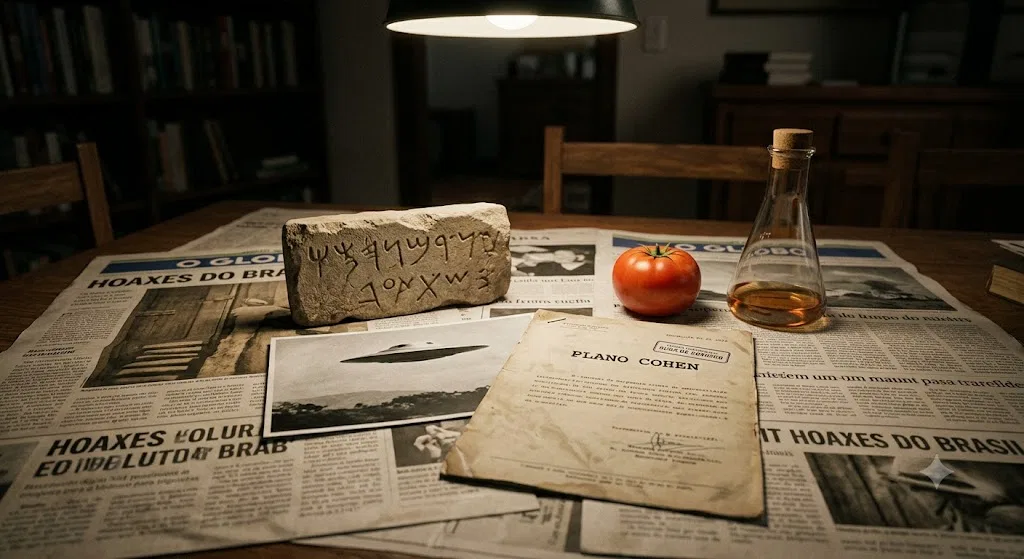
Some cases were deliberate deceptions, such as the forged Cohen Plan used to help justify dictatorship in 1937. Others began as jokes, personal frauds or speculative claims that escaped their original setting. The Escola Base scandal of 1994 was different again: not a planned hoax, but a devastating moral panic built from untested allegations, rash policing and sensational reporting. Together, these stories show why the word hoax must be used carefully. Intent matters, but so do the systems that turn an unsupported claim into an accepted public fact.
The forged inscription that put Phoenicians in Brazil
In the 1870s, scholars were sent a copy of what was said to be an ancient Phoenician inscription discovered in Paraba. The text supposedly recorded the arrival in Brazil of sailors from the eastern Mediterranean centuries before Columbus. No securely documented stone remained available for examination; the claim rested largely on a transcription supplied through correspondence.
The story was persuasive because it appeared during a period of intense interest in ancient scripts, biblical archaeology and possible pre-Columbian contact with the Americas. A Phoenician voyage to Brazil promised to rewrite world history while giving the young Brazilian nation a spectacular ancient connection with the Mediterranean.
Specialists soon detected problems. The French scholar Ernest Renan rejected the inscription in the nineteenth century, citing linguistic defects. In 1968, Harvard scholar Frank Moore Cross examined the text in detail and concluded that it was a nineteenth-century forgery. Among the warning signs were letter forms and linguistic features drawn from different historical periods, as though the author had assembled an ancient-looking text from material available in modern reference works.[JSTOR]jstor.orgx) See particularly the second taw of Judas, the third…Read more…
The case remains attractive to alternative-history writers because it offers a dramatic answer to a genuine question: could ancient mariners have crossed the Atlantic? Such voyages cannot be ruled out merely because they sound surprising. The difficulty is that the Paraba inscription is not reliable evidence for one. Its missing original, uncertain chain of custody and anachronistic writing make it a lesson in why archaeological context matters as much as an exciting translation.
The inscription also helped establish a durable form of Brazilian pseudohistory. Claims about Phoenicians, lost Old World colonies and mysterious inscriptions have repeatedly been attached to natural formations, indigenous earthworks and poorly documented artefacts. These stories often gain their power by treating uncertainty as proof of suppression rather than as a reason for caution.
The Cohen Plan: a fake conspiracy with real political consequences
The most consequential documented deception in Brazilian political history was the Cohen Plan. In September 1937, the public was told that the military had uncovered a communist plan for violent revolution. The supposed document described sabotage, social disorder and attacks on institutions. It appeared to confirm fears already encouraged by the failed communist uprising of 1935 and by years of anti-communist campaigning.
The plan was not an authentic communist document. It had been written by army captain Olmpio Mouro Filho, who was associated with the Brazilian Integralist movement, as a hypothetical exercise depicting how a communist takeover might unfold. Senior military and government figures then presented or permitted it to be presented as evidence of an imminent real conspiracy.[Taylor & Francis]taylorfrancis.comanticommunism conspiracy myths brazil rodrigo patto s mottaTaylor & FrancisAnticommunism and Conspiracy Myths in Brazil | 4July 1, 2024 by RPS Motta 2024 Cited by 3 The apex was the disclo…
Its circulation created the atmosphere that President Getlio Vargas needed. Congress restored emergency powers, political opponents were further marginalised and, on 10 November 1937, Vargas cancelled the approaching presidential election, closed the legislature and imposed the Estado Novo dictatorship. The Fundao Getulio Vargas historical archive describes the plan as a falsification intended to create conditions favourable to the new regime.[Atlas FGV]atlas.fgv.brAtlas FGV| Atlas Histrico do BrasilAtlas FGV| Atlas Histrico do Brasil
The fraud became publicly undeniable only after the dictatorship began to collapse in 1945. Military figures then accused one another of responsibility. Mouro acknowledged writing the original scenario but said it had been misused; General Gis Monteiro admitted that the document was false while attempting to shift blame for its publication.
The Cohen Plan worked because it did not have to create fear from nothing. It attached itself to existing political violence, anti-communism, antisemitic conspiracy thinking and institutional distrust. Official presentation supplied authority, while newspapers helped transform an unverified text into a national emergency. The beneficiaries were those seeking exceptional powers and the suspension of normal democratic restraints.
Its historical importance lies beyond the question of who first intended what. A fictional threat was converted into state evidence, and state evidence into a justification for dictatorship. The episode remains a powerful Brazilian example of how forged intelligence can manufacture consent for measures planned in advance.

Flying saucers made for the illustrated press
Brazils mid-century illustrated magazines operated in a highly competitive market in which dramatic photographs could reach millions of readers. The global flying-saucer craze therefore offered both a mystery and a commercial opportunity.
In May 1952, the magazine O Cruzeiro published a sequence of photographs taken near Barra da Tijuca in Rio de Janeiro by photographer Ed Keffel, who was accompanied by reporter Joo Martins. The images appeared to show a disc-like object crossing the sky. They became some of Brazils earliest famous UFO photographs and were repeatedly reproduced as evidence that flying saucers were physical machines rather than misidentified lights or rumours.[NICAP]nicap.orgBarra da Tijuca (UFO) Photos… O Cruzeiro magazine in its May 24, 1952, issue. It is claimed that the photos were actually taken on…
Contemporary and later investigators raised serious doubts about the circumstances, scale and movement of the object. A declassified United States intelligence record states that an evaluator considered the pictures a hoax and that official records characterised them as trick photography.[CIA]cia.govREPLY TO YOUR NOTE REGARDING GORDON H….Nary evaluated this picture as a hoax and official records indicate this was trick photograp… The most straightforward explanation is that a small model or ordinary object was photographed close to the camera, although surviving accounts have allowed supporters to dispute exactly how the images were made.
Another celebrated series appeared in 1958, when photographer Almiro Barana claimed to have photographed an unidentified object near Trindade Island while aboard a Brazilian Navy vessel. The presence of naval personnel gave the story unusual prestige, but the evidential record is less solid than later retellings suggest. Accounts differ over how many people actually saw the object, whether the photographs were developed under controlled conditions and how closely the negatives were examined. The case has never produced a universally accepted demonstration of fraud, but neither does it provide secure proof of an extraordinary craft.
That distinction matters. The Barra da Tijuca pictures have substantial evidence of staging; the Trindade photographs are better described as disputed and inadequately documented. Treating every questionable UFO photograph as a proven hoax can be as careless as treating every unexplained image as extraterrestrial.
Both stories reveal the power of the camera in an era when photographs were widely regarded as mechanically objective. A printed image appeared to settle an argument that testimony alone could not. Yet photographs can mislead through models, perspective, cropping, processing, selective publication or false captions without requiring sophisticated alteration.
When a joke crossed the language barrier
One of Brazils most famous media blunders began outside the country as an April Fools joke. In 1983, New Scientist published a spoof report describing a supposed genetic hybrid between a cow and a tomato. The fictional creation combined animal protein with tomato fruit and was surrounded by clues that the story was comic, including names alluding to fast-food businesses.
The Brazilian news magazine Veja reportedly treated the item as genuine, expanded it and called the supposed hybrid the Boimate. It even presented an explanatory graphic before later acknowledging the mistake.[AMACOM Books Blog]amacombooks.wordpress.comAMACOM Books Blog April Fools!: Publishing Pranks of the PastAMACOM Books Blog April Fools!: Publishing Pranks of the Past
The episode was not an elaborate Brazilian fabrication. It was a failure of source checking in which satire lost its identifying signals as it moved between publications, languages and editorial contexts. The subject also sounded plausible enough for the period. Recombinant DNA technology was advancing rapidly, while public understanding of genetic engineering was often vague. A strange laboratory claim could therefore feel futuristic rather than impossible.
The Boimate story survives because it is funny, but its mechanism remains current. Satire is often detached from its original date and setting, then circulated as news. Translation can remove jokes, names and cultural references that would have warned the first audience. A secondary outlet may add diagrams, confident prose or expert-sounding explanation, giving the borrowed error greater authority than the original parody possessed.
Escola Base and the anatomy of a moral panic
In March 1994, the owners and employees of a private nursery school in So Paulo were accused of sexually abusing children. Police comments and highly emotional allegations reached the press before reliable evidence had been established. News organisations named suspects, repeated lurid claims and treated the existence of an investigation as proof that a criminal network had been uncovered.
The consequences were immediate. The school was attacked and forced to close. Those accused lost livelihoods, suffered social isolation and experienced serious psychological and physical harm. The investigation was later shelved for lack of evidence, and authorities concluded that no crime had been demonstrated. Fundao Getulio Vargas identifies both rash police conduct and sensational press coverage as central causes of the disaster.[FGV Portal]portal.fgv.brPortalEscola Base Incident is subject of debate on criminal justice systemPortalEscola Base Incident is subject of debate on criminal justice system
Escola Base should not be described as a simple planned hoax. There is no strong evidence that all participants knowingly invented a coordinated deception. It was a cascade of error: suggestive questioning, premature conclusions, official leakage, competitive journalism and public outrage reinforced one another before the underlying claims were tested.
That makes it especially important within a history of contested truth. Deliberate fraud is only one route by which a false story becomes socially real. A sincere allegation can be distorted by adults, investigators or reporters. Once named suspects fit a frightening narrative, the demand for immediate protection can make doubt appear callous and verification seem like obstruction.
The case became a lasting reference point in Brazilian journalism and legal education because later correction could not reverse the original punishment. Acquittal did not reopen the school or erase the headlines. Escola Base demonstrates a central feature of moral panics: institutions can inflict the penalties of guilt before any court establishes that a crime occurred.[Taylor & Francis]taylorfrancis.comTaylor & Francis False Accusations in a School | Taylor & Francis GroupTaylor & Francis False Accusations in a School | Taylor & Francis Group
The fake pregnancy that became a national catchphrase
In 2012, a woman from Taubat attracted national television coverage by claiming that she was pregnant with quadruplets. Her unusually large abdomen, detailed accounts of the expected children and appearances on popular programmes encouraged donations of baby goods and other assistance.
Suspicion grew during television coverage. An investigation found that an ultrasound image associated with the claim had been copied and altered, and the supposed pregnancy was exposed as false. The womans lawyer subsequently acknowledged the deception.[Wikipedia]WikipediaTaubat pregnancy hoaxTaubat pregnancy hoax
This was a personal fraud amplified by daytime televisions preference for intimate, emotional and visually striking stories. The claim contained many elements that producers value: rarity, family drama, medical wonder and opportunities for charitable participation. Those same features made sceptical questions uncomfortable. Asking for medical confirmation could appear intrusive when the programmes emotional purpose was to celebrate and assist an expectant mother.
After exposure, the affair became much larger than the original deception. The pregnant woman from Taubat developed into a meme, and references to Taubat were used jokingly to label an obvious fake or inferior imitation. The result shows how a hoax can outlive its victims and circumstances by turning into a reusable piece of popular language.
The humour can obscure the ethical complexity. Television exposure brought donations and fame, but it also turned a troubled individual into a permanent national punchline. The case is therefore both a straightforward fraud and an example of how entertainment media can first reward an extraordinary claim and then profit again from its collapse.
Ratanab and the viral lost city
In 2022, social media posts claimed that an immense ancient city called Ratanab had been discovered beneath the Amazon rainforest. Depending on the version, it was hundreds of millions of years old, larger than Greater So Paulo, linked by tunnels and possibly connected with extraterrestrial beings or suppressed technologies.
The claims were associated with Urandir Fernandes de Oliveira and spread widely after being promoted by large entertainment and gossip accounts, influencers and political figures. Archaeologists rejected the story because its proposed dates contradicted basic human and geological history, while the images presented as evidence did not establish the existence of such a city.[Wikipedia]WikipediaOpen source on wikipedia.org.
Ratanab succeeded by attaching fantasy to real archaeological discoveries. Research has overturned the old stereotype of an Amazon untouched by complex societies. Archaeologists have documented substantial pre-colonial settlements, road systems, managed landscapes and large earthworks. Those genuine discoveries make the idea of hidden Amazonian urbanism plausible in broad outline, even though they do not support a technologically advanced megalopolis hundreds of millions of years old.
The false version also replaced indigenous achievement with a mysterious civilisation, outsiders or aliens. Archaeologist Eduardo Ges Neves has argued that such stories can erase the authorship of indigenous peoples by crediting their landscapes and structures to imagined superior cultures.[ElHuffPost]huffingtonpost.esOpen source on huffingtonpost.es.
Unlike a forged stone or staged photograph, Ratanab was a networked hoax-like narrative. It did not depend on one decisive artefact. It spread through screenshots, aerial images, recycled claims and repeated assurances that conventional experts were hiding the truth. Retractions could remove individual posts, but copies and memes continued circulating after the original assertions had been challenged.
Why Brazilian hoaxes keep changing form
These cases span more than a century, yet several mechanisms recur.
Borrowed authority makes the claim portable. The Paraba inscription borrowed the authority of ancient writing; the Cohen Plan borrowed military intelligence; UFO photographs borrowed the cameras reputation for objectivity; Ratanab borrowed genuine Amazonian archaeology.
Media speed rewards certainty. O Cruzeiro, Veja, television talk shows and social platforms operated in different technological eras, but each had incentives to publish a striking story before rivals. Once an account was packaged with photographs, diagrams or emotional testimony, later doubts appeared weaker than the first vivid impression.
Existing beliefs determine what feels plausible. Anti-communist fear prepared the ground for the Cohen Plan. Excitement about genetic engineering made the Boimate sound credible. Global flying-saucer culture gave ambiguous photographs an extraterrestrial interpretation. New archaeological discoveries helped a fictional Amazonian metropolis sound like suppressed science.
Exposure rarely ends the story. A forgery can remain useful to nationalists after specialists reject it. A political fabrication can shape institutions long after its disclosure. A television fraud can survive as slang, while a debunked lost city becomes a meme or conspiracy proof that experts are supposedly hiding something.
The digital environment has intensified these older patterns rather than replacing them. Research into fact-checked images shared through Brazilian WhatsApp groups during the 2018 election found a substantial ecosystem of manipulated or falsely captioned visual material. The technology was new, but the underlying method was familiar: use an arresting image, detach it from its context and let trusted social relationships carry the claim.[arXiv]arxiv.orgOpen source on arxiv.org.
What these cases reveal
Brazils history of famous deception is not a catalogue of people being foolish. It is a history of authority being imitated, delegated or abused. Forgers understood the prestige of scholarship. Political actors understood the force of secret intelligence. Magazine editors understood the persuasive power of photographs and scientific language. Television producers understood emotional identification. Social-media promoters understood that repetition and engagement can substitute for evidence.
The strongest defence is therefore not a vague instruction to be sceptical. Each type of claim demands a different question. Where is the original artefact? Who controlled the negatives? Was the document authenticated independently? Did a police investigation produce evidence, or merely allegations? Is a scientific report genuine, or satire stripped of context? Does an archaeological claim fit established chronology and documented excavation?
These episodes also show why categories should remain precise. The Cohen Plan was a politically exploited forgery. The Paraba inscription is regarded by leading specialists as a modern fake. The Barra da Tijuca photographs were probably staged. The Trindade images remain disputed rather than conclusively resolved. Escola Base was a media and investigative failure, not a neatly organised hoax. Ratanab blended pseudoscience, promotion and internet conspiracy culture.
That precision does not make the stories less compelling. It reveals the more interesting truth: deception succeeds not simply because a lie is clever, but because institutions, technologies and audiences provide it with a believable route into public life.
Amazon book picks
Further Reading
Books and field guides related to How Brazil's Most Famous Hoaxes Took Hold. Use these as the next step if you want deeper reading beyond the article.
Extraordinary Popular Delusions and the Madness of Crowds
Rating: 4.0/5 from 5 Google Books ratings
Covers how societies embrace false beliefs and hoaxes.
eBay marketplace picks
Marketplace Samples
Example marketplace items related to this page. Use the search link to explore similar finds on eBay.


Endnotes
1.
Source: jstor.org
Link:https://www.jstor.org/stable/43078827
Source snippet
(x) See particularly the second taw of Judas, the third...Read more...
2.
Source: atlas.fgv.br
Title: Atlas FGV| Atlas Histrico do Brasil
Link:https://atlas.fgv.br/verbete/313
3.
Source: cpdoc.fgv.br
Title: CAVALCANTI, Newton
Link:https://cpdoc.fgv.br/sites/default/files/verbetes/primeira-republica/CAVALCANTI%2C%20Newton.pdf
Source snippet
FGV CPDOCCAVALCANTI, NEWTON *militar; rev. 1930Logo em seguida, anunciou-se ao pas a descoberta do Plano Cohen um pretenso plano comun...
4.
Source: nicap.org
Link:https://www.nicap.org/bdtrep-story.htm
Source snippet
Barra da Tijuca (UFO) Photos... O Cruzeiro magazine in its May 24, 1952, issue. It is claimed that the photos were actually taken on...
Published: May 24, 1952
5.
Source: cia.gov
Link:https://www.cia.gov/readingroom/document/cia-rdp81r00560r000100040011-6
Source snippet
REPLY TO YOUR NOTE REGARDING GORDON H....Nary evaluated this picture as a hoax and official records indicate this was trick photograp...
6.
Source: portal.fgv.br
Title: PortalEscola Base Incident is subject of debate on criminal justice system
Link:https://portal.fgv.br/en/news/escola-base-incident-subject-debate-criminal-justice-system
7.
Source: Wikipedia
Title: Taubat pregnancy hoax
Link:https://en.wikipedia.org/wiki/Taubat%C3%A9_pregnancy_hoax
8.
Source: Wikipedia
Link:https://en.wikipedia.org/wiki/Ratanab%C3%A1
9.
Source: arxiv.org
Link:https://arxiv.org/abs/2005.02443
10.
Source: cpdoc.fgv.br
Title: getulio vargas
Link:https://cpdoc.fgv.br/biografias/getulio-vargas
11.
Source: cpdoc.fgv.br
Title: CAF FILHO
Link:https://cpdoc.fgv.br/sites/default/files/verbetes/primeira-republica/CAF%C3%89%20FILHO.pdf
12.
Source: cpdoc.fgv.br
Title: ARANHA, Oswaldo
Link:https://cpdoc.fgv.br/sites/default/files/verbetes/primeira-republica/ARANHA%2C%20Oswaldo.pdf
13.
Source: cpdoc.fgv.br
Title: MAGALHES, Agamenon
Link:https://cpdoc.fgv.br/sites/default/files/verbetes/primeira-republica/MAGALH%C3%83ES%2C%20Agamenon.pdf
14.
Source: cpdoc.fgv.br
Title: ERNESTO, Pedro
Link:https://cpdoc.fgv.br/sites/default/files/verbetes/primeira-republica/ERNESTO%2C%20Pedro.pdf
15.
Source: cpdoc.fgv.br
Title: CUNHA, Flores da red
Link:https://cpdoc.fgv.br/sites/default/files/verbetes/primeira-republica/CUNHA%2C%20Flores%20da%20red.pdf
16.
Source: expo-virtual-cpdoc.fgv.br
Title: br Governo Vargas | Exposio Virtual
Link:https://expo-virtual-cpdoc.fgv.br/governo-vargas
17.
Source: cpdoc.fgv.br
Title: CARVALHO, Ernides de
Link:https://cpdoc.fgv.br/sites/default/files/verbetes/primeira-republica/CARVALHO%2C%20Er%C3%B4nides%20de.pdf
18.
Source: Wikipedia
Title: Cohen Plan
Link:https://en.wikipedia.org/wiki/Cohen_Plan
19.
Source: Wikipedia
Link:https://en.wikipedia.org/wiki/Brazil
20.
Source: Wikipedia
Title: Archaeological interest of Pedra da Gvea
Link:https://en.wikipedia.org/wiki/Archaeological_interest_of_Pedra_da_G%C3%A1vea
21.
Source: Wikipedia
Title: Art forgery
Link:https://en.wikipedia.org/wiki/Art_forgery
22.
Source: Wikipedia
Title: Theory of Phoenician discovery of the Americas
Link:https://en.wikipedia.org/wiki/Theory_of_Phoenician_discovery_of_the_Americas
23.
Source: Wikipedia
Title: 1937 Brazilian coup d’tat
Link:https://en.wikipedia.org/wiki/1937_Brazilian_coup_d%27%C3%A9tat
24.
Source: Wikipedia
Title: UFO sightings in Brazil
Link:https://en.wikipedia.org/wiki/UFO_sightings_in_Brazil
25.
Source: Wikipedia
Title: Disappearance of Bruno Borges
Link:https://en.wikipedia.org/wiki/Disappearance_of_Bruno_Borges
26.
Source: hoaxes.org
Link:https://hoaxes.org/aprilfool/P20
27.
Source: hoaxes.org
Title: a case of art plagiarism
Link:https://hoaxes.org/weblog/comments/a_case_of_art_plagiarism
28.
Source: youtube.com
Title: Escola Base
Link:https://www.youtube.com/watch?v=AdLjLd5fOUw
Source snippet
THE DAMNED MOTHERS WHO KILLED MY PARENTS' DREAMS - I AM THE SON OF THE ESCOLA BASE - WITH BETO RI...
29.
Source: taylorfrancis.com
Title: anticommunism conspiracy myths brazil rodrigo patto s motta
Link:https://www.taylorfrancis.com/chapters/oa-edit/10.4324/9781003474272-4/anticommunism-conspiracy-myths-brazil-rodrigo-patto-s%C3%A1-motta
Source snippet
Taylor & FrancisAnticommunism and Conspiracy Myths in Brazil | 4July 1, 2024 by RPS Motta 2024 Cited by 3 The apex was the disclo...
Published: July 1, 2024
30.
Source: amacombooks.wordpress.com
Title: AMACOM Books Blog April Fools!: Publishing Pranks of the Past
Link:https://amacombooks.wordpress.com/2015/04/01/april-fools-publishing-pranks-of-the-past/
31.
Source: taylorfrancis.com
Title: Taylor & Francis False Accusations in a School | Taylor & Francis Group
Link:https://www.taylorfrancis.com/chapters/edit/10.4324/9781003019688-12/false-accusations-school-rafael-grohmann-felipe-moura-de-oliveira-moreno-osorio
32.
Source: huffingtonpost.es
Link:https://www.huffingtonpost.es/life/cultura/un-arqueologo-sostiene-leyenda-ciudad-perdida-amazonas-no-sentido.html
33.
Source: santos.sp.gov.br
Link:https://www.santos.sp.gov.br/?q=file%2F76085%2Fdownload&token=po3jZnu3
34.
Source: ape.es.gov.br
Link:https://ape.es.gov.br/Media/ape/PDF/Disserta%C3%A7%C3%B5es%20e%20Teses/Hist%C3%B3ria-UFES/UFES_PPGHIS_MARCELA_CAMPOREZ.pdf
35.
Source: ape.es.gov.br
Title: UFES PPGHIS FRANCISCO JOS DOS SANTOS
Link:https://ape.es.gov.br/Media/ape/PDF/Disserta%C3%A7%C3%B5es%20e%20Teses/Hist%C3%B3ria-UFES/UFES_PPGHIS_FRANCISCO_JOS%C3%89_DOS_SANTOS.pdf
36.
Source: ape.es.gov.br
Link:https://ape.es.gov.br/Media/ape/PDF/Disserta%C3%A7%C3%B5es%20e%20Teses/Hist%C3%B3ria-UFES/UFES_PPGHIS_DIEGO_STANGER.pdf
37.
Source: library.biblicalarchaeology.org
Title: phoenicians in brazil
Link:https://library.biblicalarchaeology.org/article/phoenicians-in-brazil/
38.
Source: imdb.com
Title: Escola Base
Link:https://www.imdb.com/title/tt23556222/
39.
Source: rio.rj.gov.br
Link:https://www.rio.rj.gov.br/dlstatic/10112/13233545/4333068/HISTORIA.pdf
40.
Source: rio.rj.gov.br
Link:https://www.rio.rj.gov.br/dlstatic/10112/4244908/4104910/H9_3BIM_2013_ALUNO.pdf
41.
Source: educapes.capes.gov.br
Title: Dissertao Eliene Gomes da Silva PPGH Prof Histria (1) (1)
Link:https://educapes.capes.gov.br/bitstream/capes/921692/2/Disserta%C3%A7%C3%A3o%20_Eliene%20Gomes%20da%20Silva%20_PPGH_ProfHist%C3%B3ria%20%281%29%20%281%29.pdf
42.
Source: museuparanaense.pr.gov.br
Link:https://www.museuparanaense.pr.gov.br/sites/mupa/arquivos_restritos/files/documento/2020-09/arautofinal.pdf
43.
Source: revistaacervo.an.gov.br
Link:https://revistaacervo.an.gov.br/index.php/revistaacervo/issue/download/53/72
44.
Source: repositorio.fjp.mg.gov.br
Title: fjp.mg.gov.br Resumo
Link:https://repositorio.fjp.mg.gov.br/bitstreams/9d626e0f-bb9a-4eae-8cf9-a41686a206db/download
Additional References
45.
Source: encyclopedia.com
Link:https://www.encyclopedia.com/humanities/encyclopedias-almanacs-transcripts-and-maps/cohen-plan
46.
Source: youtube.com
Title: THE DAMNED MOTHERS WHO KILLED MY PARENTS’ DREAMS
Link:https://www.youtube.com/watch?v=yYdjxbRA6Ow
Source snippet
Cafezinho 567 | O Caso Escola Base: A Fake News Que Destruiu Famlias...
47.
Source: biblicalarchaeology.org
Link:https://www.biblicalarchaeology.org/daily/phoenicians-sailing-to-the-new-world/
Source snippet
Biblical Archaeology SocietyPhoenicians Sailing to the New WorldWith regard to the Paraiba Stone and inscription, the French historian an...
48.
Source: academia.edu
Link:https://www.academia.edu/472284/Non_Provenanced_Epigraphs_I_Pillaged_Antiquities_Northwest_Semitic_Forgeries_and_Protocols_for_Laboratory_Tests
49.
Source: reddit.com
Link:https://www.reddit.com/r/UFOs/comments/123zqs9/a_real_photograph_taken_near_trindade_island/
50.
Source: freemanart.ca
Link:https://www.freemanart.ca/greatest_art_forgers_fakers.htm
51.
Source: x.com
Link:https://x.com/govbrazil/status/1527380719374311424?lang=en
52.
Source: facebook.com
Link:https://www.facebook.com/NIG.NEWS.99/posts/meet-emmanuel-nwude-the-nigerian-scammer-who-sold-a-fake-airport-to-a-brazilian-/1480189903791344/
53.
Source: instagram.com
Link:https://www.instagram.com/reel/DQu7EMLkknZ/?hl=en
54.
Source: instagram.com
Link:https://www.instagram.com/reel/DTwRCbaAaHl/?hl=en
Topic Tree
Follow this branch
Related pages 192
- Albanian Hoaxes
- Algerian Hoaxes
- Antigua Deceptions
- Argentina Hoaxes
- Armenian Hoaxes
- +187 more in sidebar