Within Dominica Deceptions
How the Cannibal Myth Justified Conquest
European claims of Kalinago cannibalism spread through hearsay, law and conquest rather than reliable observation.
On this page
- What Europeans claimed about the Kalinago
- How hearsay became a legal category
- What archaeology and later criticism changed
Page outline Jump by section
Introduction
The most influential false story associated with Dominica’s Indigenous people was not a practical joke, forged artefact or newspaper stunt. It was the colonial claim that the Kalinago—long known in European sources as “Caribs”—were habitual cannibals. The allegation became one of the most powerful myths in Caribbean history because it did more than frighten readers. It helped create legal categories, justify enslavement, legitimise military campaigns and rationalise the seizure of Indigenous land. Dominica matters especially in this story because it remained one of the strongest Kalinago centres in the Lesser Antilles long after Europeans had established control elsewhere. As a result, colonial descriptions of the island became deeply entangled with the image of the supposedly savage “Carib cannibal”. Modern historical and archaeological research has increasingly challenged that image, arguing that it was shaped less by reliable observation than by colonial interests and inherited assumptions.[tiboko.com]tiboko.comCarib-.Read moreCarib as a Colonial Category: Comparing Ethnohistoric…January 23, 2012 — by S Lenik · 2012 · Cited by 48 — Beginning with the…
What Europeans Claimed About the Kalinago
From the earliest voyages to the Caribbean, European writers described certain Indigenous groups as fierce raiders who attacked neighbouring islands, abducted captives and consumed human flesh. These stories were repeated so often that many later authors treated them as established fact. Columbus’s reports and the accounts that followed helped spread the idea that “Caribs” formed a distinct and dangerous people whose behaviour placed them outside normal moral and legal protections.[Tiboko]tiboko.comCarib-.Read moreCarib as a Colonial Category: Comparing Ethnohistoric…January 23, 2012 — by S Lenik · 2012 · Cited by 48 — Beginning with the…
The problem is that much of the evidence was indirect. Early chroniclers often relied on translators, rumours, hostile testimony from rival groups, or interpretations of human remains whose meaning was uncertain. Historians examining the documentary record have noted that accusations of cannibalism frequently rested on hearsay rather than eyewitness observation. Even where references to human remains existed, they did not necessarily demonstrate consumption of human flesh; burial practices, warfare and ritual behaviour could produce similar evidence.[Persée]persee.frPersée Carib cannibalismThe historical evidenceby NL Whitehead · 1984 · Cited by 119 — Given the fact that in 1503 the Spanish Crown had decreed that all canniba…
Dominica became central to the stereotype because it remained a major Kalinago stronghold. European observers encountering organised Indigenous resistance could easily fit what they saw into an existing narrative that portrayed Kalinago communities as inherently violent. The island’s reputation therefore became linked to a broader colonial image that had already been circulating for generations.[Refworld]refworld.orgWorld Directory of Minorities and Indigenous PeoplesThe Kalinago (island Caribs) earned an early reputation among European coloni…
How Hearsay Became a Legal Category
The cannibal story became historically significant not because it was well proven but because it acquired legal force.
Spanish policy initially recognised Indigenous peoples as subjects who could not simply be enslaved at will. Yet royal decrees created important exceptions. By 1503, people classified as cannibals could legally be captured and enslaved. This transformed an ethnographic claim into a political and economic tool. Once slavery was permitted for those labelled “Caribs” or cannibals, colonial authorities gained a strong incentive to expand the category.[mdpi.com]mdpi.comEsclavos Indios and the School of Salamanca after…by M Méndez Alonzo · 2024 · Cited by 2 — royal decree in August of 1503 permitti…
The result was a self-reinforcing system:
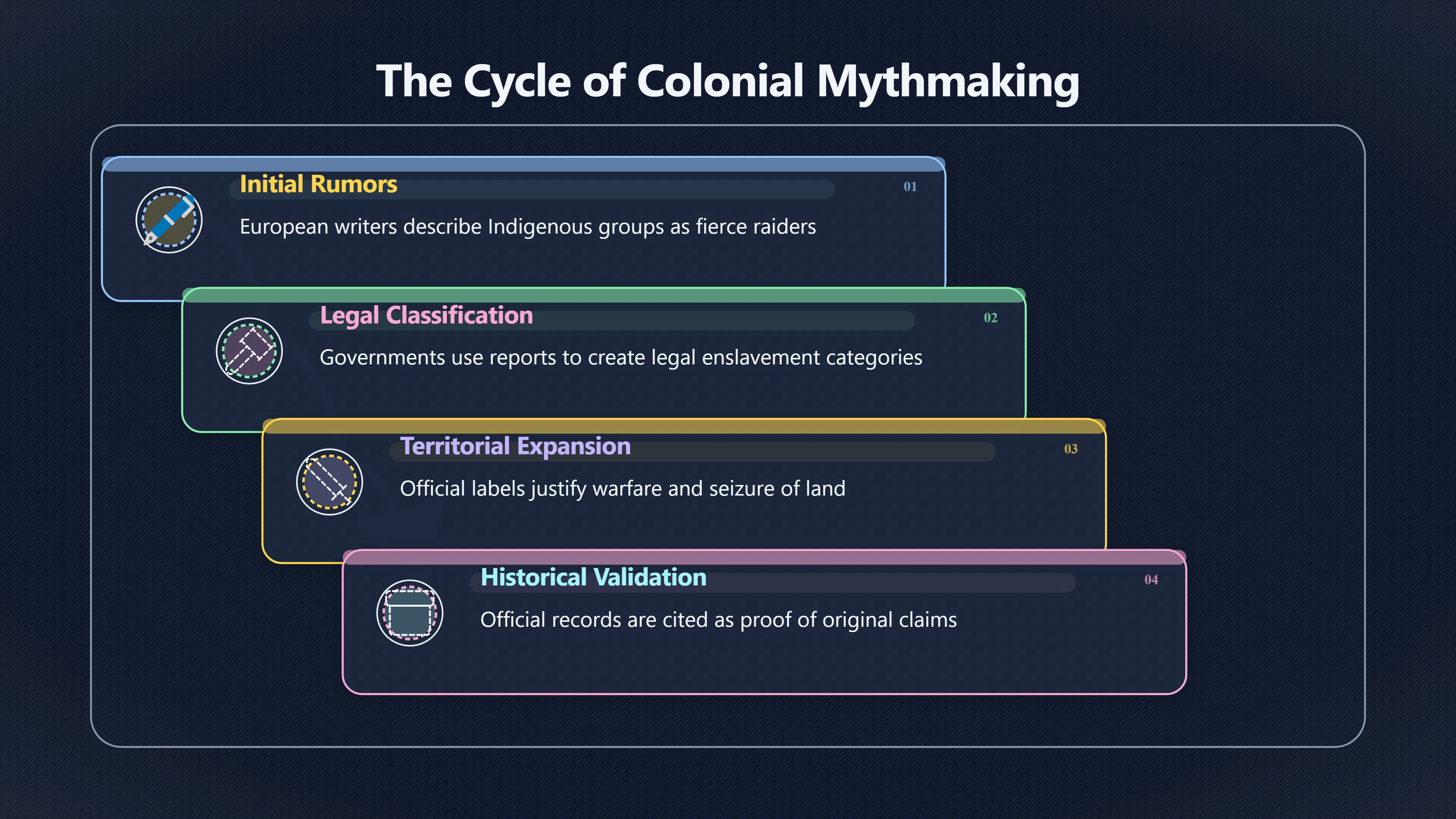
- Reports described certain island populations as cannibals.
- Governments used those reports to create legal distinctions.
- Those distinctions justified warfare, enslavement and territorial expansion.
- The resulting official records were later cited as evidence that the original accusations must have been true.
Historians of colonial law have shown that the label “Carib” often functioned less as a precise ethnic description than as a category that could be applied to resistant Indigenous populations. In practice, the accusation of cannibalism helped convert political opposition into a legally punishable condition. The spectre of cannibalism thus became a mechanism of colonial governance rather than merely a colourful travel tale.[Brill]brill.comChapter 6 Chasing 'Caribs': Defining Zones of Legal…Dec 11, 2017 — The Spaniards would use the specter of cannibalism, and the la…
This dynamic was particularly important in the Lesser Antilles, where European powers faced communities that continued to resist colonisation. A population portrayed as savage and inhuman was easier to dispossess than one recognised as defending its homeland.[Brill]brill.comChapter 6 Chasing 'Caribs': Defining Zones of Legal…Dec 11, 2017 — The Spaniards would use the specter of cannibalism, and the la…
Why the Myth Was So Persuasive
The accusation succeeded because it fitted several powerful European assumptions at once.
Cannibalism occupied a unique place in European imagination. It represented the ultimate marker of barbarism and provided a dramatic contrast to Christian ideas of civilisation. Reports of human flesh consumption therefore attracted attention and travelled rapidly through official correspondence, travel literature and popular histories.[Persée]persee.frPersée Carib cannibalismThe historical evidenceby NL Whitehead · 1984 · Cited by 119 — Given the fact that in 1503 the Spanish Crown had decreed that all canniba…
The claim also benefited from distance. Most Europeans would never visit Dominica or other Lesser Antillean islands. They depended on reports produced by explorers, missionaries, colonial officials and settlers. Once repeated across multiple texts, a rumour could acquire the appearance of independent confirmation even when later authors were ultimately drawing on the same original stories.[Tiboko]tiboko.comCarib-.Read moreCarib as a Colonial Category: Comparing Ethnohistoric…January 23, 2012 — by S Lenik · 2012 · Cited by 48 — Beginning with the…
Another reason for the myth’s durability was linguistic. European usage increasingly linked the words “Carib” and “cannibal”, making the alleged behaviour seem inseparable from the identity of the people themselves. The label gradually carried assumptions that extended far beyond any specific evidence.[CARICOM]caricom.orgdominicas kalinago people to celebrate indigenous culturedominicas kalinago people to celebrate indigenous culture
What Archaeology and Later Criticism Changed
Modern scholarship has not simply replaced one certainty with another. Researchers generally distinguish between isolated acts that may have occurred in particular circumstances and the sweeping colonial portrayal of an entire people as habitual cannibals.
Archaeological investigations in Dominica and elsewhere in the Caribbean have complicated older narratives. Evidence increasingly suggests diverse Indigenous societies connected by trade, migration and local histories that do not match the simplistic colonial division between peaceful peoples and marauding cannibal invaders. Studies of settlement patterns and material culture reveal a more complex social landscape than early European descriptions allowed.[Tiboko]tiboko.comCarib-.Read moreCarib as a Colonial Category: Comparing Ethnohistoric…January 23, 2012 — by S Lenik · 2012 · Cited by 48 — Beginning with the…
Historians have likewise re-examined the documentary record and found that many famous allegations rested on weak foundations. Neil Whitehead’s influential review of the evidence argued that the history of Caribbean cannibalism claims cannot be separated from the political and economic incentives that encouraged colonists to identify enemies as cannibals.[Persée]persee.frPersée Carib cannibalismThe historical evidenceby NL Whitehead · 1984 · Cited by 119 — Given the fact that in 1503 the Spanish Crown had decreed that all canniba…
More recent archaeological debates have occasionally revived arguments that some colonial reports may contain elements of truth. However, even researchers exploring those possibilities acknowledge that European perceptions of “Carib cannibals” had enormous historical consequences regardless of their accuracy. The crucial issue is that colonial societies transformed uncertain reports into broad racial and legal categories.[Florida Museum]floridamuseum.ufl.educarib skulls boost credibility of columbus cannibal claimscarib skulls boost credibility of columbus cannibal claims
Many archaeologists today argue that the traditional image of the Kalinago as a cannibal culture is not supported by the available evidence and reflects the biases of colonial sources more than the realities of Indigenous life.[The Guardian]theguardian.comarcheology caribbean carib people cannibalism colonial history wrongarcheology caribbean carib people cannibalism colonial history wrong

Why claims about Cannibal Myth remained persuasive
The cannibal myth survives because it is memorable, dramatic and deeply embedded in older histories of the Caribbean. Schoolbooks, travel accounts and popular retellings repeated the story for centuries, often without examining how the claim originated or who benefited from it.[sundominica.com]sundominica.comThe myth of cannibalism | LocalThe myth of cannibalism | Local
For the Kalinago themselves, the issue is not merely academic. The continued use of colonial labels has long been controversial, and efforts in Dominica to emphasise the name “Kalinago” rather than “Carib” reflect a broader attempt to move beyond identities shaped by colonial stereotypes. Community leaders have argued that the older terminology carried associations with cannibalism and savagery that distorted Indigenous history.[CARICOM]caricom.orgdominicas kalinago people to celebrate indigenous culturedominicas kalinago people to celebrate indigenous culture
The enduring lesson of the cannibal myth is not simply that Europeans believed something false. It is that a poorly supported claim became powerful because it served legal, economic and political purposes. In Dominica, the story illustrates how colonial authority could transform rumour into policy, and policy into historical “fact”, leaving a legacy that survived long after the original evidence had been questioned.[brill.com]brill.comChapter 6 Chasing 'Caribs': Defining Zones of Legal…Dec 11, 2017 — The Spaniards would use the specter of cannibalism, and the la…
Amazon book picks
Further Reading
Books and field guides related to How the Cannibal Myth Justified Conquest. Use these as the next step if you want deeper reading beyond the article.
Silencing the Past
Rating: 4.5/5 from 5 Google Books ratings
Examines how dominant groups shape historical narratives.
eBay marketplace picks
Marketplace Samples
Live-tested eBay searches with available results related to this page.
Endnotes
1.
Source: tiboko.com
Title: Carib-.Read more
Link:https://tiboko.com/wp-content/uploads/2023/07/Carib_as_a_Colonial_Category_Comparing_E.pdf
Source snippet
Carib as a Colonial Category: Comparing Ethnohistoric...January 23, 2012 — by S Lenik · 2012 · Cited by 48 — Beginning with the...
Published: January 23, 2012
2.
Source: refworld.org
Link:https://www.refworld.org/reference/countryrep/mrgi/2008/65036
Source snippet
World Directory of Minorities and Indigenous PeoplesThe Kalinago (island Caribs) earned an early reputation among European coloni...
3.
Source: mdpi.com
Link:https://www.mdpi.com/2077-1444/15/5/594
Source snippet
Esclavos Indios and the School of Salamanca after...by M Méndez Alonzo · 2024 · Cited by 2 — royal decree in August of 1503 permitti...
4.
Source: brill.com
Link:https://brill.com/display/book/edcoll/9789004356481/BP000007.xml?srsltid=AfmBOoqCsItHoBh8IlRv2ECZScKTQVzmuuibwmmh3SAnZqczNy6Ymjtg
Source snippet
Chapter 6 Chasing 'Caribs': Defining Zones of Legal...Dec 11, 2017 — The Spaniards would use the specter of cannibalism, and the la...
5.
Source: brill.com
Link:https://brill.com/downloadpdf/book/edcoll/9789004356481/BP000007.pdf?srsltid=AfmBOoo6VxQ_riue6CxgwLxRglZeIW94eewPsRP_tLky3SZLIlUPwVZU
Source snippet
Chasing 'Caribs': Defining Zones of Legal Indigenous...The unrestricted slaving of Carib Indians caused some to question whether or...
6.
Source: caricom.org
Title: dominicas kalinago people to celebrate indigenous culture
Link:https://caricom.org/dominicas-kalinago-people-to-celebrate-indigenous-culture/
7.
Source: sundominica.com
Title: The myth of cannibalism | Local
Link:https://sundominica.com/articles/the-myth-of-cannibalism-4298/
8.
Source: brill.com
Link:https://brill.com/display/book/edcoll/9789004356481/BP000007.xml?srsltid=AfmBOoot_kaBxke4lfEFOiwmBpYDv0Nv3iAsZvdWlvXeEHmZlVonIHbP
9.
Source: youtube.com
Title: Were Native Americans Cannibals? The European Obsession Explained
Link:https://www.youtube.com/watch?v=fDtRS2rMZEE
Source snippet
THE KALINAGO | DOMINICA: A POLITICAL HISTORY QUICKIE...
10.
Source: youtube.com
Title: THE KALINAGO | DOMINICA: A POLITICAL HISTORY QUICKIE
Link:https://www.youtube.com/watch?v=zYWuEMGtrhA
Source snippet
How the Caribbean Indigenous Survived Colonization: The Kalinago, Garifuna and Taino...
11.
Source: youtube.com
Title: Unveiling the Kalinago: The Untold Pre-Columbian Legacy of Dominica
Link:https://www.youtube.com/watch?v=kvMDypkJvoI
Source snippet
THE KALINAGO | DOMINICA: A POLITICAL HISTORY QUICKIE FRENCH & BRITISH IMPERIALISM | DOMINICA: A POLITICAL HISTORY QUICKIE Almira Lewis- M...
12.
Source: read.dukeupress.edu
Title: Carib as a Colonial Category Comparing
Link:https://read.dukeupress.edu/ethnohistory/article/59/1/79/26208/Carib-as-a-Colonial-Category-Comparing
Source snippet
Duke University PressCarib as a Colonial Category: Comparing Ethnohistoric...Jan 1, 2012 — Beginning with the first voyages of Columbus...
13.
Source: persee.fr
Title: Persée Carib cannibalism
Link:https://www.persee.fr/doc/jsa_0037-9174_1984_num
Source snippet
The historical evidenceby NL Whitehead · 1984 · Cited by 119 — Given the fact that in 1503 the Spanish Crown had decreed that all canniba...
14.
Source: read.dukeupress.edu
Title: Indigenous Raiding Captive Taking and the Politics
Link:https://read.dukeupress.edu/hahr/article/105/1/1/391129/Indigenous-Raiding-Captive-Taking-and-the-Politics
15.
Source: read.dukeupress.edu
Title: Carib as a Colonial Category Comparing
Link:https://read.dukeupress.edu/ethnohistory/article-abstract/59/1/79/26208/Carib-as-a-Colonial-Category-Comparing
16.
Source: floridamuseum.ufl.edu
Title: carib skulls boost credibility of columbus cannibal claims
Link:https://www.floridamuseum.ufl.edu/science/carib-skulls-boost-credibility-of-columbus-cannibal-claims/
17.
Source: theguardian.com
Title: archeology caribbean carib people cannibalism colonial history wrong
Link:https://www.theguardian.com/world/2018/apr/24/archeology-caribbean-carib-people-cannibalism-colonial-history-wrong
18.
Source: Wikipedia
Link:https://en.wikipedia.org/wiki/Kalinago
Additional References
19.
Source: youtube.com
Link:https://www.youtube.com/watch?v=qaEE8l_MSVA
Source snippet
Unveiling the Kalinago: The Untold Pre-Columbian Legacy of Dominica...
20.
Source: youtube.com
Title: The Lie That Turned an Island Into Cannibals
Link:https://www.youtube.com/watch?v=JueDVJJ-5bQ
Source snippet
Were Native Americans Cannibals? The European Obsession Explained...
21.
Source: firstblacks.org
Link:https://firstblacks.org/en/summaries/arrival-03-legal-and-illegal-slave-trade
22.
Source: researchgate.net
Link:https://www.researchgate.net/publication/270788390_Carib_as_a_Colonial_Category_Comparing_Ethnohistoric_and_Archaeological_Evidence_from_Dominica_West_Indies
23.
Source: researchgate.net
Link:https://www.researchgate.net/publication/333561190_Colonial_Encounters_in_the_Southern_Lesser_Antilles_Indigenous_Resistance_Material_Transformations_and_Diversity_in_an_Ever-Globalizing_World
24.
Source: dokumen.pub
Link:https://dokumen.pub/captives-of-conquest-slavery-in-the-early-modern-spanish-caribbean-9780812299588.html
25.
Source: massacre.omeka.net
Link:https://massacre.omeka.net/exhibits/show/the-kalinago–carib–people/carib-myths
26.
Source: study.com
Link:https://study.com/academy/lesson/carib-history-culture-facts-kalinago-people.html
27.
Source: reddit.com
Link:https://www.reddit.com/r/AskHistorians/comments/pve4fl/did_spanish_settlers_in_hispaniola_ever_actually/
28.
Source: minorityrights.org
Link:https://minorityrights.org/communities/caribs/
Topic Tree