Within French Hoaxes
Did French Physicists Really Discover N Rays?
The N-ray episode reveals how respected researchers could mistake expectation and subjective observation for a new physical phenomenon.
On this page
- What Rene Blondlot claimed to have discovered
- Why dim laboratories and subjective judgement mattered
- How failed tests changed the scientific verdict
Page outline Jump by section
Introduction
At the start of the twentieth century, French physics appeared to be witnessing another revolutionary discovery. Following the recent discoveries of X-rays, radioactivity and the electron, the respected physicist René Blondlot announced that he had found a new form of invisible radiation, which he called N-rays after the University of Nancy. Within a short time, dozens of researchers reported seeing the same effects and hundreds of scientific papers discussed the phenomenon. Yet N-rays did not exist. The episode became one of the most famous examples in the history of science of how expectation, reputation and subjective observation can create the illusion of a discovery.[Wikipedia]WikipediaOpen source on wikipedia.org.
Unlike many entries in France’s history of hoaxes and false claims, the N-ray affair was probably not a deliberate fraud. Its lasting importance lies elsewhere. It showed how skilled researchers could convince themselves that they were observing a real phenomenon when, in fact, they were seeing what they expected to see.[AIP Publishing]pubs.aip.org281 1 onlineWOOD'S EXPOSURE. The purported finding of a new radiation had, of…Read more…
Did French Physicists Really Discover N-Rays?
The short answer is no. N-rays were a mistaken discovery that spread through a scientific community already primed to expect new forms of radiation.
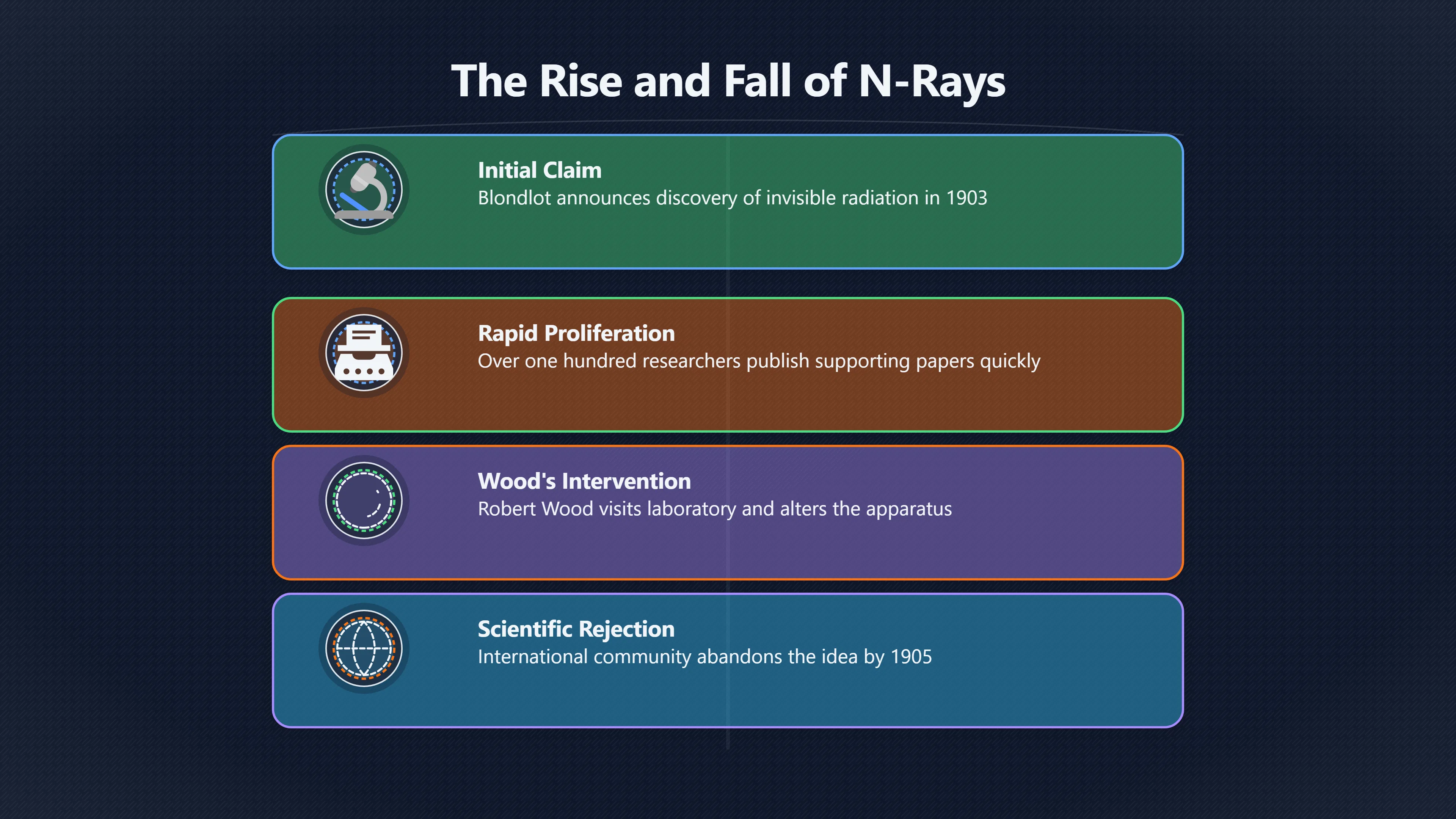
In 1903, Prosper-René Blondlot, a highly regarded physicist at the University of Nancy, announced that he had detected a previously unknown type of radiation while studying X-rays. He believed these rays could be refracted, focused and manipulated in ways similar to light. According to reports from his laboratory, N-rays were emitted by many ordinary materials and even by the human body.[Wikipedia]WikipediaOpen source on wikipedia.org.
The claim arrived at an unusually favourable moment. Physics was undergoing a period of astonishing discoveries. Wilhelm Röntgen had revealed X-rays only a few years earlier, Henri Becquerel had discovered radioactivity, and J. J. Thomson had identified the electron. The idea that another invisible radiation might be waiting to be found did not seem unreasonable.[Wikipedia]WikipediaOpen source on wikipedia.org.
The prestige of Blondlot also mattered. He was not an outsider or a crank but an established researcher with a strong scientific reputation and links to the French Academy of Sciences. When someone of his standing announced a discovery, many colleagues took the claim seriously.[Wikipedia]WikipediaOpen source on wikipedia.org.
Within a remarkably short period, more than one hundred researchers produced hundreds of publications discussing N-rays and their supposed properties. The phenomenon appeared to have independent confirmation from multiple laboratories.[AIP Publishing]pubs.aip.org281 1 onlineWOOD'S EXPOSURE. The purported finding of a new radiation had, of…Read more…
Why Dim Laboratories and Subjective Judgement Mattered
The central weakness of N-ray research was the method used to detect the rays.
Most experiments did not rely on instruments that automatically recorded measurements. Instead, researchers judged whether a faint spark, phosphorescent screen or dimly illuminated object appeared slightly brighter when N-rays were supposedly present. The differences being reported were extremely subtle and often depended on observers working in darkened rooms after allowing their eyes to adapt to low light.[Wikipedia]WikipediaOpen source on wikipedia.org.
This created ideal conditions for expectation to shape perception.
Modern psychology has shown that human perception is not a passive recording system. People interpret what they see through expectations and prior beliefs. When an observer expects a tiny increase in brightness, especially under poor viewing conditions, the brain can supply the expected effect. The observer is not necessarily lying; they genuinely believe they have seen something.[AIP Publishing]pubs.aip.org281 1 onlineWOOD'S EXPOSURE. The purported finding of a new radiation had, of…Read more…
Several factors reinforced the illusion:
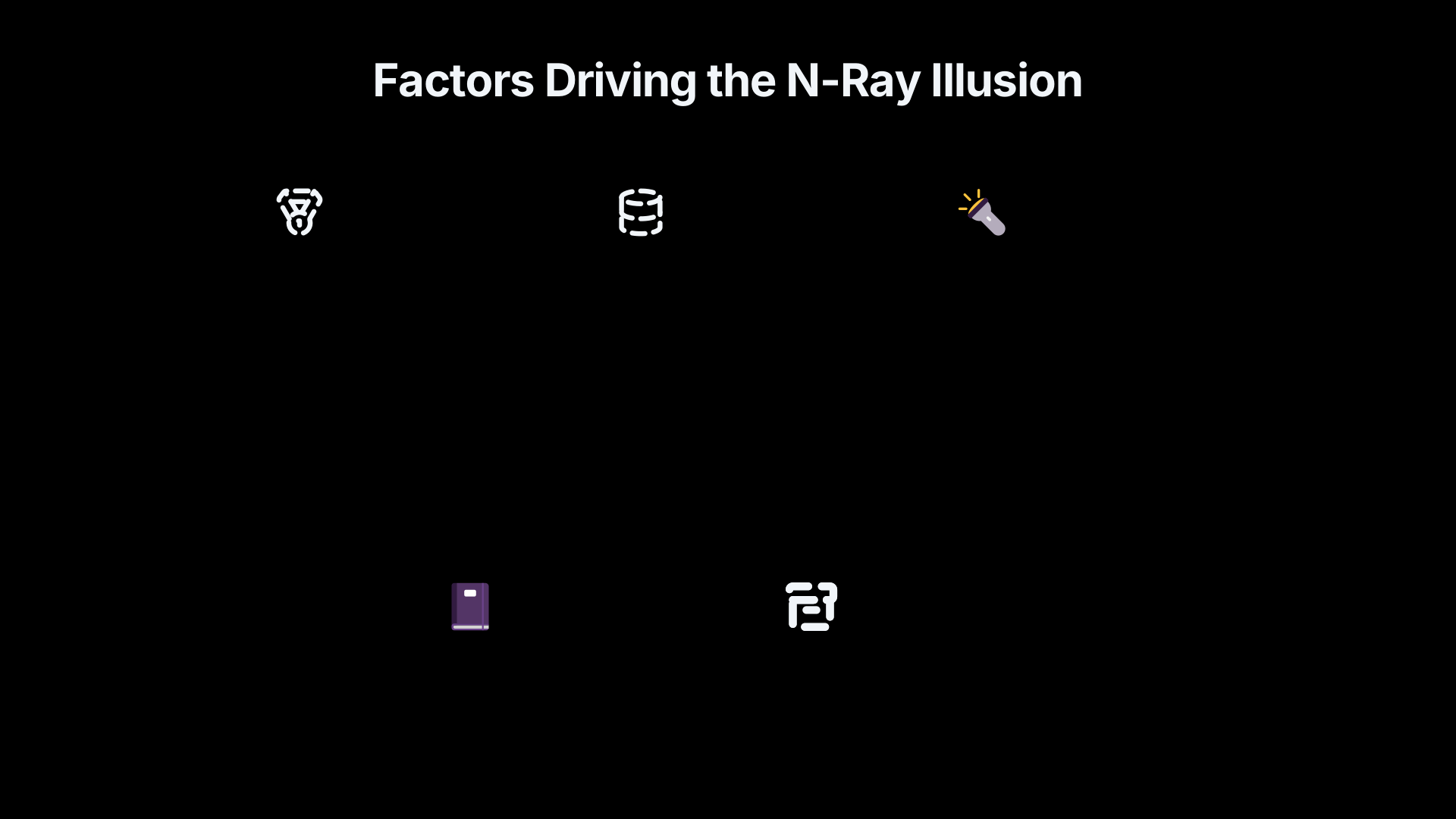
- Prestige and authority: Blondlot’s reputation encouraged confidence in the phenomenon.
- Recent scientific successes: Researchers expected more hidden forms of radiation to exist.
- Ambiguous observations: The effects were difficult to measure objectively.
- Social reinforcement: Multiple scientists reported similar results, making scepticism seem less justified.
- Confirmation bias: Positive observations were remembered and repeated more readily than failures.[wikipedia.org]WikipediaOpen source on wikipedia.org.
The N-ray affair is therefore less a story about deception than about the limits of human observation. Scientists were attempting to detect a phenomenon that existed largely in their expectations.
How Failed Tests Changed the Scientific Verdict
The turning point came in 1904 when the American physicist Robert W. Wood visited Blondlot’s laboratory on behalf of the journal Nature.
Wood was not impressed by the evidence. During demonstrations, he quietly altered the apparatus without informing the experimenters. In the most famous incident, he removed an aluminium prism that was supposedly essential for producing the observed N-ray effects. Despite the prism’s absence, the researchers continued to report seeing the expected results.[smu.edu]physics.smu.eduPhysics at SMUThe n-RaysA somewhat detailed report of the experiments which were shown to me, together with my own observations, may be o…
Wood also substituted objects that were supposed to emit N-rays with materials that should not have produced the effect. Again, the observations continued unchanged. The experimenters’ reports appeared to depend not on the apparatus but on their expectations.[stanford.edu]boole.stanford.eduOpen source on stanford.edu.
Wood published his account in Nature in September 1904. The report was devastating because it attacked the foundations of the phenomenon rather than merely disputing a detail. If the effects remained visible after crucial parts of the apparatus were removed, then the observations could not be evidence for a real physical radiation.[smu.edu]physics.smu.eduPhysics at SMUThe n-RaysA somewhat detailed report of the experiments which were shown to me, together with my own observations, may be o…
After Wood’s intervention, attempts to reproduce N-rays increasingly failed outside the circle of believers. By 1905 the wider international scientific community had largely abandoned the idea. Blondlot himself appears to have remained convinced for many years, illustrating how difficult it can be for sincere investigators to abandon a deeply held belief.[chemeurope.com]chemeurope.comN rayHis report on these investigations, published in the September 29 1904 edition of Nature, suggested that N rays were a pur…
What the N-Ray Affair Reveals About Science
The enduring lesson of N-rays is not that science is unreliable. Rather, it demonstrates how science eventually corrects itself.
The initial spread of the claim showed the vulnerability of researchers to suggestion, especially when observations are subjective and difficult to measure. The eventual collapse of the claim showed the value of independent replication, sceptical testing and experimental controls.[AIP Publishing]pubs.aip.org281 1 onlineWOOD'S EXPOSURE. The purported finding of a new radiation had, of…Read more…
Historians of science frequently cite the affair as a classic example of experimenter bias: researchers unconsciously obtaining the result they expect. The case later became one of the best-known cautionary tales about what physicist Irving Langmuir called “pathological science”, situations in which sincere investigators become convinced by weak and ambiguous evidence.[Wikipedia]WikipediaOpen source on wikipedia.org.
The story also serves as a reminder that scientific error often emerges from the same qualities that drive discovery. Curiosity, confidence and a willingness to pursue unusual ideas can produce breakthroughs. Without rigorous testing, however, those same qualities can lead researchers to mistake expectation for observation.
What N Rays reveals about belief and deception
More than a century later, N-rays remain a famous French episode in the history of mistaken discoveries because they reveal a universal human tendency rather than a uniquely French one. Researchers in several countries initially accepted the claims, and many of the scientists involved were respected professionals.[Wikipedia]WikipediaOpen source on wikipedia.org.
The affair survives in textbooks, sceptical literature and histories of science because it illustrates a problem that never entirely disappears: people often see what they expect to see. Whether in laboratories, newsrooms, political movements or everyday life, expectations can shape perception long before deliberate deception enters the picture. The N-ray episode endures as one of the clearest demonstrations that evidence must be tested independently of belief, especially when the evidence seems to confirm exactly what observers hoped to find.[wikipedia.org]WikipediaOpen source on wikipedia.org.
Amazon book picks
Further Reading
Books and field guides related to Did French Physicists Really Discover N-Rays?. Use these as the next step if you want deeper reading beyond the article.
The Demon-Haunted World
Rating: 4.5/5 from 43 Google Books ratings
Demonstrates scientific skepticism and the testing of extraordinary claims.
The Structure of Scientific Revolutions
Provides context for scientific consensus and error.
eBay marketplace picks
Marketplace Samples
Live-tested eBay searches with available results related to this page.

Endnotes
1.
Source: Wikipedia
Link:https://en.wikipedia.org/wiki/N-ray
2.
Source: pubs.aip.org
Title: 281 1 online
Link:https://pubs.aip.org/aapt/ajp/article-pdf/45/3/281/12132259/281_1_online.pdf
Source snippet
WOOD'S EXPOSURE. The purported finding of a new radiation had, of...Read more...
3.
Source: chemeurope.com
Link:https://www.chemeurope.com/en/encyclopedia/N_ray.html
Source snippet
N rayHis report on these investigations, published in the September 29 1904 edition of Nature, suggested that N rays were a pur...
4.
Source: Wikipedia
Title: Prosper-René Blondlot
Link:https://en.wikipedia.org/wiki/Prosper-Ren%C3%A9_Blondlot
5.
Source: Wikipedia
Title: René Blondlot
Link:https://de.wikipedia.org/wiki/Ren%C3%A9_Blondlot
6.
Source: physics.smu.edu
Link:https://www.physics.smu.edu/pseudo/Threshold/Wood1904.pdf
Source snippet
Physics at SMUThe n-RaysA somewhat detailed report of the experiments which were shown to me, together with my own observations, may be o...
7.
Source: Wikipedia
Title: Robert W. Wood
Link:https://en.wikipedia.org/wiki/Robert_W._Wood
8.
Source: aps.org
Title: robert wood debunks nrays
Link:https://www.aps.org/apsnews/2007/08/robert-wood-debunks-nrays
Source snippet
American Physical Society1904: Robert Wood Debunks N-rays1 Aug 2007 — On September 22, 1904, Wood sent off a letter to Nature describing...
Published: September 22, 1904
9.
Source: boole.stanford.edu
Link:https://boole.stanford.edu/Wood/
Additional References
10.
Source: centerforinquiry.org
Title: from n rays to em drives when does science become pseudoscience
Link:https://centerforinquiry.org/blog/from_n-rays_to_em-drives_when_does_science_become_pseudoscience/
Source snippet
Shortly after the discovery of X-rays, Prosper-René Blondlot was conducting experiments on electromagnetic radiation...Read more...
11.
Source: youtube.com
Title: N-Rays: The Phantom Light
Link:https://www.youtube.com/watch?v=EGSR9ctnTUs
Source snippet
N-Rays Blondlot hoax science history The Shocking Truth About N-rays Nobody Tells You The Hiddden Archive...
12.
Source: reddit.com
Link:https://www.reddit.com/r/todayilearned/comments/m7tgz9/til_that_a_physicist_p_blondlot_claimed_to/
13.
Source: youtube.com
Title: The Shocking Truth About N-rays Nobody Tells You
Link:https://www.youtube.com/watch?v=fZ8C_sOOP1U
Source snippet
N Rays: A Cautionary Tale From a Phantom Discovery...
14.
Source: youtube.com
Title: 241-A Case of Scientific Self-Deception
Link:https://www.youtube.com/watch?v=Y1PxfC_wNf0
Source snippet
The Shocking Truth About N-rays Nobody Tells You...
15.
Source: jstor.org
Link:https://www.jstor.org/stable/24966330
Source snippet
University of Nancy, announced that he had discovered the new type of radiation he called N...Read more...
16.
Source: huxley.media
Title: revelations in science blondlot s n rays and the prism in his pocket
Link:https://huxley.media/en/revelations-in-science-blondlot-s-n-rays-and-the-prism-in-his-pocket/
17.
Source: youtube.com
Title: 5 Failed Science Experiments That Made Headlines
Link:https://www.youtube.com/watch?v=-pCzLbCCppo
Source snippet
241-A Case of Scientific Self-Deception...
18.
Source: youtube.com
Title: N Rays: A Cautionary Tale From a Phantom Discovery
Link:https://www.youtube.com/watch?v=BK6eZusMF7Y
Source snippet
N-Rays: The Phantom Light...
19.
Source: optica-opn.org
Title: robert w wood the scientist who played with opti
Link:https://www.optica-opn.org/home/articles/volume_20/issue_10/features/robert_w_wood_the_scientist_who_played_with_opti/
Topic Tree