Which Famous Laos Stories Survived Sceptical Scrutiny?
Laos has no long catalogue of neatly documented, home-grown “great hoaxes”. Its strongest stories of deception sit on contested borders: between folklore and tourism, miscaptioned photographs and monster legends, flawed science and Cold War propaganda, or military operations concealed behind diplomatic language.
Page outline Jump by section
Introduction
Four episodes stand out. The annual Mekong fireballs have been attributed variously to supernatural serpents, natural gas and gunfire from the Lao bank. A photograph supposedly showing American soldiers holding a giant serpent from Laos was really taken beside the Pacific Ocean. The “yellow rain” controversy turned refugee reports and yellow spots into an international chemical-warfare accusation that later laboratory work seriously undermined. Meanwhile, the immense American air war in Laos was conducted under layers of secrecy and euphemism. Each case rewards scepticism, but none is explained fairly by simply calling it a hoax.
The Mekong fireballs: miracle, natural mystery or staged spectacle?
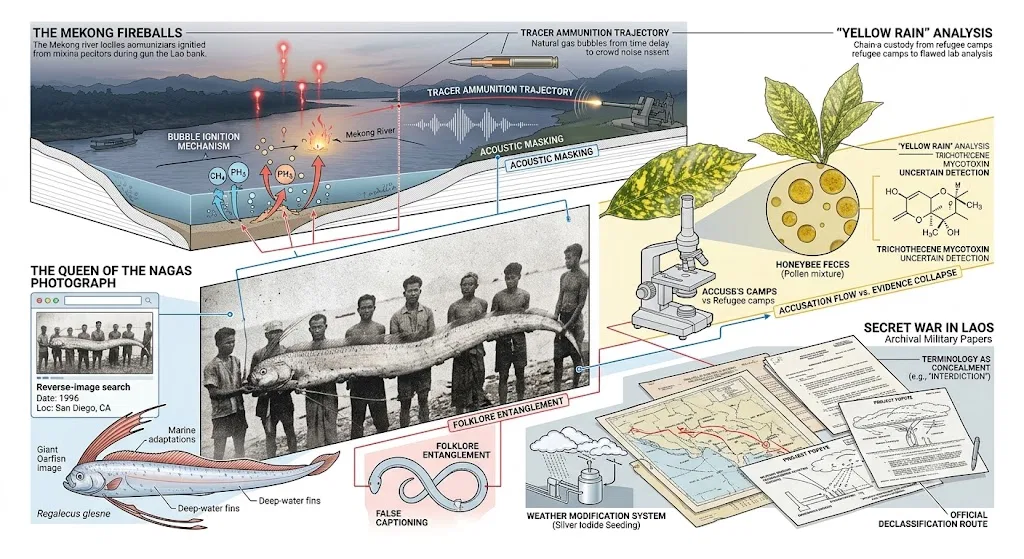
Every year around the end of Buddhist Lent, crowds gather beside the Mekong, particularly on the Thai side opposite Laos, hoping to see reddish lights rise above the river. The lights are widely associated with a sacred serpent believed to inhabit the Mekong. In modern publicity they are often presented as an ancient, precisely timed wonder of nature or religion.
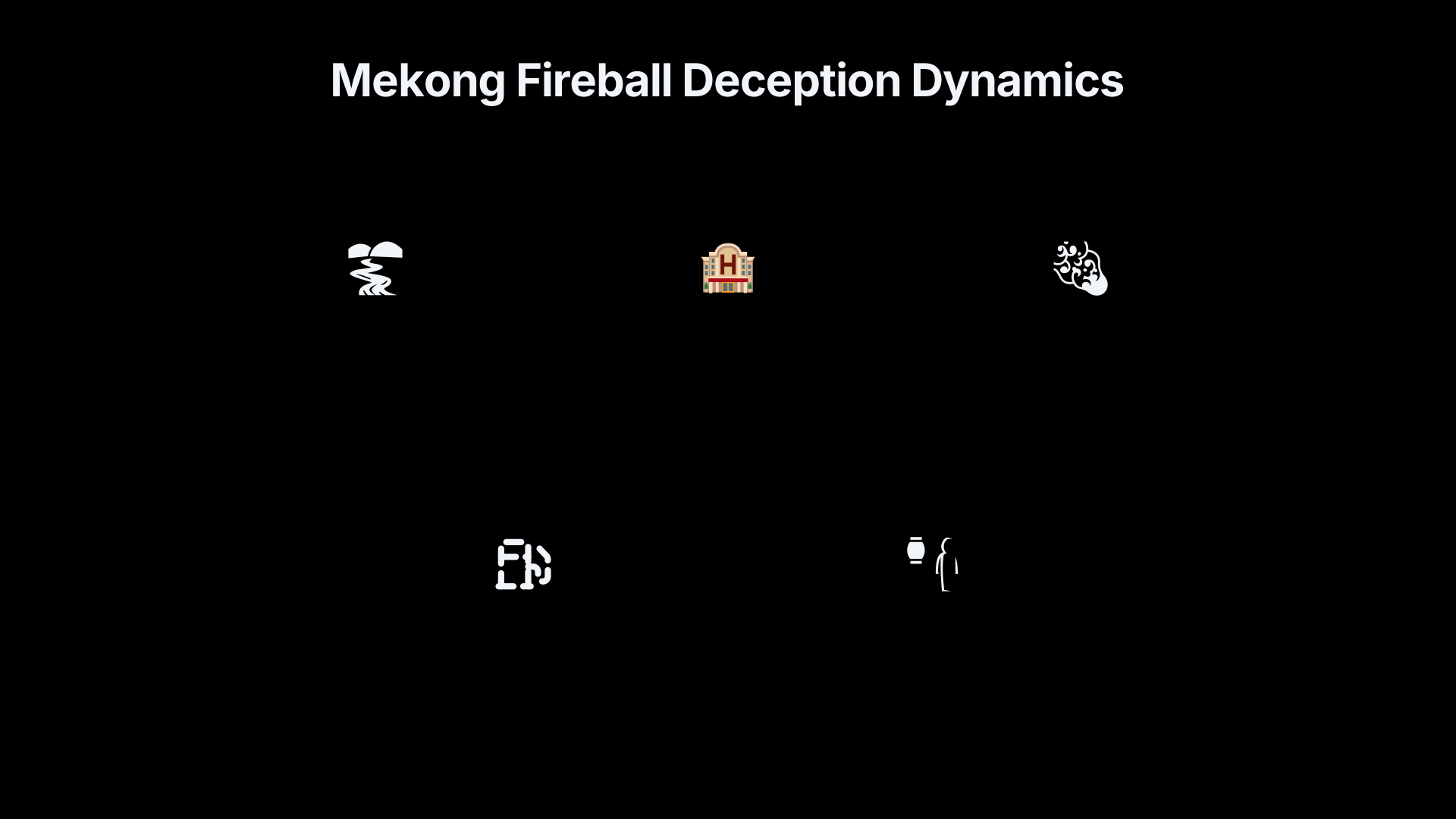
The phenomenon’s current form is newer and less tidy than that description suggests. Reports vary dramatically in the number, height and appearance of the lights. The name linking them explicitly with the serpent became prominent only in the late twentieth century, while festivals, films, press coverage and tourism helped transform scattered river lights into a scheduled mass event. A 2002 Time report found that commerce had grown around the mystery and noted that proving a coordinated fraud would require activity on a substantial scale.[Time]time.combehind the secret of the nagas fireBehind the Secret of the Naga's Fire16 Nov 2002 — If the fireballs, however, are a hoax, it is one conceived and perpetuated on a gra…
The most damaging allegation emerged from a Thai television investigation broadcast in 2002. Its reporters said that lights seen from Thailand corresponded with tracer ammunition fired into the air from the Lao side. Later sceptics and Thai biologist Jessada Denduangboripant likewise argued that at least some recorded “fireballs” behaved like flares or tracer rounds rather than gas bubbles emerging from water. The absence of an obvious gunshot is not decisive: sound crosses the river more slowly than light, and cheering crowds, music and distance can mask it.[Wikipedia]WikipediaNaga fireballNaga fireball
Yet the gunfire explanation has not been proved for every reported light. Lao officials rejected renewed accusations in 2021, saying police and soldiers had patrolled the riverbank and found no unauthorised firing. The dispute flared again precisely because the annual event continued during a period when pandemic restrictions made a large covert performance appear more difficult.[nationthailand]nationthailand.comLao National TV refutes claim that Naga fireballs are fakeOctober 30, 2021 — 29 Oct 2021 — The number of fireballs sighted…
Natural explanations are also weaker than their confident presentation sometimes suggests. A popular theory proposes that methane, phosphine or another gas rises from river sediment and ignites spontaneously. Such gases can occur in wetlands, but researchers have not demonstrated a mechanism producing silent, rapidly ascending, regularly timed balls of light matching the festival reports. Laboratory plasma experiments occasionally invoked in popular accounts require controlled electrical conditions that have not been shown to exist naturally in the Mekong.[Wikipedia]WikipediaNaga fireballNaga fireball
The most defensible conclusion is therefore mixed. Some lights may be fireworks, tracer rounds, distant lanterns or ordinary visual misidentifications. Others may have different causes. The supernatural explanation belongs to living religious folklore, not to a testable fraud claim. What becomes misleading is the confident packaging of every sighting as one identical, ancient and scientifically established phenomenon.
Tourism helps the ambiguity survive. Hotels, restaurants, transport operators, local authorities and media outlets all benefit from an event that is predictable enough to advertise but mysterious enough to debate. This does not prove that organisers manufacture the lights. It explains why a definitive answer may be less commercially useful than an annual argument.
The “Queen of the Nagas” photograph
One of the most convincing Lao monster images is convincing because the creature in it was real. The photograph shows a line of men struggling to hold an enormous, silver, ribbon-shaped fish. For years, postcards and online reposts described the scene as American servicemen in Laos in 1973 displaying the “Queen of the Nagas”, a giant serpent supposedly captured in or beside the Mekong.
Nearly every important detail in that caption is false. The picture was taken in 1996 near San Diego, California. The animal was a stranded giant oarfish, a deep-water marine fish whose long body and red fins have probably contributed to sea-serpent tales in several parts of the world. It was not caught in landlocked Laos, and the men were not posing with a Mekong monster during the Vietnam War.[WIRED]wired.comMarine biologist Mark Benfield documented the first healthy oarfish sightings using a remotely operated underwater vehicle in 2013, unvei…
The deception is an instructive form of photographic fakery because the image itself was not manipulated. Its meaning was altered by a new caption. A genuine but unfamiliar animal, grainy reproduction and anonymous uniformed men supplied all the visual ingredients of authenticity. Viewers who already knew stories about giant Mekong serpents had little reason to imagine a Californian beach or an identifiable marine species.
Later retellings added the usual folklore of suppression: the creature was allegedly sent away for secret study, vanished before experts could examine it, or brought misfortune to the men who handled it. Such claims protect a legend from disproof. Missing evidence becomes evidence of a cover-up, while the lack of named witnesses makes checking the story almost impossible.
The photograph also became entangled with the fireball controversy. Both stories drew authority from the same serpent tradition, and both circulated as tourist folklore around the Mekong. The picture seemed to prove that a huge creature existed; the lights seemed to prove that it remained active. In reality, neither story supplies evidence for the other.
This case offers a durable rule for evaluating supposed monster photographs. Before studying the creature, investigate the picture’s publication history. Reverse-image searching, contemporary captions, uniforms, landscape and known specimens can settle questions that speculation about anatomy cannot. The “Queen of the Nagas” was exposed not by proving that giant serpents are impossible, but by restoring a real photograph to its real place and date.
“Yellow rain” and the dangers of evidence gathered for war
The most consequential disputed claim associated with Laos arose after the communist victory of 1975. Hmong refugees, many from communities that had fought alongside the United States, reported aircraft attacks, coloured clouds, strange powders, illness and deaths. Yellow spots found on vegetation became associated with these accounts.
In 1981, US Secretary of State Alexander Haig publicly accused the Soviet Union of supplying toxin weapons to allied forces in Laos, Cambodia and Afghanistan. The American case identified trichothecene mycotoxins—poisonous compounds produced by certain fungi—and treated “yellow rain” as evidence of prohibited chemical or biological warfare. The allegations entered United Nations debates and became part of the Reagan administration’s wider argument that Soviet conduct was eroding international restraints on chemical weapons.[state.gov]2001-2009.state.govDepartment of StateCase Study: Yellow Rain - U.S. Department of State Archive1 Oct 2005 — In 1981, the United States Secretary of State a…
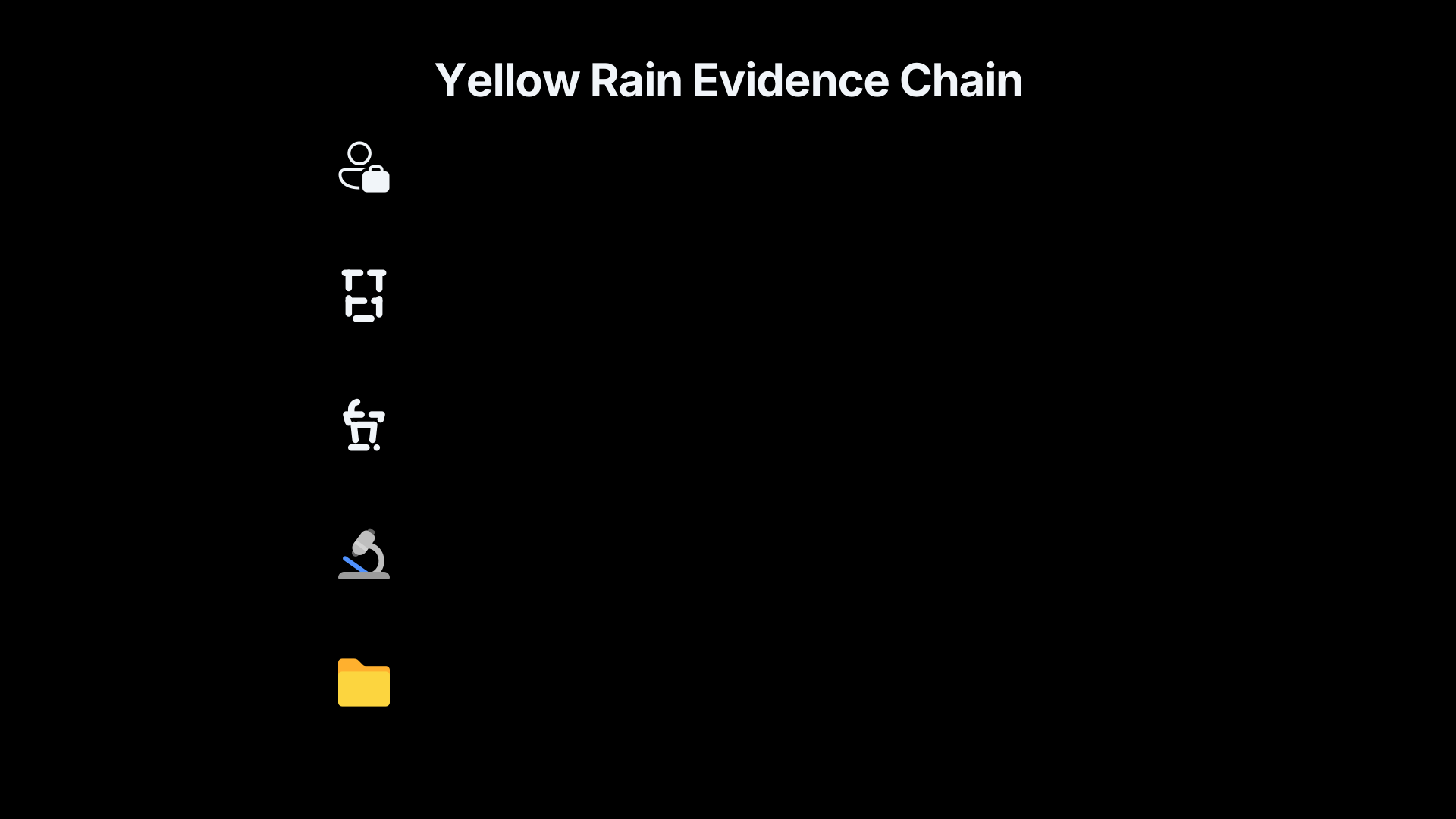
The claims were not invented from nothing. Refugees described frightening attacks and genuine sickness. Wartime conditions made independent investigation exceptionally difficult, however. Witnesses had experienced bombing, displacement, hunger and exposure to smoke, herbicides and riot-control agents. Reports describing different colours, delivery methods and symptoms were sometimes grouped together as though they concerned one weapon. Samples often passed through uncertain chains of custody before reaching laboratories. A United Nations investigation could not confirm the central American allegation.[United Nations Digital Library System]digitallibrary.un.orgOpen source on un.org.
Harvard biologist Matthew Meselson and other scientists found a mundane explanation for the yellow droplets. The material consisted largely of pollen whose contents had been digested while its outer shells remained—a pattern consistent with honeybee faeces. Different droplets contained different pollen mixtures, as would be expected if produced by individual bees feeding on varied plants. Mass cleansing flights by swarms could create showers of yellow specks without observers seeing the insects high above them.[harvard.edu]meselsonarchive.hsites.harvard.eduMeselson Archive Yellow RainMeselson Archive Yellow Rain
Scientists also questioned the toxin analyses. Trichothecenes can occur naturally, contamination was difficult to exclude, and some laboratories could not reproduce the American findings. By the late 1980s, the claim that the yellow material itself was a Soviet-supplied weapon had largely collapsed among independent researchers, although some officials and writers continued to argue that separate chemical attacks might still have occurred.[James Martin Center]nonproliferation.orgJames Martin Center The “Yellow Rain” Controversy: Lessons for Arms ControlJames Martin Center The “Yellow Rain” Controversy: Lessons for Arms Control
That distinction matters. Showing that yellow spots were bee droppings does not prove that every refugee account was false, nor does it justify dismissing Hmong suffering. Communities in Laos endured military attacks, forced displacement and harsh post-war repression. Some witnesses may have interpreted several kinds of exposure through the new language of “yellow rain”; interviewers and intelligence officials may then have organised diverse memories into a single weapons narrative.
It is therefore more accurate to call the affair a case of politically amplified error than a simple hoax. The US government had strategic reasons to publicise evidence of Soviet treaty-breaking. Soviet representatives had equally obvious reasons to deny all accusations and described the affair as American propaganda. Refugees had reasons to seek recognition for attacks that outsiders had ignored. Scientists entered a dispute in which laboratory results carried diplomatic and military consequences.[United Nations Digital Library System]digitallibrary.un.orgited Nations Digital Library System General Assemblyited Nations Digital Library System General Assembly
The affair remains important because it demonstrates how weak evidence can grow stronger as it moves upwards through institutions. A strange deposit becomes a possible toxin; a possible toxin becomes a weapons sample; a weapons sample becomes proof of a coordinated international programme. Once senior officials publicly adopt the conclusion, scientific uncertainty can be portrayed as political disloyalty rather than a normal part of investigation.

The war officially absent from Laos
The American “Secret War” in Laos was not a fabricated event but a real campaign hidden behind covert administration, diplomatic fiction and restricted public disclosure. That makes it relevant to a history of deception even though it was neither a prank nor an invented atrocity.
Laos was formally neutralised by an international agreement in 1962, while North Vietnamese forces used routes through its territory and competing Lao factions continued fighting. The United States supported anti-communist forces, including a Hmong army led by Vang Pao, through the Central Intelligence Agency. Air America supplied personnel and remote bases, while American aircraft conducted extensive bombing against communist forces and the routes commonly known as the Ho Chi Minh Trail. Declassified records show that US officials discussed bombing and covert intervention while simultaneously trying to preserve the diplomatic appearance of Lao neutrality.[CIA]cia.govOperation MILLPOND: The Beginning of a Distant Covert WarOperation MILLPOND: The Beginning of a Distant Covert War
The secrecy depended heavily on terminology. Operations were described as reconnaissance, interdiction, advisory work or support for Lao forces. Aircraft markings, civilian contractors and intelligence channels obscured direct American responsibility. Congressional knowledge was limited and fragmented, while public statements often avoided acknowledging the scale and nature of the campaign.
The deception worked partly because important fragments were visible. Journalists knew that fighting was occurring. Refugees described air attacks. Aircraft and personnel moved through Thailand. Yet no single public account initially assembled these pieces into the full operational picture. Secrecy did not make the war invisible; it prevented scattered observations from acquiring official confirmation.
Weather modification shows how unusual the concealed activities became. Under Project Popeye, US forces seeded clouds over parts of Laos, North Vietnam and South Vietnam in an attempt to extend rainfall and obstruct movement along supply routes. A declassified State Department record states plainly that the objective was to hinder vehicles and reinforce bottlenecks already created by bombing. The operation remained secret until press and congressional investigations brought it into public debate.[Office of the Historian]history.state.govOpen source on state.gov.
Unlike the Naga photograph, this was not a false image with a false caption. It was deception through omission and classification. Officials protected military operations by withholding facts, narrowing language and maintaining a legal-political distinction between an internationally neutral Laos and the battlefield that Laos had become.
The eventual exposure did not come from one dramatic confession. It emerged through investigative reporting, congressional scrutiny, veterans’ accounts and declassification. Later official histories openly used the term “secret war” and described the CIA, Air America and US military support that earlier public language had obscured.[CIA]cia.govOperation MILLPOND: The Beginning of a Distant Covert WarOperation MILLPOND: The Beginning of a Distant Covert War
This history also explains why later extraordinary claims from Laos could find receptive audiences. People who learned that a huge air campaign had genuinely been concealed might reasonably become suspicious of official denials. Real secrecy creates an environment in which unsupported stories become easier to believe: yesterday’s supposedly impossible covert operation may be tomorrow’s declassified fact.
Why these stories remain difficult to untangle
The major Lao cases resist a single label because different kinds of unreliable claim overlap.
Folklore is not automatically fraud. A religious interpretation of Mekong lights expresses belief and cultural meaning. It becomes deceptive only when someone knowingly manufactures evidence or falsely presents speculation as established fact.
A false caption can be more effective than a fake photograph. The oarfish image required no editing. Its new location, date and story were enough to turn marine biology into a Lao monster encounter.
Scientific error can be politically useful without being consciously fabricated. In the yellow-rain affair, officials may have believed the weapons claim while selecting evidence that supported an urgent Cold War narrative. Sincere conviction does not guarantee sound analysis.
Official secrecy can fertilise later conspiracy thinking. The concealed war in Laos demonstrates that governments sometimes do hide operations of enormous scale. That historical fact should encourage careful investigation, not automatic acceptance of every alleged cover-up.
Commercial success does not prove orchestration. Tourism benefits from the Mekong fireball mystery, but financial gain alone cannot establish who, if anyone, stages particular lights. Incentive is a reason to examine evidence, not a substitute for evidence.
Across all four cases, the decisive investigative move is to separate claims that have been bundled together. Did people see lights? Probably. Were all the lights identical? No. Was the giant fish real? Yes. Was the Lao caption real? No. Did Hmong refugees suffer attacks and illness? Yes. Were yellow droplets proved to be Soviet toxin weapons? The strongest independent evidence says no. Did the United States fight extensively in Laos? Yes. Was the public given a candid contemporary account? No.
Laos’s history of contested truth is therefore less a collection of comic tricks than a lesson in miscontextualisation. Strange lights acquire an ancient pedigree, a Californian fish migrates into the Mekong, bee droppings become geopolitical evidence, and a vast war disappears into bureaucratic wording. The common mechanism is not national gullibility. It is the power of a persuasive story to organise incomplete facts before careful verification catches up.
Amazon book picks
Further Reading
Books and field guides related to Which Famous Laos Stories Survived Sceptical Scrutiny?. Use these as the next step if you want deeper reading beyond the article.
The Demon-Haunted World
Rating: 4.5/5 from 43 Google Books ratings
Provides the sceptical framework that fits all of the Laos case studies.
Bad Science
Explains how weak evidence, media amplification and authority can mislead.
The Geography of Bliss
Includes travel and cultural perspectives from Laos and neighbouring regions.
eBay marketplace picks
Marketplace Samples
Live-tested eBay searches with available results related to this page.

Endnotes
1.
Source: time.com
Title: behind the secret of the nagas fire
Link:https://time.com/archive/6893606/behind-the-secret-of-the-nagas-fire/
Source snippet
Behind the Secret of the Naga's Fire16 Nov 2002 — If the fireballs, however, are a hoax, it is one conceived and perpetuated on a gra...
2.
Source: Wikipedia
Title: Naga fireball
Link:https://en.wikipedia.org/wiki/Naga_fireball
3.
Source: nationthailand.com
Link:https://www.nationthailand.com/in-focus/40008190
Source snippet
Lao National TV refutes claim that Naga fireballs are fakeOctober 30, 2021 — 29 Oct 2021 — The number of fireballs sighted...
Published: October 30, 2021
4.
Source: wired.com
Link:https://www.wired.com/2014/03/absurd-creature-week-oarfish
Source snippet
Marine biologist Mark Benfield documented the first healthy oarfish sightings using a remotely operated underwater vehicle in 2013, unvei...
5.
Source: 2001-2009.state.gov
Link:https://2001-2009.state.gov/t/vci/rls/prsrl/57321.htm
Source snippet
Department of StateCase Study: Yellow Rain - U.S. Department of State Archive1 Oct 2005 — In 1981, the United States Secretary of State a...
6.
Source: history.state.gov
Link:https://history.state.gov/historicaldocuments/frus1981-88v01/d239
7.
Source: meselsonarchive.hsites.harvard.edu
Title: Meselson Archive Yellow Rain
Link:https://meselsonarchive.hsites.harvard.edu/file_url/949
8.
Source: cia.gov
Title: Operation MILLPOND: The Beginning of a Distant Covert War
Link:https://www.cia.gov/resources/csi/static/Operation-MILLPOND.pdf
9.
Source: history.state.gov
Title: Office of the Historian Historical Documents
Link:https://history.state.gov/historicaldocuments/frus1964-68v28/d61
10.
Source: history.state.gov
Link:https://history.state.gov/historicaldocuments/frus1964-68v28/d274
11.
Source: cia.gov
Link:https://www.cia.gov/readingroom/docs/CIA-RDP90-00552R000606010001-9.pdf
12.
Source: cia.gov
Link:https://www.cia.gov/readingroom/document/cia-rdp84-00499r001000100005-0
13.
Source: cia.gov
Link:https://www.cia.gov/readingroom/document/cia-rdp90-00552r000605810002-1
14.
Source: cia.gov
Link:https://www.cia.gov/readingroom/docs/CIA-RDP80-01601R000900020001-3.pdf
15.
Source: cia.gov
Link:https://www.cia.gov/readingroom/docs/CIA-RDP88-01315R000300140002-5.pdf
16.
Source: cia.gov
Link:https://www.cia.gov/readingroom/document/cia-rdp91-00587r000100270001-3
17.
Source: cia.gov
Title: CIA RDP74B00415R000400170053 8
Link:https://www.cia.gov/readingroom/docs/CIA-RDP74B00415R000400170053-8.pdf
18.
Source: cia.gov
Link:https://www.cia.gov/readingroom/docs/LOC-HAK-106-1-22-8.pdf
19.
Source: cia.gov
Title: CIA RDP74B00415R000500090001 3
Link:https://www.cia.gov/readingroom/docs/CIA-RDP74B00415R000500090001-3.pdf
20.
Source: history.state.gov
Link:https://history.state.gov/historicaldocuments/frus1964-68v04/d41
21.
Source: state.gov
Link:https://www.state.gov/report/custom/3961a9f554
22.
Source: history.state.gov
Title: media roundtable
Link:https://history.state.gov/conferences/2010-southeast-asia/media-roundtable
23.
Source: state.gov
Link:https://www.state.gov/report/custom/c99186a0e8
24.
Source: history.state.gov
Link:https://history.state.gov/historicaldocuments/frus1964-68v01/d249
25.
Source: 2009-2017.state.gov
Link:https://2009-2017.state.gov/documents/organization/237009.pdf
26.
Source: history.state.gov
Link:https://history.state.gov/historicaldocuments/frus1969-76v09/ch3
27.
Source: 2001-2009.state.gov
Link:https://2001-2009.state.gov/documents/organization/27053.pdf
28.
Source: state.gov
Link:https://www.state.gov/report/custom/f195249851
29.
Source: history.state.gov
Title: frus1964 68v05
Link:https://history.state.gov/historicaldocuments/frus1964-68v05/index
30.
Source: 2021-2025.state.gov
Link:https://2021-2025.state.gov/report/custom/66948a461c/
31.
Source: state.gov
Link:https://www.state.gov/report/custom/760ca666ca/
32.
Source: 2009-2017.state.gov
Link:https://2009-2017.state.gov/outofdate/bgn/china/189475.htm
33.
Source: Wikipedia
Title: Yellow rain
Link:https://en.wikipedia.org/wiki/Yellow_rain
34.
Source: youtube.com
Link:https://www.youtube.com/watch?v=uiXU74YdL6o
Source snippet
Wikipedia...
35.
Source: digitallibrary.un.org
Title: ited Nations Digital Library System General Assembl Y
Link:https://digitallibrary.un.org/record/28787/files/A_37_157-EN.pdf
36.
Source: digitallibrary.un.org
Link:https://digitallibrary.un.org/record/30875/files/A_37_234-EN.pdf
37.
Source: digitallibrary.un.org
Link:https://digitallibrary.un.org/record/31617/files/A_37_308-EN.pdf
38.
Source: hsp.sussex.ac.uk
Link:https://hsp.sussex.ac.uk/new/_uploads/publications/2008_Meselson_and_Robinson_The_Yellow_Rain_Affair.pdf
39.
Source: nonproliferation.org
Title: James Martin Center The “Yellow Rain” Controversy: Lessons for Arms Control
Link:https://www.nonproliferation.org/wp-content/uploads/npr/81tucker.pdf
40.
Source: digitallibrary.un.org
Title: ited Nations Digital Library System General Assembly
Link:https://digitallibrary.un.org/record/44482/files/A_38_86-EN.pdf
41.
Source: thaipbs.or.th
Link:https://www.thaipbs.or.th/verify/en/content/2186
42.
Source: digitallibrary.un.org
Title: A C 1 36 PV 52 EN
Link:https://digitallibrary.un.org/record/27101/files/A_C-1_36_PV-52-EN.pdf
43.
Source: digitallibrary.un.org
Title: A C 1 37 PV 7 EN
Link:https://digitallibrary.un.org/record/37021/files/A_C-1_37_PV-7-EN.pdf
44.
Source: digitallibrary.un.org
Title: A C 1 38 PV 25 EN
Link:https://digitallibrary.un.org/record/56851/files/A_C-1_38_PV-25-EN.pdf
45.
Source: digitallibrary.un.org
Title: S SUPP 1983 1 ^OR SC 1983 I^ EN
Link:https://digitallibrary.un.org/record/97699/files/S_SUPP_1983_1–%5EOR_SC_1983_I%5E-EN.pdf
46.
Source: digitallibrary.un.org
Link:https://digitallibrary.un.org/record/66919/files/E_CN.4_1984_SR.25-EN.pdf
Additional References
47.
Source: bangkokpost.com
Title: lao villagers accused of yearly festival fireball con
Link:https://www.bangkokpost.com/thailand/general/2203923/lao-villagers-accused-of-yearly-festival-fireball-con
Source snippet
Naga fire balls (yellow dots) shoot up into the sky along with... Anutin vows to break up exam paper fraud network · 11 arrests made in...
48.
Source: thestar.com.my
Title: scientist insists naga fireballs are prank by laos villagers
Link:https://www.thestar.com.my/aseanplus/aseanplus-news/2023/10/30/scientist-insists-naga-fireballs-are-prank-by-laos-villagers
Source snippet
Ram Temple donation scam: Were stolen gold ornaments melted into biscuits?Read more...
49.
Source: youtube.com
Link:https://www.youtube.com/watch?v=uk8mayS3idE
Source snippet
The Secret War in Laos: South East Asia's Heart of Darkness...
50.
Source: youtube.com
Title: The Secret War in Laos: South East Asia’s Heart of Darkness
Link:https://www.youtube.com/watch?v=Uv56Qj8CZS4
Source snippet
Wartime Life Inside the Pathet Lao Caves, Sam Neua Laos...
51.
Source: youtube.com
Title: Wartime Life Inside the Pathet Lao Caves, Sam Neua Laos
Link:https://www.youtube.com/watch?v=4C51xDVIMkQ
Source snippet
The Hmong and the Secret War PBS Documentary...
52.
Source: airandspaceforces.com
Link:https://www.airandspaceforces.com/app/uploads/2024/09/AFmag_1977_09.pdf
53.
Source: researchgate.net
Link:https://www.researchgate.net/publication/279640502_The_Yellow_Rain_controversy_Are_there_lessons_from_the_past
54.
Source: facebook.com
Link:https://www.facebook.com/Cheiyyappan/posts/a-doctored-video-is-circulating-on-social-mediathe-video-in-circulation-is-fake-/10243167811517427/
55.
Source: airandspaceforces.com
Link:https://www.airandspaceforces.com/app/uploads/2023/06/Almanac2023_Fullissue_REV-1.pdf
56.
Source: facebook.com
Link:https://www.facebook.com/groups/109373389318/posts/10165161704959319/
Topic Tree
Follow this branch
Related pages 192
- Albanian Hoaxes
- Algerian Hoaxes
- Antigua Deceptions
- Argentina Hoaxes
- Armenian Hoaxes
- +187 more in sidebar