Within Kiribati
Was There Really a First Climate Refugee?
Ioane Teitiota was widely called the first climate refugee even though his legal claim failed and no refugee status was granted.
On this page
- What Ioane Teitiota argued
- Why the refugee claim was rejected
- What the human rights ruling actually changed
Page outline Jump by section
Introduction
Ioane Teitiota is often described as the world’s first climate refugee. The phrase appeared in headlines around the world and became a powerful symbol of the human consequences of rising seas in Kiribati. Yet the legal reality was more complicated. Teitiota never received refugee status, and the courts that heard his case repeatedly rejected the argument that he met the legal definition of a refugee. What made the story remarkable was not a legal victory, but the gap between a memorable public narrative and a much narrower legal judgment.[Wikipedia]WikipediaTeitiota v Chief Executive Ministry of Business, Innovation and EmploymentTeitiota v Chief Executive Ministry of Business, Innovation and Employment
For a project about contested claims and misleading narratives, the Teitiota case is important because it shows how a real problem can become simplified into an inaccurate slogan. Climate change impacts in Kiribati were not invented, and neither were Teitiota’s concerns. The misunderstanding arose when many reports transformed an unsuccessful legal case into the story of a recognised new category: the “first climate refugee”.[Coventry University]pureportal.coventry.ac.ukCoventry UniversityIoane Teitiota v New Zealand: A landmark ruling for climate…by K Steenmans · Cited by 8 — 9 Teitiota claimed that e…
Was There Really a First Climate Refugee?
The short answer is no. Ioane Teitiota became famous because journalists, campaigners and commentators treated his case as a test of whether international law would recognise climate refugees. However, neither New Zealand’s courts nor the United Nations Human Rights Committee formally granted him that status.[Wikipedia]WikipediaTeitiota v Chief Executive Ministry of Business, Innovation and EmploymentTeitiota v Chief Executive Ministry of Business, Innovation and Employment
The label spread because it captured a larger global anxiety. Kiribati, a low-lying Pacific island nation, had become one of the world’s most recognisable examples of vulnerability to sea-level rise. A Kiribati citizen seeking protection abroad seemed to embody a future in which environmental change would force millions of people to move. The phrase “first climate refugee” was concise, emotionally powerful and easy to understand, even though it overstated what the legal proceedings actually decided.[OHCHR]ohchr.orghistoric un human rights case opens door climate change asylum claimsTeitiota argued that the rise in sea level and other effects of climate change had rendered Kiribati uninhabitable for all its residents…
In that sense, the case resembles many famous misunderstandings rather than a deliberate hoax. The distortion emerged through repetition and simplification rather than outright fabrication.
What Ioane Teitiota Argued
Teitiota, a citizen of Kiribati, moved to New Zealand with his family. After his visa status expired, he sought refugee or protected-person status, arguing that environmental conditions in Kiribati had become dangerous. His claim pointed to sea-level rise, saltwater contamination of freshwater supplies, overcrowding on South Tarawa, difficulties obtaining land, and increasing social tensions linked to environmental pressures.[coventry.ac.uk]pureportal.coventry.ac.ukCoventry UniversityIoane Teitiota v New Zealand: A landmark ruling for climate…by K Steenmans · Cited by 8 — 9 Teitiota claimed that e…
His lawyers argued that returning him to Kiribati would expose him and his family to serious risks. The claim did not depend on a single flood or disaster. Instead, it presented climate change as a slow-moving threat that was already affecting daily life through water insecurity, population pressure and environmental degradation.[Coventry University]pureportal.coventry.ac.ukCoventry UniversityIoane Teitiota v New Zealand: A landmark ruling for climate…by K Steenmans · Cited by 8 — 9 Teitiota claimed that e…
The argument attracted worldwide attention because it raised a question international law had never fully resolved: what protection exists for people displaced not by war or political persecution, but by environmental change?
Why the Refugee Claim Was Rejected
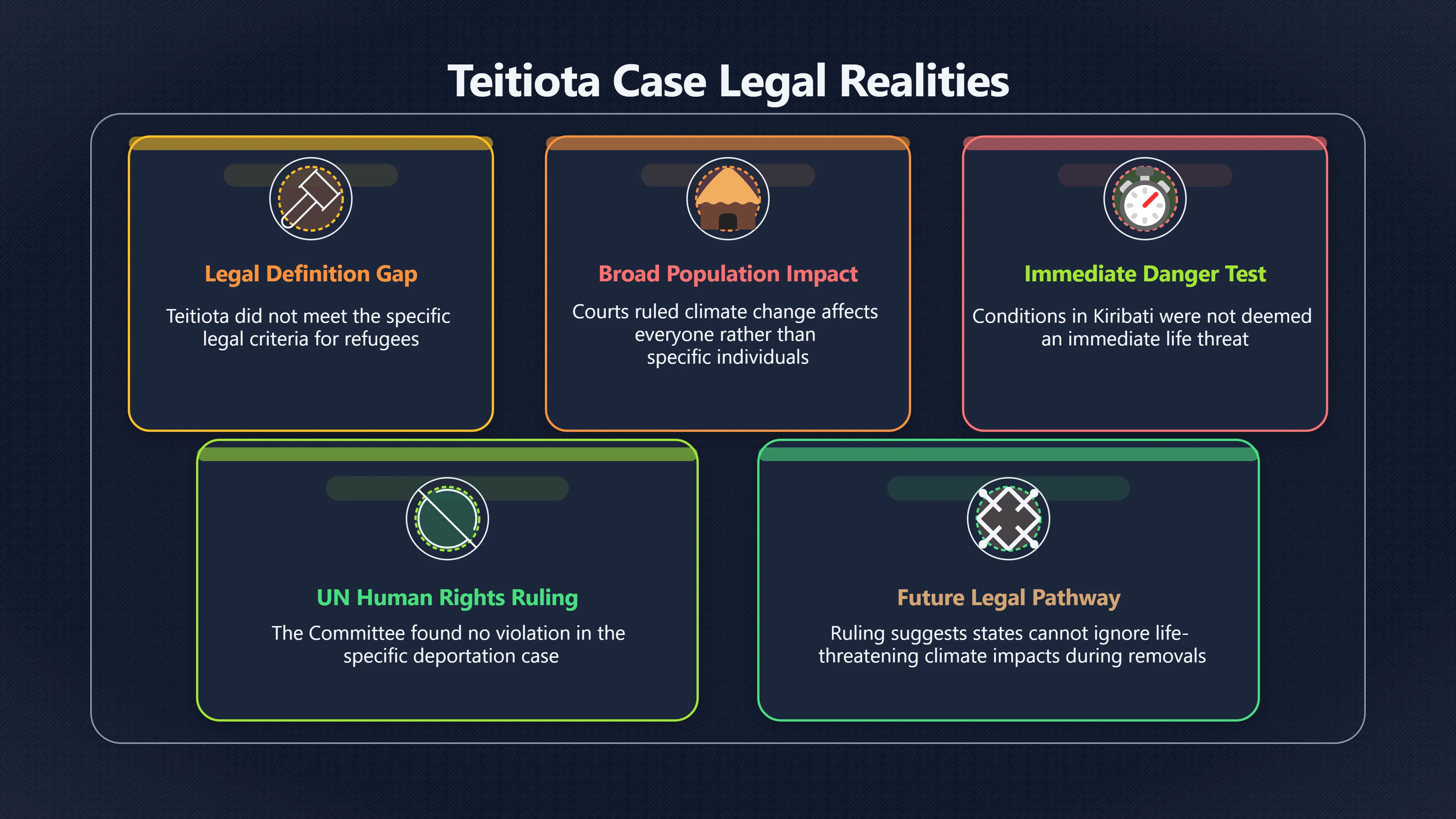
The courts accepted that climate change posed genuine challenges for Kiribati. The rejection was not based on a finding that environmental risks were imaginary. Instead, judges concluded that Teitiota did not fit the legal definition contained in the 1951 Refugee Convention.[Climate Case Chart]climatecasechart.comClimate Case ChartAF (Kiribati) | Teitiota v The Chief Executive of Ministry…Teitiota's concerns about Kiribati and its future were ju…
Under that convention, a refugee must generally show persecution linked to specific protected grounds such as race, religion, nationality, political opinion or membership of a particular social group. The New Zealand courts found that climate change affected the population broadly rather than constituting persecution directed at Teitiota personally on one of those grounds.[Wikipedia]WikipediaTeitiota v Chief Executive Ministry of Business, Innovation and EmploymentTeitiota v Chief Executive Ministry of Business, Innovation and Employment
The courts also concluded that conditions in Kiribati, while difficult, had not yet reached a point where his life faced the immediate level of danger required under the relevant legal tests. The tribunal acknowledged the seriousness of environmental pressures but ruled that they did not create an entitlement to refugee status under existing law.[Climate Case Chart]climatecasechart.comClimate Case ChartAF (Kiribati) | Teitiota v The Chief Executive of Ministry…Teitiota's concerns about Kiribati and its future were ju…
This distinction is crucial. The courts did not rule that climate change could never become relevant to refugee or human-rights protection. They ruled that Teitiota’s particular circumstances did not satisfy the legal requirements then before them.[Wikipedia]WikipediaTeitiota v Chief Executive Ministry of Business, Innovation and EmploymentTeitiota v Chief Executive Ministry of Business, Innovation and Employment
What the Human-Rights Ruling Actually Changed
The most important development came after Teitiota’s deportation, when he brought a complaint before the United Nations Human Rights Committee. This later stage is often misunderstood. The Committee did not overturn New Zealand’s decision, and it did not declare Teitiota a climate refugee. It found no violation in his specific case.[Refworld]refworld.orgIoane Teitiota v. New Zealand7 Jan 2020 — Ioane Teitiota v. New Zealand · Document…
However, the Committee also made an important observation. It stated that climate change and environmental degradation can, in principle, create situations where returning someone to their country would expose them to a threat to life. In such circumstances, international human-rights obligations could prevent deportation.[refworld.org]refworld.orgIoane Teitiota v. New Zealand7 Jan 2020 — Ioane Teitiota v. New Zealand · Document…
That was the genuinely significant part of the ruling. The decision suggested that future claimants might succeed if environmental conditions became severe enough and the risk sufficiently immediate. The Committee noted that states cannot simply ignore life-threatening climate impacts when considering removals or deportations.[Sage Journals]journals.sagepub.comOpen source on sagepub.com.
The ruling therefore opened a potential legal pathway without creating a new refugee category. Many headlines focused on the symbolic breakthrough and overlooked the fact that Teitiota himself lost his case.[Amnesty International]amnesty.orgun landmark case for people displaced by climate changeAmnesty InternationalUN landmark case for people displaced by climate changeJan 20, 2020 — Ioane Teitiota, a man from the Pacific nation…
How a Legal Defeat Became a Global Symbol
The transformation of the case into the story of the “first climate refugee” demonstrates how public narratives can diverge from legal realities.
Several factors made the simplification attractive:
- A compelling character: Teitiota provided a human face for a complex global issue.
- A powerful setting: Kiribati was already widely portrayed as a nation threatened by rising seas.
- A dramatic legal question: Could climate change create refugees?[youtube.com]youtube.comKiribati and climate change | DW DocumentaryIoane Teitiota climate refugee Climate change and the protection of displaced persons: Analysis of the Teitiota v New Zealand case Raoul…
- A simple headline: “First climate refugee” was easier to communicate than a detailed explanation of refugee law and human-rights jurisprudence.[wikipedia.org]WikipediaTeitiota v Chief Executive Ministry of Business, Innovation and EmploymentTeitiota v Chief Executive Ministry of Business, Innovation and Employment
As the story circulated, many readers came away with the impression that international law had officially recognised climate refugees. In reality, the case highlighted the opposite problem: existing legal categories did not fit neatly with climate-driven displacement.[Opinio Juris]opiniojuris.orgthe historic case of teitiota climate induced asylum and its futurethe historic case of teitiota climate induced asylum and its future
What Climate Refugee reveals about belief and deception
The Teitiota case remains influential because it exposed a growing tension between environmental reality and legal definitions. Climate change may force migration, yet international refugee law was largely designed in response to persecution, conflict and political oppression rather than environmental transformation.[Opinio Juris]opiniojuris.orgthe historic case of teitiota climate induced asylum and its futurethe historic case of teitiota climate induced asylum and its future
For Kiribati, the case also illustrates a recurring pattern in international coverage. Real concerns about flooding, freshwater contamination and long-term habitability were compressed into a dramatic narrative that was easier to remember than the legal facts. The result was not a classic fraud or fabricated story, but a widely repeated misunderstanding.[Coventry University]pureportal.coventry.ac.ukCoventry UniversityIoane Teitiota v New Zealand: A landmark ruling for climate…by K Steenmans · Cited by 8 — 9 Teitiota claimed that e…
That misunderstanding continues to circulate because it captures an emotional truth even while missing a legal one. Ioane Teitiota became a symbol of climate displacement, but he never became the world’s first recognised climate refugee. The significance of his case lies precisely in that contradiction.[refworld.org]refworld.orgIoane Teitiota v. New Zealand7 Jan 2020 — Ioane Teitiota v. New Zealand · Document…
Amazon book picks
Further Reading
Books and field guides related to Was There Really a First Climate Refugee?. Use these as the next step if you want deeper reading beyond the article.
The Uninhabitable Earth
Provides context for public discussions about displacement and climate risk.
Factfulness
Helps readers understand why memorable labels can oversimplify complex realities.
How to Avoid a Climate Disaster
Explains climate risks without relying on simplified legal narratives.
eBay marketplace picks
Marketplace Samples
Live-tested eBay searches with available results related to this page.


Endnotes
1.
Source: Wikipedia
Title: Teitiota v Chief Executive Ministry of Business, Innovation and Employment
Link:https://en.wikipedia.org/wiki/Teitiota_v_Chief_Executive_Ministry_of_Business%2C_Innovation_and_Employment
2.
Source: amnesty.org
Title: un landmark case for people displaced by climate change
Link:https://www.amnesty.org/en/latest/news/2020/01/un-landmark-case-for-people-displaced-by-climate-change/
Source snippet
Amnesty InternationalUN landmark case for people displaced by climate changeJan 20, 2020 — Ioane Teitiota, a man from the Pacific nation...
3.
Source: refworld.org
Link:https://www.refworld.org/jurisprudence/caselaw/hrc/2020/123128
Source snippet
Ioane Teitiota v. New Zealand7 Jan 2020 — Ioane Teitiota v. New Zealand · Document...
4.
Source: ohchr.org
Title: historic un human rights case opens door climate change asylum claims
Link:https://www.ohchr.org/en/press-releases/2020/01/historic-un-human-rights-case-opens-door-climate-change-asylum-claims
Source snippet
Teitiota argued that the rise in sea level and other effects of climate change had rendered Kiribati uninhabitable for all its residents...
5.
Source: Wikipedia
Title: Rieko Ioane
Link:https://en.wikipedia.org/wiki/Rieko_Ioane
6.
Source: Wikipedia
Title: United Nations
Link:https://en.wikipedia.org/wiki/United_Nations
7.
Source: refworld.org
Link:https://www.refworld.org/jurisprudence/caselaw/hrc/2020/en/123128
8.
Source: climatecasechart.com
Link:https://www.climatecasechart.com/document/af-kiribati-teitiota-v-the-chief-executive-of-ministry-of-business-innovation-and-employment_78a8
Source snippet
Climate Case ChartAF (Kiribati) | Teitiota v The Chief Executive of Ministry...Teitiota's concerns about Kiribati and its future were ju...
9.
Source: pureportal.coventry.ac.uk
Link:https://pureportal.coventry.ac.uk/files/45460923/Steenmans_et_al_Ioane_Teitiota_Coventry_Law_Journal.pdf
Source snippet
Coventry UniversityIoane Teitiota v New Zealand: A landmark ruling for climate...by K Steenmans · Cited by 8 — 9 Teitiota claimed that e...
10.
Source: climatecasechart.com
Link:https://www.climatecasechart.com/document/un-human-rights-committee-views-adopted-on-teitiota-communication_7511
Source snippet
Climate Case ChartUN Human Rights Committee Views Adopted on Teitiota...The High Court found that the impacts of climate change on Kirab...
11.
Source: journals.sagepub.com
Link:https://journals.sagepub.com/doi/10.1177/14614529211039469
12.
Source: opiniojuris.org
Title: the historic case of teitiota climate induced asylum and its future
Link:https://opiniojuris.org/2020/10/12/the-historic-case-of-teitiota-climate-induced-asylum-and-its-future/
13.
Source: ueaeprints.uea.ac.uk
Link:https://ueaeprints.uea.ac.uk/id/document/64019
14.
Source: opiniojuris.org
Link:https://opiniojuris.org/2025/09/26/symposium-on-the-icj-climate-change-advisory-opinion-new-impetus-for-climate-non-refoulement-cases-in-international-court-advisory-opinions/
15.
Source: law.app.unimelb.edu.au
Link:https://law.app.unimelb.edu.au/climate-change/case.php?CaseID=811&browseChron=1
Additional References
16.
Source: cambridge.org
Title: University Press & Assessment Teitiota v
Link:https://www.cambridge.org/core/journals/international-law-reports/article/teitiota-v-chief-executive-of-the-ministry-of-business-innovation-and-employment/EB21A6E744426373D94C2980BDEAB7A2
Source snippet
chief executive of the ministry of business...Whether requiring person to return to country threatened by climate change would violate...
17.
Source: youtube.com
Link:https://www.youtube.com/watch?v=lJgeyTCrCgk
Source snippet
United Nations rules you can't deport climate change refugees | Sheila Gunn Reid...
18.
Source: youtube.com
Title: Kiribati and climate change | DW Documentary
Link:https://www.youtube.com/watch?v=3EQLFHRHpag
Source snippet
Ioane Teitiota climate refugee Climate change and the protection of displaced persons: Analysis of the Teitiota v New Zealand case Raoul...
19.
Source: youtube.com
Title: United Nations rules you can’t deport climate change refugees | Sheila Gunn Reid
Link:https://www.youtube.com/watch?v=UYNJ_HB4qKA
Source snippet
Climate Change Refugee Rejected By New Zealand's High Court...
20.
Source: youtube.com
Title: Climate Change Refugee Rejected By New Zealand’s High Court
Link:https://www.youtube.com/watch?v=n1dZOJk5b_8
Source snippet
Climate change forces man to stay in New Zealand...
21.
Source: researchgate.net
Link:https://www.researchgate.net/publication/305197035_Teitiota_v_The_Chief_Executive_Of_Ministry_Of_Business_Innovation_And_Employment-_A_Person_Displaced
22.
Source: idos-research.de
Link:https://www.idos-research.de/en/the-current-column/article/the-implications-of-the-uns-ruling-on-climate-refugees/
23.
Source: ccprcentre.org
Link:https://ccprcentre.org/decision/17018
24.
Source: amnesty.org.nz
Link:https://amnesty.org.nz/un-landmark-case-people-displaced-climate-change/
25.
Source: uclouvain.be
Link:https://www.uclouvain.be/fr/instituts-recherche/juri/cedie/news/united-nations-human-rights-committee-views-on-communication-no-2728/2016-ioane-teitiota-v.-new
Topic Tree