Within Lebanon Hoaxes
When Fake Antiquities Become Official Heritage
Fake objects and invented ownership histories can turn uncertain artefacts into valuable and officially recognised heritage.
On this page
- How forged objects acquire convincing histories
- The disputed mosaics returned to Lebanon
- Why provenance matters more than paperwork
Page outline Jump by section
Introduction
Lebanon’s archaeological heritage is unusually vulnerable to a problem that sits at the boundary between crime, scholarship and national identity: the transformation of doubtful objects into recognised heritage. In a country rich in Phoenician, Roman, Byzantine and Islamic remains, antiquities can acquire enormous cultural and financial value once they are accepted as authentic and linked to a convincing history of ownership. The difficulty is that authenticity and provenance are not the same thing. An artefact can have elaborate paperwork yet still be a forgery, while a genuine object can have a fabricated ownership history designed to conceal looting. In Lebanon, where conflict, displacement and decades of antiquities trading have complicated the historical record, this distinction has become central to debates about cultural heritage.[Returning Heritage]returningheritage.comReturning HeritageFaked artefacts: Exposing a damaging trendMay 6, 2020 — 6 May 2020 — These provide ideal shelter and anonymity for trad…

The most revealing controversies are not simple cases of fake objects fooling collectors. They are cases in which disputed artefacts move through courts, museums, repatriation programmes and official ceremonies, acquiring the status of national heritage before their authenticity is fully settled. Those episodes show how forged antiquities can become entangled with legitimate efforts to recover stolen cultural property.
How forged objects acquire convincing histories
The modern antiquities market often rewards stories as much as artefacts. A pottery fragment, mosaic or statue becomes more valuable when accompanied by a believable account of where it was found, who owned it and how it left its country of origin. That documented ownership chain is known as provenance. When provenance is missing, forged paperwork can sometimes fill the gap.
In Lebanon and neighbouring Syria, years of conflict created conditions in which both genuine looted antiquities and modern fakes circulated together. Archaeologists and heritage officials repeatedly warned that large numbers of objects appearing on the market were not authentic at all. In 2016, Syria’s antiquities chief Maamoun Abdulkarim estimated that roughly 70% of purported antiquities seized in Syria and Lebanon were fakes, reflecting a surge in workshops producing imitation coins, manuscripts, mosaics and sculptures for buyers seeking “Middle Eastern antiquities”.[theartnewspaper.com]theartnewspaper.comArt NewspaperAlmost 70% of smuggled objects seized in Syria and…August 24, 2016 — 24 Aug 2016 — Objects seized by police in Damascus i…
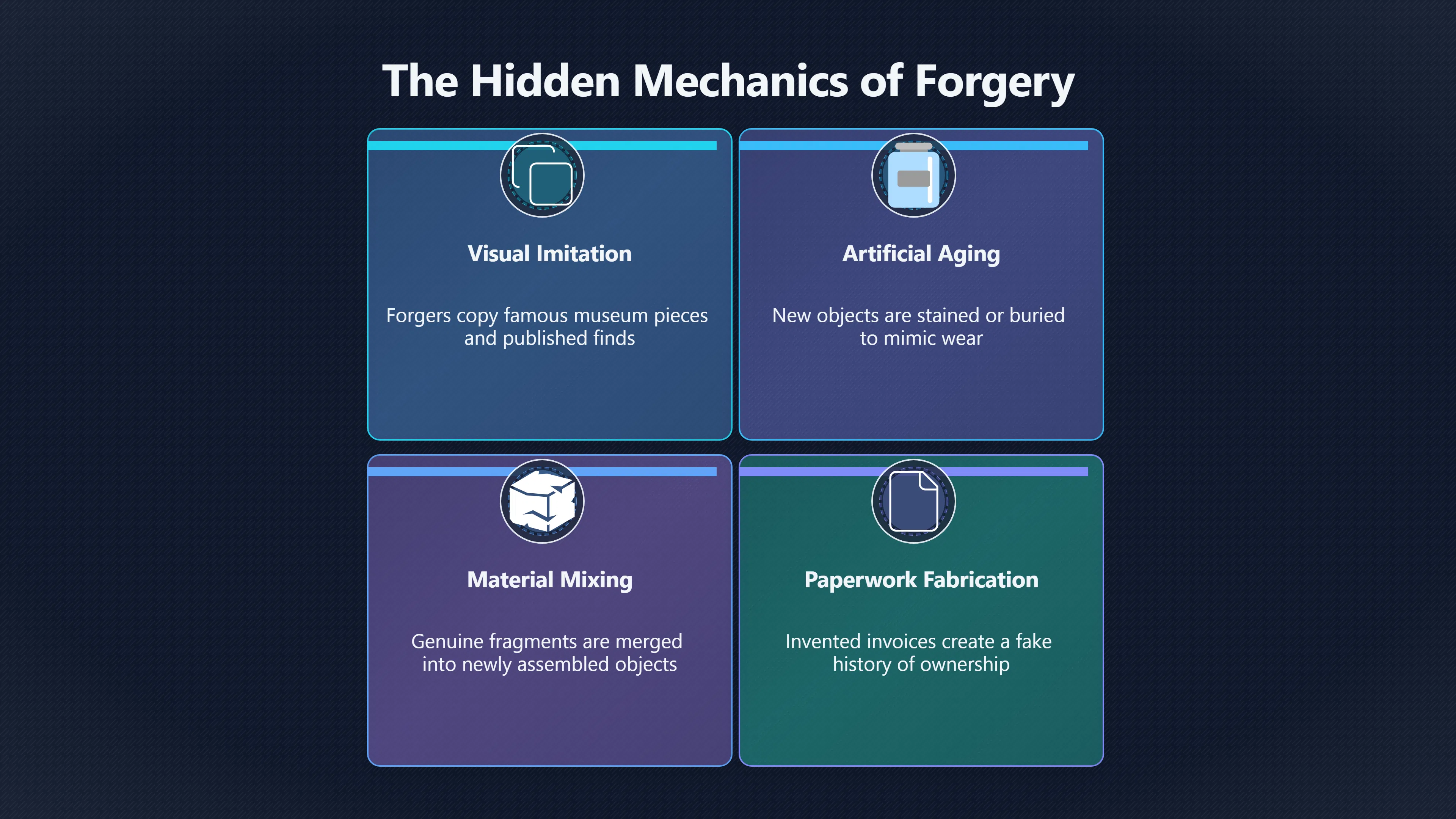
Several mechanisms make forged objects persuasive:
- Artificial ageing: New objects are stained, weathered or buried temporarily to imitate archaeological wear.
- Borrowed designs: Forgers copy famous museum pieces or published archaeological finds, assuming buyers will recognise the style but not the exact source.
- Invented ownership records: Documents, invoices and collection histories can be fabricated to make an object appear to have been circulating legally for decades.
- Mixing real and fake material: Genuine ancient fragments may be incorporated into newly assembled objects, making scientific assessment more difficult.[Returning Heritage]returningheritage.comReturning HeritageFaked artefacts: Exposing a damaging trendMay 6, 2020 — 6 May 2020 — These provide ideal shelter and anonymity for trad…
The result is a system in which authenticity can appear to be confirmed by paperwork, expert opinion or repeated circulation through the market even when the underlying evidence is weak.
The disputed mosaics returned to Lebanon
The most striking recent example emerged from a high-profile repatriation effort in 2023. The Manhattan District Attorney’s Antiquities Trafficking Unit returned twelve antiquities to Lebanon after investigations linked them to the collection of Lebanese antiquities dealer Georges Lotfi. New York authorities described the objects as trafficked cultural property and highlighted a broader effort to recover antiquities allegedly moved through Lotfi’s network.[Manhattan District Attorney's Office]manhattanda.orgManhattan District Attorney's Office D.ABragg Announces Return of 12 Antiquities To The…September 7, 2023 — 7 Sept 2023 — Since 2017, the ATU has recovered 28 antiquities col…
The return was presented as a heritage success story. Yet shortly afterwards, specialists in Roman art and archaeology challenged the authenticity of several of the mosaics. French archaeologist Djamila Fellague and other scholars argued that many of the panels appeared to be modern copies rather than ancient works. According to their analysis, the images reproduced well-known mosaics already documented in museums and archaeological sites in Italy, Tunisia, Algeria and Turkey. One mosaic was said to copy imagery from the famous Villa Romana del Casale in Sicily.[theguardian.com]theguardian.comOpen source on theguardian.com.
The controversy was significant because it raised an uncomfortable possibility: a legal process designed to return stolen heritage might also have granted official legitimacy to forged objects. If the scholars were correct, the mosaics had passed through investigations, seizures, transport arrangements and public ceremonies without the authenticity question being fully resolved.[The Guardian]theguardian.comOpen source on theguardian.com.
The dispute remains important precisely because it is not merely about whether particular mosaics are genuine. It highlights the tension between two separate objectives:
- Determining ownership — whether an object was removed illegally and should be returned.
- Determining authenticity — whether the object is ancient at all.
Those questions are related but not identical. An artefact can be illegally exported and still be fake. Conversely, an authentic artefact may have an uncertain legal history.
Why provenance matters more than paperwork
The Lebanese heritage debate increasingly centres on provenance rather than on visual appearance alone. A convincing-looking artefact may still be impossible to place within a documented archaeological context. Without that context, scholars lose information about where the object was found, what it was associated with and what it can reveal about the past.
For museums and governments, provenance performs several functions at once:
- It helps establish legal ownership.
- It provides evidence against looting.
- It allows researchers to evaluate authenticity.
- It reduces the risk that forged objects enter public collections.
The disputed mosaics demonstrate the limits of relying solely on possession records or market histories. Even when an artefact is recovered through a legitimate legal process, questions remain if there is no secure archaeological documentation linking it to a known excavation or site.[Art Newspaper]theartnewspaper.comarrest warrant georges lotfi looted smuggled antiquitiesprovenance beginning in the 1970s with George Lotfi. According… fake provenance documents” for a “multimillion dollar object which…
This is why many heritage specialists increasingly argue that undocumented antiquities should be treated with caution regardless of how impressive they appear. The object itself may be ancient, modern or a combination of both; what matters is whether its history can be independently verified.
When repatriation and authentication collide
Lebanon has invested considerable effort in recovering cultural property believed to have left the country illegally. These initiatives reflect legitimate concerns about looting, wartime trafficking and the loss of national heritage. Yet the mosaic controversy revealed a governance challenge that affects heritage authorities worldwide.
Repatriation programmes are often designed to answer legal questions: where did an object come from, and who has the strongest claim to it? Authentication, by contrast, requires specialist archaeological, stylistic and scientific examination. When those processes move at different speeds, an object may acquire official recognition before scholarly debate is complete.[Manhattan District Attorney's Office]manhattanda.orgManhattan District Attorney's Office D.ABragg Announces Return of 12 Antiquities To The…September 7, 2023 — 7 Sept 2023 — Since 2017, the ATU has recovered 28 antiquities col…
The lesson is not that repatriation is misguided. Rather, it is that recovering heritage and verifying heritage are separate tasks. A successful recovery operation can still leave unanswered questions about what exactly has been recovered.
What Lebanon’s forged-heritage disputes reveal
The most revealing aspect of Lebanon’s forged-antiquities controversies is that they are rarely about gullible buyers being tricked by obvious fakes. Instead, they expose how authority is created around cultural objects. Courts, dealers, museums, governments, scholars and the media all contribute to the stories that make artefacts meaningful.
In that environment, a forgery does not become influential merely because it resembles an ancient object. It becomes influential when it acquires a believable biography. The disputed mosaics show how quickly an uncertain artefact can move from the marketplace into official heritage narratives, and how difficult it can be to separate legal recovery from historical certainty.[theguardian.com]theguardian.comOpen source on theguardian.com.
For Lebanon, the enduring question is therefore not only whether particular objects are genuine. It is how a country with a rich but heavily contested archaeological record can protect its heritage while ensuring that the stories attached to recovered artefacts are as carefully examined as the artefacts themselves.
Amazon book picks
Further Reading
Books and field guides related to When Fake Antiquities Become Official Heritage. Use these as the next step if you want deeper reading beyond the article.
The Medici Conspiracy
Explores illicit antiquities trade, provenance, and authenticity.
eBay marketplace picks
Marketplace Samples
Live-tested eBay searches with available results related to this page.


Endnotes
1.
Source: rand.org
Title: RAND RR2706
Link:https://www.rand.org/content/dam/rand/pubs/research_reports/RR2700/RR2706/RAND_RR2706.pdf
Source snippet
Museums in Syria, said the percentage of fakes among looted antiquities seized in. Syria and...Read more...
2.
Source: news.artnet.com
Title: scholars us repatriated fake roman mosaics lebanon 2397462
Link:https://news.artnet.com/art-world-archives/scholars-us-repatriated-fake-roman-mosaics-lebanon-2397462
3.
Source: returningheritage.com
Link:https://www.returningheritage.com/faked-artefacts-exposing-a-damaging-trend
Source snippet
Returning HeritageFaked artefacts: Exposing a damaging trendMay 6, 2020 — 6 May 2020 — These provide ideal shelter and anonymity for trad...
Published: May 6, 2020
4.
Source: theartnewspaper.com
Title: arrest warrant georges lotfi looted smuggled antiquities
Link:https://www.theartnewspaper.com/2022/08/09/arrest-warrant-georges-lotfi-looted-smuggled-antiquities
Source snippet
provenance beginning in the 1970s with George Lotfi. According... fake provenance documents” for a “multimillion dollar object which...
5.
Source: theartnewspaper.com
Link:https://www.theartnewspaper.com/2016/08/24/almost-70percent-of-smuggled-objects-seized-in-syria-and-lebanon-are-fakes-antiquities-chief-says
Source snippet
Art NewspaperAlmost 70% of smuggled objects seized in Syria and...August 24, 2016 — 24 Aug 2016 — Objects seized by police in Damascus i...
Published: August 24, 2016
6.
Source: manhattanda.org
Title: Manhattan District Attorney’s Office D.A
Link:https://manhattanda.org/d-a-bragg-announces-return-of-12-antiquities-to-the-people-of-lebanon/
Source snippet
Bragg Announces Return of 12 Antiquities To The...September 7, 2023 — 7 Sept 2023 — Since 2017, the ATU has recovered 28 antiquities col...
Published: September 7, 2023
7.
Source: theguardian.com
Link:https://www.theguardian.com/culture/2023/nov/19/us-accused-of-sending-fake-roman-mosaics-back-to-lebanon
8.
Source: culturalpropertynews.org
Title: at great expense manhattan da returns fakes to lebanon
Link:https://culturalpropertynews.org/at-great-expense-manhattan-da-returns-fakes-to-lebanon/
9.
Source: culturalpropertynews.org
Title: the antiquities trade a reflection on the past 25 years part 2
Link:https://culturalpropertynews.org/the-antiquities-trade-a-reflection-on-the-past-25-years-part-2/
10.
Source: culturalpropertynews.org
Title: georges lotfi dramatic open after
Link:https://culturalpropertynews.org/georges-lotfi-dramatic-open-after/
Additional References
11.
Source: obs-traffic.museum
Link:https://www.obs-traffic.museum/sites/default/files/ressources/files/Book_observatory_illicit_traffic_version%20issuu.pdf
Source snippet
Observatory TrafficCountering Illicit Traffic in Cultural Goods25 Nov 2014 — that are difficult to fake can be used to produce fakes, e.g...
12.
Source: youtube.com
Link:https://www.youtube.com/watch?v=jJWT16wlb0I
Source snippet
Press Conference: The Need for Prosecuting Participants in the Illegal Antiquities Trade...
13.
Source: youtube.com
Title: Disrupting the Illicit Antiquities Trade in the Real and Virtual World
Link:https://www.youtube.com/watch?v=H2nmR_5xGpc
Source snippet
Who Owns the Past? Middle East Archaeology: Geoff Emberling, James Cuno, Gil Stein, Carlos Tortolero...
14.
Source: latimes.com
Link:https://www.latimes.com/world/middleeast/la-fg-syria-fake-antiquities-2016-story.html
Source snippet
Los Angeles TimesAfter Islamic State institutionalized looting in Syria, the...31 Dec 2016 — After Islamic State institutionalized looti...
15.
Source: nowlebanon.com
Title: stolen artifacts returned
Link:https://nowlebanon.com/stolen-artifacts-returned/
Source snippet
Stolen artifacts, returned7 Mar 2025 — The court charged Georges Lotfi of stealing a total of twenty-four antiquities that he e...
16.
Source: youtube.com
Link:https://www.youtube.com/watch?v=VD-V-fEOUgQ
Source snippet
Dr. Christos Tsirogiannis on illicit trafficking of cultural heritage...
17.
Source: youtube.com
Title: Lebanon returns over 300 ancient artifacts to Iraq
Link:https://www.youtube.com/watch?v=YRM4GALQvWU
Source snippet
Disrupting the Illicit Antiquities Trade in the Real and Virtual World...
18.
Source: escholarship.org
Link:https://escholarship.org/content/qt5xf6b5zd/qt5xf6b5zd_noSplash_abb583c26e373e1d6399daeaf9af2656.pdf?t=qb1u2t
19.
Source: facebook.com
Link:https://www.facebook.com/AUBArchaeologicalMuseum/posts/new-article-from-the-series-curatorspicksus-accused-of-sending-fake-roman-mosaic/909603021173952/
20.
Source: catalogus.boekman.nl
Link:https://catalogus.boekman.nl/pub/P19-0434.pdf
Topic Tree