Within Bulgaria Hoaxes
How Fake Thracian Treasures Rewrite Bulgaria's Past
Fake artefacts can deceive collectors, distort scholarship and help genuine looted objects disappear into the same opaque trade.
On this page
- How forgers make modern objects look ancient
- Why missing provenance makes false histories believable
- How testing, policing and scholarship expose the fraud
Page outline Jump by section
Introduction
Bulgaria is home to some of the world’s most celebrated Thracian treasures, including spectacular gold and silver hoards that transformed understanding of the ancient Thracians. That prestige has created an unintended side effect: a market in forged “Thracian” artefacts designed to exploit collectors, investors and sometimes even scholars. The problem is not simply that buyers can be deceived. Fake treasures can enter publications, exhibitions and private collections, creating false evidence about the ancient past while helping genuine looted objects disappear into the same shadowy trade. In Bulgaria, the story of forged Thracian treasures sits at the intersection of archaeology, organised crime, collecting culture and national heritage protection. It shows how difficult it can be to distinguish a remarkable discovery from a carefully manufactured illusion when provenance—the documented history of an object’s discovery and ownership—is missing.[BNR News]bnrnews.bgBNR NewsForgery of historical and cultural artefacts "contaminates…"History cannot be built on forgeries, the influence of counterfeit…

Why Thracian Treasures Are Such Attractive Targets
Authentic Thracian treasures are among Bulgaria’s most famous archaeological discoveries. Richly decorated gold vessels, silver drinking sets, ceremonial masks and jewellery have become symbols of the country’s ancient heritage. Their rarity and prestige make them highly valuable on the international antiquities market.[ancientbulgaria.bg]ancientbulgaria.bgThracian treasuresANCIENT BULGARIAThe most commonly found Thracian treasures are vessels used for drinking and libations, or the pouring of a liquid during…
Forgers exploit that reputation. A supposed newly discovered Thracian treasure offers several attractions to buyers:
- It can be presented as a unique archaeological find.
- Genuine comparisons exist in museum collections.
- Many real objects have emerged through accidental discoveries or illicit digging, making dramatic discovery stories seem plausible.
- Wealthy collectors may be willing to pay large sums for pieces associated with Thracian royalty, religion or warfare.
The result is a market in which extraordinary claims often appear before extraordinary evidence. When an object lacks a documented excavation record, collectors may be forced to rely on the seller’s story rather than independently verifiable facts.
How Forgers Make Modern Objects Look Ancient
The popular image of forgery is a crude replica covered in dirt. In reality, successful antiquities forgery is usually much more sophisticated.
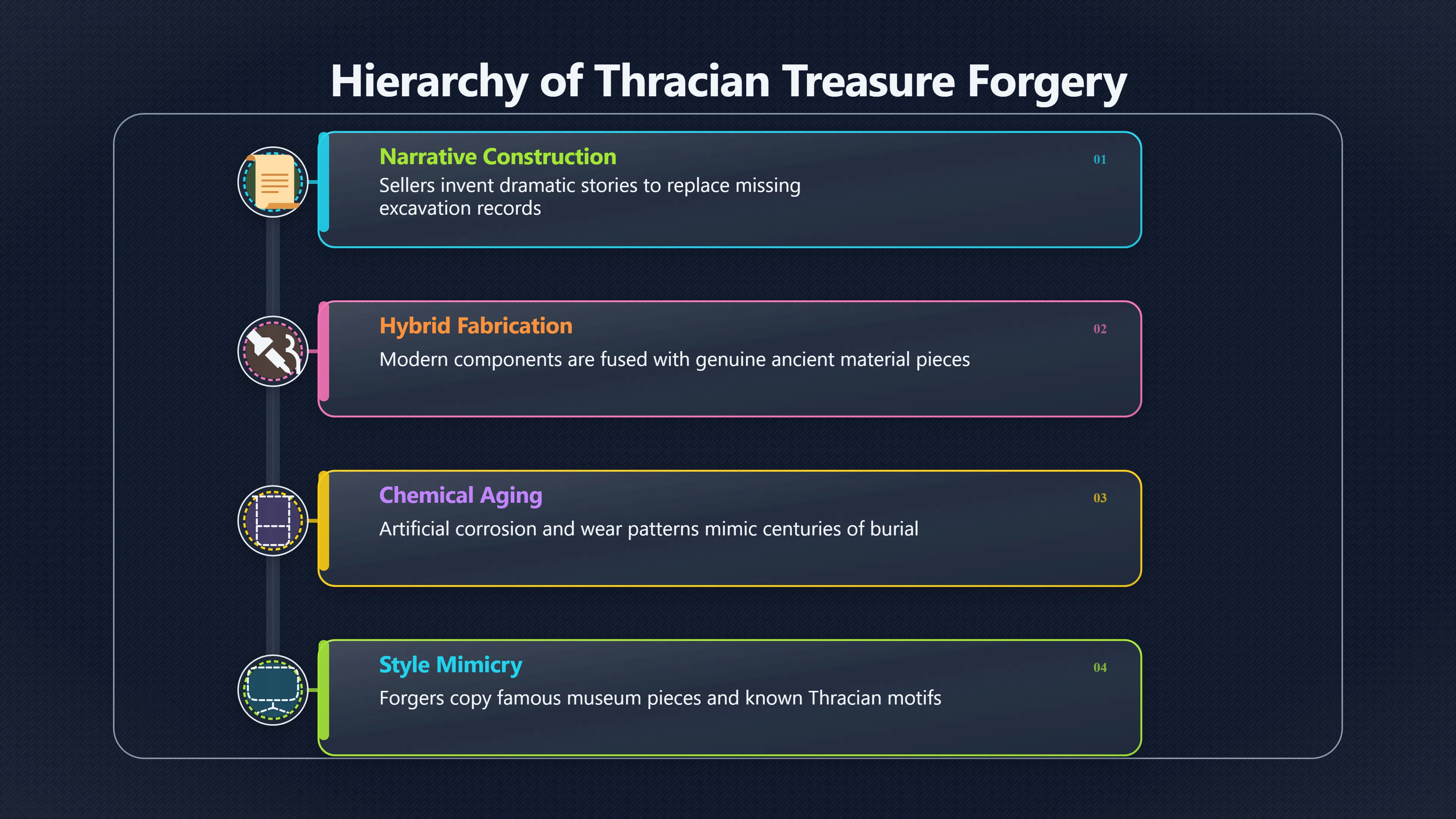
Modern workshops can copy famous museum pieces, combine authentic design elements from several genuine artefacts or invent entirely new objects that resemble known Thracian styles. Artificial ageing techniques may include chemical treatments, controlled corrosion, manufactured wear patterns and carefully applied surface deposits intended to imitate centuries of burial.[researchgate.net]researchgate.netResearch Gate(PDF) Ancient Coin Counterfeitsforgery techniques and object XRF testing. Figure by the authors (Ilya. Prokopov). 36. ancient coin counterfeits. Figure.. CN…Read more…
Some counterfeiters take advantage of genuine ancient material. A damaged authentic object may be altered, repaired with modern additions or combined with newly manufactured components. Such hybrid objects can be especially difficult to identify because laboratory testing may confirm that part of the artefact is ancient.
Coin forgery has been particularly important. Bulgaria has long been known among numismatists as a source of sophisticated counterfeit ancient coins. Researchers such as Ilya Prokopov have documented workshops, dies and production techniques used to create convincing imitations for the international market.[corpus-nummorum.eu]corpus-nummorum.euThey will introduce the counterfeiters and their workshops and…Read more…
Why Missing Provenance Makes False Histories Believable
The most powerful tool available to a forger is often not craftsmanship but storytelling.
Archaeologists place enormous importance on context. An object found during a controlled excavation can reveal information about trade, religion, politics, burial customs and chronology. An object appearing on the market without documentation cannot provide the same certainty.
This absence of context allows sellers to construct attractive narratives. A gold vessel may be described as part of a royal Thracian burial. A silver cup may supposedly come from a secret hoard discovered by chance. Because many genuine archaeological finds have emerged unexpectedly, such stories can sound credible.
The problem extends beyond private collecting. Once an undocumented object is accepted as genuine and cited in a catalogue, article or exhibition, it may begin generating false historical conclusions. Scholars can unknowingly build arguments around evidence that never existed in antiquity. Prokopov has argued that counterfeit artefacts effectively “contaminate” scientific research because they introduce false data into attempts to reconstruct the past.[BNR News]bnrnews.bgBNR NewsForgery of historical and cultural artefacts "contaminates…"History cannot be built on forgeries, the influence of counterfeit…
When Genuine Looting and Forgery Feed Each Other
One reason forged Thracian treasures are difficult to combat is that they operate within the same networks used for trafficking genuine artefacts.
Bulgaria has struggled for decades with illegal excavation, often called treasure hunting. Objects removed from archaeological sites lose their scientific context before they reach collectors. At the same time, counterfeit artefacts move through many of the same channels. Buyers therefore encounter a mixture of genuine and fake material.[RadioFreeEurope/RadioLiberty]rferl.orgRadio Free Europe/Radio Liberty Bulgaria: Police Fight Theft Of AntiquitiesRadio Free Europe/Radio Liberty Bulgaria: Police Fight Theft Of Antiquities
This blending creates several advantages for traffickers:
- Genuine objects lend credibility to forged ones.
- Forged objects can inflate the apparent size of a collection.
- Investigators must spend time authenticating material instead of simply recovering it.
- Uncertain provenance becomes normalised within the market.
A widely reported 2018 operation by Spanish authorities illustrates the scale of the problem. Police displayed tens of thousands of seized artefacts associated with trafficking networks linked to Bulgaria, including both genuine and forged items. The case demonstrated how difficult it can be to separate authentic cultural heritage from modern fabrications once both circulate through the same illicit trade routes.[Reuters]reuters.comrescued from the black market bulgarian artefacts go on display id USL8N1XI4D7Rescued from the black market, Bulgarian artefacts go on…7 Nov 2018 — Spanish police on Monday announced they had seized tens o…

The €200,000 Fake Treasure and Other Warning Signs
Individual cases rarely become famous in the way art forgeries sometimes do, because many are intercepted before reaching major museums. Nevertheless, investigators have repeatedly reported forged “Thracian treasures” being offered at very high prices.
A frequently cited example emerged in 2015 when Bulgarian investigators reported that traffickers were attempting to sell a fabricated Thracian treasure for approximately €200,000. The case attracted attention because it highlighted the profitability of creating impressive-looking archaeological objects rather than merely looting genuine ones. The incident also appeared in later academic and legal discussions of antiquities trafficking and forgery.[albanylawreview.org]albanylawreview.orgOpen source on albanylawreview.org.
Older reports reveal that the issue is not new. As far back as the 1990s, Bulgarian authorities were warning international institutions about sophisticated forgeries. One reported case involved a supposedly rare ancient coin that was nearly acquired by the British Museum before Bulgarian police reportedly identified it as a fake.[RadioFreeEurope/RadioLiberty]rferl.orgRadio Free Europe/Radio Liberty Bulgaria: Police Fight Theft Of AntiquitiesRadio Free Europe/Radio Liberty Bulgaria: Police Fight Theft Of Antiquities
Such episodes demonstrate that expertise, reputation and financial resources do not guarantee protection from forgery.
How Testing and Scholarship Expose the Fraud
Modern authentication relies on a combination of scientific testing, archaeological knowledge and market intelligence.
Laboratory Clues
Specialists may examine:
- Metal composition and trace elements.
- Casting and manufacturing techniques.
- Tool marks invisible to casual inspection.
- Corrosion layers and patina formation.
- Residues from artificial ageing processes.
Scientific methods such as X-ray fluorescence analysis can reveal whether alloys match known ancient production practices or contain modern signatures. Researchers working on counterfeit coin studies have increasingly employed such techniques to identify suspicious objects.[ResearchGate]researchgate.netResearch Gate(PDF) Ancient Coin Counterfeitsforgery techniques and object XRF testing. Figure by the authors (Ilya. Prokopov). 36. ancient coin counterfeits. Figure.. CN…Read more…
Archaeological Context
Even when laboratory results do not immediately expose a forgery, archaeologists look for inconsistencies in style, iconography, inscriptions and manufacturing methods.
A convincing fake may copy known motifs but combine them in ways that would have made little sense within authentic Thracian culture. Sometimes the object appears too perfect, incorporating features from several famous discoveries that would never naturally occur together.
Tracking Forgery Networks
Authentication increasingly involves studying the forgers themselves. Numismatic researchers have documented recurring dies, production methods and workshop characteristics associated with counterfeit objects originating from Bulgaria. Identifying these patterns can connect apparently unrelated artefacts to the same source.[corpus-nummorum.eu]corpus-nummorum.euThey will introduce the counterfeiters and their workshops and…Read more…
Law-enforcement operations across Europe have likewise focused on trafficking networks rather than isolated objects, recognising that forgery and illicit excavation often function as parts of the same criminal ecosystem.[Europol]europol.europa.euEuropol35 arrests in Bulgaria in a large art trafficking investigationEuropol35 arrests in Bulgaria in a large art trafficking investigation
What Forged Treasures Reveal About the Antiquities Market
The story of forged Thracian treasures is not mainly about gullible buyers. It is about incentives. Genuine Thracian artefacts are prestigious, rare and valuable. Demand encourages looting, while looting creates undocumented objects. Those undocumented objects create space for convincing fakes.
As a result, the most important question in the antiquities market is often not whether an object looks ancient but whether its history can be verified. A spectacular gold vessel with no reliable provenance may be less trustworthy than a modest artefact recovered through a documented excavation.
For Bulgaria, the danger goes beyond financial fraud. Every forged treasure that enters circulation risks rewriting the archaeological record. False objects can generate false histories, while genuine artefacts stripped from their original context lose much of the information that made them valuable in the first place. The challenge is therefore not simply to catch counterfeiters but to preserve the evidence needed to understand the real Thracian past.[bnrnews.bg]bnrnews.bgBNR NewsForgery of historical and cultural artefacts "contaminates…"History cannot be built on forgeries, the influence of counterfeit…
Amazon book picks
Further Reading
Books and field guides related to How Fake Thracian Treasures Rewrite Bulgaria's Past. Use these as the next step if you want deeper reading beyond the article.
The Medici Conspiracy
Shows how undocumented artifacts enter collections and distort history.
eBay marketplace picks
Marketplace Samples
Live-tested eBay searches with available results related to this page.


Endnotes
1.
Source: reuters.com
Title: rescued from the black market bulgarian artefacts go on display id USL8N1XI4D7
Link:https://www.reuters.com/article/business/rescued-from-the-black-market-bulgarian-artefacts-go-on-display-idUSL8N1XI4D7/
Source snippet
Rescued from the black market, Bulgarian artefacts go on...7 Nov 2018 — Spanish police on Monday announced they had seized tens o...
2.
Source: ancientbulgaria.bg
Title: Thracian treasures
Link:https://ancientbulgaria.bg/thracian/thracian-treasures
Source snippet
ANCIENT BULGARIAThe most commonly found Thracian treasures are vessels used for drinking and libations, or the pouring of a liquid during...
3.
Source: Wikipedia
Title: Panagyurishte Treasure
Link:https://en.wikipedia.org/wiki/Panagyurishte_Treasure
4.
Source: Wikipedia
Title: Rogozen Treasure
Link:https://en.wikipedia.org/wiki/Rogozen_Treasure
5.
Source: researchgate.net
Title: Research Gate(PDF) Ancient Coin Counterfeits
Link:https://www.researchgate.net/publication/395687230_Ancient_Coin_Counterfeits
Source snippet
forgery techniques and object XRF testing. Figure by the authors (Ilya. Prokopov). 36. ancient coin counterfeits. Figure.. CN...Read more...
6.
Source: corpus-nummorum.eu
Link:https://www.corpus-nummorum.eu/en/news/1295
Source snippet
They will introduce the counterfeiters and their workshops and...Read more...
7.
Source: new.coinsweekly.com
Title: prokopov ilya s
Link:https://new.coinsweekly.com/whoswho/prokopov-ilya-s/
Source snippet
Prokopov, Ilya S.19 Jul 2016 — Ilya Prokopov is best known for his research on Bulgarian counterfeits. He has published the fu...
8.
Source: albanylawreview.org
Link:https://www.albanylawreview.org/article/69704-official-fakes-the-consequences-of-governmental-treatment-of-forged-antiquities-as-genuine-during-seizures-prosecutions-and-repatriations.pdf
9.
Source: rand.org
Title: RAND RR2706
Link:https://www.rand.org/content/dam/rand/pubs/research_reports/RR2700/RR2706/RAND_RR2706.pdf
10.
Source: Wikipedia
Title: Thracian treasure
Link:https://en.wikipedia.org/wiki/Thracian_treasure
11.
Source: bnrnews.bg
Link:https://bnrnews.bg/en/post/116266/forgery-of-historical-and-cultural-artefacts-contaminates-science
Source snippet
BNR NewsForgery of historical and cultural artefacts "contaminates..."History cannot be built on forgeries, the influence of counterfeit...
12.
Source: independent.academia.edu
Title: Ilya Prokopov
Link:https://independent.academia.edu/IlyaProkopov
Source snippet
Prokopov - Independent Researcher“Forgeries of Ancient and Medieval Coins 'manifactured' in Bulgaria“ by Ilya S. Prokopov is addressed to...
13.
Source: rferl.org
Title: Radio Free Europe/Radio Liberty Bulgaria: Police Fight Theft Of Antiquities
Link:https://www.rferl.org/a/1090264.html
14.
Source: europol.europa.eu
Title: Europol35 arrests in Bulgaria in a large art trafficking investigation
Link:https://www.europol.europa.eu/media-press/newsroom/news/35-arrests-in-bulgaria-in-large-art-trafficking-investigation
15.
Source: europol.europa.eu
Title: Europol Police recover ‘millions’ in stolen treasures after
Link:https://www.europol.europa.eu/media-press/newsroom/news/police-recover-%E2%80%98millions%E2%80%99-in-stolen-treasures-after-busting-archaeological-crime-gang-in-bulgaria
16.
Source: archaeologyinbulgaria.com
Link:https://archaeologyinbulgaria.com/tag/trafficking/
Additional References
17.
Source: youtube.com
Link:http://www.youtube.com/watch?v=85VHEP15DoM
Source snippet
How To Spot A Fake Antique- The Naked Archaeologist 106 - Fame or Forgery?...
18.
Source: youtube.com
Title: Fake Artifacts: The Shocking Truth About the Antiquities Black Market
Link:http://www.youtube.com/watch?v=kFVK6Rp5iIM
Source snippet
101 arrested and 19,000 stolen artefacts recovered in international crackdown on art trafficking...
19.
Source: youtube.com
Title: The Exchange: Art and crime
Link:http://www.youtube.com/watch?v=w_0L6DijDEE
Source snippet
Fake Artifacts: The Shocking Truth About the Antiquities Black Market...
20.
Source: youtube.com
Link:http://www.youtube.com/watch?v=Z3V9qPbAYiA
Source snippet
The Exchange: Art and crime - the dark side of the antiquities trade euronews · 86K views...
21.
Source: facebook.com
Link:https://www.facebook.com/groups/320499045629956/posts/1323702295309621/
22.
Source: digitalheritagelab.eu
Link:https://digitalheritagelab.eu/wp-content/uploads/2026/02/ANCHISE-publication-Artefacts-roots-networks-compressed.pdf
23.
Source: facebook.com
Link:https://www.facebook.com/groups/994968377500743/posts/1931191787211726/
24.
Source: proviaspublishing.com
Link:https://proviaspublishing.com/wp-content/uploads/2021/08/COUNTERFEITS-OF-ROMAN-AND-BYZANTINE-GOLD-COINS.pdf
25.
Source: academia.edu
Link:https://www.academia.edu/37032984/The_Illicit_Antiquities_Trade_as_a_Transnational_Criminal_Network_Characterizing_and_Anticipating_Trafficking_of_Cultural_Heritage
26.
Source: papers.ssrn.com
Link:https://papers.ssrn.com/sol3/Delivery.cfm/SSRN_ID3268273_code2167867.pdf?abstractid=3268273
Topic Tree