Within North Macedonia Hoaxes
When Monumental History Starts to Look Invented
Skopje 2014 used statues and classical architecture to promote a disputed link between modern national identity and Alexander the Great.
On this page
- What the antiquisation campaign claimed
- How monuments gave the story public authority
- Why political mythmaking is not a simple hoax
Page outline Jump by section
Introduction
Skopje 2014 was not a classic hoax in the sense of forged documents or fabricated artefacts. It was something more complicated: a state-sponsored attempt to reshape public memory through architecture, monuments and urban design. Beginning under the government of Nikola Gruevski and his VMRO-DPMNE party, the project transformed central Skopje with enormous statues, neo-classical façades, triumphal arches and historical figures intended to link modern Macedonian identity to the ancient kingdom of Alexander the Great. Critics argued that the programme presented a highly selective and historically disputed story as if it were settled fact. Supporters saw it as a legitimate effort to strengthen national pride and visibility. The controversy matters because it shows how political narratives can gain authority not through textbooks alone, but through stone, bronze and public space.[researchgate.net]researchgate.netNation-building ancient Macedonian style: the origins and…The Skopje 2014 initiative by the VMRO-DPMNE in Macedonia was us…
When Monumental History Starts to Look Invented
The redevelopment of central Skopje was announced as an urban renewal and cultural project. Yet many of its most recognisable features pointed toward a much larger identity claim. Massive monuments to figures associated with ancient Macedonia appeared throughout the city centre, including the huge equestrian statue officially called “Warrior on a Horse” but widely understood as representing Alexander the Great. Nearby monuments honoured Philip II and other figures linked to the ancient Macedonian kingdom.[reuters.com]reuters.comMacedonia erects Alexander The Great statueThe government put a price tag of 80 million euros ($115 million) on the project when it unveiled…Read more…
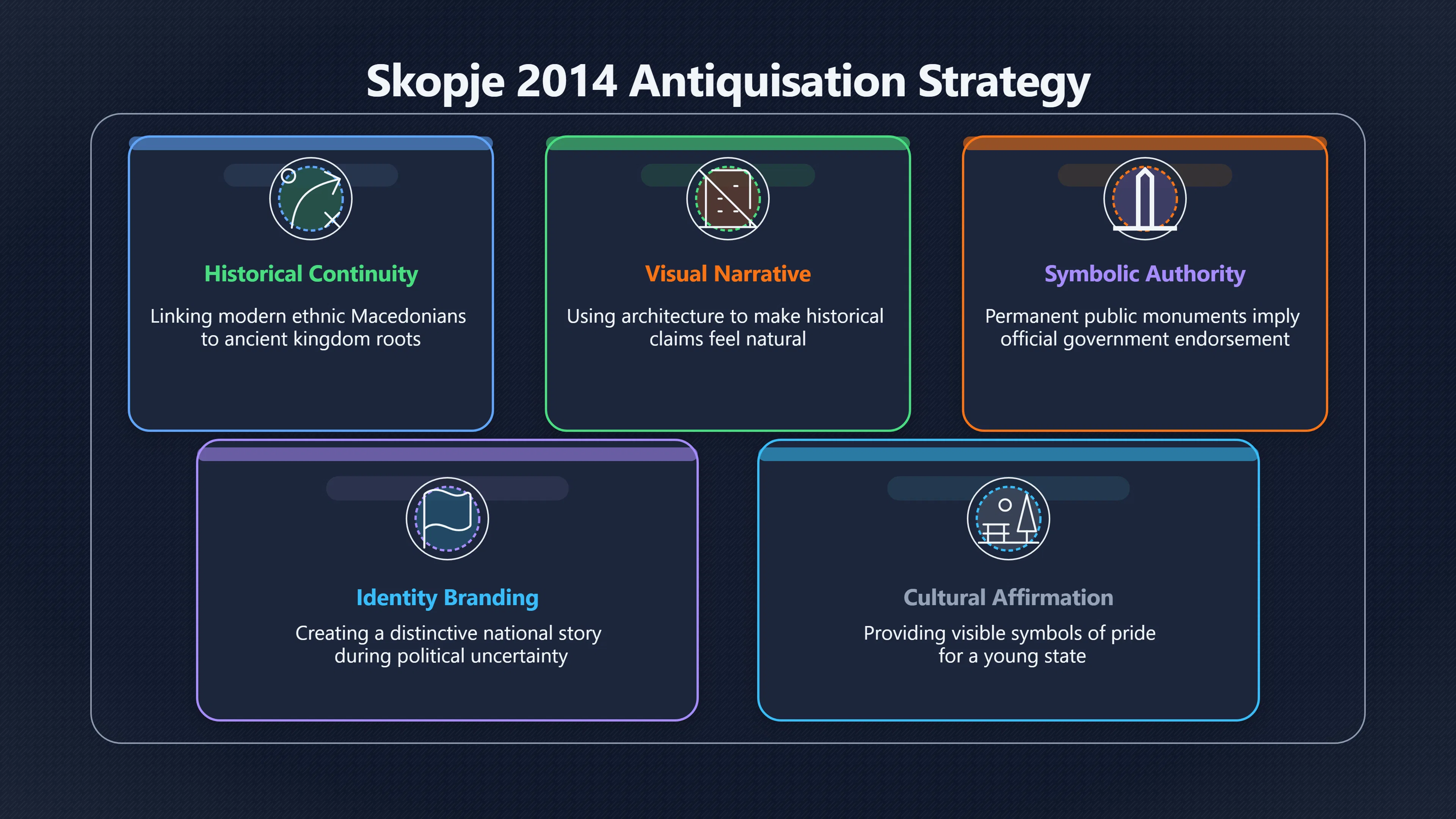
The broader political idea behind these additions became known as “antiquisation” or “antiquization”: the effort to emphasise continuity between contemporary ethnic Macedonians and the ancient Macedonians of classical antiquity. Scholars studying the project describe it as a nation-building strategy that sought to anchor modern identity in a prestigious ancient past rather than primarily in the Slavic migrations that shaped the region after antiquity.[researchgate.net]researchgate.netNation-building ancient Macedonian style: the origins and…The Skopje 2014 initiative by the VMRO-DPMNE in Macedonia was us…
This did not mean that every monument literally claimed direct biological descent from Alexander the Great. The project worked more subtly. By filling the capital with classical imagery and heroic statues, it encouraged visitors and residents to absorb a particular historical narrative simply by moving through the city.[focusongeography.org]focusongeography.orgOpen source on focusongeography.org.
What the Antiquisation Campaign Claimed
The central claim was not a single statement but a broader historical story. In this story, modern Macedonian nationhood was presented as having exceptionally deep roots reaching back to the ancient Macedonian kingdom. Ancient symbols, rulers and military heroes were elevated to a prominent place in the national landscape.[CEEOL]ceeol.comarticle detailCEEOL'Antiquization' and the Macedonian National Identityby P Atanasov · 2011 · Cited by 5 — The paper will try to analyze the 'antiquiza…
This approach emerged during a period when North Macedonia was involved in a long-running dispute with Greece over history, symbols and the use of the name “Macedonia”. The promotion of Alexander the Great and other ancient figures became internationally controversial because Greece also regards ancient Macedonia as a fundamental part of its own historical heritage. Critics therefore argued that Skopje 2014 was not merely commemorative architecture but an attempt to strengthen a contested historical claim through public symbolism.[reuters.com]reuters.comMacedonia erects Alexander The Great statueThe government put a price tag of 80 million euros ($115 million) on the project when it unveiled…Read more…
Academic studies of the project generally describe antiquisation as a political and cultural strategy rather than an established historical consensus. Researchers have noted that the campaign sought to create a distinctive national narrative at a moment of political uncertainty and international dispute.[researchgate.net]researchgate.netNation-building ancient Macedonian style: the origins and…The Skopje 2014 initiative by the VMRO-DPMNE in Macedonia was us…
How Monuments Gave the Story Public Authority
One reason Skopje 2014 remains such a revealing case is that it demonstrates how physical environments can make historical claims feel natural and unquestionable.
A monument possesses a different kind of authority from a political speech. Statues occupy public squares permanently. Government buildings, museums and bridges imply official endorsement. Visitors may not know the scholarly debates behind a historical claim, but they often assume that something commemorated on such a scale must be widely accepted.[focusongeography.org]focusongeography.orgOpen source on focusongeography.org.
The project eventually included more than 130 new objects, buildings, monuments and redesigned façades across central Skopje. The cumulative effect was to transform the visual identity of the city. A visitor arriving after the redevelopment encountered a landscape saturated with classical references, heroic sculpture and monumental symbolism.[cultures-of-history.uni-jena.de]cultures-of-history.uni-jena.dethe skopje 2014 project at its tenth anniversary a story of resilienceThe “Skopje 2014 project” at its Tenth Anniversary: A Story…Jun 20, 2024 — Beginning in the early 2010s, the project radically changed…
Critics argued that this created what amounted to a three-dimensional historical narrative. Rather than persuading citizens through direct argument, the city itself became the argument. The architecture suggested continuity with a glorious ancient past whether or not historians agreed on the details of that continuity.[focusongeography.org]focusongeography.orgOpen source on focusongeography.org.

Why So Many People Accepted the Narrative
The success of the project cannot be explained simply by propaganda. It resonated because it addressed genuine social and political needs.
For a relatively young state that emerged from the breakup of Yugoslavia, questions of national identity carried unusual weight. Many citizens felt that Macedonia’s history and distinctiveness were insufficiently recognised abroad. Linking the nation to famous figures of antiquity offered an emotionally powerful answer to those concerns.[CEEOL]ceeol.comarticle detailCEEOL'Antiquization' and the Macedonian National Identityby P Atanasov · 2011 · Cited by 5 — The paper will try to analyze the 'antiquiza…
The monuments also provided visible symbols of pride and permanence. Large public works often create the impression of national confidence, regardless of whether observers agree with the historical message. To supporters, the statues and new buildings represented cultural affirmation rather than deception.[AnthroSource]anthrosource.onlinelibrary.wiley.comAnthro Source COUNTERFEITING THE NATION?Skopje 2014 and the…1 Feb 2013 — This article analyzes the political dynamics centered on Skopje 2014, an urban renovation project spo…
At the same time, the project’s visual scale helped normalise its historical assumptions. People encounter monuments repeatedly in everyday life. Over time, symbols that once seemed controversial can begin to appear familiar and self-evident simply because they are always present.[Tuhat]tuhat.helsinki.fiGraan.Counterfeiting The NationGraan.Counterfeiting The Nation
Why Political Mythmaking Is Not a Simple Hoax
Describing Skopje 2014 as a hoax captures only part of the story.[Wikipedia]WikipediaSkopje 2014Skopje 2014
A hoax usually involves knowingly false information presented as truth. Skopje 2014 operated differently. Its promoters did not secretly forge evidence or invent fictional historical figures. Most of the monuments depicted real people from history. The controversy concerned interpretation rather than outright fabrication.[ResearchGate]researchgate.netNation-building ancient Macedonian style: the origins and…The Skopje 2014 initiative by the VMRO-DPMNE in Macedonia was us…
The key dispute was whether the project transformed contested historical interpretations into apparent certainties. Historians, architects, political scientists and critics argued that the redevelopment simplified complex questions of identity and ancestry into a visually persuasive but historically debatable narrative.[researchgate.net]researchgate.netNation-building ancient Macedonian style: the origins and…The Skopje 2014 initiative by the VMRO-DPMNE in Macedonia was us…
For that reason, Skopje 2014 is often better understood as political mythmaking. Political myths are not necessarily complete inventions. They usually combine real people, real events and selective interpretation into a story designed to strengthen collective identity. The power of such myths comes not from forgery but from repetition, symbolism and institutional endorsement.[ceeol.com]ceeol.comarticle detailCEEOL'Antiquization' and the Macedonian National Identityby P Atanasov · 2011 · Cited by 5 — The paper will try to analyze the 'antiquiza…
The Backlash and the Question of Cost
The project generated criticism on several fronts. Opponents questioned both its historical message and its expense. Estimates of the total cost varied considerably over time, with official and independent calculations often differing. Investigations and reporting suggested that the final price greatly exceeded the sums originally discussed when the project was unveiled.[reuters.com]reuters.comMacedonia erects Alexander The Great statueThe government put a price tag of 80 million euros ($115 million) on the project when it unveiled…Read more…
Architects and urban planners criticised the aesthetic approach, arguing that the classical façades and monumental style obscured parts of Skopje’s modern architectural heritage. Others argued that the project privileged one version of national history while sidelining the city’s multicultural character and the experiences of minority communities.[culanth.org]culanth.orgOpen source on culanth.org.
Public opposition became particularly visible during the political crisis of the mid-2010s, when protesters famously splashed paint on some of the project’s most recognisable monuments. The colourful attacks turned the statues themselves into symbols of broader arguments about corruption, identity and political power.[DNB]d-nb.infoOpen source on d-nb.info.
How Skopje 2014 entered public memory
More than a decade after construction began, Skopje 2014 remains one of the most striking examples of how governments can use urban space to shape historical consciousness. The debate is no longer simply about statues. It concerns the relationship between history, memory and political authority.[Sage Journals]journals.sagepub.comOpen source on sagepub.com.
The project demonstrates that contested historical claims do not need forged artefacts or fabricated documents to become influential. Public squares, monuments and architecture can perform a similar function by giving one interpretation of the past a permanent physical presence. Whether viewed as nation-building, cultural branding, political mythmaking or historical overreach, Skopje 2014 remains a powerful example of how identities can be constructed not only through stories people are told, but through landscapes they inhabit every day.[focusongeography.org]focusongeography.orgOpen source on focusongeography.org.
Amazon book picks
Further Reading
Books and field guides related to When Monumental History Starts to Look Invented. Use these as the next step if you want deeper reading beyond the article.
Black Lamb and Grey Falcon
Provides broad historical context for identity debates in the region.
eBay marketplace picks
Marketplace Samples
Live-tested eBay searches with available results related to this page.




Endnotes
1.
Source: researchgate.net
Link:https://www.researchgate.net/publication/232817792_Nation-building_ancient_Macedonian_style_the_origins_and_the_effects_of_the_so-called_antiquization_in_Macedonia
Source snippet
Nation-building ancient Macedonian style: the origins and...The Skopje 2014 initiative by the VMRO-DPMNE in Macedonia was us...
2.
Source: cultures-of-history.uni-jena.de
Title: the skopje 2014 project at its tenth anniversary a story of resilience
Link:https://www.cultures-of-history.uni-jena.de/politics/north-macedonia/the-skopje-2014-project-at-its-tenth-anniversary-a-story-of-resilience
Source snippet
The “Skopje 2014 project” at its Tenth Anniversary: A Story...Jun 20, 2024 — Beginning in the early 2010s, the project radically changed...
3.
Source: reuters.com
Title: Macedonia erects Alexander The Great statue
Link:https://www.reuters.com/article/lifestyle/macedonia-erects-alexander-the-great-statue-idUSTRE75K3RF/
Source snippet
The government put a price tag of 80 million euros ($115 million) on the project when it unveiled...Read more...
4.
Source: artmargins.com
Title: troubles with history skopje 2014
Link:https://artmargins.com/troubles-with-history-skopje-2014/
Source snippet
ARTMargins OnlineTroubles with History: Skopje 201429 Dec 2011 — Another sign of the troubled Antiquisation is the monument of Alexander...
5.
Source: Wikipedia
Link:https://en.wikipedia.org/wiki/Warrior_on_Horseback
Source snippet
s €9.4 million...
6.
Source: ceeol.com
Title: article detail
Link:https://www.ceeol.com/search/article-detail?id=640236
Source snippet
CEEOL'Antiquization' and the Macedonian National Identityby P Atanasov · 2011 · Cited by 5 — The paper will try to analyze the 'antiquiza...
7.
Source: focusongeography.org
Link:https://www.focusongeography.org/publications/photoessays/skopje/index.html
8.
Source: Wikipedia
Title: Skopje 2014
Link:https://en.wikipedia.org/wiki/Skopje_2014
9.
Source: Wikipedia
Link:https://en.wikipedia.org/wiki/Antiquization
10.
Source: d-nb.info
Link:https://d-nb.info/1385178213/34
11.
Source: researchgate.net
Link:https://www.researchgate.net/publication/344070633_Skopje_2014_Antiquisation_urban_identity_and_the_rejection_of_Balkan_otherness
12.
Source: researchgate.net
Link:https://www.researchgate.net/publication/259690203_Counterfeiting_The_Nation_Skopje_2014_and_the_Politics_of_Nation_Branding_in_Macedonia
13.
Source: youtube.com
Link:https://www.youtube.com/watch?v=bWIdayA3H4w
Source snippet
Skopje 2014: A New Vision for a Timeless City...
14.
Source: youtube.com
Link:https://www.youtube.com/watch?v=Fd87IFIEynI
Source snippet
Skopje 2014 - Shaping identities...
15.
Source: youtube.com
Link:https://www.youtube.com/watch?v=jZG-I9q0xaI
Source snippet
How Skopje 2014 Ate The Urban Commons...
16.
Source: anthrosource.onlinelibrary.wiley.com
Title: Anthro Source COUNTERFEITING THE NATION?
Link:https://anthrosource.onlinelibrary.wiley.com/doi/10.1111/j.1548-1360.2012.01179.x
Source snippet
Skopje 2014 and the...1 Feb 2013 — This article analyzes the political dynamics centered on Skopje 2014, an urban renovation project spo...
17.
Source: tuhat.helsinki.fi
Title: Graan.Counterfeiting The Nation
Link:https://tuhat.helsinki.fi/ws/files/144277249/Graan.CounterfeitingTheNation.pdf
18.
Source: journals.sagepub.com
Link:https://journals.sagepub.com/doi/10.1177/03058298241231742
19.
Source: culanth.org
Link:https://www.culanth.org/fieldsights/counterfeiting-the-nation-skopje-2014-and-the-politics-of-nation-branding-in-macedonia
20.
Source: tandfonline.com
Link:https://www.tandfonline.com/doi/full/10.1080/21599165.2022.2136652
21.
Source: balkaninsight.com
Title: all balkan countries
Link:https://balkaninsight.com/2015/07/27/true-cost-of-skopje-2014-revealed/bi/all-balkan-countries/
22.
Source: balkaninsight.com
Title: all balkan countries
Link:https://balkaninsight.com/2012/09/14/secret-contracts-hide-cost-of-skopje-makeover/bi/all-balkan-countries/
23.
Source: balkaninsight.com
Title: macedonia politics and society
Link:https://balkaninsight.com/2017/11/23/macedonia-s-alexander-statue-faces-uncertain-fate-11-23-2017/bi/macedonia/macedonia-politics-and-society/
24.
Source: balkaninsight.com
Title: all balkan countries
Link:https://balkaninsight.com/2013/04/26/skopje-revamp-has-made-sculptors-millionaires/bi/all-balkan-countries/
Additional References
25.
Source: studenttheses.universiteitleiden.nl
Link:https://studenttheses.universiteitleiden.nl/access/item%3A2660458/view
Source snippet
Student ThesesThe controversial Antiquisation of the national identity in...The thesis attempts to tackle the question “What is the orig...
26.
Source: ft.com
Link:https://www.ft.com/content/ae1d35e3-e60f-4b9d-ae99-36272d1988d3
27.
Source: shareok.org
Link:https://shareok.org/server/api/core/bitstreams/642fd2b7-42c9-4b04-b281-9e51f3b97db8/content
28.
Source: facebook.com
Link:https://www.facebook.com/groups/3392705360850639/posts/26418013021226547/
29.
Source: thegazelle.org
Link:https://www.thegazelle.org/issue/153/the-political-discourse-surrounding-a-name-issue
30.
Source: facebook.com
Title: in pictures eleven years after it was unveiled with a price tag that exceeded 7
Link:https://www.facebook.com/balkaninsight/posts/-in-pictures-eleven-years-after-it-was-unveiled-with-a-price-tag-that-exceeded-7/10165550942925506/
31.
Source: academia.edu
Title: Skopje 2014 Antiquisation urban identity and the rejection of Balkan otherness
Link:https://www.academia.edu/42977706/Skopje_2014_Antiquisation_urban_identity_and_the_rejection_of_Balkan_otherness
32.
Source: eurasiareview.com
Title: 13072011 macedonias statue of philip to top alexanders
Link:https://www.eurasiareview.com/13072011-macedonias-statue-of-philip-to-top-alexanders/
33.
Source: youtube.com
Link:https://www.youtube.com/watch?v=siK_MlYuI8s
Source snippet
Skopje 2014 Uncovered [English version]...
34.
Source: ets.lstc.lt
Title: 32023 Article Text 85300 1 10 20211116
Link:https://ets.lstc.lt/wp-content/uploads/2010/02/32023-Article-Text-85300-1-10-20211116.pdf
Topic Tree