Within Argentina Hoaxes
Were Miramar's Ancient Human Finds Too Good to Be True?
Disputed finds at Miramar became a test case for how archaeology separates genuine discoveries from planted evidence.
On this page
- Ameghino's ambitious theories
- The disputed Miramar artefacts
- How investigators challenged the evidence
Page outline Jump by section
Introduction
The Miramar discoveries occupy a peculiar place in Argentina’s history of disputed evidence. They were not a straightforward hoax exposed by a single dramatic revelation. Instead, they became a long-running argument about whether extraordinary archaeological finds represented genuine evidence of extremely ancient humans in South America or whether they resulted from mistakes, contamination, wishful thinking, or deliberate planting. At stake was a remarkable claim: that humans, or human-like toolmakers, had been present in the Pampas millions of years earlier than accepted prehistory allowed. The controversy helped shape modern archaeological standards by forcing investigators to ask a fundamental question: how can anyone prove that an artefact truly comes from the geological layer where it was supposedly found?[si.edu]repository.si.eduSmithsonian Research Onlineearly man in south- americaSmithsonian Research OnlineLehmann-Nitsche and a number of his associates, and this was soon followed by the reports on the apparenth' ep…

Ameghino’s Ambitious Theories
The debate centred on the work of Florentino Ameghino, one of Argentina’s most influential naturalists and palaeontologists. During the late nineteenth and early twentieth centuries, Ameghino argued that humans had an extremely deep antiquity in the Río de la Plata region and that evidence of their presence could be found alongside fossil animals in deposits thought to date from the Pliocene and other ancient geological periods. These claims attracted international attention because they challenged the prevailing understanding of human evolution and migration.[wikipedia.org]WikipediaFlorentino AmeghinoFlorentino Ameghino
Ameghino’s broader ideas were controversial even in his own time. He believed South America played a far more important role in human origins than most European and North American researchers accepted. His supporters viewed him as a visionary willing to challenge orthodox thinking. His critics argued that his theoretical commitments made him too willing to interpret ambiguous evidence as proof of ancient humanity.[isita-org.com]isita-org.comArgentinean naturalist Florentino Ameghino. (1854-1911), investigated the geology and co- occurrence of humans and animal fossils in.Read…
After Florentino Ameghino’s death in 1911, his brother Carlos continued investigations along the Atlantic coast near Miramar in Buenos Aires Province. It was there that some of the most disputed discoveries emerged.[ResearchGate]researchgate.netResearch Gatefrom burmeister to ameghino and the worldwideAmeghino brought global visibility and reconnaissance of the Argentine paleontology due to his numerous publications based on the collect…
The Disputed Miramar Artefacts
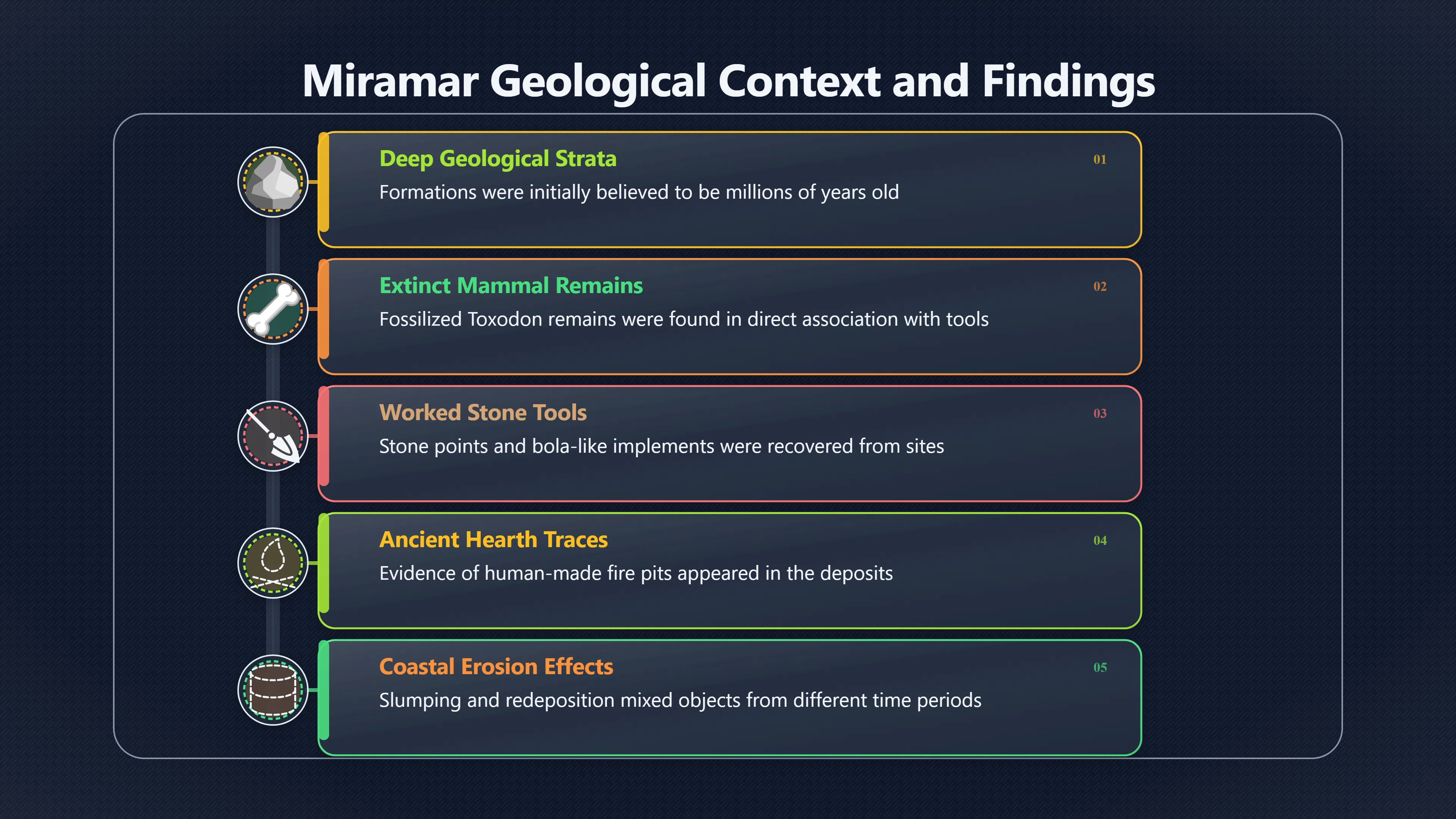
The Miramar finds appeared astonishing. Reports described worked stones, bola-like implements, traces interpreted as ancient hearths, and other objects supposedly recovered from geological formations considered millions of years old. Particularly dramatic were claims that artefacts had been found in direct association with extinct animals from deep geological strata. Some discoveries seemed to imply that tool-making humans had lived in the region long before accepted timelines for human evolution.[si.edu]repository.si.eduSmithsonian Research Onlineearly man in south- americaSmithsonian Research OnlineLehmann-Nitsche and a number of his associates, and this was soon followed by the reports on the apparenth' ep…
One of the most famous examples involved a stone point reportedly found embedded in the fossilised remains of a Toxodon, an extinct South American mammal. If authentic and undisturbed, such an association would have suggested human activity at an implausibly early date. Other reported discoveries included worked stones recovered from the Chapadmalalan deposits near Miramar, formations then believed to be several million years old.[backtogodhead.in]backtogodhead.inforbidden archeology by drutakarma dasa michael cremoForbidden Archeology by Drutakarma Dasa (Michael Cremo)1 May 1993 — Florentino Ameghino, a respected Argentine paleontologist, found ston…
These discoveries spread because they seemed to offer exactly the kind of dramatic evidence archaeologists were searching for. Around the world, researchers were debating when humans first arrived in the Americas. A find that pushed human presence back by hundreds of thousands or even millions of years would have rewritten textbooks. The Miramar artefacts therefore received attention far beyond Argentina.[Smithsonian Research Online]repository.si.eduSmithsonian Research Onlineearly man in south- americaSmithsonian Research OnlineLehmann-Nitsche and a number of his associates, and this was soon followed by the reports on the apparenth' ep…

Why Some Researchers Suspected Fraud
The Miramar controversy became a test case in archaeological scepticism because critics increasingly questioned not the objects themselves but their context. A stone tool can only prove ancient human activity if its geological position is secure. Investigators therefore focused on how the artefacts had been recovered and documented.[Smithsonian Research Online]repository.si.eduSmithsonian Research Onlineearly man in south- americaSmithsonian Research OnlineLehmann-Nitsche and a number of his associates, and this was soon followed by the reports on the apparenth' ep…
Several concerns emerged:
- Some artefacts resembled naturally fractured stones rather than unquestionably human-made tools.
- Coastal cliffs around Miramar were subject to erosion, slumping and redeposition, creating opportunities for objects from different periods to become mixed together.
- Critics argued that artefacts could have fallen into cracks or been introduced into older sediments after their original deposition.
- Documentation standards of the period were often less rigorous than modern archaeological excavation methods, making later verification difficult.[si.edu]repository.si.eduSmithsonian Research Onlineearly man in south- americaSmithsonian Research OnlineLehmann-Nitsche and a number of his associates, and this was soon followed by the reports on the apparenth' ep…
As debate intensified, some researchers went further and suggested that at least certain finds might have been planted, manipulated or incorrectly presented. The suspicion did not necessarily extend to every discovery or every investigator. Rather, opponents argued that the extraordinary nature of the claims demanded stronger proof than was available. Later reviews of the controversy have noted that allegations of fraud and evidence manipulation became part of the dispute, reflecting the high scientific stakes involved.[pleistocenecoalition.com]pleistocenecoalition.comPCNthe Miramar findings were the subject of debate and controversy, and even of suspected fraud or manipu- lation, as noted in Part 1. As…
How Investigators Challenged the Evidence
The most influential challenge came from researchers associated with the Smithsonian Institution, particularly Aleš Hrdlička and other critics of Ameghino’s conclusions. Their investigations emphasised geology, stratigraphy and excavation context rather than the artefacts alone. They argued that many supposed signs of great antiquity could be explained by recent Indigenous occupations, natural geological processes or mistaken interpretations of deposits.[Smithsonian Research Online]repository.si.eduSmithsonian Research Onlineearly man in south- americaSmithsonian Research OnlineLehmann-Nitsche and a number of his associates, and this was soon followed by the reports on the apparenth' ep…
A key methodological shift emerged from these disputes. Instead of asking whether an object looked ancient, investigators increasingly demanded evidence that it had remained undisturbed within a dated geological layer. This required careful observation of sedimentary relationships, controlled excavation and independent verification. The Miramar claims often struggled under these stricter standards because the original discoveries could not always be re-examined under controlled conditions.[Smithsonian Research Online]repository.si.eduSmithsonian Research Onlineearly man in south- americaSmithsonian Research OnlineLehmann-Nitsche and a number of his associates, and this was soon followed by the reports on the apparenth' ep…
The debate also highlighted a recurring problem in archaeology: spectacular finds attract attention, but proving their authenticity requires documentation that survives scrutiny long after the original discoverers are gone. In many Miramar cases, later researchers had access only to collections, reports and testimony rather than the original excavation context.[ResearchGate]researchgate.neta study case of the Florentino Ameghino collection housed…8 Jun 2020 — The collection comprises bones with evidences of an…

Were the Finds a Hoax or a Scientific Error?
Modern assessments generally do not treat the entire Miramar episode as a simple fraud. The historical picture is more complicated. Some researchers believe that enthusiasm for proving extreme human antiquity encouraged overly generous interpretations of ambiguous evidence. Others point to the possibility of isolated instances of planted or manipulated artefacts. Still others argue that certain discoveries deserve more attention than they received from critics.[pleistocenecoalition.com]pleistocenecoalition.comPCNthe Miramar findings were the subject of debate and controversy, and even of suspected fraud or manipu- lation, as noted in Part 1. As…
What has not survived is the original extraordinary conclusion. Archaeologists today do not accept Miramar as evidence that humans occupied Argentina millions of years ago. Subsequent research on the peopling of the Americas has produced a very different chronology based on stratified archaeological sites, radiometric dating and multiple independent lines of evidence. The Miramar finds are therefore remembered primarily as a cautionary episode in the history of archaeology rather than as proof of a revolutionary human past.[isita-org.com]isita-org.comArgentinean naturalist Florentino Ameghino. (1854-1911), investigated the geology and co- occurrence of humans and animal fossils in.Read…
Why the Miramar Debate Still Matters
The enduring significance of Miramar lies less in the artefacts themselves than in the questions they forced scientists to confront. The controversy demonstrated how easily dramatic discoveries can gain credibility when they appear to support a compelling theory. It also showed why archaeology relies so heavily on provenance—the documented origin and context of a find—rather than on the object alone.[Smithsonian Research Online]repository.si.eduSmithsonian Research Onlineearly man in south- americaSmithsonian Research OnlineLehmann-Nitsche and a number of his associates, and this was soon followed by the reports on the apparenth' ep…
Within Argentina’s broader history of disputed discoveries, Miramar stands as an example of the blurry boundary between genuine scientific investigation, confirmation bias, mistaken interpretation and suspected fraud. The case remains memorable because the claims were so consequential. If true, the finds would have transformed our understanding of human history in the Americas. Their eventual rejection helped establish stricter standards for evaluating extraordinary archaeological evidence, making Miramar one of the most instructive controversies in Argentine scientific history.[si.edu]repository.si.eduSmithsonian Research Onlineearly man in south- americaSmithsonian Research OnlineLehmann-Nitsche and a number of his associates, and this was soon followed by the reports on the apparenth' ep…
Amazon book picks
Further Reading
Books and field guides related to Were Miramar's Ancient Human Finds Too Good to Be True?. Use these as the next step if you want deeper reading beyond the article.
Frauds, Myths, and Mysteries: Science and Pseudoscience in Ar...
Directly addresses disputed discoveries and how archaeologists test evidence.
The Demon-Haunted World
Rating: 4.5/5 from 43 Google Books ratings
Supports critical evaluation of extraordinary historical claims.
Archaeology : theories, methods, and practice
Explains stratigraphy, dating and context central to the Miramar debate.
eBay marketplace picks
Marketplace Samples
Live-tested eBay searches with available results related to this page.




Endnotes
1.
Source: isita-org.com
Link:https://www.isita-org.com/jass/Contents/2024vol102/Menendez/38676454.pdf
Source snippet
Argentinean naturalist Florentino Ameghino. (1854-1911), investigated the geology and co- occurrence of humans and animal fossils in.Read...
2.
Source: researchgate.net
Link:https://www.researchgate.net/publication/342004709_Going_back_to_collections_a_study_case_of_the_Florentino_Ameghino_collection_housed_in_the_Museo_de_La_Plata_Argentina
Source snippet
a study case of the Florentino Ameghino collection housed...8 Jun 2020 — The collection comprises bones with evidences of an...
3.
Source: Wikipedia
Title: Florentino Ameghino
Link:https://en.wikipedia.org/wiki/Florentino_Ameghino
4.
Source: researchgate.net
Title: Research Gatefrom burmeister to ameghino and the worldwide
Link:https://www.researchgate.net/publication/393035303_FROM_BURMEISTER_TO_AMEGHINO_AND_THE_WORLDWIDE_RECOGNITION_OF_THE_VERTEBRATE_PALEONTOLOGY_FROM_ARGENTINA
Source snippet
Ameghino brought global visibility and reconnaissance of the Argentine paleontology due to his numerous publications based on the collect...
5.
Source: pleistocenecoalition.com
Link:https://pleistocenecoalition.com/newsletter/september-october2019.pdf
Source snippet
PCNthe Miramar findings were the subject of debate and controversy, and even of suspected fraud or manipu- lation, as noted in Part 1. As...
6.
Source: backtogodhead.in
Title: forbidden archeology by drutakarma dasa michael cremo
Link:https://www.backtogodhead.in/forbidden-archeology-by-drutakarma-dasa-michael-cremo/
Source snippet
Forbidden Archeology by Drutakarma Dasa (Michael Cremo)1 May 1993 — Florentino Ameghino, a respected Argentine paleontologist, found ston...
Published: May 1993
7.
Source: krishna.com
Link:https://krishna.com/topic-index/evolution/forbidden-archeology/
Source snippet
Forbidden ArcheologyFlorentino Ameghino, a respected Argentine paleontologist, found stone tools, broken mammal bones, a human ver...
8.
Source: repository.si.edu
Title: Smithsonian Research Onlineearly man in south- america
Link:https://repository.si.edu/bitstream/handle/10088/15519/bulletin521912smit.pdf
Source snippet
Smithsonian Research OnlineLehmann-Nitsche and a number of his associates, and this was soon followed by the reports on the apparenth' ep...
Additional References
9.
Source: youtube.com
Title: Hommo Pampeus
Link:https://www.youtube.com/watch?v=m8E7DOstvms
Source snippet
Florentino Ameghino vs. Perito Moreno: Why did they fight?...
10.
Source: youtube.com
Title: The Naturalist | The Bone Maniac: Trial of Florentino Ameghino
Link:https://www.youtube.com/watch?v=fzmADjpZ6Pw
Source snippet
Hommo Pampeus - Ep 6 | The Bone Maniac | Biography of Florentino Ameghino...
11.
Source: facebook.com
Link:https://www.facebook.com/100090508931535/posts/a-viral-story-claims-that-researchers-discovered-tiny-human-like-skeletons-in-th/986751001018522/
12.
Source: arp.org.pt
Link:https://arp.org.pt/revista_antiga/pdf/2018027.pdf
13.
Source: facebook.com
Link:https://www.facebook.com/archaeologicalconservancy/posts/archaeologists-say-human-evolution-study-used-stolen-bone/10155910594914837/
14.
Source: harekrishna.com
Link:https://www.harekrishna.com/col/books/science/intro.html
15.
Source: facebook.com
Link:https://www.facebook.com/Nature/posts/sharp-criticism-of-controversial-ancient-human-claims-tests-elifes-revamped-peer/673453008148010/
16.
Source: khaisor.com
Link:https://khaisor.com/wp-content/uploads/2019/03/%E2%80%9CForbidden-Archeology%E2%80%9D.pdf
17.
Source: youtube.com
Title: Miramar, Museo de Ciencias naturales
Link:https://www.youtube.com/watch?v=HDvGZywH5_s
Source snippet
The Bizarre Discovery in Patagonia That Shouldn't Exist...
18.
Source: facebook.com
Title: scientists have finally assigned foot bones found in 2009 to an ancient human sp
Link:https://www.facebook.com/newscientist/posts/scientists-have-finally-assigned-foot-bones-found-in-2009-to-an-ancient-human-sp/1284461027055845/
Topic Tree